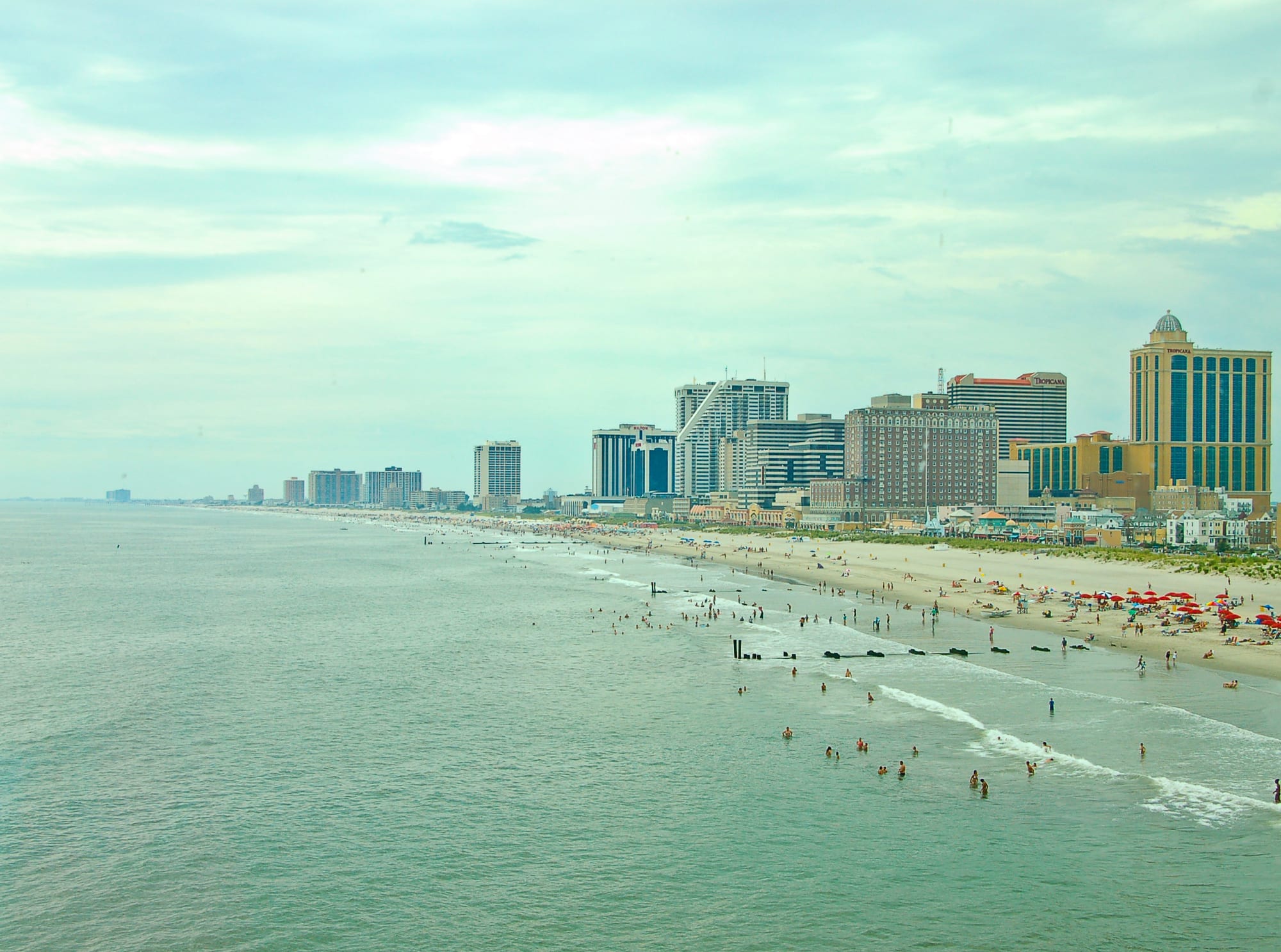
Swimmers in pale green surf and red umbrellas on a wide beach, with a line of hotel towers along the shore

New York & the Mid-Atlantic, United States

Atlantic City

The Atlantic City beach and skyline, looking south along Absecon Island. (Britt Reints / Wikimedia Commons · CC BY 2.0)

A seaside resort on Absecon Island in South Jersey, built in the 1850s as a railway beach town for Philadelphia and famous for the world's first boardwalk, salt water taffy and the streets of the Monopoly board. Legal casinos revived it from 1978; today a skyline of casino towers rises over a long, free, lifeguarded beach in a small city that still has deep economic problems.

Neighbourhoods

  • The Boardwalk and beachfront
    • First-time visitors
    • Beaches
    • Nightlife

    The strip along the ocean, where casino towers, shops, arcades, Boardwalk Hall and the Steel Pier face the beach. Most visitors stay and spend their time here, walking or riding the wooden promenade between the piers, with the sand on one side and the lights of the casinos on the other.

    Open in Maps
  • The Orange Loop
    • Nightlife
    • Live music
    • Best for food

    A small downtown neighbourhood near the beach, around Tennessee, St. James and New York avenues, that has been remade as a district of independent restaurants, bars, coffee, public art and live music venues — a local alternative to the casino floors.

    Open in Maps
  • Ducktown
    • Best for food
    • Local life

    The historically Italian American district between Missouri and Texas avenues, which the local newspaper has called Atlantic City's Little Italy. Its Italian bakeries and sub shops keep up the district's food traditions.

    Open in Maps
  • The Marina District
    • Nightlife
    • Shows

    A district on the bay side of the city, away from the Boardwalk and the ocean, where large casino resorts stand beside the marina. It is reached by the Atlantic City–Brigantine Connector road and is a world of its own, best reached by car, taxi or jitney.

    Open in Maps
  • South Inlet and Gardner's Basin
    • Quiet and residential
    • Waterfront
    • Historic sights

    The northern end of the island on Absecon Inlet, a residential area around the Absecon Lighthouse. Gardner's Basin, a short way north of the lighthouse, has the city aquarium, boats, small shops and restaurants.

    Open in Maps

Things to do

Famous landmarks

  • Atlantic City Boardwalklandmark

    Opened in 1870 to keep sand out of hotel lobbies, the oldest, longest and busiest boardwalk in the world runs about four miles from Absecon Inlet to the city limit and on into Ventnor.

    Open in Maps
  • Boardwalk Halllandmark

    The arena built in 1926–29 as the city's convention hall, a National Historic Landmark that housed the Miss America pageant for decades and holds a pipe organ of more than 33,000 pipes, described as the world's largest musical instrument.

    Open in Maps
  • Steel Pierattraction

    A pier of 1898 that once billed itself as the Showplace of the Nation, famous for its concerts and diving horses, and now an amusement pier with a Ferris wheel, rides, arcades and food stands.

    Open in Maps
  • Absecon Lighthouselandmark

    At 171 feet, the tallest lighthouse in New Jersey, first lit in 1857 and designed by George Meade; visitors can climb to the gallery, and the original Fresnel lens is still in place.

    Open in Maps

Beaches and the waterfront

  • Missouri Avenue Beach (Chicken Bone Beach)beach

    The section of the beach that was a segregated Black resort beach in the early and mid-20th century; the Black community has reclaimed its nickname as a point of pride, and it now hosts swimming and jazz events.

    Open in Maps
  • Atlantic City Aquariumattraction

    A small aquarium at Gardner's Basin on the inlet, with large tanks, a touch tank and shipwreck artefacts.

    Open in Maps

Museums and nights out

  • Atlantic City Historical Museummuseum

    A museum opened in 1985, now in Boardwalk Hall, covering more than 150 years of the resort's history.

    Open in Maps
  • The Orange Loopneighborhood

    The downtown streets near the beach where an indie rock club, a beer hall and an outdoor amphitheatre host live music.

    Open in Maps

Short trips from the city

  • Lucy the Elephantlandmark

    In Margate City, about five and a half miles down the island, a six-storey wood and tin building in the shape of an elephant, built in 1881 to sell land and now the oldest surviving roadside tourist attraction in the country.

    Open in Maps
  • Brigantineattraction

    The quieter island city just north of Atlantic City across the inlet, known locally as The Island, with residential streets and beaches.

    Open in Maps
  • Edwin B. Forsythe National Wildlife Refugepark

    Tidal wetlands and shallow bays protected for migratory water birds; the Brigantine Division lies about ten miles north of Atlantic City.

    Open in Maps
  • Smithvilleattraction

    A community about 15 miles inland whose Towne Center, opened in the 1960s, gathers dozens of shops, many in historic buildings brought from around South Jersey.

    Open in Maps
  • Ocean Cityattraction

    A family seaside resort to the south with guarded beaches and a boardwalk of about two and a half miles, which has never allowed the sale of alcohol since its founding in 1879.

    Open in Maps

Seasonal events

  • Thunder over the Boardwalksummer

    One of the largest airshows in North America, held since 2003 over the beach in front of the casino skyline, usually on a weekday.

  • TidalWave Music FestivalAugust

    A country music festival staged on the Atlantic City beach.

Eat and drink

Long-standing places and food districts in Atlantic City. Hours, ratings and directions come from your maps app, always current.

Atlantic City classics

  • White House Sub Shoprestaurant

    A submarine sandwich deli founded in 1946 on Arctic Avenue, regarded locally as a landmark and known for its long, packed subs.

    Open in Maps
  • Dock's Oyster Houserestaurant

    A family-owned seafood restaurant opened in 1897 by Harry 'Dock' Dougherty.

    Open in Maps
  • Salt water taffy on the Boardwalkmarket

    Taffy and fudge shops line the Boardwalk, among them Fralinger's, named for Joseph Fralinger, who popularised the candy by boxing it, and Steel's, a family fudge maker.

    Open in Maps

Food districts

  • Ducktownneighborhood

    The old Italian quarter between Missouri and Texas avenues, with sub shops and Italian bakeries such as Formica Freitag on Arctic Avenue.

    Open in Maps
  • The Orange Loopneighborhood

    Independent restaurants, a beer hall and coffee bars in the small downtown district near the beach.

    Open in Maps

Experience Atlantic City

History

Atlantic City was planned as a resort. In the early 1850s the physician Jonathan Pitney, later called the Father of Atlantic City, promoted a health resort on Absecon Island and persuaded the municipal authorities that a railway to the beach would be beneficial. The city was incorporated in 1854. Visitors from Philadelphia came by train, and in 1870 the first boardwalk was laid along the sand so that hotel owners could keep it out of their lobbies.

By the early 20th century grand hotels lined the Boardwalk, piers such as the Steel Pier offered concerts and diving horses, and the Miss America pageant began here in 1921. Under the political boss Enoch "Nucky" Johnson, Prohibition was largely ignored and gambling ran in back rooms. The vast Convention Hall, now Boardwalk Hall, opened in 1929. In the segregated city, the Black Northside had its own nightlife on Kentucky Avenue, where clubs such as Club Harlem drew Black and white audiences.

After the Second World War, cheap jet travel, air conditioning and suburban swimming pools drew visitors elsewhere, and most of the old hotels were demolished in the 1970s and 1980s. New Jersey voters legalised casinos in the city in 1976, and Resorts opened in May 1978 as the first legal casino in the eastern United States. Casinos brought jobs and tax revenue, but competition from Connecticut, Pennsylvania and other states brought a string of closures after 2006. Superstorm Sandy flooded the city in October 2012 and destroyed the northern section of the Boardwalk. Sports betting, legal since 2018, now adds to the business.

Culture & Customs

Atlantic City's imprint on American culture is out of all proportion to its size. The American version of Monopoly takes its street names from the city — and their prices reflect the social standing of neighbourhoods at the time, with streets where Black and Asian residents lived priced lowest. Salt water taffy and the seaside pier amusement all became national images of the summer holiday here, and for decades the Miss America pageant made the city famous; it left in 2004, returned from 2013 to 2018, and is now held elsewhere.

Black Atlantic City has its own history: Kentucky Avenue's clubs were a stop for leading Black entertainers, and Missouri Avenue Beach, once a segregated beach nicknamed Chicken Bone Beach, now hosts jazz events and is remembered with pride. The population today is mixed, with large Black, Hispanic and Asian communities and an old Italian American quarter, Ducktown.

Entertainment is the business of the city. Concerts and sporting events fill Boardwalk Hall and the casino theatres, the Thunder over the Boardwalk airshow draws crowds to the beach each summer, and beach festivals bring country acts to the sand. The Orange Loop, a small downtown district of clubs, a beer hall and an amphitheatre, has grown as a home for independent music away from the casinos.

Daily Life

About 38,500 people lived in Atlantic City at the 2020 census, a slow decline from earlier decades; the surrounding Atlantic County is culturally tied to Philadelphia and counted as part of its wider metropolitan area. Nine large casinos, the convention centre and the hotels, restaurants and shops that serve visitors are the backbone of the economy, and casino tax revenue funds state programmes for older and disabled people.

Behind the Boardwalk, the city is poorer than the resort suggests. Many residents do not own a car, and as of 2024 the city had only one working supermarket; after a planned new supermarket fell through, the city announced in October 2025 a plan to redevelop Renaissance Plaza around an expanded store. Neighbourhoods range from the dense blocks near the beach to quieter residential districts such as Chelsea Heights. Stockton University runs classes in the city.

The year has a strong rhythm: crowded summer weekends of beach, concerts and the airshow; quieter shoulder seasons; and winters when the Boardwalk empties and the life of the city moves indoors to the casinos and conventions. Casino workers' pay and staffing have been a recurring issue since the pandemic years.

Food

The submarine sandwich is the local staple. White House Sub Shop has served long subs packed with cold cuts on Arctic Avenue since 1946, and Ducktown's Italian bakeries supply the bread and pastries that go with the city's Italian American heritage. Cheesesteaks, a Philadelphia favourite, are sold widely too.

Salt water taffy is the Boardwalk's sweet. According to the traditional story, the name dates from 1883, when David Bradley's shop flooded with sea water after a storm and he sold his soaked taffy as "salt water taffy"; Joseph Fralinger turned it into a business, and taffy and fudge shops still line the Boardwalk. Street stands sell pretzels, hot dogs, pizza, funnel cakes and candyfloss.

Seafood comes from the surrounding coast and bays, and Dock's Oyster House, a family-owned restaurant, opened in 1897. The casinos hold most of the large restaurants and steakhouses, while the Orange Loop and the streets around Ducktown offer smaller independent places and bakeries.

Planning tools

Budget

Atlantic City is cheaper than New York or Washington, and hotel prices swing widely: casino rooms can be inexpensive midweek and outside summer, then climb on summer weekends and around big concerts, fights and conventions. The beach is free, as are the Boardwalk and much of the people-watching; gambling, shows and dinners in the casinos are where budgets go.

Daily Budget Midrange
USD 230–450 (casino-district hotel, sit-down seafood and Italian dinners, a show or concert, taxis)
Daily Budget Shoestring
USD 110–180 (budget motel or off-season casino room, subs and Boardwalk snacks, jitneys and buses)

Compare weekday and weekend rates — the difference can be large — and set a gambling limit before arriving.

Best Time to Visit

June to September is beach season, with lifeguards on duty, the airshow and beach concerts, and the busiest Boardwalk. Late spring and early autumn are quieter and milder, with lower prices. Winter is cold and windy on the seafront, but the casinos, shows and indoor attractions carry on all year.

Suggested Number of Days

One or two days is enough for most first visits. Allow three or four to add the neighbouring beach towns and the wetlands of the mainland shore. Beach weather and the events calendar change the number more than anything else.

First Visit
1–2 days
With Surroundings
3–4 days

Transportation

The city is long and narrow, stretched along the island. The Atlantic City Jitney minibuses run day and night along Pacific Avenue, one block inland from the Boardwalk, and out to the Marina District; NJ Transit buses cover the city and nearby towns. Taxis and ride-hailing fill the gaps, and the Boardwalk itself is the main route on foot.

The Boardwalk casinos and the Marina District are a few miles apart — use the jitney or a taxi rather than walking between them.

Airport & Station Connections

Atlantic City International Airport is about 9 miles north-west of the centre, off the Atlantic City Expressway, with a small number of flights. Many travellers fly into Philadelphia instead, about 60 miles away. NJ Transit's Atlantic City Line runs from Philadelphia's 30th Street Station to the rail terminal at the convention centre, and buses run from New York's Port Authority Bus Terminal, Philadelphia and elsewhere to the city bus terminal and some casinos. Drivers arrive by the Atlantic City Expressway.

Walkability

The Boardwalk is a long, flat, car-free walk with the ocean alongside, and the casinos, piers, Boardwalk Hall and the Orange Loop are all close to it. Inland, blocks can feel empty, with vacant lots and parking garages between busy spots, and the Marina District is too far to walk to comfortably.

Safety

For most visitors the US is safe, with the main risks being petty theft and car break-ins in tourist areas of some cities, road accidents over long distances, extreme weather, and the hazards of the outdoors. Atlantic City's Boardwalk and casino areas are busy and well lit, but poverty, homelessness and drug use are visible in parts of the city a block or two inland. Rip currents are the main risk on the beach.

Swim only on lifeguarded beaches and in season, keep to busy streets or use a jitney or taxi after dark, and leave nothing in sight in a parked car. Check current official travel advice before travelling.

Climate

A humid subtropical climate tempered by the ocean. A cooling afternoon sea breeze blows on most summer days, though spells of heat and humidity can push the heat index to 95°F or more. Winters are cool, with occasional cold, windy spells and some snow, most often in February.

Summer
warm and humid, eased by sea breezes, though heat waves can push the heat index to 95°F or more
Winter
cool and windy on the seafront; cold snaps can bring wind chills below 0°F, and nor'easter storms and snow peak in February

Local Customs

Tipping is expected: roughly 18–22 per cent in restaurants and for many services, plus small tips for casino and hotel staff. Sales tax is added at the till. Casinos check identification. Beachwear belongs on the beach and Boardwalk; the shows and some restaurants are more dressed-up. Locals often call the city A.C.

Identification is asked for when buying alcohol and entering casino floors. Ask before photographing people, and note that photography is often restricted on casino floors.

Common Payment Methods

The currency is the US dollar. Cards and contactless payment are accepted almost everywhere, and casinos have ATMs and cashiers. Small bills are useful for tips, Boardwalk stands and jitney fares.