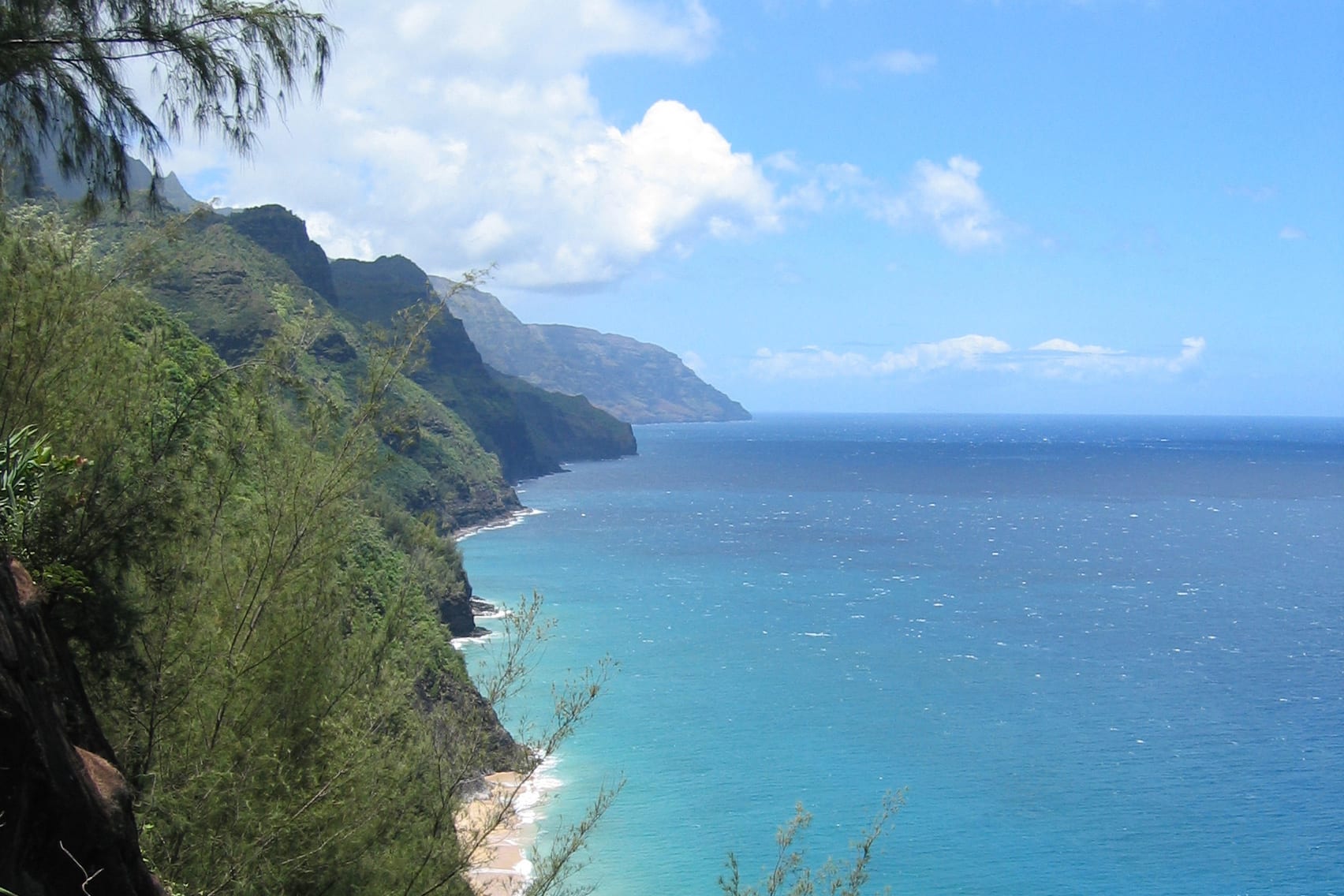
Steep green ridges dropping into a turquoise ocean, with a strip of sandy beach below and white clouds overhead

United States

Hawaii

The Na Pali coast seen from the Kalalau Trail on the north-west shore of Kauai. (Dcrjsr / Wikimedia Commons · CC BY-SA 3.0)

The island state in the middle of the North Pacific, some 2,000 miles south-west of the US mainland — a chain of volcanic islands settled by Polynesian voyagers, ruled by its own kings and queens until 1893, and now a place of beaches, active volcanoes, sea cliffs and a mixed Asian, Native Hawaiian and American culture unlike anywhere else in the country.

Explore Hawaii

History

The islands were among the last places on earth settled by people. Polynesian voyagers, navigating by stars, swells and birds, reached them in double-hulled canoes around a thousand years ago, most likely from the Marquesas and Society Islands. They built a society of chiefs and commoners bound by the kapu system of sacred laws, divided each island into land sections running from mountain to sea, and built stone temples, taro terraces and fishponds.

The British navigator James Cook landed at Waimea on Kauai in 1778 and was killed at Kealakekua Bay on the Big Island in 1779. Kamehameha I, a chief from the Big Island, won Oahu at the Battle of Nuuanu in 1795 and by 1810 had brought all the islands under one kingdom. After his death the kapu system was abolished, New England missionaries arrived from 1820, and whaling ships crowded Lahaina and Honolulu. Introduced diseases caused a catastrophic fall in the Native Hawaiian population, while the land division of 1848 opened the way for foreign-owned sugar plantations, which brought workers from China, Japan, Portugal, the Philippines and Korea.

In 1893 a group of mainly American businessmen, backed by US Marines, overthrew Queen Liliuokalani; the United States annexed the islands in 1898, and Congress formally apologised for the overthrow in 1993. On 7 December 1941 Japanese aircraft attacked Pearl Harbor, killing about 2,400 Americans and bringing the country into the Second World War. Hawaii was placed under martial law, and some Japanese Americans in the islands were detained, though most were not, and their sons fought in the 442nd Regimental Combat Team. Hawaii became the 50th state in 1959. Jet travel brought mass tourism, and the 1970s Hawaiian Renaissance revived the language, hula and voyaging. In 2023 a wildfire destroyed the historic town of Lahaina on Maui, killing about 100 people.

Culture & Customs

No ethnic group is a majority in Hawaii. People of Japanese, Filipino, Chinese, Native Hawaiian, Portuguese, Korean, Samoan and European descent live side by side, and many residents are of mixed ancestry. Everyday speech mixes English with Hawaiian words, and many locals speak Hawaii Pidgin, a creole born on the plantations. Hawaiian is an official state language alongside English, and immersion schools have brought it back from near extinction.

The idea of aloha, meaning love, compassion and greeting, is written into state law as a guide to conduct, and ohana, or extended family, is central to social life. Shoes come off at the door, gatherings are large, and lei are given at graduations, arrivals and farewells; 1 May is Lei Day. Hula, in its ancient chanted form and its modern style accompanied by guitar and ukulele, is taught in schools, known as halau, and celebrated at the Merrie Monarch Festival in Hilo. Slack-key guitar and the ukulele, adapted from a Portuguese instrument, are the islands' musical signatures.

Surfing, the sport of Hawaiian chiefs, was spread worldwide by the Olympic swimmer Duke Kahanamoku, and big-wave contests at Waimea Bay and the Banzai Pipeline draw the world's best each winter. Many Native Hawaiians regard Mauna Kea as sacred, and plans to build a large new telescope on its summit have led to protests and a long dispute. Aloha shirts are acceptable business wear, especially on Aloha Friday.

Daily Life

About 1.4 million people live in Hawaii, around 70 per cent of them on Oahu, where the City and County of Honolulu covers the whole island; urban Honolulu has about 350,000 people. Hilo and Kailua-Kona are the main towns of the Big Island, Kahului and Wailuku of Maui, and Lihue of Kauai. Molokai and Lanai are small and rural.

Tourism is by far the largest industry, bringing close to 10 million visitors in a typical year, and the military is second: Pearl Harbor–Hickam and other bases on Oahu house the command responsible for US forces across the Indo-Pacific. Sugar, once the backbone of the economy, ended when Maui's last plantation closed in 2016, and agriculture now centres on coffee, macadamia nuts, flowers and diversified farming.

Hawaii has one of the highest costs of living in the country, and housing is the dominant local issue. Many Native Hawaiians and other residents have moved to the mainland, and the Native Hawaiian population on the mainland keeps growing. Tension between tourism and residents' needs surfaces in debates over short-term rentals, crowding at beaches and trails, and Lahaina's rebuilding, and a 2021 fuel leak from the Navy's Red Hill storage tanks contaminated drinking water for thousands of Oahu households.

Food

Hawaiian food reflects every group that came to the islands. Traditional dishes include poi, a paste of pounded taro root; kalua pig, roasted whole in an underground oven called an imu; laulau, pork wrapped in taro leaves and steamed; lomi salmon, a salad of salted salmon with tomato and onion; and haupia, a firm coconut pudding. Poke, cubes of raw fish seasoned with soy, sesame, seaweed or salt, has spread worldwide from its Hawaiian roots, and all of these appear at a luau, the traditional feast.

The plate lunch, born on the plantations, is the everyday meal: two scoops of rice, macaroni salad and a main such as teriyaki beef, katsu chicken or kalua pork. Loco moco, created in Hilo, is rice topped with a hamburger patty, fried egg and brown gravy. Spam, adopted during and after the Second World War, becomes Spam musubi, a slice on rice wrapped in seaweed. Saimin is a noodle soup whose name comes from Cantonese, manapua are steamed buns filled with barbecued pork, and malasadas, sugar-dusted Portuguese doughnuts, are sold fresh on Oahu.

Shave ice, finely shaved ice drenched in flavoured syrups, is the classic sweet. Kona coffee from the Big Island's western slopes, macadamia nuts, pineapple, apple bananas and lilikoi, or passion fruit, are local products. Maui has a winery on the slopes of Haleakala at Ulupalakua and a growing number of craft breweries.

Attractions & Natural Wonders

Oahu has Waikiki's beach and hotels, and the hike up Diamond Head crater for views over Honolulu. The city holds Iolani Palace, the royal residence of Hawaii's last monarchs, the Bishop Museum of Hawaiian and Pacific culture and a historic Chinatown. Pearl Harbor National Memorial includes the USS Arizona Memorial, the battleship Missouri, on whose deck Japan's surrender was signed in 1945, and aviation and submarine museums. Hanauma Bay is a protected snorkelling reserve, and the North Shore's Waimea Bay, Banzai Pipeline and Sunset Beach are the stage for winter surfing.

On Maui, the Road to Hana winds along the north-east coast past waterfalls, black-sand beaches and rainforest to the quiet town of Hana. Haleakala National Park takes in the summit crater of the volcano, at about 3,055 metres, and the Iao Valley lies near Wailuku. Kaanapali and Wailea have the resort beaches, humpback whales winter offshore, and boats run to Molokini crater for snorkelling.

The Big Island, the largest, has Hawaii Volcanoes National Park, a UNESCO World Heritage Site, where Kilauea's summit crater and Chain of Craters Road show fresh lava fields, and Mauna Loa rises above. Mauna Kea's summit holds major astronomical observatories. The Kona coast offers Kealakekua Bay, Puuhonua o Honaunau, an ancient place of refuge, and manta-ray night snorkelling, while the wet Hilo side has Akaka Falls and the Waipio Valley.

Kauai, the oldest of the main islands, has the Na Pali coast, reached by the Kalalau Trail, boat or helicopter, and Waimea Canyon, the deep red gorge across the island's west. Hanalei Bay's beaches and the sunny resort coast at Poipu complete the island.

Cities in Hawaii

Planning basics

Budget

Hawaii is one of the most expensive places in the country to visit. Flights are long, resort hotels on Maui and Kauai charge high nightly rates and resort fees, and food costs more because most of it is shipped in. Oahu has the widest range of prices, including hostels in Waikiki, and the Big Island is generally cheaper than Maui or Kauai. Parking, park reservations and activities such as boat tours and helicopter flights add up fast.

Daily Budget Midrange
USD 300–600 (mid-range hotel or condo, restaurant meals, rental car, a snorkel trip or luau)
Daily Budget Shoestring
USD 120–200 (hostel or budget room, plate lunches and supermarket food, TheBus on Oahu, free beaches and hikes)

Eat plate lunches and poke from markets and local diners, book condos with kitchens, and reserve popular spots such as Haena in advance.

Safety

Violent crime against visitors is uncommon, but car break-ins at beaches, trailheads and lookouts are frequent. The ocean is the biggest danger: strong currents, shore breaks and big winter surf cause drownings among visitors every year, and many beaches have no lifeguards. On land the risks include flash floods in streams and valleys, crumbling cliff edges, volcanic gases near Kilauea, and wildfire in dry leeward areas, as the destruction of Lahaina in 2023 showed.

Swim at lifeguarded beaches, never turn one's back on the waves, stay out of streams after heavy rain, and leave nothing in parked cars. Check current official travel advice before travelling.

Climate

Tropical and remarkably even. Temperatures at sea level stay warm all year, cooled by the trade winds, and the real difference is between the wet windward sides of the islands, facing north-east, and the dry, sunny leeward sides. Winter, roughly November to March, is wetter and brings big surf to north-facing shores. The summits of Mauna Kea, Mauna Loa and Haleakala are cold and can see snow. Hurricanes are rare but possible.

Summer
79–88°F at sea level, drier, with steady trade winds; calmer seas on north shores
Winter
72–81°F at sea level, more showers, big waves on north shores; near or below freezing on the high summits

Transportation

Honolulu is the main gateway, with direct flights also landing at Kahului on Maui, Kona and Hilo on the Big Island and Lihue on Kauai. Short inter-island flights link the islands; there are no regular passenger ferries between them apart from the Maui–Lanai route. On Oahu, TheBus serves much of the island and the new Skyline rail line links East Kapolei, Pearl Harbor and the airport, but on the other islands a rental car is close to essential. Some popular sites, such as Haena on Kauai, need advance reservations.

Book rental cars early for Maui and Kauai; allow a full day for the Road to Hana, and do not stop on the road itself.

Best Time to Visit

Hawaii can be visited all year. April to May and September to October bring good weather, lower prices and fewer visitors. Winter, from about mid-December to March, is peak season, with humpback whales off Maui and famous surf on Oahu's North Shore, while June to August is busy with families and has the calmest water for snorkelling on north-facing coasts. The Merrie Monarch hula festival fills Hilo in the week after Easter.