Attractions & Natural Wonders · United States
Why is Hawaii still growing?
The island of Hawaiʻi sits over a hotspot that keeps feeding its volcanoes, so lava still adds new land, while a future island rises underwater.
By Globeway Editorial · 13 October 2026
The short answer
Hawaii is still growing because its youngest island sits directly over a hotspot, a long-lived source of molten rock rising from deep inside the Earth. The hotspot feeds the volcanoes of the island of Hawaiʻi, often called the Big Island, and when their lava reaches the coast it cools into fresh rock and pushes the shoreline out to sea. Kīlauea, one of the most active volcanoes on Earth, added about 875 acres of new land in a single eruption in 2018.
The growth is not evenly shared. The Pacific plate, the slab of the Earth's outer shell on which the islands ride, is carrying them slowly northwest, away from the hotspot. Once an island drifts off its source of lava, erosion and sinking take over, and it begins to shrink. So the chain is both growing and dying at once: building new land in the southeast, losing it in the northwest, and already preparing its next island beneath the waves.
A conveyor belt of volcanoes
In 1963 the geologist John Tuzo Wilson proposed the idea that still explains Hawaii in outline. A plume of hot rock rises from deep in the mantle, heats the base of the plate above and produces magma, which builds a volcano. The plate keeps moving, carrying the volcano away from the plume, and a new volcano forms in its place. Today Hawaiian volcanoes drift northwest from the hotspot at about 2 to 4 inches (5 to 10 centimetres) a year.
The result is a line of islands that get older in one direction. The rocks of Kauaʻi, in the northwest of the main islands, are about 5.5 million years old and deeply eroded. Those of the island of Hawaiʻi are 700,000 years old or less. Beyond Kauaʻi the chain continues as low atolls and then sunken mountains, the Hawaiian–Emperor seamount chain, which runs for about 3,900 miles (6,200 kilometres) across the Pacific floor. In at least 85 million years of activity, the hotspot has produced an estimated 180,000 cubic miles (750,000 cubic kilometres) of rock. A sharp bend in the chain, about 47 million years old, was long explained as a change in the plate's direction; since 2003 some researchers have argued instead that the hotspot itself moved.
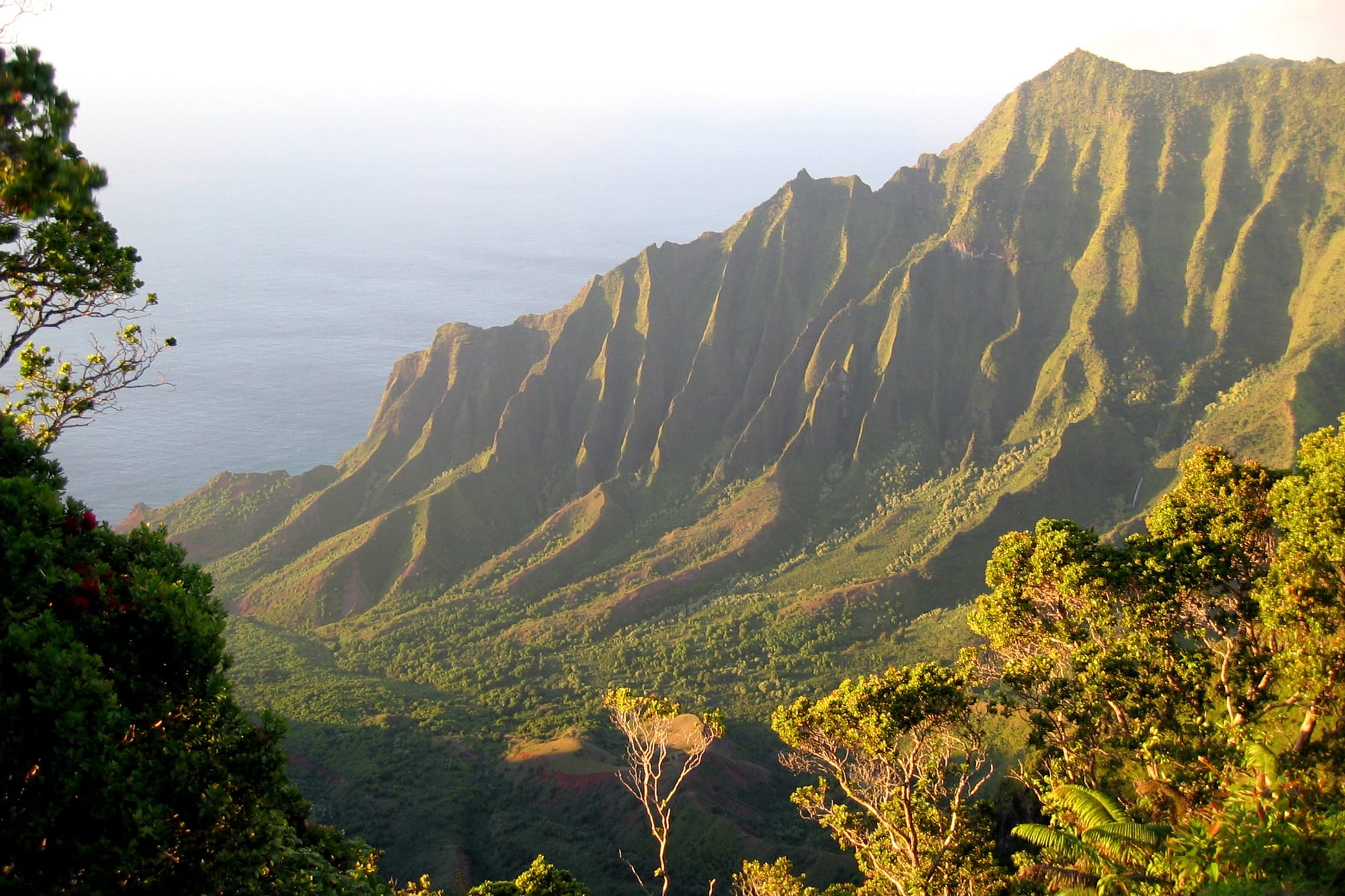
Kauaʻi has drifted far from the hotspot. With no fresh lava to build it up, rain and waves have carved it into knife-edged ridges and deep valleys.
Long before scientists, Hawaiians had noticed the pattern. On voyages along the chain they saw that the islands to the northwest, Niʻihau and Kauaʻi, differed in erosion, soil and vegetation from Maui and Hawaiʻi to the southeast, and concluded that they were older. The story of Pele, the goddess of volcanoes, follows the same path: in the tradition she first lived on Kauaʻi and was driven southeast from island to island by her sister Nāmaka, goddess of the sea, until she settled in Halemaʻumaʻu at the summit of Kīlauea, where, in the tradition, she still lives.
The Big Island, built by five volcanoes
The island of Hawaiʻi is the newest and largest of the main islands. Its 4,028 square miles (10,430 square kilometres) make up 63 percent of the land area of the whole archipelago. It is made of five shield volcanoes, broad domes built from runny lava, that grew one overlapping the next. The oldest, Kohala, is more than a million years old; the youngest, Kīlauea, is believed to be between 210,000 and 280,000 years old.
Its volcanoes are giants. Mauna Loa is the largest active volcano on Earth, covering more than half the island. Measured from the sea floor, Mauna Kea rises more than 30,000 feet (9,000 metres), making it taller from base to peak than Mount Everest.
Lava that makes new land
Kīlauea erupted 61 separate times between 1823 and 2024, and its eruptions are what add new coast. When lava flows reach the sea they build out deltas of fresh rock. The Mauna Ulu eruption of 1969 to 1974 added 230 acres to the island. The long eruption at Puʻu ʻŌʻō, which began in January 1983, had added 442 acres by the end of 2016, while covering 56 square miles of existing land.
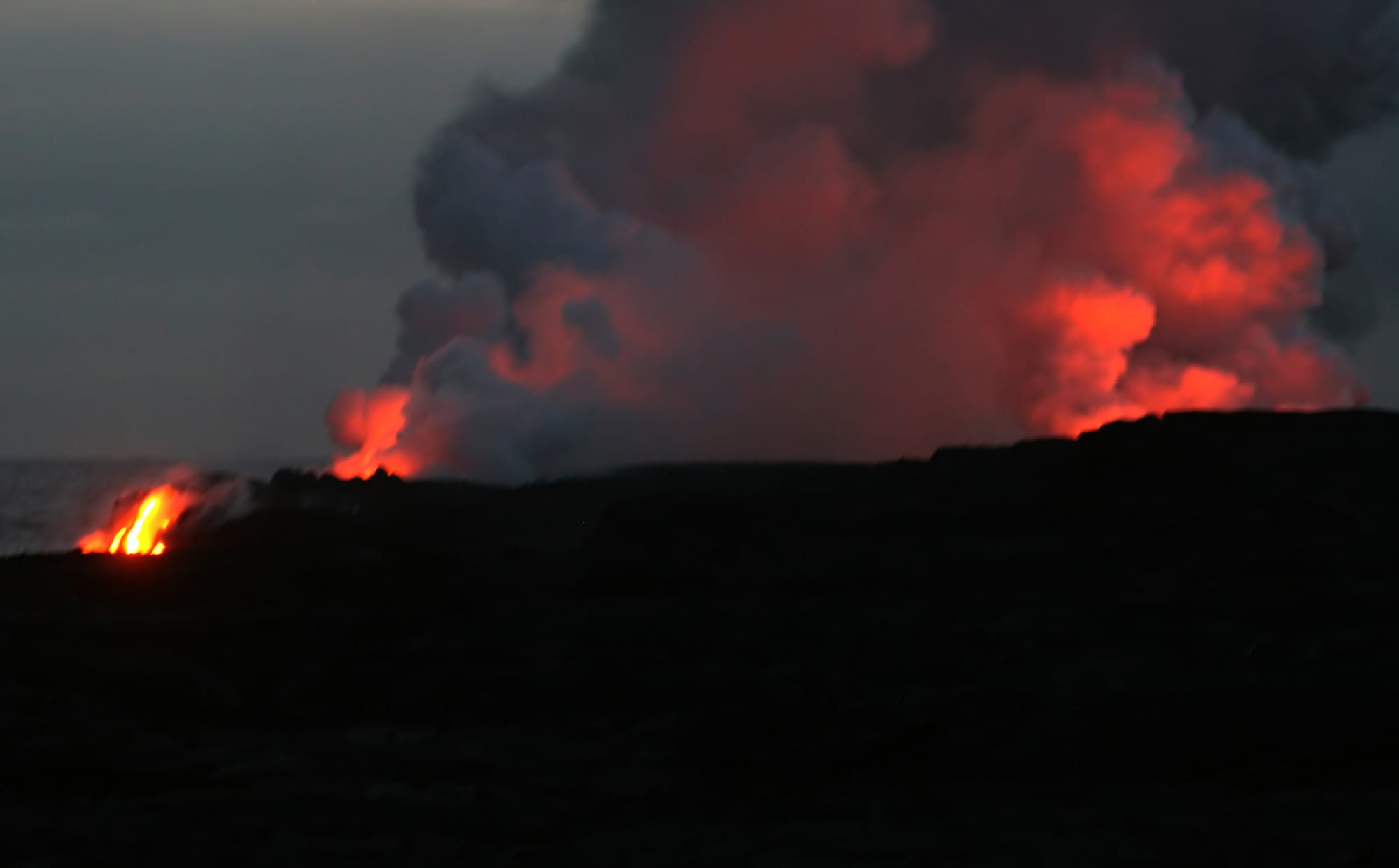
Where lava meets seawater it sends up plumes of steam, and the cooled rock builds the shoreline outwards.
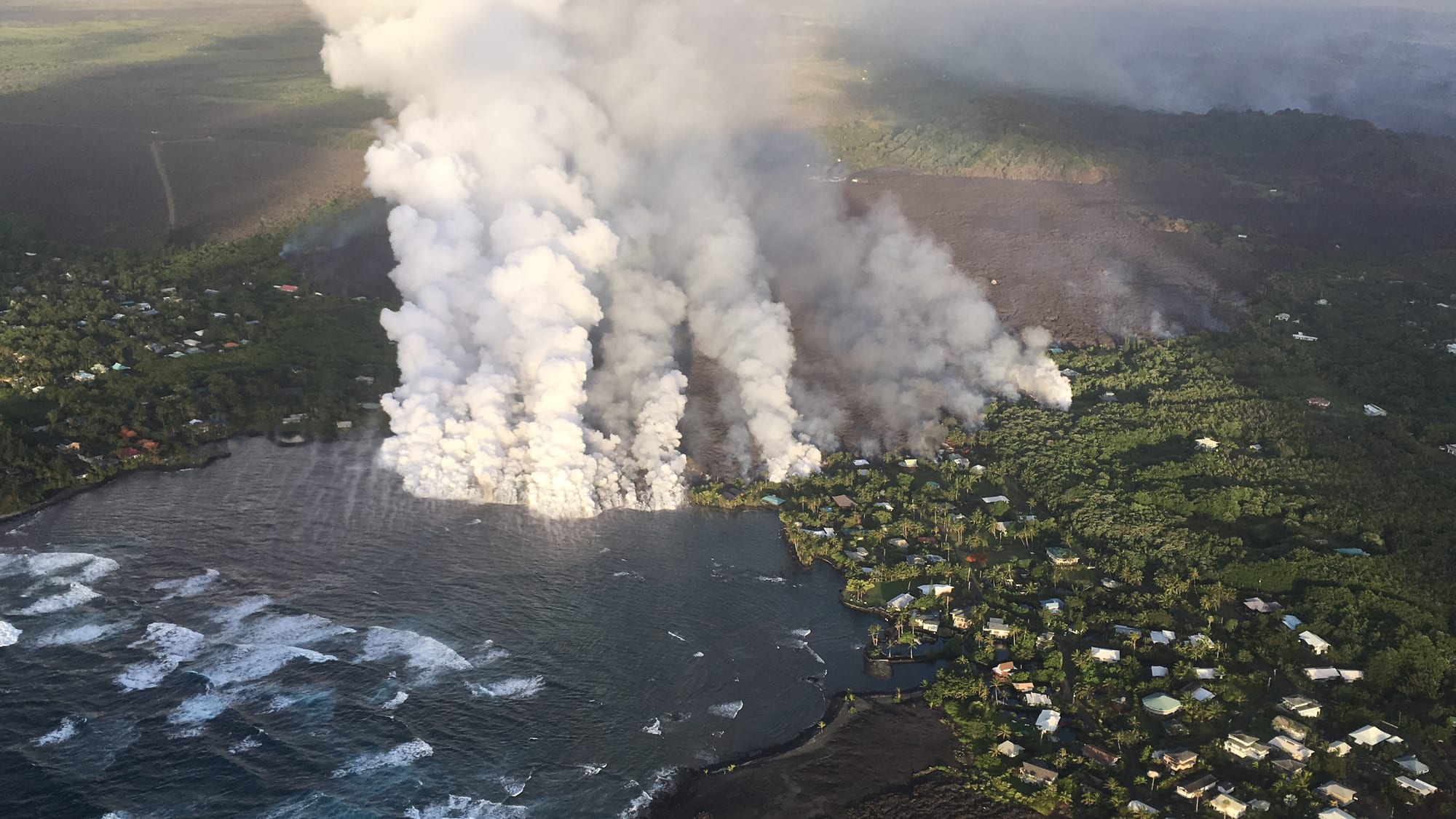
The largest recent burst of growth came in 2018. Fissures opened in the Leilani Estates neighbourhood in lower Puna, and a river of lava flowed to the coast, reaching Kapoho Bay on 4 June. By the next day the bay had been filled in and replaced by a point of new land, and in all about 875 acres were created in the ocean. The growth came at a heavy price. Lava covered 5,914 acres, destroyed hundreds of homes, buried most of the town of Kapoho and boiled away Green Lake, the largest natural freshwater lake in Hawaiʻi.
The volcano has not stopped. An eruption that began inside Halemaʻumaʻu, the crater at Kīlauea's summit, in December 2024 has continued in dozens of short episodes of lava fountaining into 2026, some throwing lava more than 1,000 feet (300 metres) high. Because this activity has stayed inside the crater, it has not reached the coast.
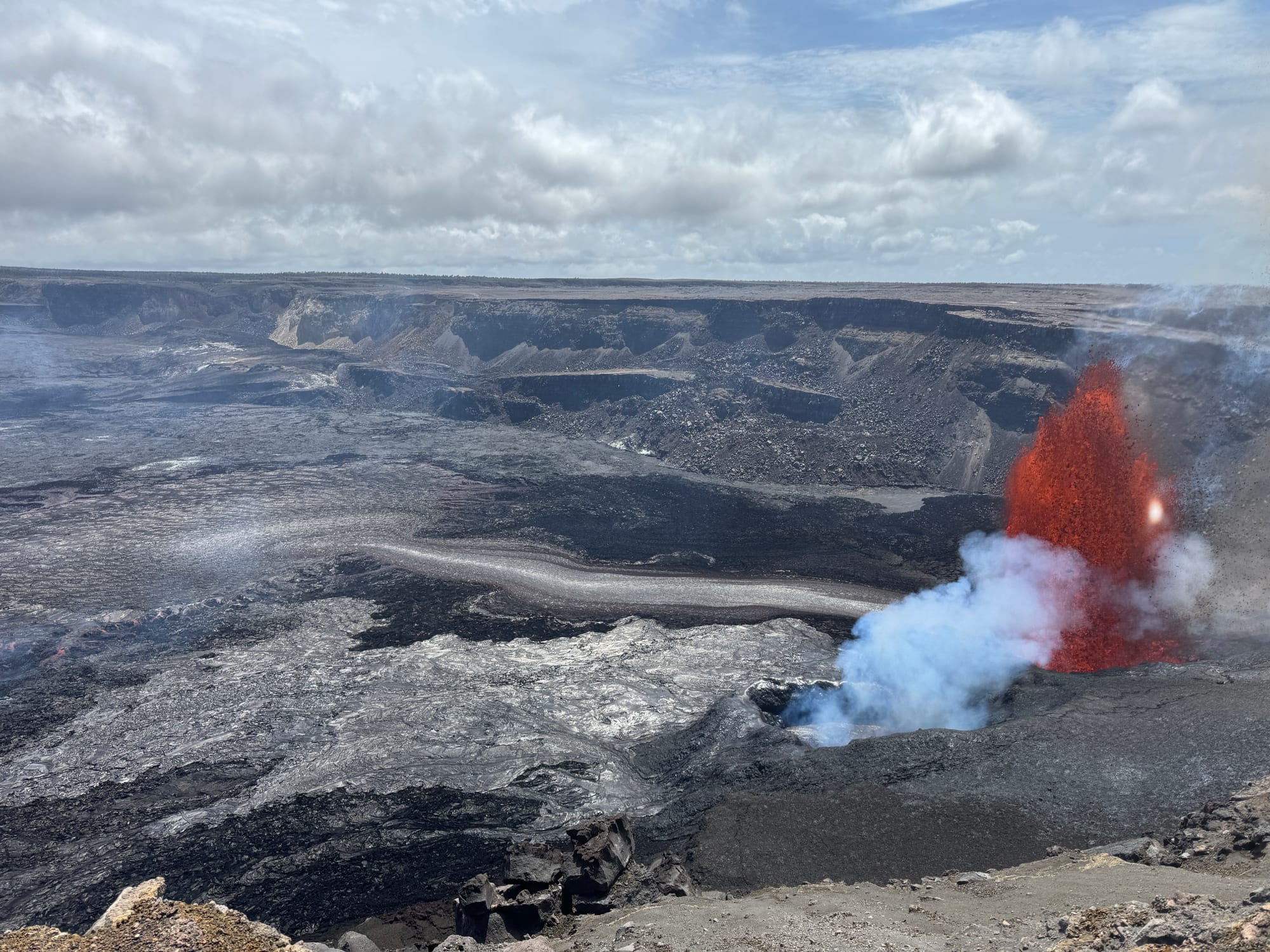
The fountain fed a long, narrow lava channel that ran across the crater floor into a circular pond of lava.
Growing and falling apart at once
Even the Big Island is not only growing. Its volcanoes are so heavy and steep that their flanks slowly collapse. Kīlauea's southern flank is sliding towards the sea at about 2 to 4 inches (6 to 10 centimetres) a year. Part of it, the Hilina Slump, sometimes moves in sudden jolts: in November 1975 it lurched seaward in a magnitude 7.2 earthquake, one of Hawaii's largest historical earthquakes. Mapping of the sea floor has revealed the remains of many giant landslides off the islands' flanks.
Further northwest, the older islands are past their building years. Once a volcano is cut off from the hotspot, collapse, sinking and erosion wear it down until it becomes an atoll and finally a seamount, a mountain entirely under water.
The next island
The newest Hawaiian volcano has not yet reached the surface. Kamaʻehuakanaloa Seamount, about 22 miles (35 kilometres) off the southeast coast of the island of Hawaiʻi, began forming around 400,000 years ago and already stands more than 10,000 feet (3,000 metres) above the sea floor, though its summit is still about 3,200 feet (975 metres) below sea level. It last erupted in 1996. Its name, given in 2021, means "glowing child of Kanaloa", the god of the ocean; from 1955 it had been called Lōʻihi, "long". It is expected to break the surface in 10,000 to 100,000 years. That is the deepest reason Hawaii keeps growing: the hotspot is still there, and it is still building.