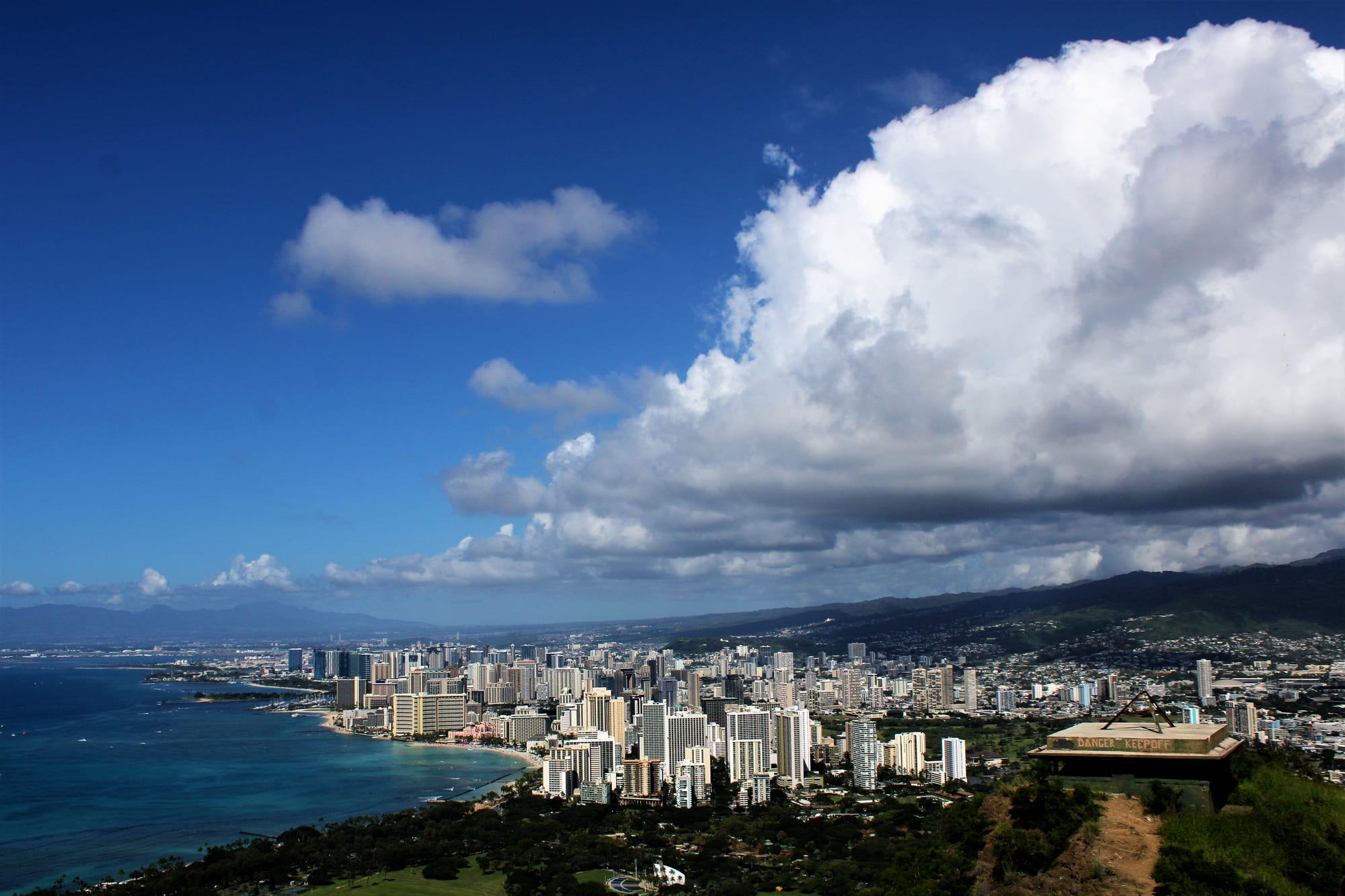
Waikīkī's high-rise hotels and apartments along a turquoise shore, seen from the rim of Diamond Head under tall white clouds

Hawaii, United States

Honolulu

Waikīkī and central Honolulu seen from Diamond Head. (Farragutful / Wikimedia Commons · CC BY-SA 4.0)

Hawaii's capital and largest city, on the south shore of Oʻahu, grown around a sheltered harbour that made it the seat of the Hawaiian Kingdom from 1845. Today it is a high-rise Pacific city of royal palaces, Asian and Hawaiian neighbourhoods and military bases, with Waikīkī's beach and hotels below Diamond Head and the Pearl Harbor memorials to the west.

Neighbourhoods

  • Waikīkī
    • First-time visitors
    • Beaches
    • Nightlife

    The tourist district between the Ala Wai Canal and the ocean, beside Diamond Head, with thousands of hotel rooms, shops and restaurants behind a largely man-made beach. Kapiʻolani Park, the zoo and the aquarium fill its quieter eastern end.

    Open in Maps
  • Downtown and the Capitol District
    • Historic district
    • Royal history
    • Close to public transport

    The centre of state government, with ʻIolani Palace, the State Capitol, Honolulu Hale and the statue of Kamehameha I among office towers. Aloha Tower stands on the harbour front a few blocks away.

    Open in Maps
  • Chinatown
    • Best for food
    • Markets
    • Arts

    One of the oldest Chinatowns in the United States, a district of historic buildings with food and seafood markets, lei makers on the street corners and the Arts District around its theatre. Extra care is needed after dark.

    Open in Maps
  • Kakaʻako and Ala Moana
    • Shopping
    • Street art
    • Beaches

    The former light-industrial district between downtown and Waikīkī, now being redeveloped with residential towers and known for its murals, leading east to Ala Moana Center, the world's largest open-air shopping centre, and the long sandy beach park beside it.

    Open in Maps
  • Mānoa and Makiki
    • Quiet and residential
    • Students
    • Hiking

    Green residential valleys just inland, where the flagship campus of the University of Hawaiʻi sits below rainforest trails to Mānoa Falls and the Lyon Arboretum.

    Open in Maps
  • Kaimukī and Kapahulu
    • Local life
    • Best for food

    Residential neighbourhoods behind Diamond Head, where Waiʻalae Avenue, Kaimukī's main street, is lined with restaurants and stores.

    Open in Maps

Things to do

Royal Honolulu

  • ʻIolani Palacelandmark

    The royal palace completed in 1882 for King Kalākaua, where Queen Liliʻuokalani was later imprisoned for nine months; the only royal palace on US soil, restored and opened as a museum in 1978.

    Open in Maps
  • Kawaiahaʻo Churchlandmark

    The coral-stone church once known as the chapel of the Hawaiian royal family, the oldest church on Oʻahu, which still uses the Hawaiian language in parts of its services.

    Open in Maps
  • Queen Emma Summer Palacemuseum

    Hānaiakamalama, the retreat of Queen Emma and King Kamehameha IV in the cool Nuʻuanu valley above downtown, now a museum.

    Open in Maps
  • Aloha Towerlandmark

    A retired lighthouse opened in 1926 at Pier 9 of Honolulu Harbor, which greeted hundreds of thousands of immigrants arriving in Honolulu.

    Open in Maps

Museums

  • Bishop Museummuseum

    Founded in 1889 in the Kalihi district, the largest museum in Hawaiʻi, holding the world's largest collection of Polynesian cultural artefacts and natural history specimens.

    Open in Maps
  • Honolulu Museum of Artmuseum

    The state's largest art museum, founded in 1922 by Anna Rice Cooke, with one of the largest collections of Asian and Pan-Pacific art in the United States.

    Open in Maps
  • Capitol Modernmuseum

    The Hawaiʻi State Art Museum, in the Capitol District downtown, showing works collected through the state's art in public places programme.

    Open in Maps
  • Waikīkī Aquariummuseum

    Founded in 1904 beside a living reef on the Waikīkī shore, the second-oldest public aquarium still operating in the United States.

    Open in Maps

Pearl Harbor and war memorials

  • Pearl Harbor National Memoriallandmark

    The national memorial to the attack of 7 December 1941, which killed more than 2,400 Americans; a visitor centre with galleries and a film, and a ferry out to the USS Arizona Memorial.

    Open in Maps
  • Battleship Missourimuseum

    The last battleship commissioned by the US Navy, on whose deck Japan's surrender was signed in 1945, now a museum ship moored at Pearl Harbor.

    Open in Maps
  • National Memorial Cemetery of the Pacificlandmark

    The military cemetery in Punchbowl Crater above downtown, a memorial to those who served in the US armed forces, with views over the city.

    Open in Maps

Beaches and parks

  • Waikīkī Beachbeach

    The hotel-lined beach below Diamond Head, made up of several named stretches of sand, almost entirely man-made, with Diamond Head as its backdrop.

    Open in Maps
  • Ala Moana Beach Parkbeach

    A 100-acre park with a half-mile gold-sand beach protected by an offshore reef, one of the most popular swimming spots in Hawaii, with lawns and banyans for picnics.

    Open in Maps
  • Kapiʻolani Parkpark

    The largest public park in Hawaii, at the eastern end of Waikīkī, home to the Waikīkī Shell and the Honolulu Zoo and a favourite with joggers.

    Open in Maps
  • Foster Botanical Gardenpark

    The oldest botanical garden in Hawaii, 13.5 acres of tropical trees and plants near Chinatown.

    Open in Maps
  • Hanauma Baybeach

    A bay formed inside a volcanic tuff ring on the south-east coast of the island, a nature preserve and the first of Hawaii's marine life conservation districts.

    Open in Maps

Walks and viewpoints

  • Diamond Headtrail

    Lēʻahi, the volcanic tuff cone behind Waikīkī; a 0.8-mile trail climbs 560 feet through steps and tunnels to old military bunkers on the rim, and non-residents must reserve online in advance and pay a small fee.

    Open in Maps
  • Mānoa Fallstrail

    A 150-foot waterfall at the end of a rainforest trail in Mānoa Valley; swimming in the pool below is strongly discouraged because of the risk of leptospirosis.

    Open in Maps
  • Lyon Arboretumpark

    A 200-acre arboretum run by the University of Hawaiʻi at the head of Mānoa Valley, with trails through a planted lowland rainforest.

    Open in Maps

Seasonal events

  • King Kamehameha DayJune

    A state holiday on 11 June honouring Kamehameha I, with a floral parade from ʻIolani Palace through Kakaʻako and Waikīkī to Kapiʻolani Park, featuring the Royal Hawaiian Band and traditional paʻu riders.

  • Hawaiʻi International Film FestivalOctober and November

    A festival of Asian-Pacific cinema, with a focus on Native Hawaiian and Pacific Islander film-making.

  • Honolulu MarathonDecember, usually the second Sunday

    One of the five largest marathons in the United States, held since 1973, open to anyone with no qualifying time or time limit and popular with runners from Japan.

Eat and drink

Long-standing places and food districts in Honolulu. Hours, ratings and directions come from your maps app, always current.

Honolulu classics

  • Leonard's Bakeryrestaurant

    The Portuguese bakery, opened in 1952, that popularised the malasada — a fried, holeless pastry rolled in sugar, crisper and chewier than a doughnut.

    Open in Maps
  • Helena's Hawaiian Foodsrestaurant

    A long-standing Hawaiian food restaurant named one of 'America's Classics' by the James Beard Foundation in 2000.

    Open in Maps

Food districts and markets

  • Chinatown marketsmarket

    Food and seafood markets, noodle shops, bakeries and dim sum restaurants, with lei makers on the street corners.

    Open in Maps
  • Kaimukī's Waiʻalae Avenueneighborhood

    Kaimukī's main street near Diamond Head, with several restaurants and stores.

    Open in Maps
  • Farmers marketsmarket

    Weekly farmers markets around the city sell local fruit and vegetables and plate lunches.

    Open in Maps

Experience Honolulu

History

The name Honolulu means sheltered harbour, and the harbour made the city. In November 1794 the British captain William Brown became the first foreigner to sail into it. In May 1795 Kamehameha I conquered Oʻahu at the Battle of Nuʻuanu, and Waikīkī served as the first capital of his kingdom from 1795 to 1796; he moved his court there again in 1804 and in 1810 chose Honolulu as his residence, before returning to Kailua-Kona in 1812. Trading ships and whalers turned the harbour village into a town.

In 1845 Kamehameha III moved the permanent capital from Lahaina on Maui to Honolulu, and he and the monarchs who followed built a modern capital with St. Andrew's Cathedral, Aliʻiōlani Hale and ʻIolani Palace, completed in 1882 for King Kalākaua. In 1893 the monarchy was overthrown, and after a failed rising in 1895 Queen Liliʻuokalani was imprisoned for nine months in a room of her own palace. The United States annexed the islands in 1898, and Honolulu remained the capital of the territory; a large fire swept the city in 1900.

On 7 December 1941 the Japanese attack on Pearl Harbor, just west of the city, killed more than 2,400 Americans and brought the United States into the Second World War, and the harbour remains a major naval base. Statehood in 1959 brought an economic and tourism boom: Honolulu filled with high-rise buildings, and Waikīkī became the centre of Hawaii's tourist industry. In 2023 the first stretch of the Skyline rail line opened west of the city, and in October 2025 it was extended past Pearl Harbor and the airport to Middle Street in Kalihi.

Culture & Customs

Honolulu is a city of many heritages, where Asian Americans make up just over half the population and Asian, Native Hawaiian, Pacific Islander and European roots meet in families, food and speech. Hawaiian words and Pidgin are part of everyday conversation, and the language is still heard at Kawaiahaʻo Church, where parts of the service are in Hawaiian. The royal past is close at hand: the palace, the statue of Kamehameha I, honoured with a floral parade on King Kamehameha Day in June, and the Royal Hawaiian Band, the oldest municipal band in the United States.

The Bishop Museum, founded in 1889, holds the world's largest collection of Polynesian cultural artefacts, and the Honolulu Museum of Art has one of the largest collections of Asian and Pan-Pacific art in the country. The Honolulu Symphony dates from 1900, Kumu Kahua Theatre and Diamond Head Theatre stage local and touring plays, and the Hawaiʻi International Film Festival each autumn showcases Asian-Pacific film.

Surfing, once known only in Hawaii, was popularised around the world by the competition swimmer Duke Kahanamoku, who grew up on the outskirts of Waikīkī, and the surf breaks off the beach are still busy from dawn. The Honolulu Marathon, open to all, draws around 20,000 finishers in December, many of them from Japan. Lei, hula and slack-key guitar are part of ordinary celebrations as well as performances for visitors.

Daily Life

The 2020 census counted 350,964 people in Honolulu, and an estimate put the figure at 341,868 in 2025; the metropolitan area, which covers the whole of Oʻahu, had just over a million people in 2020. Tourism brings millions of visitors and about $10 billion a year, and military defence, research and manufacturing are other important parts of the economy. The cost of living is much higher than on the mainland, rents are among the highest in the United States, and many residents have left for the mainland.

The neighbourhoods range from the upper-class districts of Kāhala and Waiʻalae east of Diamond Head to the working-class areas of Kalihi and Pālama, with their public housing, and the university valley of Mānoa. Kakaʻako, a former warehouse district, has filled with apartment towers in recent years. Many people commute from the suburbs to the west, and congestion on the main highways is the problem the Skyline rail line was built to ease.

Daily life is lived outdoors and early: surfers and swimmers at dawn, joggers in Kapiʻolani Park and Ala Moana, family picnics at beach parks at weekends. Current issues include the cost of living, drought and water shortages, and flooding from rising seas.

Food

Honolulu eats from every community that has settled in the islands. The plate lunch — one or two scoops of rice, macaroni salad and a main such as teriyaki beef or chicken katsu — is the everyday meal, sold from lunch counters and food trucks. Poke, rough-cut raw fish traditionally seasoned with seaweed, kukui nut and sea salt, is a local favourite. Spam musubi, a slice of fried Spam on rice wrapped in seaweed, is eaten as a snack, and saimin, a noodle soup, has long been sold in neighbourhood saimin houses.

Hawaiian food — kalua pig roasted in an underground oven, laulau of pork wrapped in taro leaves, lomi salmon, poi of pounded taro and haupia coconut pudding — is served at Hawaiian restaurants such as Helena's and at luau. Chinatown has dim sum, noodle shops and manapua, steamed buns filled with barbecued pork, and Japanese, Korean, Filipino and Vietnamese restaurants are spread across the city.

The malasada, a holeless Portuguese doughnut rolled in sugar, was brought to a wider audience by Leonard's Bakery, which opened in 1952. Shave ice, a block of ice shaved fine and flavoured with syrups, is the classic cooling sweet, and macadamia nuts and tropical fruit appear in shops and markets across the city.

Planning tools

Budget

Honolulu is one of the most expensive American cities to visit, with Waikīkī hotel rates and resort fees the largest cost. It is still the cheapest base in Hawaii for travellers on a budget: Waikīkī has hostels, TheBus covers the city, and plate lunches, poke and bakery food keep eating costs down.

Daily Budget Midrange
USD 280–550 (mid-range Waikīkī hotel, restaurant meals, museum tickets, buses or ride-hailing, a snorkel trip or luau)
Daily Budget Shoestring
USD 110–180 (hostel bed in Waikīkī, plate lunches and supermarket food, TheBus, free beaches and hikes)

Budget for resort and parking fees on top of room rates; a car is often unnecessary in the city and expensive to park.

Best Time to Visit

Honolulu can be visited all year, with little change in temperature. April to May and September to October bring good weather, lower prices and fewer visitors. Mid-December to March is peak season; most of the city's rain falls between October and early April, mostly in short showers, while summer is dry and busy with families.

Suggested Number of Days

Three or four days cover the city, the beach and the memorials at an easy pace. A week allows for the rest of Oʻahu, from the windward coast to the North Shore. Booking times for some sights and the pace of traffic both add to the number of days needed.

First Visit
3–4 days
With Surroundings
6–8 days

Transportation

TheBus runs routes across the city and the island, and a bike share scheme has stations between Chinatown, Waikīkī and the university. The Skyline elevated rail line runs from East Kapolei past Pearl Harbor and the airport to Middle Street in Kalihi; an extension across the city to downtown is due in 2031. Traffic is heavy at rush hour, and parking in Waikīkī is scarce and costly. A car is useful mainly for trips around the island.

Use TheBus or ride-hailing within the city, and hire a car only for the days spent beyond it.

Airport & Station Connections

Daniel K. Inouye International Airport, the main gateway to Hawaii and the hub of Hawaiian Airlines, is about three miles north-west of downtown, with nonstop flights from across North America, Asia and Oceania and inter-island flights to the other islands. Skyline stops at the airport, and TheBus runs from the airport through downtown to Waikīkī.

Walkability

Waikīkī is flat and easy on foot, with the beach path running its whole length, and downtown, the Capitol District and Chinatown are close together. The districts in between are linked by wide, busy boulevards, and the valleys and Diamond Head need a bus or car to reach. Sun and humidity make long midday walks tiring.

Safety

For most visitors the US is safe, with the main risks being petty theft and car break-ins in tourist areas of some cities, road accidents over long distances, extreme weather, and the hazards of the outdoors. In Honolulu, break-ins at parked cars are common at popular lookouts and trailheads, including Diamond Head. Chinatown calls for extra care after dark. The ocean is the main danger: currents and shore breaks catch out visitors, and not every beach has lifeguards.

Swim at lifeguarded beaches, never turn one's back on the waves, stay out of streams after heavy rain, and leave nothing in parked cars. Check current official travel advice before travelling.

Climate

Warm all year, cooled by the trade winds, and drier than most tropical places: about 16 inches of rain fall in an average year, mostly from October to early April. The city sees around 278 sunny days a year. Climate change has brought more drought and water shortages, and flooding from rising seas.

Summer
hot and dry — average highs reach around 90°F, which is passed on about 32 days a year; the record is 95°F
Winter
warm with more showers — average highs around 80°F and lows that can fall below 67°F

Local Customs

Tipping is expected: roughly 18–22 per cent in restaurants, and about a dollar a drink in bars. Shoes come off at the door of a home, lei are given at arrivals, graduations and farewells, and aloha shirts are acceptable business wear. Directions are often given as mauka (towards the mountains) and makai (towards the sea), and along the shore as ʻEwa and Diamond Head.

Identification is asked for when buying alcohol (the legal age is 21). Treat memorials, cemeteries and Hawaiian sacred sites with quiet respect, and do not touch or stand on coral.

Common Payment Methods

The currency is the US dollar. Cards and contactless payment are accepted almost everywhere. Some small market stalls and older lunch counters prefer cash, and ATMs are easy to find.