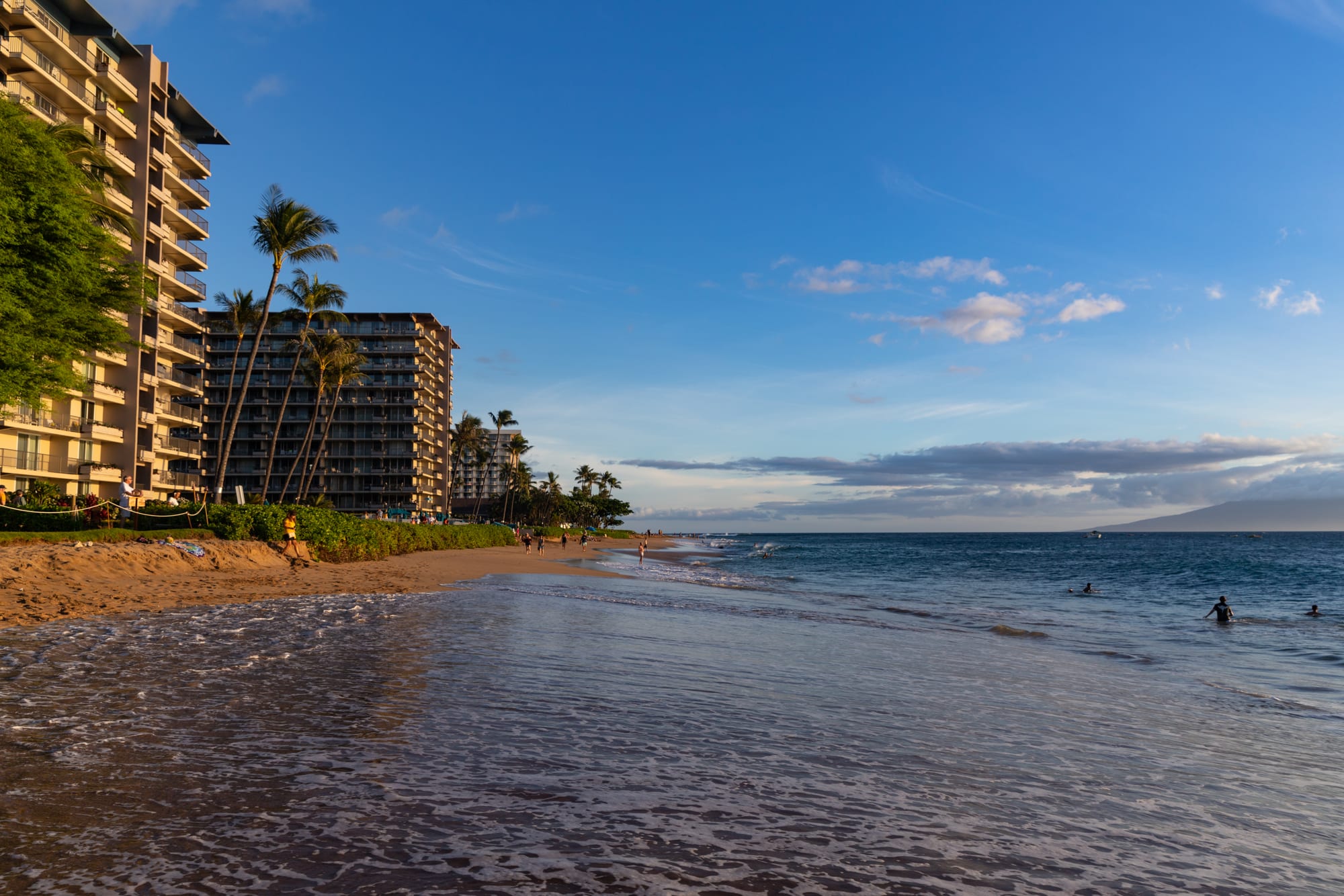
Palm trees and high-rise condominiums behind a wet golden beach, with swimmers in calm blue water and an island on the horizon

Hawaii, United States

Kaanapali

Kāʻanapali Beach near Black Rock on Maui's west coast. (dronepicr / Wikimedia Commons · CC BY 2.0)

A planned resort area on Maui's west coast, a few miles north of Lahaina, built from the 1960s along a mile-long golden beach. Hotels, condominiums, golf courses and a beachfront shopping centre line the shore, with snorkelling at Black Rock and humpback whales offshore in winter.

Neighbourhoods

  • Kāʻanapali Beach resort
    • First-time visitors
    • Beaches
    • Shopping

    The original resort strip, with hotels and condominiums along the mile-long beach from Hanakaʻōʻō Canoe Beach in the south to Black Rock in the north. The Whalers Village shopping centre sits in the middle, and a beachfront walk links the whole strip.

    Open in Maps
  • North Kāʻanapali
    • Families
    • Condo stays
    • Quieter beaches

    The stretch north of Black Rock, where Kāʻanapali's own small airport operated from 1965 to 1986. The land has since been built up with large vacation-ownership and condominium complexes, with car rental offices on the highway above.

    Open in Maps
  • Honokōwai and Nāpili
    • Condo stays
    • Good value
    • Quieter base

    The coast north towards Kapalua, made up of the neighbourhoods of Honokōwai, Kahana and Nāpili, with about 7,000 residents and a more residential feel. Rainfall here is about double that of Kāʻanapali.

    Open in Maps

Things to do

The beach

  • Kāʻanapali Beachbeach

    About a mile of golden sand lined with resort hotels, good for swimming for much of the year, with the beachfront walk running behind it.

    Open in Maps
  • Black Rocklandmark

    The ancient Hawaiian landmark at the north end of the beach, steeped in legend and known for its snorkelling.

    Open in Maps
  • Whalers Villageattraction

    The oceanfront shopping centre in the middle of the beach, with shops, restaurants and snorkel-gear rental.

    Open in Maps

Short trips along West Maui and beyond

  • Kapaluaneighborhood

    A resort development at the northern tip of West Maui, built by the Maui Land & Pineapple Company inland from Kapalua Bay and Honolua Bay.

    Open in Maps
  • Honolua Baybeach

    A bay just north of Kapalua that, with neighbouring Mokuleʻia Bay, forms a 45-acre marine life conservation district.

    Open in Maps
  • ʻĪao Valleypark

    A lush stream-cut valley in the West Maui Mountains, about three miles west of Wailuku, designated a National Natural Landmark in 1972.

    Open in Maps
  • Haleakalā National Parkpark

    The national park around the summit crater of east Maui's dormant volcano, where visitors gather to watch the sunrise and sunset and trails lead down into the crater.

    Open in Maps

Eat and drink

Long-standing places and food districts in Kaanapali. Hours, ratings and directions come from your maps app, always current.

Kāʻanapali dining

  • Whalers Village restaurantsneighborhood

    Several beachfront restaurants in the shopping centre at the heart of the resort, among them the Hula Grill.

    Open in Maps
  • Hotel luaurestaurant

    Several resorts on the beach stage luau, evening feasts of Hawaiian food with hula and music.

    Open in Maps

Local food nearby

  • Honokōwai and Nāpili food spotsneighborhood

    The residential coast north of the resort, with places to eat used by residents and condominium guests.

    Open in Maps

Experience Kaanapali

History

Kāʻanapali, Hawaiian for Kāʻana cliff, lies in the traditional land division of Hanakaʻōʻō on the leeward coast of West Maui, and the name of the canoe beach at the south end of the resort still recalls it. The remains of soldiers from both sides of a battle between rival chiefs are said to be buried in the sands of the Kāʻanapali district. Just to the south, Lahaina was the kingdom's capital and, in the 19th century, a busy whaling port where ships put in for water and food, until Kamehameha III moved the capital to Honolulu in 1845.

A narrow-gauge heritage railway, the Sugar Cane Train, ran between Lahaina and Puukolii with a stop at Kāʻanapali until its operator closed in 2014; its Lahaina station was destroyed in 2023. In the 1960s the company Amfac began building the Kaanapali Beach Resort on the mile-long beach a couple of miles north of Lahaina. Hotels opened through the 1970s and 1980s, condominiums followed for several miles up and down the coast, and Kāʻanapali had its own airport at the north end of the beach from 1965 until the Kapalua–West Maui airport replaced it in 1987.

On 8–9 August 2023 a wind-driven wildfire destroyed about 80 per cent of Lahaina and killed 102 people, the deadliest natural disaster in Hawaii since statehood. Kāʻanapali was evacuated during later fires that month, and access to West Maui was restricted for a time. In 2024 Maui County released plans for rebuilding Lahaina's commercial district, infrastructure and affordable housing over about six years.

Culture & Customs

Kāʻanapali is a resort first, and its culture is shaped by visitors and the people who work for them. Luau, evening feasts of Hawaiian food with hula and music, are staged at several of the beachfront resorts, and the Hawaiian names of the beach, the land division and Black Rock — an ancient Hawaiian landmark at the north end of the beach — tie the resort to the older history of West Maui.

Winter is whale season. The Hawaiian Islands Humpback Whale National Marine Sanctuary, in the islands' waters, is one of the most important whale habitats in the world, hosting thousands of humpbacks each winter, and whale watching from boats and from the shore is the season's main activity. Snorkelling at Black Rock and golf on the resort's two courses fill the rest of the year.

Since 2023 the culture of the area has also been shaped by the destruction of much of Lahaina, its historic neighbour, including much of the historic district centred on Front Street; the town's great banyan tree was charred but left standing. Rebuilding Lahaina, and housing for those who lost their homes, are central concerns across West Maui.

Daily Life

The Kāʻanapali census-designated place had 1,161 residents at the 2020 census, a small permanent population in a place built for visitors. The wider Lahaina area, which takes in Kāʻanapali, had about 12,700 residents in 2020, before the fire.

Tourism is the whole economy here: hotels, condominiums, restaurants, golf and boat trips employ most of the people who work in the resort. Housing has been a pressing issue since 2023, when the fire damaged or destroyed more than 2,200 structures in Lahaina, most of them homes. After the fire, West Maui was closed to the public, then reopened at first only to residents with proof of residency and visitors with hotel reservations.

Daily rhythm follows the visitors and the weather — early swims and walks along the beachfront path, boat departures for snorkelling and whale watching, and sunset crowds along the beach. The leeward coast is sunny and dry, and the north end of the resort catches more breeze and rain than the south.

Food

The food of Kāʻanapali is the food of Hawaii served in a resort setting. The luau menu brings together the traditional dishes: kalua pig roasted in an underground oven called an imu, poi of pounded taro, laulau wrapped in leaves and cooked in the imu, lomi salmon and haupia, a coconut cream pudding. Poke — rough-cut raw fish traditionally seasoned with seaweed, kukui nut and sea salt — is a local favourite.

The everyday food of West Maui residents is the plate lunch: one or two scoops of rice, macaroni salad and a main such as teriyaki beef or chicken katsu. Spam musubi and saimin noodle soup are local snacks, and shave ice, a block of ice shaved fine and flavoured with syrups, is the classic cooling sweet after the beach.

Maui also has Hawaii's first commercial winery, founded at Ulupalakua Ranch in 1974 and at first focused on pineapple wine.

Planning tools

Budget

Kāʻanapali is among the most expensive places to stay in Hawaii. Beachfront hotel rates are high and usually carry resort fees, parking is charged at the hotels and at Whalers Village, and restaurant prices reflect the setting. Condominiums with kitchens, a little further north, cut costs, and the beach itself is free to all.

Daily Budget Midrange
USD 330–650 (beachfront hotel or condo with resort fees, restaurant meals, a hire car, a snorkel or whale-watching trip)
Daily Budget Shoestring
USD 150–230 (budget condo or room away from the beach, supermarket food and plate lunches, bus or shuttle, free beaches)

A condo with a kitchen and meals from the supermarket save a good deal here.

Best Time to Visit

The resort is busy all year. Winter, from about mid-December to March, is peak season and brings humpback whales close offshore, while April to May and September to October are quieter and cheaper. Summer brings families. The north end of the beach gets more rain than the south, and Lahaina, a few miles south, gets about half as much.

Suggested Number of Days

Most visitors use Kāʻanapali as a beach base, and four or five days suit a stay centred on the resort. A week or more allows for Maui's other regions, which are a long drive away; whale season and the number of boat trips planned are what usually change the length.

First Visit
4–5 days
With Surroundings
7–10 days

Transportation

Honoapiʻilani Highway (Route 30) is the only highway in and out of West Maui, linking the resort with Lahaina, Kapalua and the rest of Maui. A shuttle runs between the main hotels and Whalers Village, and a beachfront walk connects the resort on foot. Buses serve the coast, but most visitors hire a car to see the rest of the island; rental companies have offices in north Kāʻanapali.

Hire a car only for the days spent beyond the resort; parking at the hotels is charged by the day.

Airport & Station Connections

Most visitors fly into Kahului Airport, Maui's main airport, about 45 minutes' drive away, with flights from Honolulu and the mainland. The small Kapalua Airport, about ten minutes' drive away, takes mainly inter-island commuter flights.

Walkability

The resort strip is easy to walk: the beachfront path runs past the hotels, Whalers Village and Black Rock. Beyond it, the highway is built for cars, and the condominium areas to the north and the shops of the wider coast need a car, bus or shuttle.

Safety

For most visitors the US is safe, with the main risks being petty theft and car break-ins in tourist areas of some cities, road accidents over long distances, extreme weather, and the hazards of the outdoors. On the West Maui coast the ocean is the main danger, with currents and shore breaks that vary along the beach and by season. The dry leeward hillsides are prone to wildfire, as the destruction of Lahaina in August 2023 showed.

Swim where conditions are calm, never turn one's back on the waves, follow any fire or evacuation warnings, and leave nothing in parked cars. Check current official travel advice before travelling.

Climate

Warm and sunny on Maui's dry leeward side, with breezes on the north end of the beach. Kāʻanapali lies on a wind line: the north end gets more rain than the south, rainfall doubles a few miles north at Nāpili and Kapalua, and halves at Lahaina. The figures below are those of the wider Hawaii region, as none are published for the resort itself.

Summer
79–88°F at sea level across Hawaii, drier, with steady trade winds
Winter
72–81°F at sea level across Hawaii, with more showers

Local Customs

Tipping is expected: roughly 18–22 per cent in restaurants, and about a dollar a drink in bars. Resort wear is normal everywhere. West Maui is still recovering from the 2023 fire, and many residents lost homes and family: Lahaina's burned areas are not a sightseeing stop.

Identification is asked for when buying alcohol (the legal age is 21). Do not stand on or touch coral when snorkelling, and keep a respectful distance from sea turtles and monk seals.

Common Payment Methods

The currency is the US dollar. Cards and contactless payment are accepted almost everywhere in the resort.