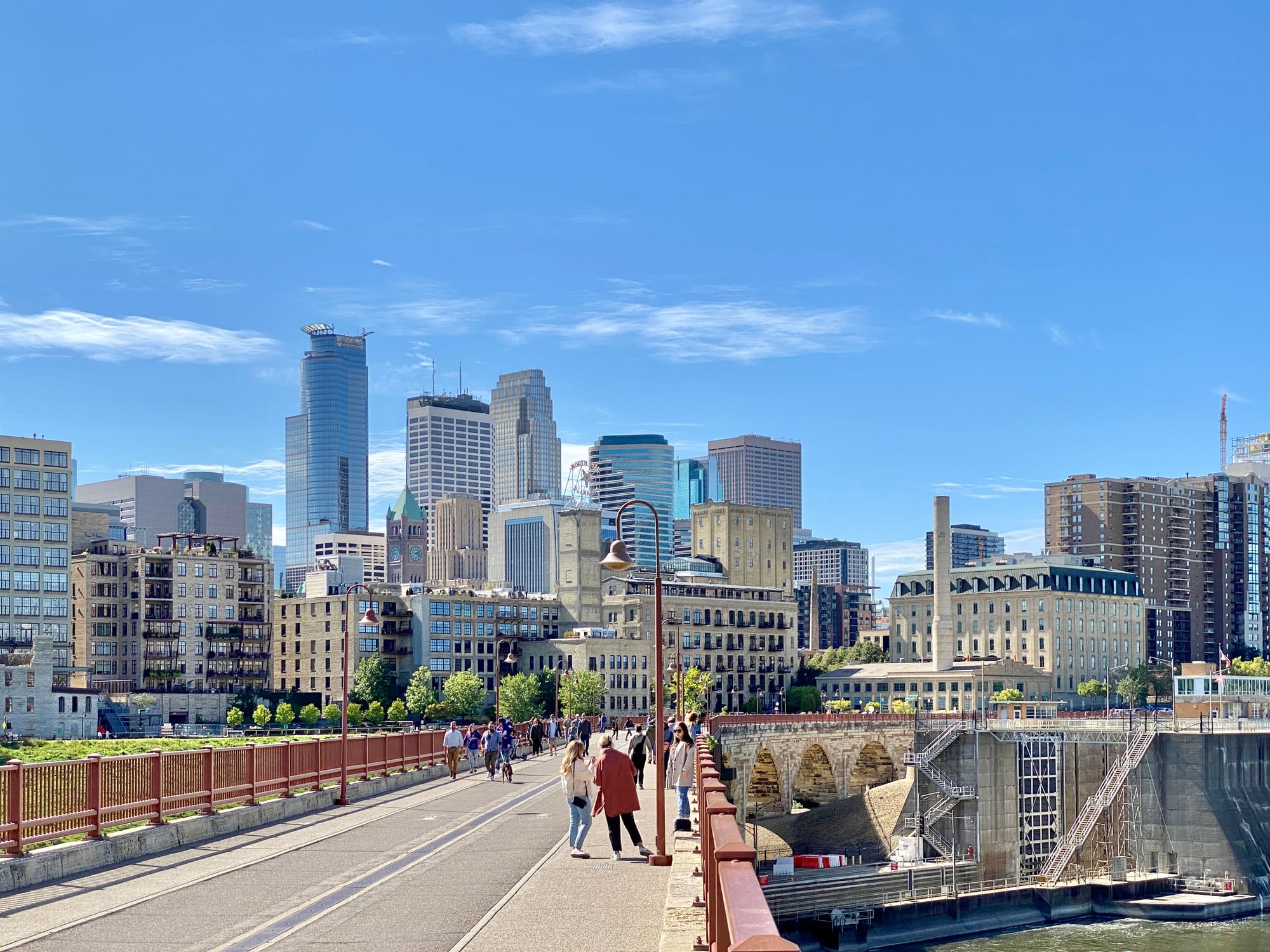
People walking across the Stone Arch Bridge towards the downtown Minneapolis skyline, with old mill buildings and the river lock below

Chicago & the Great Lakes, United States

Minneapolis

Walkers on the Stone Arch Bridge, looking towards downtown Minneapolis and the Mill District. (w_lemay / Wikimedia Commons · CC BY-SA 2.0)

Minnesota's largest city, on both banks of the Upper Mississippi beside Saint Paul, built on Dakota land around Saint Anthony Falls. The falls powered the sawmills and flour mills that made it the milling capital of the world; today it is a city of corporate headquarters, theatres and art museums, with thirteen lakes and a ring of parkland inside its limits.

Neighbourhoods

  • Downtown
    • First-time visitors
    • Theatre and sport
    • Close to public transport

    The business and entertainment core on the south-west bank of the river. About 9.5 miles of enclosed skyways link 80 blocks at second-floor level, the restored vaudeville theatres line Hennepin Avenue, First Avenue's nightclub is here, and downtown is a hub for light rail and rapid buses.

    Open in Maps
  • North Loop
    • Best for food
    • Nightlife
    • Historic district

    The old Warehouse District, the city's commercial hub in its shipping years, where historic brick warehouses now hold restaurants, shops and flats, beside the baseball park at Target Field.

    Open in Maps
  • The Mill District and the riverfront
    • History
    • Walks
    • Arts and culture

    The stretch of the Mississippi around Saint Anthony Falls, where flour mills once stood. The Stone Arch Bridge, the Mill City Museum in the ruins of the Washburn A Mill and the Guthrie Theater are here, along with riverside paths on both banks.

    Open in Maps
  • Northeast
    • Arts and culture
    • Local life
    • Bars

    The former city of St. Anthony across the river, with old housing, busy commercial streets and industrial buildings. Its arts district holds hundreds of independent artists and opens its studios to the public every May.

    Open in Maps
  • Uptown and the Chain of Lakes
    • Lakes and parks
    • Shopping
    • Nightlife

    A commercial district around Hennepin Avenue and Lake Street on the edge of the lakes, with shops, bars and restaurants a short walk from the trails around Bde Maka Ska and Lake of the Isles.

    Open in Maps
  • Cedar-Riverside
    • Local life
    • Music
    • Best for food

    Also called the West Bank, a neighbourhood between the river and Interstate 94, with a long tradition of cultural diversity, immigrant settlement and the arts.

    Open in Maps

Things to do

The river and the falls

  • Stone Arch Bridgelandmark

    A former railway bridge built in 1883 for James J. Hill's Great Northern Railway, the only stone arch bridge on the Mississippi, now a walking and cycling crossing with views of the falls.

    Open in Maps
  • Saint Anthony Fallsviewpoint

    Owámniyomni to the Dakota, once the only natural major waterfall on the Mississippi, now defined by a spillway, dams and locks; its power built the city's mills.

    Open in Maps
  • Mill City Museummuseum

    A museum opened in 2003 inside the ruins of the Washburn A Mill, telling the story of the city's flour milling and the industries powered by the falls.

    Open in Maps
  • Guthrie Theaterattraction

    A theatre company founded in 1963 that helped create American regional theatre, now in a riverside building by Jean Nouvel opened in 2006.

    Open in Maps

Art museums

  • Walker Art Centermuseum

    One of the most visited modern and contemporary art museums in the country, which began in 1879 as the private gallery of the lumber baron Thomas Barlow Walker.

    Open in Maps
  • Minneapolis Sculpture Gardenpark

    An 11-acre park beside the Walker, one of the largest urban sculpture gardens in the country, with about forty works on view all year.

    Open in Maps
  • Minneapolis Institute of Artmuseum

    One of the largest art museums in the United States, with free general admission and more than 100,000 works spanning some 5,000 years.

    Open in Maps
  • Weisman Art Museummuseum

    The University of Minnesota's art museum, founded in 1934 and housed since 1993 in a building designed by Frank Gehry.

    Open in Maps
  • American Swedish Institutemuseum

    A museum and cultural centre in the Turnblad mansion devoted to Sweden and Swedish Americans.

    Open in Maps

Lakes and parks

  • Bde Maka Skapark

    The largest lake in the city and part of the Chain of Lakes, formerly Lake Calhoun, circled by parkland and walking and cycling trails.

    Open in Maps
  • Lake Harrietpark

    A lake of 335 acres south of Bde Maka Ska, surrounded by parkland as part of the Chain of Lakes.

    Open in Maps
  • Minnehaha Parkpark

    A park around the 53-foot Minnehaha Falls near the Mississippi, made famous by Longfellow's Song of Hiawatha, with a Victorian railway depot and a house of 1849.

    Open in Maps
  • Grand Rounds National Scenic Bywaytrail

    A 51-mile loop of parkways, cycle paths and walkways linking the city's lakes, creeks and riverfront.

    Open in Maps

Music and sport

  • First Avenueattraction

    The nightclub in a 1937 bus depot where Prince, Hüsker Dü and The Replacements made Minneapolis a music city in the 1980s; it appeared in the film Purple Rain.

    Open in Maps
  • Target Fieldattraction

    The Minnesota Twins' baseball park in the North Loop, their home since 2010.

    Open in Maps

Short trips from the city

  • Mall of Americaattraction

    A vast shopping and entertainment complex in suburban Bloomington, beside the airport and reached directly on the Blue Line light rail.

    Open in Maps
  • Historic Fort Snellingmuseum

    The 1820s fort on the bluffs above the meeting of the Minnesota and Mississippi rivers — Bdóte, sacred to the Dakota — where Dred Scott lived in the 1830s and Dakota non-combatants were held in a camp after the war of 1862.

    Open in Maps
  • Saint Paulneighborhood

    Minnesota's capital, the other half of the Twin Cities, reached from downtown Minneapolis on the Green Line light rail.

    Open in Maps

Seasonal events

  • Art-A-WhirlMay

    An open-studio weekend in the Northeast arts district, where hundreds of independent artists show their work.

  • Minneapolis AquatennialJuly

    A civic celebration of the City of Lakes' lakes, rivers and streams, held since 1940 in the third full week of July.

  • Minnesota State Fairlate summer

    The 'Great Minnesota Get-Together' between Minneapolis and Saint Paul, the largest state fair in the country by average daily attendance, with about two million visitors a year.

Eat and drink

Long-standing places and food districts in Minneapolis. Hours, ratings and directions come from your maps app, always current.

Minneapolis classics

  • Matt's Barrestaurant

    A south Minneapolis bar, one of the two places that claim to have invented the Jucy Lucy, a burger with molten cheese sealed inside, served here since the 1950s.

    Open in Maps
  • 5-8 Clubrestaurant

    The other claimant to the Jucy Lucy, serving it since the 1950s.

    Open in Maps
  • Owamnirestaurant

    A Native American restaurant overlooking the Mississippi near the falls, cooking only with ingredients from before European contact — game, corn and wild plants.

    Open in Maps

Food districts and markets

  • Farmers marketsmarket

    About twenty farmers markets and mini-markets operate across the city, including West Broadway on the North Side; four stay open in winter.

    Open in Maps
  • North Loopneighborhood

    Restaurants and bars in the converted brick warehouses of the old Warehouse District.

    Open in Maps

Experience Minneapolis

History

The Dakota are the original people of this land, and one widely told story says they emerged at Bdóte, where the Minnesota River meets the Mississippi; in 1680 the cleric Louis Hennepin renamed the waterfall they called Owámniyomni the Falls of St. Anthony. The US Army built Fort Snelling near the confluence from 1819, and under a series of treaties the Dakota were pressed to cede their land on both sides of the river. When owed payments were late in 1862 and the Dakota faced starvation, war broke out; afterwards 38 Dakota men were hanged, 1,700 non-combatants were held in a camp at Fort Snelling, and most Dakota were exiled from Minnesota.

Settlers claimed both banks of the falls, and the towns of St. Anthony and Minneapolis — a name joining the Dakota word for water, mni, with the Greek polis — merged in 1872 to use its power. Sawmills and flour mills made "Mill City" the world's leader: in 1884 its flour milling was the most valuable on earth, and in 1899 it sold more lumber than any other market. Washburn-Crosby, which became General Mills, and Pillsbury grew here. Lumbering declined around the turn of the century, and the milling era later waned.

The population peaked at about 522,000 in 1950, and urban renewal later destroyed about 40 per cent of downtown, including the Gateway District. The American Indian Movement was founded here in 1968. In 2020 the murder of George Floyd by a police officer set off protests across the country and beyond. From December 2025 a federal immigration enforcement operation deployed about 3,000 agents in the state, and in January 2026 two people were killed by federal agents.

Culture & Customs

Minneapolis supports an unusually large arts scene. The Guthrie Theater, founded in 1963 with a thrust stage surrounded by the audience on three sides, is often called the granddaddy of American regional theatre, and the city bought and restored the Orpheum, State and Pantages vaudeville houses on Hennepin Avenue. The Walker Art Center and its Sculpture Garden, the free Minneapolis Institute of Art and Frank Gehry's Weisman museum anchor the visual arts, and the Northeast arts district holds some 400 independent artists.

Music is a point of pride. Prince was born here, and in the 1980s First Avenue made the city a centre of underground rock alongside R&B, funk and soul, with Hüsker Dü and The Replacements. Sport follows the Twins, who won the World Series in 1987 and 1991, the Vikings, the Timberwolves, the Lynx and the University of Minnesota's Golden Gophers.

The city's heritage is German, Irish, Norwegian and Swedish, kept alive at the American Swedish Institute, and newer communities have changed it: about 20,000 Somalis live in Minneapolis, the Somali Museum of Minnesota opened on Lake Street in 2013, and since 2022 the Muslim call to prayer may be broadcast five times a day. Dakota presence is being restored too — five acres around the falls are due to pass to a Dakota-led nonprofit in 2026. Life outdoors follows the seasons: the lakes in summer, and skating, ice fishing and cross-country skiing in winter.

Daily Life

Minneapolis had 429,954 residents at the 2020 census — about 430,000 — and the Twin Cities metropolitan area about 3.69 million. Over half of adult residents hold a bachelor's degree, well above the national average, but almost 17 per cent lived in poverty in 2023, and gaps in income and home ownership between White and Black families remain wide.

The economy is built on headquarters, finance, health care and education. Target and U.S. Bancorp are among five Fortune 500 companies based in the city, the Federal Reserve Bank of Minneapolis serves the upper Midwest, and the metro area has one of the highest concentrations of large corporate headquarters in the country. Medical technology grew from Medtronic, founded in a Minneapolis garage in 1949, and the University of Minnesota enrolls more than 45,000 students on its Twin Cities campus.

Winter shapes daily routine: office workers move through the skyways, and public works crews plough snow for months. Housing has been a long-running debate, and in 2024 the state legislature approved the city's 2040 plan for denser zoning after years of court battles. Jacob Frey has been mayor since 2018.

Food

The city's own invention is the Jucy Lucy, a burger with the cheese sealed inside the patty so that it melts as it cooks. Two bars in south Minneapolis, Matt's Bar and the 5-8 Club, both claim to have created it and have served it since the 1950s.

Minnesota's lakes and Scandinavian past shape much of the rest. Walleye and wild rice are favourite Minnesota ingredients; the hotdish, a casserole often topped with tater tots, is everyday comfort food; and lutefisk, dried whitefish treated with lye and introduced by Scandinavians, is still eaten. The Minnesota State Fair, between Minneapolis and Saint Paul, is as much about eating as anything else.

Minneapolis also has a serious restaurant scene, with several winners of the James Beard awards. Owamni, run by the chef Sean Sherman by the Mississippi, cooks only with Indigenous ingredients — game, corn and wild plants — and has won a James Beard award. Some twenty farmers markets operate across the city, four of them in winter, and East African cuisine arrived with the Somali migrants of the 1990s.

Planning tools

Budget

Minneapolis is moderately priced for a big American city. Downtown hotel rates rise for conventions, concerts and big games, and in late summer during the State Fair. Several major attractions are free — the Minneapolis Institute of Art, the Sculpture Garden, the lakes and the riverfront — and light rail links the airport, downtown and the Mall of America.

Daily Budget Midrange
USD 220–400 (downtown hotel, restaurant dinners with tax and tip, theatre or museum tickets, light rail and ride-hailing)
Daily Budget Shoestring
USD 90–150 (hostel or budget motel, burgers and market food, light rail and buses)

Use the light rail from the airport, stay near a Green or Blue Line stop, and plan around the free museums and parks.

Best Time to Visit

June to September is the season for the lakes, the riverfront, patios and festivals, from the Aquatennial in July to the State Fair in late summer. Autumn colour arrives in late September and October. Winters are long and very cold, but the skyways keep downtown usable, and the lakes are used for skating, ice fishing and cross-country skiing.

Suggested Number of Days

Two or three days cover the riverfront, the main museums and the lakes. Allow four or five to take in the wider Twin Cities and the suburbs at an easier pace. Winter cold slows outdoor sightseeing.

First Visit
2–3 days
With Surroundings
4–5 days

Transportation

Metro Transit runs two light-rail lines and eight bus rapid transit lines. The Blue Line connects the airport and the Mall of America with downtown, and the Green Line runs from downtown through the University of Minnesota to downtown Saint Paul. The city has over 200 miles of bike lanes, bikeways and trails, and shared electric bikes and scooters can be hired in warm weather.

Downtown's skyways let pedestrians cross 80 blocks indoors in winter; a car is useful only for the outer suburbs.

Airport & Station Connections

Minneapolis–Saint Paul International Airport, a major Delta hub, lies within 10 miles of both downtowns, between the two cities. The Blue Line light rail links it with downtown.

Walkability

Downtown and the riverfront are good on foot, with the Stone Arch Bridge and riverside paths linking both banks, and the skyways make walking possible in deep winter. The lakes are a few miles south-west, best reached by bus or bicycle, and then walked on the shoreline trails.

Safety

For most visitors the US is safe, with the main risks being petty theft and car break-ins in tourist areas of some cities, road accidents over long distances, extreme weather, and the hazards of the outdoors. As elsewhere in the region, tourist areas are generally safe. The bigger seasonal risks are extreme cold, icy pavements and winter driving.

Dress for serious cold from December to March, keep off lake ice unless it is clearly marked safe, and leave nothing visible in parked cars. Check current official travel advice before travelling.

Climate

A humid continental climate with cold, snowy winters and hot, humid summers. Snow, sleet, ice, thunderstorms and fog all occur, and on average the sun shines for 58 per cent of the possible hours.

Summer
warm to hot and humid — highs across the region typically 77–88°F, and the record is 108°F
Winter
long and very cold — around 10 to 32°F across the region and often colder in Minnesota, with the record low at -41°F

Local Customs

Tipping of 18–22 per cent is expected in restaurants, and sales tax is added at the till. 'Minnesota nice' — a polite, understated, sometimes reserved manner — is the regional label, and conversation about the weather is a local art. Scandinavian, German and Irish ancestry runs deep, alongside large Somali, Hmong and Latino communities.

Identification is asked for when buying alcohol (the legal age is 21). Lake ice and winter roads deserve local advice before venturing out.

Common Payment Methods

The currency is the US dollar. Cards and contactless payment are accepted almost everywhere, and some places no longer take cash. ATMs are easy to find downtown and in the skyways.