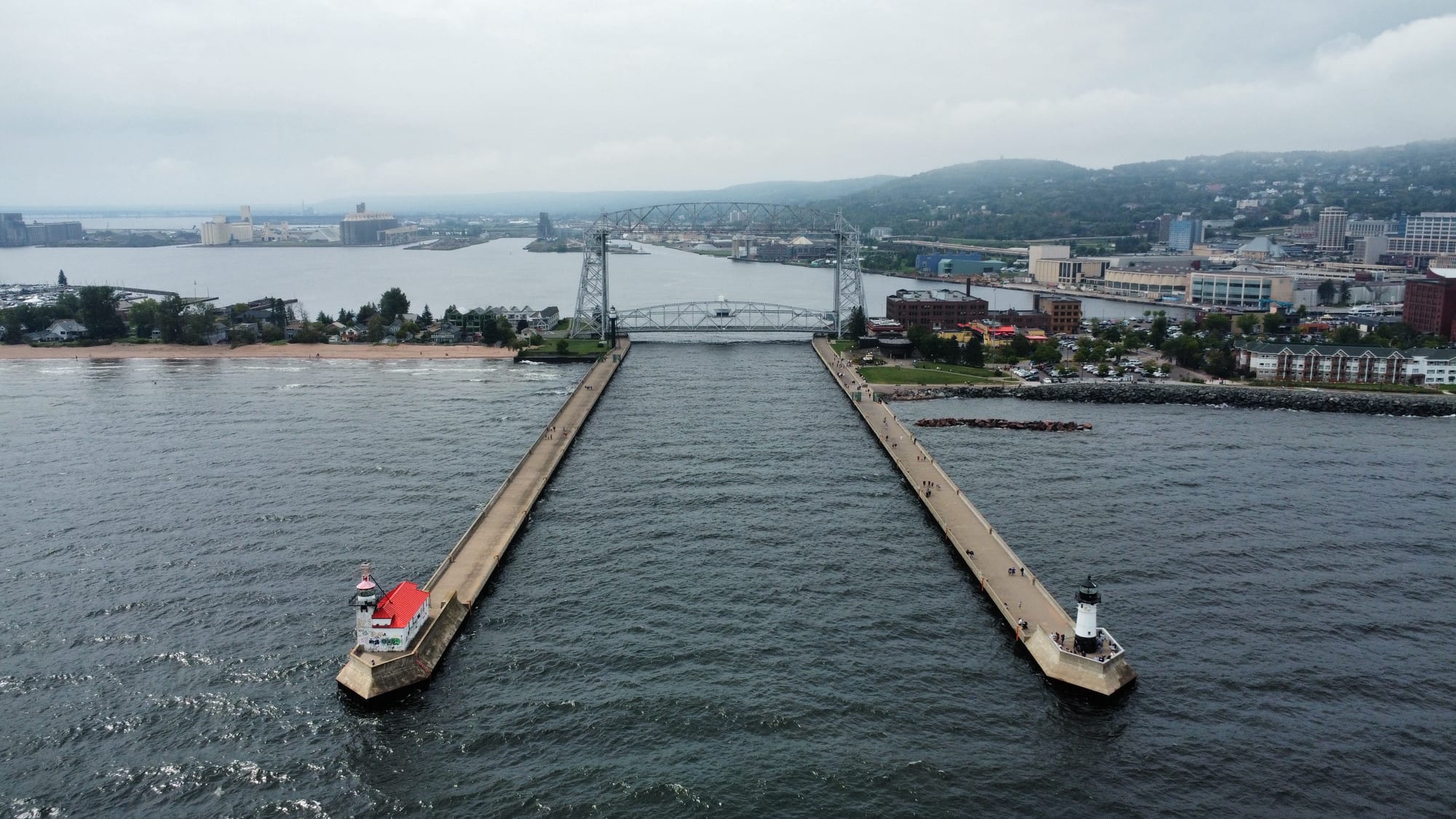
Aerial view of the Duluth ship canal between two piers with lighthouses, leading to the Aerial Lift Bridge and the harbour

Chicago & the Great Lakes, United States

Duluth

The ship canal and the Aerial Lift Bridge at the entrance to Duluth's harbour on Lake Superior. (Bspor.88 / Wikimedia Commons · CC0)

A port city in north-eastern Minnesota at the western tip of Lake Superior, climbing steep hills above a harbour shared with Superior, Wisconsin. Iron ore, grain, timber and shipping built it; today ore boats still pass under its Aerial Lift Bridge, and the city is a base for the lakeshore, the forests and the scenic North Shore drive.

Neighbourhoods

  • Canal Park
    • First-time visitors
    • Best for food
    • Lake views

    The former warehouse district beside the ship canal, now full of restaurants, shops and lodgings, with the Aerial Lift Bridge, the maritime visitor centre and the start of the Lakewalk. It is the place to watch ships come in.

    Open in Maps
  • Downtown
    • Architecture
    • Close to public transport

    The historic business district on Superior Street, just uphill from Canal Park, with brick and stone buildings from the city's boom years, the old railway depot and covered skywalks linking many blocks.

    Open in Maps
  • East End and Chester Park
    • Quiet and residential
    • Historic homes

    The leafy neighbourhoods east of downtown, with large early 20th-century houses built by the city's timber and mining families, the Glensheen estate on the lakeshore, the university and the restored Fitger's brewery complex.

    Open in Maps
  • Lincoln Park
    • Best for food
    • Breweries

    A former industrial neighbourhood west of downtown, revived as a craft district with breweries, restaurants, studios and shops along West Superior Street.

    Open in Maps
  • Park Point
    • Beaches
    • Quiet and residential

    A long, narrow sandbar reached across the lift bridge, lined with houses on one side and a long sandy Lake Superior beach on the other.

    Open in Maps

Things to do

The harbour and the lake

  • Aerial Lift Bridgelandmark

    The city's symbol, built in 1905 as a transporter bridge and converted into a lift bridge in 1929–30, whose deck rises for passing ships with an exchange of horn signals.

    Open in Maps
  • Lake Superior Maritime Visitor Centermuseum

    A museum by the ship canal on the history of shipping on Lake Superior, with a three-storey steam engine, scale models of ships and interactive displays.

    Open in Maps
  • SS William A. Irvinmuseum

    A retired Great Lakes ore carrier of 1938, moored in the harbour as a museum ship with tours of its decks, cabins and engine room.

    Open in Maps
  • Great Lakes Aquariumattraction

    An aquarium on the waterfront devoted largely to the fish and habitats of the Great Lakes.

    Open in Maps

Landmarks and museums

  • Glensheenlandmark

    A mansion of 1908 on the lakeshore built for the mining magnate Chester Congdon, with its original furnishings, gardens and grounds open for tours.

    Open in Maps
  • The Depotmuseum

    The city's grand old railway station of 1892, now a centre for the arts and history that includes the Lake Superior Railroad Museum.

    Open in Maps
  • Enger Towerviewpoint

    A stone observation tower on a hill above downtown, with wide views over the city, the harbour and the lake.

    Open in Maps
  • Clayton Jackson McGhie Memoriallandmark

    A memorial downtown to Elias Clayton, Elmer Jackson and Isaac McGhie, three young Black men lynched by a mob in Duluth in 1920.

    Open in Maps

Parks and outdoors

  • Skyline Parkwayviewpoint

    A scenic road along the ridge above the city, with overlooks of the harbour, the lake and the bridges.

    Open in Maps

Short trips from the city

  • Jay Cooke State Parkpark

    A park south-west of the city where the St. Louis River tumbles over tilted rock, crossed by a swinging footbridge, replaced after a flood in 2012.

    Open in Maps
  • Gooseberry Falls State Parkpark

    A popular park on the North Shore with a series of waterfalls dropping towards Lake Superior.

    Open in Maps
  • Split Rock Lighthouselandmark

    A lighthouse of 1910 on a cliff above Lake Superior, built after a series of shipwrecks in a storm in 1905, now a museum.

    Open in Maps
  • Superior, Wisconsinattraction

    The neighbouring port city across the harbour, sharing the docks, ore yards and grain elevators of the Twin Ports.

    Open in Maps

Seasonal events

  • John Beargrease Sled Dog MarathonJanuary

    A long-distance sled-dog race along the North Shore, named after an Ojibwe mail carrier of the late 19th century.

  • Grandma's MarathonJune

    A marathon run along the North Shore from Two Harbors to Canal Park, one of the biggest in the region.

  • Bayfront Blues FestivalAugust

    A blues festival on the harbour front at Bayfront Festival Park.

Eat and drink

Long-standing places and food districts in Duluth. Hours, ratings and directions come from your maps app, always current.

Duluth classics

  • Smoked fish and lake fishrestaurant

    Lake Superior herring, whitefish and trout, smoked and sold by fish shops along the North Shore, and walleye served in restaurants across the city.

    Open in Maps
  • Canal Park restaurantsneighborhood

    Restaurants, cafés and ice-cream shops among the old warehouses by the lift bridge, many with views of the lake and passing ships.

    Open in Maps

Breweries and bars

  • Lincoln Park craft districtneighborhood

    Breweries, restaurants, coffee shops and artists' studios in a former blue-collar neighbourhood west of downtown.

    Open in Maps
  • Fitger'sneighborhood

    The old lakeside brewery buildings east of downtown, converted into shops, restaurants and a brewpub.

    Open in Maps

Experience Duluth

History

The Ojibwe and the Dakota lived around the head of Lake Superior, and the area was a meeting place on the fur-trade route. The city takes its name from Daniel Greysolon, Sieur du Lhut, a French explorer who reached the region in 1679. In the 19th century the American Fur Company had a trading post nearby, and settlement grew slowly until copper and land speculation brought interest in the 1850s.

In the late 1860s the financier Jay Cooke persuaded the Lake Superior and Mississippi Railroad to extend its line from St. Paul to Duluth, and the town boomed, only to collapse when his firm failed in the Panic of 1873. Recovery came with timber, grain and above all iron ore from the Mesabi Range, discovered in 1890; by the early 20th century Duluth was one of the busiest ports in the country and was said to have more millionaires per head than anywhere else in the United States. The ship canal was cut through Minnesota Point in 1871, and the Aerial Lift Bridge was built across it in 1905.

In 1920 a mob lynched three Black circus workers, Elias Clayton, Elmer Jackson and Isaac McGhie, after a false accusation; a memorial was dedicated in 2003. The city declined as mining and manufacturing shrank after the mid-20th century, losing much of its population, but it has since rebuilt its economy around healthcare, education, tourism and the port.

Culture & Customs

Duluth's culture is tied to the lake and the port. People gather in Canal Park to watch the ore boats and ocean-going ships — lakers and salties — sail under the lift bridge, and ship arrivals are followed closely by enthusiasts. Outdoor life is central: hiking, cycling, kayaking and skiing in the hills and forests that run down to the water.

Bob Dylan was born in Duluth in 1941, and a route through the city is named Bob Dylan Way. Music, theatre and the arts are active for a city of its size, with venues downtown, the arts centre in the Depot and the University of Minnesota Duluth. The city's breweries and craft districts have become a focus of social life.

The Ojibwe presence remains strong in the wider region, with the Fond du Lac reservation nearby, and Ojibwe heritage is part of local identity. Duluthians are known for their resilience in harsh winters, a sense of humour about the cold, and a strong attachment to their lake.

Daily Life

About 87,000 people live in Duluth, and around 280,000 in the wider Duluth–Superior metropolitan area. The city stretches for many miles along the shore and up the steep hills behind it, from industrial and working-class western neighbourhoods to the leafy East End.

Healthcare is now a major employer, and the city is a regional centre for hospitals, alongside the University of Minnesota Duluth and other colleges, tourism, government and the port, which still ships iron ore, coal and grain. Like many older industrial cities, Duluth has dealt with population loss, ageing housing and poverty in some areas, and housing costs and the shortage of homes are current issues.

The seasons dominate daily life. Summers are busy with visitors, festivals and life outdoors; winters are long, dark and snowy, with skiing, skating, ice fishing and indoor social life in cafés and breweries. The lake moderates the weather near the shore, and "cooler by the lake" is a familiar phrase.

Food

Lake Superior fish is the local speciality. Herring, whitefish and lake trout are smoked in fish shops along the North Shore and sold whole, as fillets or in spreads, and walleye — Minnesota's state fish — is served pan-fried or battered in restaurants and bars. Wild rice, harvested by hand by the Ojibwe in the lakes of the region, appears in soups, casseroles and side dishes.

Upper Midwest comfort food is common: hotdish, a baked casserole often topped with tater tots; pasties, brought to the Iron Range by Cornish and other miners; and Scandinavian dishes such as lefse, a soft potato flatbread, reflecting the region's Norwegian, Swedish and Finnish heritage. Porketta, a herb-seasoned roast pork associated with the Italian immigrants of the Iron Range, is another regional favourite.

Duluth has a lively brewing scene, with breweries in Lincoln Park and the restored Fitger's complex, alongside coffee shops and cafés. In summer, ice cream shops and fish stands near the lift bridge are busy with visitors.

Planning tools

Budget

Duluth is moderately priced, cheaper than the Twin Cities for food and lodging. Summer and autumn weekends are the expensive times, especially around Grandma's Marathon and big festivals, when rooms in Canal Park sell out. Winter is cheaper and quieter.

Daily Budget Midrange
USD 200–360 (mid-range hotel, restaurant dinners with tax and tip, a museum or mansion tour, a hire car for the North Shore)
Daily Budget Shoestring
USD 90–150 (budget motel or campsite, fish shacks and café food, free trails, the Lakewalk and the maritime centre)

Book well ahead for summer weekends and Grandma's Marathon; many of the best sights — the lift bridge, the Lakewalk and the views — are free.

Best Time to Visit

Summer is the main season, with ships in the harbour, festivals and cool weather by the lake. September and early October bring autumn colour along the North Shore and are very popular. Winter is long, snowy and cold, with skiing and sled-dog racing, and most shipping pauses from about January to March.

Suggested Number of Days

Two to three days cover the city and its waterfront. Four or five allow time for the North Shore and the state parks along it. In winter the shorter days and the weather can slow travel, so extra time helps.

First Visit
2–3 days
With Surroundings
4–5 days

Transportation

A car is the easiest way to get around, especially for the hills, the outer neighbourhoods and the North Shore. Duluth Transit Authority buses cover the city. Canal Park, downtown and the Lakewalk are easy on foot, and skywalks link many downtown buildings in winter.

Duluth's streets are very steep, and snow and ice make some of them hard to climb in winter; drive slowly and leave space.

Airport & Station Connections

Duluth International Airport is a few miles north-west of downtown, with a limited number of flights to major hubs. Many visitors fly into Minneapolis–Saint Paul, about two and a half hours away by car, and drive north on Interstate 35; shuttle buses also run between the two cities.

Walkability

Canal Park, downtown and the Lakewalk are compact and pleasant to walk, and the skywalks help in winter. The city stretches for many miles along the shore, and the hills above it are steep, so the outer neighbourhoods need a car or a bus.

Safety

Duluth is generally safe for visitors. The main risks are natural: Lake Superior's cold water and powerful waves, especially on the piers and rocky shores in storms, and icy roads and pavements in winter.

Stay off the piers and wet rocks in high waves, and be ready for sudden weather changes on the lake. Check current official travel advice before travelling.

Climate

A cold continental climate shaped by Lake Superior, which keeps summers cool near the shore and brings fog. Winters are long, cold and snowy, and the weather can change quickly.

Summer
cool and mild — July days are usually in the 70s °F, often cooler by the lake
Winter
very cold and snowy — January days are often below 20°F and nights well below 0°F in cold spells

Local Customs

Duluth is informal, outdoorsy and proud of its lake and its working port. Tipping follows US custom — about 18–20 per cent in restaurants. Sales tax is added at the till. Watching ships come and go is a local pastime, and many people dress for the weather in layers all year.

The legal age for alcohol is 21, and identification is asked for. Respect Ojibwe sites and reservation rules when travelling in the wider region.

Common Payment Methods

The currency is the US dollar. Cards and contactless payment are accepted almost everywhere, and ATMs are easy to find. A little cash is useful at smaller shops and fish stands along the North Shore.