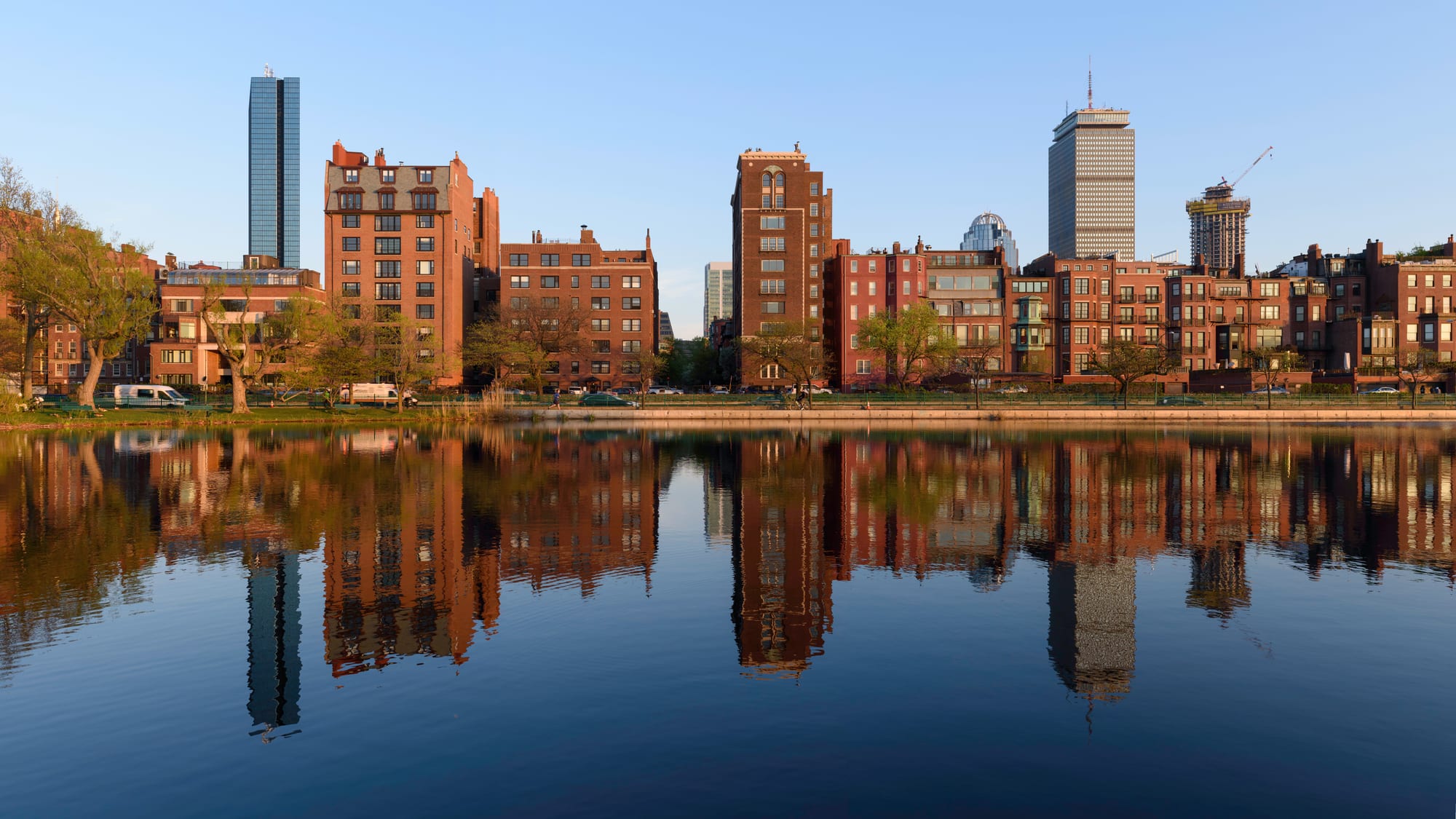
Red-brick Back Bay apartment buildings and two tall towers reflected in still water along the Charles River Esplanade

New England, United States

Boston

Back Bay reflected in Storrow Lagoon on the Charles River Esplanade, Boston. (King of Hearts / Wikimedia Commons · CC BY-SA 4.0)

The capital of Massachusetts and the largest city in New England, founded by English Puritans in 1630 on a small peninsula in Boston Harbor. It was a centre of the American Revolution, grew on landfill and immigration, and is now a compact city of brick neighbourhoods, universities, hospitals and biotechnology, with Cambridge across the Charles River.

Neighbourhoods

  • Beacon Hill
    • First-time visitors
    • Historic district

    The narrow streets of Federal-style brick row houses and brick pavements behind the gold-domed State House, between Boston Common and the Charles River. Charles Street runs along the foot of the hill, and the Common and the Public Garden are next door.

    Open in Maps
  • North End
    • Best for food
    • Historic district

    The oldest residential neighbourhood in the city, a dense grid of narrow streets that later became Boston's Italian quarter. Paul Revere's house and the Old North Church are here, and Hanover Street is lined with Italian restaurants, cafés and bakeries.

    Open in Maps
  • Back Bay
    • Architecture
    • Shopping
    • Close to public transport

    A 19th-century district built on filled-in tidal flats, laid out on a regular grid of Victorian brownstones. Newbury Street's shops, Copley Square with Trinity Church and the Boston Public Library, and the city's two tallest towers are all here.

    Open in Maps
  • Downtown and the Waterfront
    • First-time visitors
    • Close to public transport

    The old commercial heart around Faneuil Hall, Quincy Market and the Financial District, with the Rose Kennedy Greenway running along the line of the demolished elevated highway and the wharves and the aquarium on the harbour beyond.

    Open in Maps
  • South End
    • Best for food
    • Quiet and residential

    A large Victorian neighbourhood of brick and brownstone row houses and small residential squares, built on filled marshland in the mid-19th century.

    Open in Maps
  • Seaport District
    • Waterfront
    • Nightlife

    Former docks and car parks on the South Boston waterfront, rebuilt since the 2000s with offices, flats, restaurants and the convention centre, around the Institute of Contemporary Art and the Harborwalk.

    Open in Maps
  • Fenway–Kenmore
    • Sport
    • Museums
    • Students and nightlife

    The area around Kenmore Square and the Back Bay Fens, home to Fenway Park, the Museum of Fine Arts, the Isabella Stewart Gardner Museum, Symphony Hall and several universities and colleges, with bars on Lansdowne Street beside the ballpark.

    Open in Maps
  • Cambridge
    • Universities
    • Bookshops and cafés

    A separate city across the Charles River, home to Harvard and MIT. Harvard Square has bookshops, cafés and street performers around the old college buildings, and Kendall Square near MIT is a centre of biotechnology. The Red Line links both to central Boston.

    Open in Maps

Things to do

The Freedom Trail and colonial Boston

  • Freedom Trailtrail

    A 2.5-mile red line through the city linking 16 sites of the Revolution and early republic, from Boston Common to the Old North Church and the Bunker Hill Monument in Charlestown; most sites are free.

    Open in Maps
  • Boston Commonpark

    Laid out in 1634 and counted as the oldest public park in the country, once a cow pasture and militia ground, now the city's central green.

    Open in Maps
  • Massachusetts State Houselandmark

    The seat of the state government on Beacon Hill, with its gilded dome looking over the Common.

    Open in Maps
  • Faneuil Halllandmark

    A market hall and meeting place of the 18th century where colonists gathered to protest British rule.

    Open in Maps
  • Old North Churchlandmark

    The North End church, built in 1723, from whose steeple two lanterns were hung in April 1775 to warn that British troops were moving towards Lexington and Concord.

    Open in Maps
  • Paul Revere Housemuseum

    The wooden house in the North End where the silversmith and messenger of 1775 lived, one of the oldest buildings in downtown Boston.

    Open in Maps
  • USS Constitutionattraction

    The wooden-hulled frigate launched in 1797, still a commissioned ship of the US Navy, berthed at the Charlestown Navy Yard at the end of the trail.

    Open in Maps

Museums

  • Museum of Fine Artsmuseum

    The 20th-largest art museum in the world by public gallery area, with collections from ancient Egypt to American painting, on Huntington Avenue in the Fenway.

    Open in Maps
  • Isabella Stewart Gardner Museummuseum

    A collector's palazzo opened in 1903 around a flowered courtyard, kept as she arranged it; thirteen works stolen in 1990 have never been recovered, and their empty frames still hang.

    Open in Maps
  • Institute of Contemporary Artmuseum

    Boston's museum of contemporary art, in a building on the harbour in the Seaport District.

    Open in Maps
  • New England Aquariumattraction

    A large public aquarium on Central Wharf built around a tall cylindrical ocean tank.

    Open in Maps
  • John F. Kennedy Presidential Library and Museummuseum

    The presidential library of the Boston-born president, on Columbia Point in Dorchester, looking out over the harbour.

    Open in Maps

Parks and the waterfront

  • Boston Public Gardenpark

    A Victorian botanical garden beside the Common, with a lagoon crossed by the swan boats in summer.

    Open in Maps
  • Charles River Esplanadepark

    A long riverside park along the Back Bay bank of the Charles, used for walking, running and sailing, and home to the Hatch Shell, the stage of the Fourth of July concert.

    Open in Maps
  • Rose Kennedy Greenwaypark

    A chain of gardens, plazas and fountains running for over a mile through downtown on land freed by the Big Dig, opened in 2008.

    Open in Maps
  • Arnold Arboretumpark

    Harvard's tree collection in Jamaica Plain, part of Frederick Law Olmsted's Emerald Necklace of parks, with a Lilac Sunday celebration each May.

    Open in Maps
  • Boston Harbor Islandspark

    A park of 34 islands and peninsulas in the harbour, with trails, beaches and Civil War-era Fort Warren; Georges and Spectacle islands are reached by seasonal ferry from the city.

    Open in Maps

Sport, music and Cambridge

  • Fenway Parkattraction

    Home of the Red Sox since 1912 and the oldest active ballpark in Major League Baseball, known for the high left-field wall called the Green Monster.

    Open in Maps
  • TD Gardenattraction

    The arena above North Station, home of the Celtics basketball team and the Bruins ice hockey team.

    Open in Maps
  • Symphony Hallattraction

    The concert hall of the Boston Symphony Orchestra and the Boston Pops, opened in 1900 and famous for its acoustics.

    Open in Maps
  • Harvard Yardattraction

    The old heart of Harvard University in Cambridge, the oldest institution of higher education in the country, a short ride across the river on the Red Line.

    Open in Maps

Short trips from the city

  • Minute Man National Historical Parkpark

    The road between Lexington and Concord where the first battles of the Revolutionary War were fought on 19 April 1775, with the North Bridge at Concord.

    Open in Maps
  • Salemattraction

    A historic port on the North Shore, remembered for the witch trials of 1692 and home to the Peabody Essex Museum.

    Open in Maps
  • Walden Pondpark

    The pond in Concord where Henry David Thoreau lived in a cabin for two years from 1845, now a state reservation used for walking and swimming.

    Open in Maps

Seasonal events

  • Saint Patrick's Day and Evacuation DayMarch

    Boston marks the day the British left the city in March 1776, which shares its date with Saint Patrick's Day in a city of strong Irish heritage.

  • Boston MarathonPatriots' Day, the third Monday of April

    The world's oldest annual marathon, first run in 1897, from Hopkinton to Boylston Street near Copley Square, watched by large crowds along the route.

  • Boston Harborfest and the Fourth of Julyearly July

    Independence Day is celebrated with the week-long Harborfest and a Boston Pops concert with fireworks on the banks of the Charles River.

  • North End Italian feastssummer

    Street feasts in honour of Catholic saints, with food stalls, music and processions through the North End.

  • Head of the Charles RegattaOctober

    The largest three-day regatta in the world, with thousands of rowers racing up the Charles River between Boston and Cambridge.

  • First NightNew Year's Eve

    A New Year's Eve celebration of the arts held in Boston since the 1970s.

Eat and drink

Long-standing places and food districts in Boston. Hours, ratings and directions come from your maps app, always current.

Boston classics

  • Union Oyster Houserestaurant

    A restaurant in the Blackstone Block near Faneuil Hall that has served diners since 1826, the oldest known to have operated continuously in the country, with an oyster bar and New England seafood.

    Open in Maps
  • Quincy Marketmarket

    The granite market hall of 1826 next to Faneuil Hall, now a long food hall of chowder, lobster rolls and snacks.

    Open in Maps
  • Haymarketmarket

    An open-air pushcart market of fruit, vegetables and fish on Fridays and Saturdays between the North End and Government Center, with roots in the early 19th century.

    Open in Maps

Food districts

  • The North Endneighborhood

    Italian restaurants, cafés and pastry shops along Hanover Street and the side streets of the old Italian quarter.

    Open in Maps
  • Chinatownneighborhood

    Chinese and Vietnamese restaurants and markets in the district between downtown and the South End.

    Open in Maps

Experience Boston

History

Remains of a Native fish weir found under Boylston Street date back thousands of years. The first European to live on the Shawmut Peninsula was the Anglican cleric William Blaxton, who invited the Puritans of the Massachusetts Bay Colony to join him; they founded Boston in 1630 and named it after the market town in Lincolnshire.

Boston led the resistance to British rule: the Boston Massacre of 1770, the Tea Party of 1773, when chests of East India Company tea were thrown into the harbour, and, after fighting broke out at Lexington and Concord in April 1775, a siege that ended when cannon placed on Dorchester Heights forced the British to leave in March 1776. In the 19th century the old merchant families, later called the Boston Brahmins, made the city a centre of learning and of the abolitionist movement, while Irish immigrants arrived from the 1820s and Italians and Russian Jews later filled the North End and the West End. Hills were levelled to fill the tidal flats of the Back Bay, and neighbouring towns were annexed.

The 20th century brought decline as factories closed, a deadly molasses flood in the North End in 1919 and conflict over school desegregation busing from 1974. Universities, hospitals and finance led a recovery. The Big Dig buried the elevated highway through downtown between 1991 and 2007, and the Rose Kennedy Greenway opened on the land in 2008. The bombing at the marathon finish line in 2013 was met with the slogan Boston Strong. Michelle Wu became mayor in 2021.

Culture & Customs

Boston has long been called the Athens of America for its literary and academic life, and its density of universities — Harvard and MIT across the river in Cambridge, Boston University, Northeastern, Berklee College of Music and many more — shapes the city, which draws more than 350,000 college students. Symphony Hall is home to the Boston Symphony Orchestra and the Boston Pops, and the Museum of Fine Arts and the Isabella Stewart Gardner Museum anchor a strong museum culture.

Irish Catholic heritage runs deep in politics and in neighbourhoods such as South Boston and Charlestown, and Catholics are the largest religious community; the Italian North End keeps its summer feasts for patron saints. Boston also has large Black, Dominican, Puerto Rican, Haitian, Cape Verdean and Chinese communities, and East Boston has a mixed Latin American population. The Pride parade and festival are held in June.

Sport is close to a civic religion. The Red Sox have played at Fenway Park since 1912, the Celtics and the Bruins share TD Garden, and the Patriots play in Foxborough; between 2001 and 2024 the city's teams won thirteen championships. The marathon on Patriots' Day and the Head of the Charles regatta in October are the year's great participation events.

Daily Life

Boston had about 676,000 residents at the 2020 census, and Greater Boston about 5 million people in 2025, the largest metropolitan area in New England. The city covers only 48 square miles, so it feels dense by American standards, and a large part of the population is young: students, medical residents and early-career researchers.

The economy is led by finance, professional services, information technology and government, and by medicine and research. Massachusetts General, Brigham and Women's and Beth Israel Deaconess are among the country's leading hospitals — the last two clustered with medical schools in the Longwood area — and Boston and Cambridge together form one of the largest biotechnology hubs in the world. Housing is the pressing issue: prices have risen sharply since rent control was ended by a statewide vote in the 1990s, and high rents push many workers to the suburbs.

Daily routines follow the T and the commuter trains, and Boston, nicknamed 'the Walking City', has more pedestrian commuters than comparable cities. The outer neighbourhoods — Dorchester, Roxbury, Jamaica Plain, Charlestown, South Boston, East Boston — are home to most Bostonians. Life moves outdoors in summer, onto the Esplanade, the harbour islands and the ballpark, and back indoors through long winters of snow.

Food

The city's cooking grew from the sea and from New England farms, with an emphasis on seafood, salt and dairy. Clam chowder, a creamy soup of clams and potatoes, is sold everywhere from market stalls to old oyster bars, and the lobster roll — lobster meat in a toasted bun, usually served cold — is the summer treat. Boston baked beans, sweetened with molasses, were a product of the city's place on the Caribbean trade route, and Boston cream pie, a custard-filled cake, carries the city's name.

The Union Oyster House near Faneuil Hall has served diners since 1826, and the neighbouring Quincy Market is a long food hall in a granite market building of the same year. Next door, the Haymarket pushcart vendors sell fruit, vegetables and fish on Fridays and Saturdays, as they have in one form or another for two centuries.

Immigrant neighbourhoods supply the rest. The North End's Italian restaurants and pastry shops line Hanover Street; Chinatown is the place for Chinese and Vietnamese food, and the city's Dominican, Salvadoran, Haitian and Cape Verdean communities bring their own cooking. Dunkin', founded in nearby Quincy, is part of the daily routine for many Bostonians.

Planning tools

Budget

Boston is one of the most expensive cities in the United States, and hotel rooms are the largest cost, rising sharply in summer, in the autumn foliage season and at university graduation time. Food ranges from market stalls and takeaway chowder to expensive seafood restaurants. Many sights are free, including most stops on the Freedom Trail and the city's parks.

Daily Budget Midrange
USD 300–500 (mid-range hotel, restaurant dinners with tax and tip, museum tickets, the T and a harbour ferry)
Daily Budget Shoestring
USD 120–190 (hostel bed, market and takeaway meals, the T and walking)

Skip a hire car in the city, where parking is expensive and the T covers the sights; rooms in Cambridge or near a subway line further out can cost less.

Best Time to Visit

May to October. Late spring brings the marathon and the gardens in flower, summer the harbour ferries, the Esplanade and baseball at Fenway, and September and October mild days and autumn colour along the river. Winters are cold and stormy, with occasional heavy snow, but the museums, concerts and indoor sport carry on.

Suggested Number of Days

Most first visits take three to four days. Allow five or six to add Cambridge at a slower pace and trips out of the city. A visit in winter, or one built around a game or a concert, changes the number less than the choice of day trips does.

First Visit
3–4 days
With Surroundings
5–6 days

Transportation

The Massachusetts Bay Transportation Authority (MBTA), known as the T, runs the oldest underground rapid transit system in the Americas — the Red, Orange, Blue and Green lines — as well as the Silver Line bus rapid transit, buses, commuter rail and harbour ferries. Downtown streets follow old paths rather than a grid, and driving and parking are slow and costly. The Bluebikes bike share has hundreds of stations across Boston and its neighbouring cities.

Use the T and walking in the centre, and keep a car for trips out of the city.

Airport & Station Connections

Logan International Airport, the largest in New England, is in East Boston, about 2.5 miles north-east of Back Bay across the harbour. The Silver Line SL1 bus runs from every terminal to South Station, free shuttle buses link the terminals with Airport station on the Blue Line, and a water transportation dock serves the harbour. Amtrak's Acela and Northeast Regional trains arrive at South Station and Back Bay from New York and Washington, and trains from Maine use North Station.

Walkability

One of the most walkable cities in the United States, with a high share of residents who walk to work. The historic centre, Beacon Hill, the North End and Back Bay are close together, and the Freedom Trail is a 2.5-mile walk. The State House to Fenway Park is about two miles. Brick and cobbled pavements are uneven, and snow and ice make them slippery in winter.

Safety

For most visitors the US is safe, with the main risks being petty theft and car break-ins in tourist areas of some cities, road accidents over long distances, extreme weather, and the hazards of the outdoors. New England has some of the lowest crime rates in the country, and the central districts visitors use are busy day and night. Sports rivalries run high, and fans of visiting teams can expect some verbal ribbing near the stadiums.

Keep valuables out of sight on crowded trains and at big events, and take care on icy pavements in winter. Check current official travel advice before travelling.

Climate

Four distinct seasons. Summers are warm to hot and humid; winters are cold and stormy, with occasional heavy snow, though near the coast rain often falls instead of snow when warm air is drawn off the Atlantic.

Summer
warm and humid — July is the warmest month, averaging about 74°F, and about 13 days a year pass 90°F
Winter
cold and stormy — January averages about 30°F, and with occasional periods of heavy snow

Local Customs

Tipping is expected: roughly 18–22 per cent in restaurants and about a dollar a drink at a bar, and sales tax is added at the till. Bostonians are devoted to their sports teams; the Boston accent, which drops the 'r' after vowels, is still heard, though fading among younger people. Dress is casual except in a few formal restaurants and at concerts.

Identification is asked for when buying alcohol (the legal age is 21).

Common Payment Methods

The currency is the US dollar. Cards and contactless payment are accepted almost everywhere, including on the T, and some places no longer take cash. ATMs are everywhere; a few market stalls and small shops prefer cash.