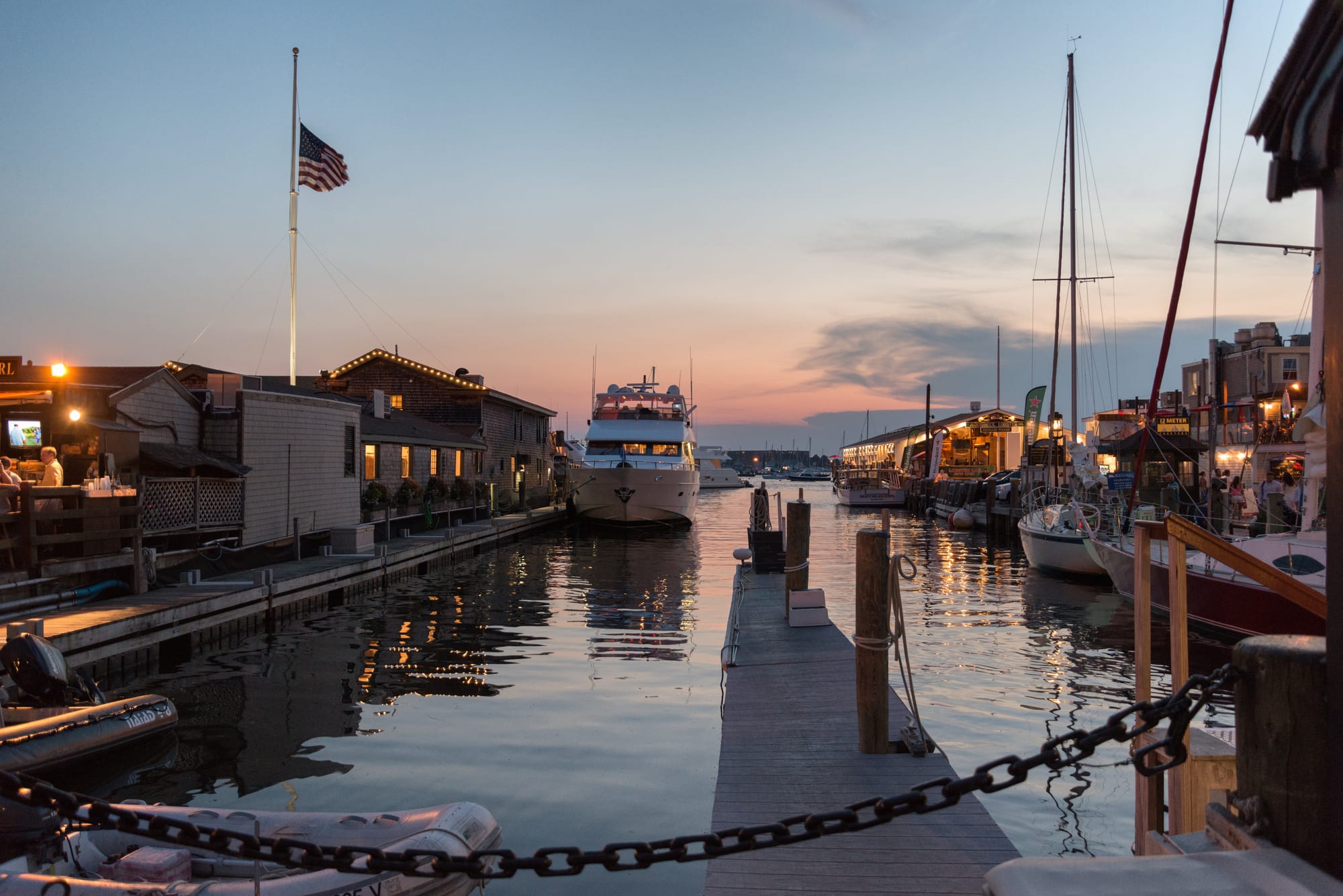
Wooden wharves with lit restaurants, a motor yacht and sailing boats moored in calm water at dusk under a pink sky

New England, United States

Newport

Bannister's and Bowen's wharves on Newport harbour at dusk. (Giorgio Galeotti / Wikimedia Commons · CC BY 4.0)

A small seaside city on Aquidneck Island in Narragansett Bay, Rhode Island. Founded in 1639, it was a wealthy colonial port built partly on whaling and the slave trade, then the Gilded Age summer resort of the Vanderbilts and Astors. Today it lives on tourism, sailing and the Navy, with colonial streets downtown and mansions above the sea.

Neighbourhoods

  • Downtown and the wharves
    • First-time visitors
    • Best for food
    • Nightlife

    The colonial heart of the city around Washington Square, the Old Brick Market and Thames Street, with Bannister's and Bowen's wharves on the harbour. Restaurants, bars, shops and marinas fill the waterfront, and the bus terminal is on America's Cup Avenue.

    Open in Maps
  • Bellevue Avenue
    • Gilded Age mansions
    • Historic district

    The long avenue south of downtown lined with the summer 'cottages' of the Vanderbilts, Astors and other wealthy families, built around the turn of the 20th century. Several are museums, and the Cliff Walk runs behind them along the ocean.

    Open in Maps
  • Fifth Ward
    • Local life
    • Quiet and residential

    A residential district in the southern part of the city, for generations a staunchly Irish neighbourhood, away from the main tourist crowds.

    Open in Maps
  • Ocean Drive
    • Coastal scenery
    • Driving and cycling

    The road along the southern shore, laid out to an Olmsted design in the 1860s, with large houses on big lots overlooking beaches and the ocean, once the picnic ground of the Bellevue Avenue families, and Brenton Point at its western end.

    Open in Maps

Things to do

Gilded Age mansions

  • The Breakersmuseum

    Cornelius Vanderbilt II's 70-room Renaissance Revival summer house of 1893–95 on the cliffs over the Atlantic, designed by Richard Morris Hunt and open all year as a house museum.

    Open in Maps
  • Marble Housemuseum

    The Beaux-Arts 'cottage' built in 1888–92 for Alva and William Kissam Vanderbilt, unmatched in opulence for an American house when it was finished.

    Open in Maps
  • The Elmsmuseum

    A mansion completed in 1901 for the coal baron Edward Julius Berwind, modelled on an 18th-century French château.

    Open in Maps
  • Rosecliffmuseum

    Stanford White's mansion of 1898–1902 for the silver heiress Theresa Fair Oelrichs, modelled on the Grand Trianon at Versailles.

    Open in Maps
  • Rough Pointmuseum

    An English manorial house of red sandstone and granite built for Frederick William Vanderbilt and later the home of Doris Duke, now a museum.

    Open in Maps
  • Chateau-sur-Mermuseum

    One of the first grand Bellevue Avenue mansions, whose lavish parties ushered in Newport's Gilded Age.

    Open in Maps

Colonial Newport

  • Touro Synagoguelandmark

    Built in 1763 for a congregation of Sephardic Jews, the oldest synagogue building still standing in the United States and a symbol of Rhode Island's religious freedom.

    Open in Maps
  • Trinity Churchlandmark

    A Georgian wooden church of 1725–26 on Queen Anne Square, one of the largest surviving 18th-century churches in New England.

    Open in Maps
  • Museum of Newport Historymuseum

    The Newport Historical Society's museum in the 18th-century Old Brick Market on Washington Square.

    Open in Maps
  • Newport Towerlandmark

    A round stone tower in Touro Park, most likely the remains of a 17th-century windmill, long the subject of theories of a much older origin that mainstream scholars reject.

    Open in Maps

The coast and the bay

  • Cliff Walktrail

    A 3.5-mile public path along the shore from First Beach to Bailey's Beach, looking out over the ocean and up at The Breakers, Marble House and other mansions; the first National Recreation Trail in New England.

    Open in Maps
  • Easton's Beachbeach

    Also called First Beach, the city's largest public beach, with a view along the Cliff Walk.

    Open in Maps
  • Fort Adams State Parkpark

    A large 19th-century coastal fort at the mouth of the harbour, with lawns, a beach and views of the bay, and the stage for the jazz and folk festivals.

    Open in Maps
  • Brenton Point State Parkpark

    An 89-acre park at the south-western tip of Aquidneck Island on Ocean Drive, with wide views where the Atlantic meets Narragansett Bay.

    Open in Maps

Sport and sailing

  • International Tennis Hall of Famemuseum

    A museum in the former Newport Casino, where the US National Championships, now the US Open, began in 1881; its grass courts host a professional tournament each July.

    Open in Maps
  • Sailing on Narragansett Bayattraction

    Sometimes called the sailing capital of the world, with several yacht clubs based here; the city hosted the America's Cup from 1930 to 1983, and it is the starting point of the Newport Bermuda Race.

    Open in Maps

Seasonal events

  • Saint Patrick's Day ParadeMarch

    A large parade down Thames Street, a day of pride for the city's Irish community.

  • Hall of Fame OpenJuly, during the second week of Wimbledon

    A professional grass-court tournament held at the Tennis Hall of Fame since 1976, with a women's event added in 2025.

  • Newport Folk Festivalsummer

    Founded in 1959 as a counterpart to the jazz festival, and remembered for Bob Dylan's controversial electric set in July 1965; held at Fort Adams.

  • Newport Jazz Festivalsummer

    Established in 1954 by Elaine Lorillard and George Wein, a famous annual festival held at Fort Adams, often in the same month as the folk festival.

Eat and drink

Long-standing places and food districts in Newport. Hours, ratings and directions come from your maps app, always current.

Newport classics

  • White Horse Tavernrestaurant

    A tavern in a building put up before 1673, believed to be the oldest tavern building in the United States, on the corner of Farewell and Marlborough streets.

    Open in Maps
  • The Black Pearlrestaurant

    One of the restaurants on Bannister's Wharf, looking out over the harbour.

    Open in Maps

Food districts

  • Thames Street and the wharvesneighborhood

    Seafood restaurants, raw bars and pubs along Thames Street and Bannister's and Bowen's wharves, serving chowder, stuffies and lobster.

    Open in Maps

Experience Newport

History

Newport was founded in 1639 on Aquidneck Island by a group of eight settlers led by figures such as William Coddington, John Clarke and Nicholas Easton, and it grew into the largest of the four settlements that formed the Colony of Rhode Island and Providence Plantations. The colony's religious tolerance drew Quakers and Sephardic Jews, whose congregation built Touro Synagogue in 1763. Newport merchants grew rich on whaling, spermaceti candles, rum and shipping — and the city was a major centre of the slave trade, part of the 'triangle trade' that distilled Caribbean molasses into rum. In 1780 free Black residents founded the Free African Union Society, the first African mutual aid society in America.

The Revolution ruined the port. British occupation cut the population from over 9,000 in 1774 to fewer than 4,000 by 1783; French troops under Rochambeau arrived in 1780 and left the next year for the march to Yorktown. Newport shared the role of state capital until 1900. From the mid-19th century southern planters and then the country's richest families made it a summer resort, and between about 1870 and 1915 the Vanderbilts, Astors and others built palatial 'cottages' along Bellevue Avenue.

The 20th century tied the city to the US Navy and to yachting, with every America's Cup challenge held here from 1930 to 1983. Presidents Eisenhower and Kennedy kept summer White Houses in Newport. The departure of the Navy's cruiser-destroyer fleet in the 1970s hit the economy hard, but the Pell Bridge, a rebuilt downtown, the Preservation Society's mansion museums and Doris Duke's Newport Restoration Foundation turned tourism into the main industry.

Culture & Customs

Newport is known above all for its two great architectural layers: the colonial houses and churches of the old town, many saved by the Newport Restoration Foundation, and the Gilded Age mansions modelled on the palaces of Europe. The Preservation Society of Newport County, Rhode Island's largest and most visited cultural organisation, runs many of the mansions as museums, and has gone to court to oppose offshore wind farms it says would spoil historic views.

Music gave the city a second fame. The Newport Jazz Festival, founded in 1954 by Elaine Lorillard and George Wein, and the Folk Festival, founded in 1959, are held at Fort Adams; Bob Dylan's electric set at the folk festival in July 1965 proved influential on folk rock. Sailing is the other civic passion: Newport is sometimes called the sailing capital of the world, the New York Yacht Club and the Ida Lewis Yacht Club are based here, the National Sailing Hall of Fame moved to the city in 2019, and the Newport Bermuda Race starts here.

Tennis began its American story at the Newport Casino, and Irish Newport fills Thames Street for the Saint Patrick's Day parade. The city's tone mixes old-money reserve, Navy families, students at Salve Regina University and summer crowds.

Daily Life

Newport had about 25,000 people at the 2020 census. Seasonal tourism is the city's great economic engine — hotels, restaurants and shops — and retail and restaurant jobs can grow by as many as 1,500 in the peak summer season. Technology and defence are the largest employment sectors in the wider region, and Naval Station Newport is home to the Naval War College, the Naval Undersea Warfare Center and Navy officer training.

Salve Regina University uses several former mansions, converted into academic buildings from the 1930s, when their owners could no longer pay the taxes. Away from the mansion district lie older residential neighbourhoods, including the historically Irish Fifth Ward.

Summer brings traffic, full marinas and crowded wharves; the rest of the year the city is quieter and more local. In March 2024 the Hamilton Family Aquarium, run by the environmental group Save the Bay, opened on America's Cup Avenue.

Food

Rhode Island's seafood traditions are at the centre of Newport's tables. Chowder is a point of pride — the city hosts the Great Chowder Cook-Off, where restaurants compete in clam, seafood and creative categories — and stuffies, stuffed quahogs (large hard-shell clams), are a local favourite. Lobster, oysters and other shellfish fill the menus of the raw bars and seafood restaurants along Thames Street and the wharves.

The White Horse Tavern, in a building put up before 1673 and believed to be the oldest tavern building in the country, still serves as a tavern and restaurant. On Bannister's Wharf, the Black Pearl and other restaurants look out over the harbour, and Fort Adams hosts a public clambake.

Rhode Island adds its own specialities, such as coffee milk, the state drink, made with sweet coffee syrup. Restaurant and bar life is busiest in summer, but the downtown restaurants stay open year-round for locals and off-season visitors.

Planning tools

Budget

Newport is expensive in summer, on festival weekends and in the autumn, when hotel prices peak and parking downtown is costly. Mansion tickets add up for anyone visiting several houses, but the Cliff Walk, the beaches' views and Ocean Drive are free. Winter and early spring are far cheaper.

Daily Budget Midrange
USD 280–500 (mid-range hotel, seafood dinners with tax and tip, mansion tickets, parking or a hire car)
Daily Budget Shoestring
USD 120–190 (room outside the city, takeaway chowder and sandwiches, the bus and walking)

Book rooms well ahead for the jazz and folk festival weekends.

Best Time to Visit

June to October. Summer brings the festivals, sailing races and busy beaches; September and October are calmer and mild, and good for the Cliff Walk. Winters are cold and quiet, though the city stays open.

Suggested Number of Days

Two days suit a first visit for most people. Allow three or four to add more of Aquidneck Island and the bay. A festival weekend, or a wish to tour several mansions, adds a day.

First Visit
2 days
With Surroundings
3–4 days

Transportation

Downtown and the harbour are compact and walkable, and RIPTA buses, trolleys and a tourist trolley link the bus terminal on America's Cup Avenue with Bellevue Avenue and the mansions. Parking is difficult in summer. Ferries link the city with Jamestown, Block Island and Providence. A car or bicycle is the way to see Ocean Drive.

Walk the Cliff Walk one way and take the bus back towards downtown rather than retracing the route.

Airport & Station Connections

Newport is about 33 miles south-east of Providence and 74 miles south of Boston. The nearest major airport is Rhode Island T. F. Green International in Warwick, south of Providence, from where most visitors continue by car or bus. Drivers reach Aquidneck Island over the Claiborne Pell Bridge from Jamestown or by bridges from the east, and RIPTA runs express buses from Providence.

Walkability

The colonial centre, the wharves and Thames Street are best seen on foot, and Bellevue Avenue begins a short walk south. The Cliff Walk is 3.5 miles long, with several exits back to Bellevue Avenue, and most people take two to four hours over it.

Safety

For most visitors the US is safe, with the main risks being petty theft and car break-ins in tourist areas of some cities, road accidents over long distances, extreme weather, and the hazards of the outdoors. New England has some of the lowest crime rates in the country, and Newport is a small, busy resort. The main risks are traffic in the narrow downtown streets and the rocky shoreline along the Cliff Walk.

Stay on the path on the Cliff Walk, keep off wet rocks in heavy seas, and drink in moderation at the busy waterfront bars. Check current official travel advice before travelling.

Climate

Humid continental, bordering on humid subtropical and oceanic; surrounded by the sea, the city is often cooler in summer than Boston. Summers are warm and can be humid, and winters are cold, with snow some years.

Summer
warm and sometimes humid — the summer heat index averages about 81°F by day and 66°F at night
Winter
cold, with winters across the New England region typically around 14 to 37°F

Local Customs

Tipping is expected: roughly 18–22 per cent in restaurants, and sales tax is added at the till. Dress is casual in most places. Many mansions and some beaches and clubs are private: Bailey's Beach and other stretches of shore belong to members' clubs.

Identification is asked for when buying alcohol (the legal age is 21). Respect private property signs along Ocean Drive and the shore.

Common Payment Methods

The currency is the US dollar. Cards and contactless payment are accepted almost everywhere, including at mansion ticket desks; a little cash is useful for parking machines and small stalls. ATMs are easy to find downtown.