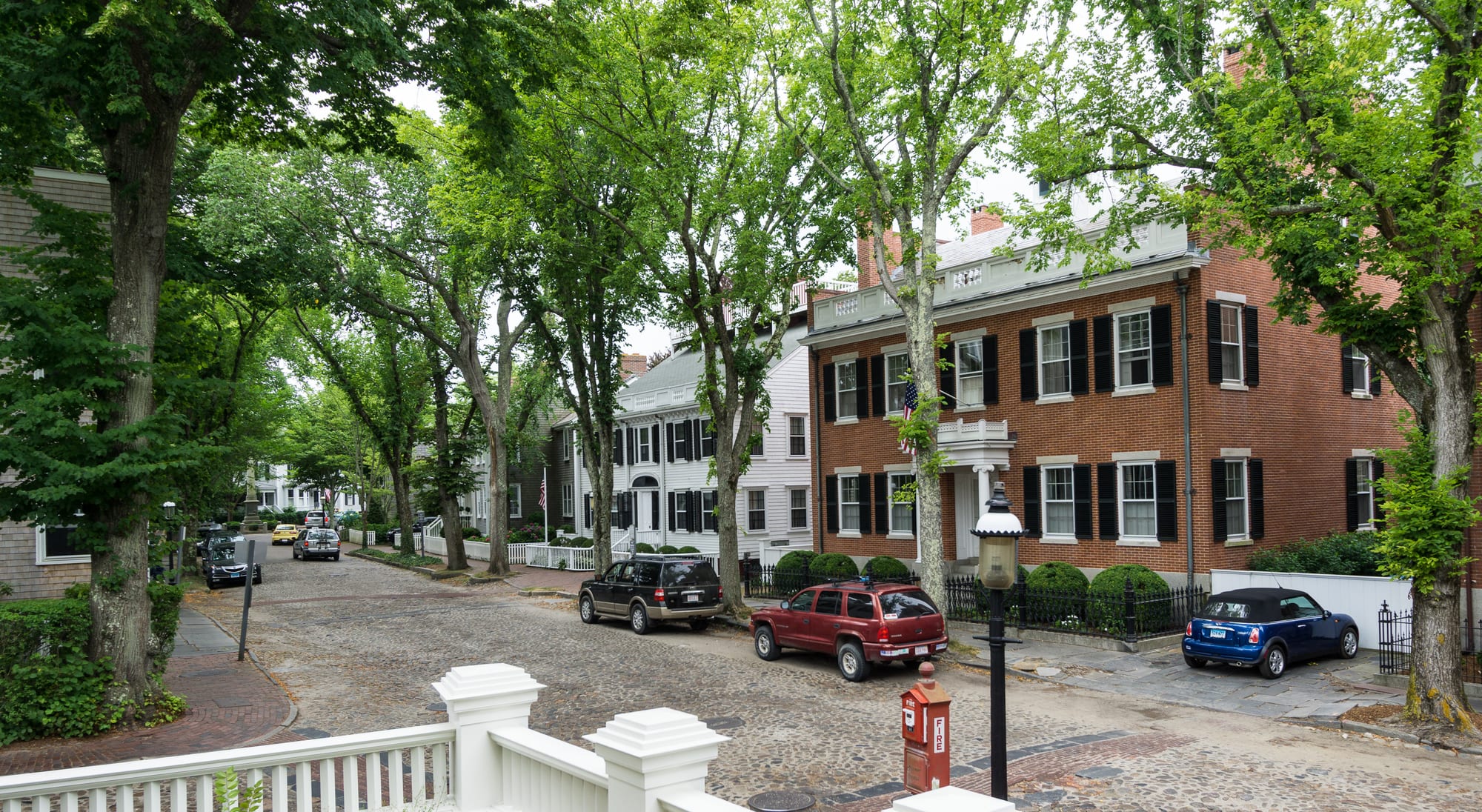
Cobbled Main Street in Nantucket under elm trees, with a brick Federal-style mansion with black shutters and white clapboard houses beyond

New England, United States

Nantucket

Upper Main Street in Nantucket town, where whaling-era mansions line the cobblestones. (Kenneth C. Zirkel / Wikimedia Commons · CC BY-SA 4.0)

An island about 30 miles south of Cape Cod, Massachusetts, that was once the whaling capital of the world and became a summer resort after the whaling ended. Its town of cobbled streets and grey-shingled houses is one of the best-preserved early American townscapes, ringed by beaches, moors, lighthouses and the small village of Siasconset.

Neighbourhoods

  • Nantucket Town
    • First-time visitors
    • Historic district
    • Best for food

    The old whaling port on the harbour, where almost every visitor stays and eats. Cobbled Main Street climbs from the wharves past the brick mansions of the whaling merchants, and the surrounding lanes of shingled houses, the Whaling Museum, the shops, galleries and most of the island's restaurants are all within a few minutes' walk of the ferry.

    Open in Maps
  • Brant Point and the harbour shore
    • Quiet and residential
    • Beaches
    • Families

    The sandy point guarding the harbour entrance, a short walk from town, with the small white lighthouse that ferries pass on arrival, Children's Beach and Jetties Beach on the calm harbour side, and quiet streets of large summer houses.

    Open in Maps
  • Siasconset
    • Quiet and residential
    • Historic village
    • Beaches

    'Sconset, a former fishing village of small cottages, some grown from old fishing shacks, on the eastern end of the island, about 7 miles from town by road or bike path. It has an ocean beach, Sankaty Head Light on the bluff to the north, a few places to eat and a slower, more private feel than town.

    Open in Maps
  • Madaket
    • Beaches
    • Sunsets
    • Quiet and residential

    The western end of the island, about 5 miles from town in a straight line and reached by a bike path, with a surf beach facing west, a harbour of small boats and little else — summer houses, dunes and marsh.

    Open in Maps
  • Surfside and the south shore
    • Beaches
    • Budget
    • Cycling

    The ocean beaches south of town, including Surfside and Cisco, reached by bike path or shuttle bus, with heavier Atlantic surf and slightly cooler water than the harbour beaches; Surfside is the southernmost settlement in Massachusetts.

    Open in Maps

Things to do

Whaling town landmarks

  • Nantucket Whaling Museummuseum

    The island's main museum, in a former spermaceti candle factory on Broad Street, with a 46-foot sperm whale skeleton, the original lens of Sankaty Head Light and the old oil refinery's lever press, run by the Nantucket Historical Association.

    Open in Maps
  • Nantucket Historic Districtlandmark

    The whole island is a National Historic Landmark district, the largest conventional one by area in the contiguous United States, with buildings from the 1686 Jethro Coffin House to the Federal mansions of the whaling merchants and the brick blocks rebuilt after the fire of 1846.

    Open in Maps
  • Nantucket Atheneumlandmark

    The town's library, a building of 1847, whose first librarian, from 1836, was the astronomer Maria Mitchell.

    Open in Maps
  • Old Milllandmark

    A wooden windmill of 1746 on a hill at the edge of town, the oldest functioning mill in the United States, restored to working order and able to grind corn.

    Open in Maps
  • African Meeting Houselandmark

    A school, church and meeting house founded in 1824 in the former Black neighbourhood of New Guinea, now run by the Museum of African American History.

    Open in Maps
  • Maria Mitchell Housemuseum

    The birthplace of the astronomer who discovered a comet in 1847, on Vestal Street, run with observatories, a natural science museum and an aquarium by the association that bears her name.

    Open in Maps
  • First Congregational Church and towerlandmark

    One of the old town's historic churches, counted among the island's notable historic sites.

    Open in Maps

Lighthouses

  • Brant Point Lightlandmark

    A short wooden lighthouse of 1901 on the sandy point at the harbour mouth, at a light station established in 1746, passed by every arriving ferry.

    Open in Maps
  • Sankaty Head Lightlandmark

    A lighthouse of 1850 on the eastern bluff by 'Sconset, moved about 400 feet back from the eroding cliff edge in 2007; its original lens is in the Whaling Museum.

    Open in Maps
  • Great Point Lightlandmark

    A stone tower on a thin spit of sand at the northernmost point of the island, rebuilt in 1986 as a copy of the tower toppled by a storm in 1984, inside the Coskata-Coatue refuge.

    Open in Maps

Beaches

  • Jetties Beachbeach

    A calm harbour-side beach easily reached from town by bike or shuttle, with gentler water than the south shore and views of the ferries coming in past Brant Point.

    Open in Maps
  • Surfside Beachbeach

    The main south-shore ocean beach, reached by bike path or shuttle, with big waves for boogie boarding and crowds of locals and visitors in summer.

    Open in Maps
  • Madaket Beachbeach

    The western surf beach at the end of the Madaket bike path, facing west over the open sea.

    Open in Maps
  • Siasconset Beachbeach

    The village's own ocean beach below the eastern bluff, with heavier surf than the harbour beaches.

    Open in Maps

Walks, cycling and nature

  • Island bike pathstrail

    Paved paths run from town to 'Sconset, Madaket, Surfside and Cisco, and cycling is the way most visitors see the island's moors and ponds.

    Open in Maps
  • Coskata-Coatue Wildlife Refugepark

    A reserve of miles of beaches and the largest red cedar woodland in New England, running north to Great Point and managed by the Trustees of Reservations.

    Open in Maps
  • Cisco Brewersattraction

    A brewery, distillery and winery founded on the island in 1992, whose Triple Eight vodka is named after the island well that supplies its water.

    Open in Maps

Seasonal events

  • Daffodil Festivallate April

    A spring festival when more than three million daffodils bloom across the island, marking the start of the season.

  • Figawi sailing raceMemorial Day weekend, late May

    A sailing race from Hyannis to Nantucket that fills the harbour and the town's bars for the weekend.

  • Nantucket Film FestivalJune

    A festival devoted to screenwriting and storytelling, with screenings, readings and talks around town.

  • Nantucket bay scallop seasonwinter

    The winter scalloping season in Nantucket Harbor, when islanders gather the bay scallops that are worth millions of dollars to the island's economy.

  • Christmas Strollearly December

    A December festival weekend in the old town, the busiest moment of the off-season.

Eat and drink

Long-standing places and food districts in Nantucket. Hours, ratings and directions come from your maps app, always current.

Nantucket classics

  • Nantucket bay scallopsrestaurant

    Small, sweet scallops from Nantucket Harbor, gathered in winter and served simply in the town's seafood restaurants; in summer the menu turns to lobster, striped bass, bluefish and clam chowder.

    Open in Maps
  • Cisco Brewersrestaurant

    The island's brewery, founded in 1992, which also makes Triple Eight spirits and wine with its sister winery, Nantucket Vineyard.

    Open in Maps

Food districts and markets

  • Straight Wharf and the waterfrontneighborhood

    Restaurants, raw bars and takeaway windows on the wharves where the ferries come in, with tables looking over the boat basin.

    Open in Maps
  • Main Street and the town lanesneighborhood

    Most of the island's restaurants, from old-fashioned chowder houses and sandwich shops to expensive summer dining rooms, are in the few blocks around Main, Centre and Broad Streets.

    Open in Maps
  • Siasconset villageneighborhood

    A few places to eat in the old fishing village at the eastern end of the island, quieter than town.

    Open in Maps

Experience Nantucket

History

The Wampanoag lived on Nantucket for thousands of years before English settlement began in earnest in 1659, when Thomas Mayhew sold most of his interest in the island to a group of investors led by Tristram Coffin. Whaling began from small boats rowed largely by Wampanoag crews, and over the century that followed the Wampanoag community declined sharply. By 1774 Nantucket accounted for about sixty percent of the New England whaling fleet, and the Quaker faith that most islanders came to share gave the town its plain, disciplined character.

Nantucket was for decades the whaling capital of the world. Its ships reached the Pacific, its candle factories made spermaceti candles for cities on both sides of the Atlantic, and its merchants built the Federal and Greek Revival mansions that line Main Street. The whaleship Essex, sunk by a sperm whale in 1820, inspired Moby-Dick. The island also produced the astronomer Maria Mitchell and heard Frederick Douglass speak at an anti-slavery convention on the island in 1841.

The fall was as fast as the rise. A sandbar across the harbour mouth kept out the larger ships that New Bedford could handle, the Great Fire of 1846 destroyed much of the business district and the wharves, the Gold Rush drew away young men, and railways favoured mainland ports. The last whaler sailed in 1869 and the population fell by two-thirds. Poverty preserved the town: nobody could afford to rebuild, and when summer visitors were arriving by the 1870s they found an intact early American townscape. Preservation rules from 1955, National Historic Landmark status in 1966 and the district's extension to the whole island in 1975 kept it so, as the island became one of the most expensive resorts in the country.

Culture & Customs

Nantucket's identity is bound up with the sea and with its own history. The Nantucket Historical Association runs the Whaling Museum and other historic properties, the lightship-basket — a tightly woven rattan basket once made by lighthouse-ship crews — is the island's craft, and since 1955 the Historic District Commission has overseen the preservation that gives the town its look. The Quaker past survives in the plainness of the older houses and in a local tendency to understatement.

Sailing is the sport: the harbour fills with yachts in summer, the Figawi race from Hyannis opens the season. Surfcasting for striped bass and bluefish, scalloping in the harbour and shellfishing from the flats are year-round pursuits for islanders. The arts have a long summer presence — the Nantucket Film Festival, galleries on the wharves, and a tradition of painters drawn by the light and the moors.

Social life divides along lines everyone understands: the year-rounders of about 14,000 who keep the island running, the summer families who have owned houses for generations, and the day-trippers off the ferries. Nantucket is famously preppy in dress and expensive in habit, but also informal; people walk and cycle, greet one another on the lanes and dress down rather than up. The island was an early centre of abolitionism and of women's independence, and both are part of how it tells its story.

Daily Life

About 14,000 people live on Nantucket all year, a figure that rises to around 80,000 in summer. The town and county are the same body, and the island governs itself by open town meeting. Many houses, especially in the historic town, are second homes that stand empty for much of the year.

The economy is tourism, second homes and the trades that serve them — building, landscaping, property management, restaurants and retail — with a small fishing fleet, the hospital and the schools. Housing is the dominant issue: the median house price is among the highest of any county in the country, and teachers, nurses and tradespeople struggle to live on the island they work on. Seasonal workers staff the summer, and the year-round population includes sizeable Salvadoran and Jamaican communities.

The year has two speeds. In summer the ferries run constantly, the streets fill by mid-morning and restaurants turn tables until late. From November to April the island goes quiet, most restaurants close, islanders scallop, hunt deer and fix houses, and the weekly round centres on the schools, the churches and the Stop and Shop. Erosion of the eastern bluff and the cost of protecting the island from rising seas are constant subjects of debate.

Food

Nantucket bay scallops are the island's great delicacy: small, sweet shellfish gathered in Nantucket Harbor in winter and served seared or raw with very little else. Summer brings lobster rolls, clam chowder in the thick New England style, steamers (soft-shell clams), oysters from the harbour, and striped bass and bluefish caught from the beaches. Clambakes and the produce of the island's farm stands fill out the summer table.

Eating out is concentrated in town, in old-fashioned chowder houses, sandwich and takeaway windows popular with beachgoers, and summer-only dining rooms whose prices match the island's reputation. The wharves have raw bars and tables over the boat basin, and 'Sconset has a small market and a few places to eat around its square.

Cisco Brewers, on a farm near the south shore, makes the island's beer and spirits, with wine from its sister winery, Nantucket Vineyard. Nantucket Nectars, the juice company begun in 1989 by two young men running a supply boat in the harbour, carried the island's name onto mainland shelves. The food year turns on the winter scallop harvest and on the Christmas Stroll, a December weekend that brings the town back to life.

Planning tools

Budget

Nantucket is one of the most expensive places to stay in the United States in summer. Inns and rentals in town charge their highest rates from late June to Labor Day and fall sharply in May, late September and October, when the weather is often still good. The ferry crossing, bike hire and restaurant meals all cost more than on the mainland. Day trips from Hyannis avoid the accommodation cost entirely.

Daily Budget Midrange
USD 400–700 (inn or guesthouse in town, restaurant dinners, bike hire, ferry and museum tickets)
Daily Budget Shoestring
USD 150–250 (a share of a rental or the cheapest rooms out of season, takeaway sandwiches and chowder, bikes and the shuttle bus)

Book summer rooms months ahead, leave the car on the mainland, and consider a shoulder-season visit for the same island at half the price.

Best Time to Visit

June to September for beaches and the full run of restaurants and ferries; the sea is warmest in August. Late September and October bring mild weather, scallop season and far fewer people. Late April to May is quiet and green, with the Daffodil Festival. From November to March much of the island closes, though the Christmas Stroll fills one December weekend.

Suggested Number of Days

A day trip from Cape Cod covers the town, but two or three days allow the beaches, a lighthouse and 'Sconset by bike. Longer stays suit those who want a slower beach holiday or to combine the island with Cape Cod and Martha's Vineyard.

First Visit
2–3 days
With Surroundings
4–5 days

Transportation

The town is walked, and the rest of the island is covered by bike on paved paths to 'Sconset, Madaket and the south-shore beaches, all within an hour's ride. The island's transit authority runs bus services all year, and its shuttle, the Wave, links town with the beaches, 'Sconset, Madaket and the airport; taxis meet the ferries and flights. Most visitors do not bring a car: the vehicle ferry is expensive and often fully booked, and parking in town is scarce.

Hire a bike near the ferry wharves and ride the paths rather than the narrow roads; carry water, as the moors have no shade.

Airport & Station Connections

Nearly everyone arrives by ferry from Hyannis on Cape Cod: the Steamship Authority and Hy-Line Cruises run high-speed and traditional ferries all year, and seasonal ferries also sail from Harwich, Oak Bluffs on Martha's Vineyard and New Bedford. The wharves are in the centre of town. Nantucket Memorial Airport, about 3 miles south-east of town, has short flights on small planes and seasonal jet services to hubs including Boston, New York, Washington, D.C. and Chicago.

Walkability

The town is small, flat near the harbour and made for walking, though the cobbles on Main Street are hard on wheels and heels. Everything from the ferry to the Whaling Museum, the shops and the restaurants is within ten minutes on foot, and Brant Point and Jetties Beach are a twenty-minute walk. Beyond town, distances suit a bike rather than feet.

Safety

Nantucket is a very safe island; the risks are natural. The south-shore beaches have strong surf and rip currents, and the ocean is cold outside high summer. Deer ticks carrying Lyme disease are common in the moors and dune grass, and cycling on the unlit roads at night is dangerous. Fog can halt flights and fast ferries.

Swim at guarded beaches, check for ticks after walking through grass, and allow a spare day in case weather cancels the crossing. Check current official travel advice before travelling.

Climate

A maritime climate, milder and windier than the mainland: the sea keeps spring cool and autumn warm, and fog is frequent in early summer. Nor'easters bring storms in winter and the island is slowly losing its eastern shore to erosion.

Summer
mild — July highs in the mid-70s °F, cooled by sea breezes, with the water warmest in August
Winter
cool, damp and windy rather than bitter — January highs around 40 °F, with many cloudy days

Local Customs

Tipping is expected: 18–22 per cent in restaurants, a dollar or two a drink. Prices exclude Massachusetts sales tax and a meals tax. The island dresses casually but neatly — boat shoes, chinos and the faded 'Nantucket red' trousers are a local joke and a local uniform — and the strict historic-district rules on paint colours and shingles are taken seriously. Islanders distinguish between year-rounders, summer people and day-trippers and value quiet and privacy.

The drinking age is 21 and identification is checked; drinking on beaches is restricted, and lifeguards' flags on the south shore should be obeyed.

Common Payment Methods

The currency is the US dollar. Cards and contactless payment are accepted almost everywhere, including on the ferries and shuttle bus, and ATMs are easy to find in town. A little cash is useful for farm stands and the smaller takeaway windows.