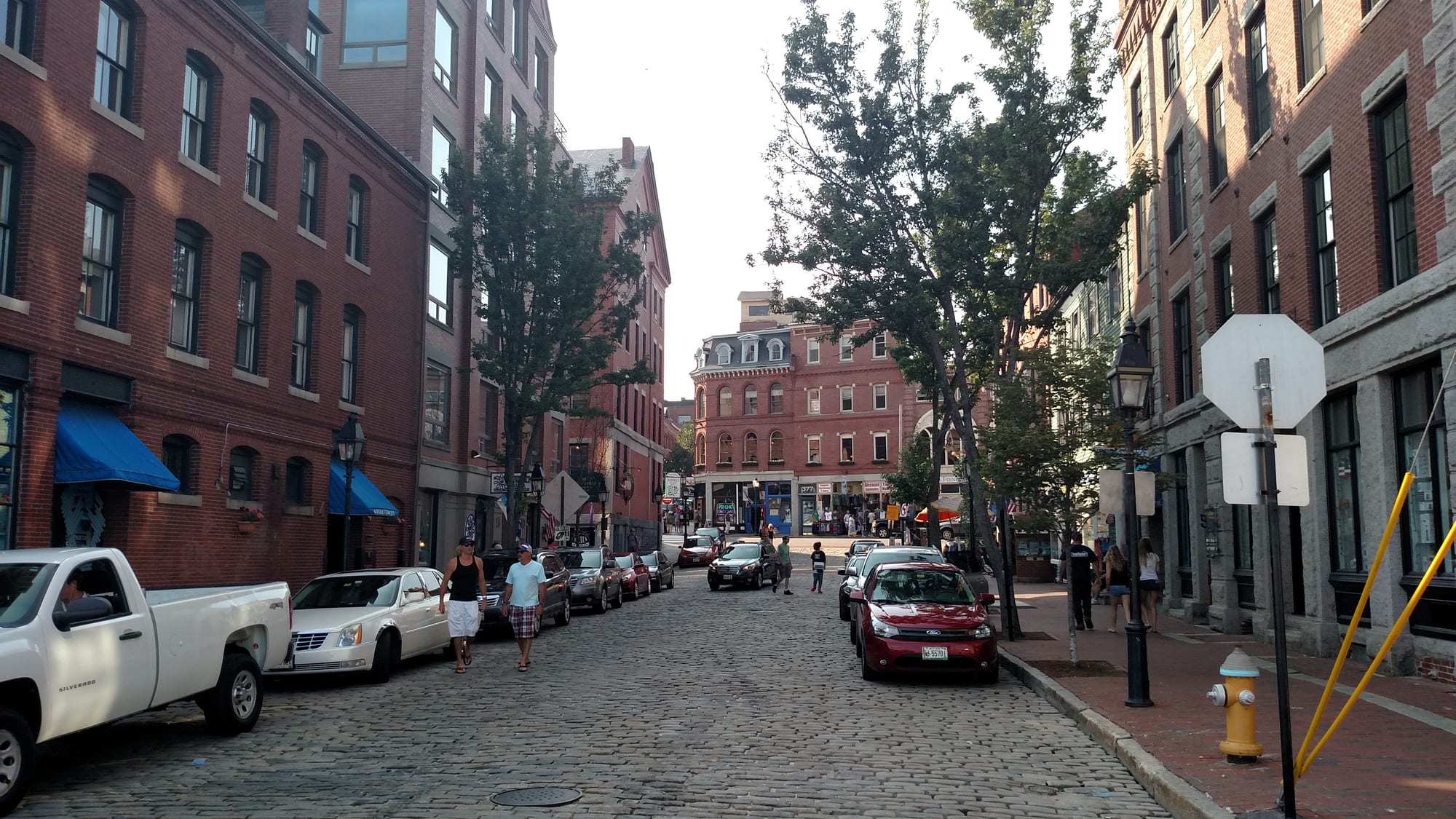
A cobbled street lined with 19th-century red-brick buildings, parked cars and trees on a summer day

New England, United States

Portland

Moulton Street in the Old Port, Portland, Maine. (Bd2media / Wikimedia Commons · CC BY-SA 4.0)

Maine's largest city, on a hilly peninsula in Casco Bay. Burned and rebuilt several times — a phoenix on the city seal recalls four great fires — it grew as a shipping port and now lives mainly on services, with a working waterfront, the cobbled Old Port and a restaurant scene known far beyond the state.

Neighbourhoods

  • Old Port
    • First-time visitors
    • Best for food
    • Nightlife

    The waterfront district of cobbled streets, 19th-century brick buildings and fishing piers, rebuilt after the fire of 1866. Boutiques, restaurants and bars fill Exchange, Fore and Wharf streets, and the island ferries leave from Commercial Street.

    Open in Maps
  • Arts District
    • Museums
    • Close to the centre

    The stretch of Congress Street around Monument Square, home to the Portland Museum of Art, the Maine Historical Society and the Longfellow house, the public library, Portland Stage and the Maine College of Art, with galleries open late on the First Friday Art Walk.

    Open in Maps
  • Munjoy Hill
    • Views
    • Quiet and residential

    The hill at the eastern end of the peninsula, historically Irish and Italian, now filling with new condominiums. The Portland Observatory stands on its crest and the Eastern Promenade runs along its edge above Casco Bay, with India Street's restaurants at its foot.

    Open in Maps
  • West End
    • Historic homes
    • Quiet and residential

    A residential district at the western end of the peninsula, ending at the Western Promenade, one of the city's historic parks.

    Open in Maps
  • Peaks Island
    • Island life
    • Cycling

    The most populous island in Casco Bay, about three miles from downtown and part of the city, reached by ferry. It has a small village with an ice cream parlour, a restaurant, a grocery and galleries, and two small museums.

    Open in Maps

Things to do

Historic sights

  • Portland Observatorylandmark

    A wooden maritime signal tower of 1807 on Munjoy Hill, the only known surviving tower of its kind in the country, from which incoming ships were spotted and signalled hours before they docked.

    Open in Maps
  • Victoria Mansionmuseum

    A brownstone Italianate villa of the years before the Civil War, completed in 1860, with elaborate interiors and opulent furnishings that show lavish living in 19th-century America.

    Open in Maps
  • Wadsworth-Longfellow Housemuseum

    The childhood home of the poet Henry Wadsworth Longfellow on Congress Street, run as a museum by the Maine Historical Society.

    Open in Maps
  • Old Portneighborhood

    Cobbled streets, brick warehouses rebuilt after the 1866 fire and working fishing piers, the busiest part of the city day and night.

    Open in Maps

Museums

  • Portland Museum of Artmuseum

    The largest and oldest public art institution in Maine, founded in 1882, in a complex that includes the McLellan House and the Payson Building, designed by Henry Nichols Cobb of I. M. Pei & Partners.

    Open in Maps
  • Maine Narrow Gauge Railroad Museummuseum

    A museum of Maine's two-foot-gauge railways, with a 1.5-mile line along the Casco Bay waterfront beside the Eastern Promenade and a Polar Express train from November to Christmas.

    Open in Maps

Parks and the waterfront

  • Eastern Promenadepark

    A park of about 68 acres designed by the Olmsted Brothers, running 1.5 miles around Munjoy Hill above Casco Bay, with East End Beach and a summer gathering of food trucks.

    Open in Maps
  • Western Promenadeviewpoint

    One of the city's historic parks, at the western end of the peninsula beyond the West End.

    Open in Maps
  • Casco Bay ferriestransit hub

    The public ferry company running year-round from the Old Port to Peaks, the Diamond islands, Long, Chebeague and Cliff islands, with more trips in summer.

    Open in Maps

Sport and nights out

  • Hadlock Fieldattraction

    The city-owned ballpark of the Portland Sea Dogs, a minor-league affiliate of the Boston Red Sox.

    Open in Maps

Short trips from the city

  • Portland Head Lightlandmark

    Completed in 1791, the first lighthouse built by the US government and the oldest in Maine, on a headland in Cape Elizabeth at the entrance to the harbour; the keeper's house is a maritime museum.

    Open in Maps
  • Fort Williams Parkpark

    A 90-acre park around Portland Head Light, holding the ruins of an army post used in both world wars.

    Open in Maps
  • Old Orchard Beachbeach

    A beach resort town south of the city, busy in summer.

    Open in Maps

Seasonal events

  • Maine Restaurant WeekMarch

    Twelve days of special menus at restaurants in Portland and across the state.

  • First Friday Art Walkfirst Friday of each month

    Held since 2000, an evening when galleries, studios and shops in the Arts District stay open and draw thousands of people.

  • Maine VegFestOctober

    An all-vegan food festival held since 2005, in a city with more than 200 vegetarian-friendly restaurants.

Eat and drink

Long-standing places and food districts in Portland. Hours, ratings and directions come from your maps app, always current.

Portland classics

  • Seafood on Commercial Streetneighborhood

    Lobster, haddock, clams and scallops from the boats that land on the waterfront, served in the many seafood restaurants of the Old Port.

    Open in Maps
  • Fore Streetrestaurant

    One of the restaurants named among the city's best known, on Fore Street.

    Open in Maps
  • Becky's Dinerrestaurant

    A long-standing diner on the working waterfront, among the city's best-known places to eat.

    Open in Maps
  • The Holy Donutcafe

    A doughnut shop on Exchange Street in the Old Port.

    Open in Maps

Breweries and markets

  • Allagash Brewing Companyrestaurant

    A brewery specialising in Belgian-style beers, the Maine craft brewery with the highest beer sales in 2024, one of several in the city along with Geary's and Shipyard.

    Open in Maps
  • Portland Farmers' Marketmarket

    Maine farmers sell produce and flowers in Deering Oaks park on Saturdays from May to November and in Monument Square on Wednesdays.

    Open in Maps

Experience Portland

History

The first European settler was Christopher Levett, an English naval captain granted land on Casco Bay in 1623. The settlement changed names and hands several times, becoming Falmouth after the Massachusetts Bay Colony took over Casco Bay in 1658, and it was repeatedly destroyed in wars between the English, the French and their Native allies — among them the Battle of Fort Loyal in 1690. In October 1775 the Royal Navy under Captain Henry Mowat burned the town to punish its rebellion.

After the Revolution the harbour district known as the Neck grew quickly as a shipping centre, and in 1786 its people formed a separate town named Portland, after the Isle of Portland in Dorset. The city prospered on trade and industry: the Portland Company on Fore Street built hundreds of steam locomotives and employed immigrants from Canada, Ireland and Italy, and the poet Henry Wadsworth Longfellow grew up here. In June 1863 a Confederate raid on the harbour led to one of the northernmost battles of the Civil War.

On 4 July 1866 a fire that began during the Independence Day celebrations destroyed most of the commercial district, half the churches and hundreds of homes. The phoenix on the city seal recalls that fire and three earlier ones. The port declined in the 20th century, until tourists and new businesses revived the old seaport, now the Old Port. Since the 1990s the industrial Bayside district, India Street and Munjoy Hill have been rebuilt with shops and flats.

Culture & Customs

Portland has a long arts tradition; in the early 19th century it was described as a rival, not a satellite, of Boston or New York, and Longfellow is its most famous son. Today the Arts District along Congress Street holds the Portland Museum of Art, the oldest and largest public art institution in Maine, the Maine College of Art, Portland Stage and a cluster of galleries. Since 2000 the First Friday Art Walk has drawn thousands of people into the galleries and studios each month.

Greater Portland has become an important centre of the creative economy, and that success has brought gentrification and complaints about rising rents. The waterfront keeps the city tied to the sea: fishing boats still land their catch beside the restaurants that serve it.

Summer is the high season, when the island ferries fill, the Portland Sea Dogs, a Red Sox affiliate, play at Hadlock Field and the Eastern Promenade fills with picnickers. Craft brewing is part of local identity, with breweries and taprooms scattered across the city and the Maine Brewers' Guild holding festivals several times a year.

Daily Life

Portland had about 68,000 people at the 2020 census, and Greater Portland about 550,000, the largest metropolitan area in Maine. Most of the city's land lies on the mainland beyond the peninsula, and several islands in Casco Bay, including Peaks Island, are part of the city and linked to it by ferry.

Once tied to shipping, the marine economy and light industry, Portland now lives mainly on services, with most national banks basing their Maine operations here, and is Maine's economic capital, with the state's largest port. The port is the second-largest by tonnage in New England, and a container terminal has revived part of the waterfront. Housing is the main local issue: the Portland Press Herald has reported on a tight rental market, evictions and steep jumps in rent.

Daily life follows the seasons. Summers are busy with visitors and island traffic; winters are long, snowy and quiet, and life moves into cafés, bars and restaurants. Sea-level rise is a growing concern, and in January 2024 the harbour recorded its highest tide on record.

Food

Portland has built a national reputation for its restaurants; Bon Appétit named it Restaurant City of the Year in 2018. The foundation is the catch landed on its own waterfront — lobster, haddock, clams and scallops — which makes seafood less expensive here than in most American cities. Lobster rolls, chowder and fried clams are summer staples, and restaurants such as Fore Street and Duckfat are among the city's best known.

The city is home to many microbreweries and brewpubs, among them D. L. Geary, Shipyard, Gritty McDuff's and Allagash, as well as coffee roasters and distilleries. Food trucks park on city streets, at festivals and at breweries, and the Saturday farmers' market in Deering Oaks brings produce and flowers from Maine farms.

Portland has more than 200 vegetarian-friendly restaurants, and Maine VegFest has been held every October since 2005. The city's food history reaches back: Maine's first documented Chinese restaurant opened on Custom House Wharf in 1880.

Planning tools

Budget

Portland is cheaper than Boston but not cheap in summer, when hotel prices peak with the tourist season and the autumn foliage weekends. Seafood is more affordable than in most American cities because it is landed here, and many pleasures — the promenades, the Old Port and the views — cost nothing.

Daily Budget Midrange
USD 250–450 (mid-range hotel, seafood dinners with tax and tip, a ferry or lighthouse trip, occasional taxis)
Daily Budget Shoestring
USD 110–170 (hostel bed or motel outside town, food trucks and diner meals, buses and walking)

Book summer and October weekends well ahead; prices fall sharply from November to April.

Best Time to Visit

June to October. Summer is warm and short, with the ferries, beaches and ballpark in full swing; September and early October bring settled weather and autumn colour. Winters are cold and snowy, with nor'easters, but the restaurants stay open and prices fall.

Suggested Number of Days

Two days cover the compact peninsula for most visitors. Allow three or four to add the islands and the coast to the south. The number grows in summer, when the ferries and the beaches add more to choose from.

First Visit
2 days
With Surroundings
3–4 days

Transportation

The peninsula is small enough to walk, and Greater Portland Metro buses serve the city, with connections to towns to the south. Casco Bay Lines ferries leave the Old Port for the islands year-round, with more trips in summer. A car is useful for the lighthouses and beaches south of the city and for travelling further along the Maine coast.

Parking in the Old Port is tight in summer; leave the car at the hotel and walk.

Airport & Station Connections

Portland International Jetport, the busiest airport in Maine, is about two miles west of downtown, a short taxi ride. Amtrak's Downeaster trains run several times a day between Boston and Brunswick by way of Portland, and many visitors drive from Boston, about 105 miles to the south-west.

Walkability

Very walkable. The Old Port, the Arts District, Munjoy Hill and the West End all sit on a peninsula a couple of miles long, with steep streets up the hills and cobbles in the Old Port. Snow and ice make pavements slippery from November to April.

Safety

For most visitors the US is safe, with the main risks being petty theft and car break-ins in tourist areas of some cities, road accidents over long distances, extreme weather, and the hazards of the outdoors. New England has some of the lowest crime rates in the country, and Portland is a quiet city. The Old Port is crowded with bar-goers on summer weekend nights.

The sea is cold even in August, so swim only at guarded beaches and check for ticks after walks in long grass. Check current official travel advice before travelling.

Climate

Humid continental, with cold, snowy and often long winters and warm, relatively short summers. Nor'easters can bring high winds and more than a foot of snow, and about 69 inches of snow fall in an average year.

Summer
warm and short — July highs average around 80°F, and 90°F is reached on only about four days a year
Winter
cold and snowy — January highs average around 30°F, and about ten nights a year fall to 0°F or below

Local Customs

Tipping is expected: roughly 18–22 per cent in restaurants and about a dollar a drink at a bar, and sales tax is added at the till. Dress is casual almost everywhere. The working waterfront is a place of business, so keep out of the way of fishermen and their gear on the piers.

Identification is asked for when buying alcohol (the legal age is 21).

Common Payment Methods

The currency is the US dollar. Cards and contactless payment are accepted almost everywhere; a little cash is useful for food trucks, farmers' market stalls and island shops. ATMs are easy to find downtown.