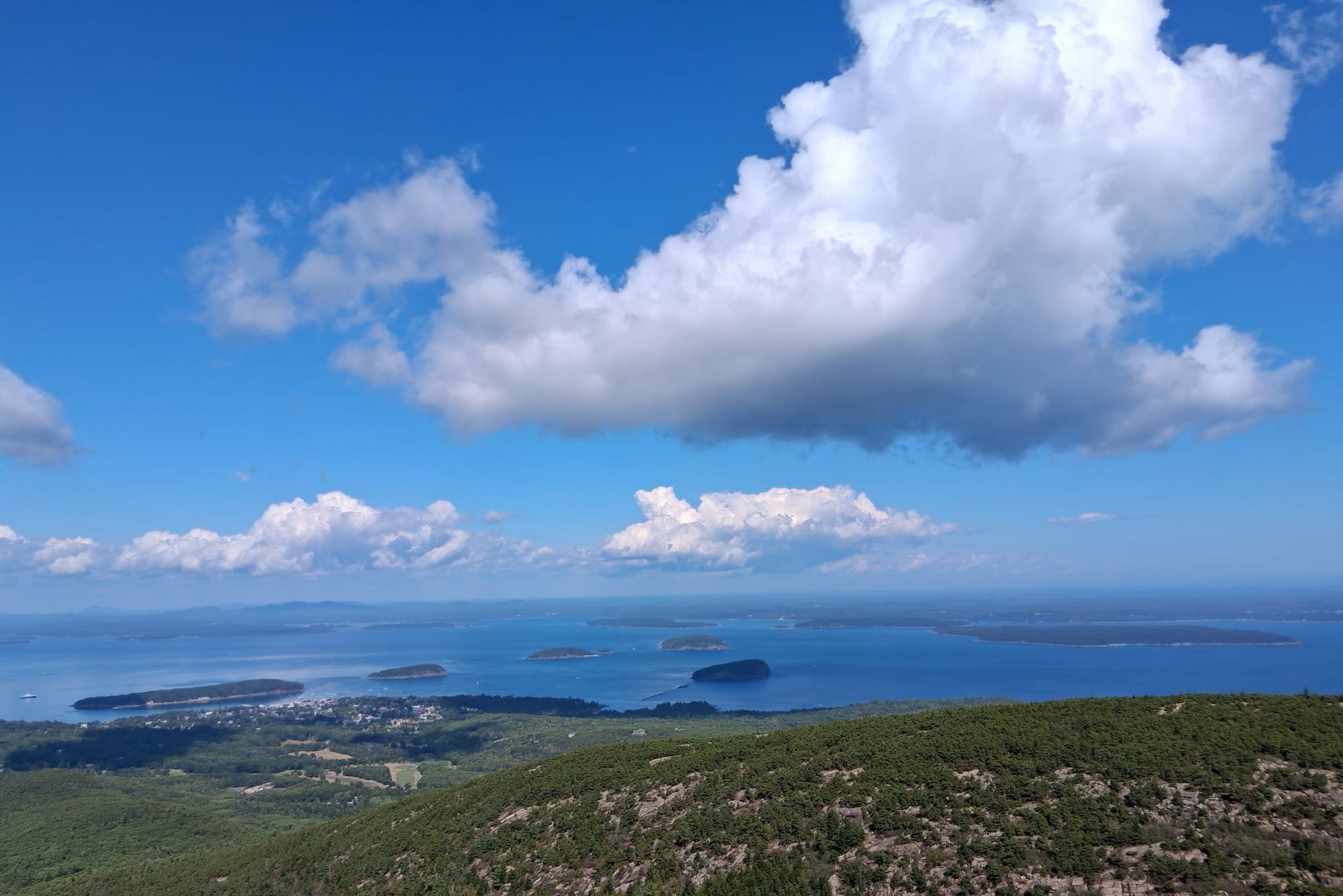
The town of Bar Harbor and the wooded Porcupine Islands in a blue bay, seen from a green granite summit under white clouds

New England, United States

Bar Harbor

Bar Harbor and the Porcupine Islands in Frenchman Bay, seen from the summit of Cadillac Mountain. (Staryu / Wikimedia Commons · CC0)

A resort town of about 5,000 people on Mount Desert Island, Maine, facing the islands of Frenchman Bay. A fishing and shipbuilding village became a Gilded Age summer colony of grand 'cottages'; today it is the gateway to Acadia National Park and its granite mountains, and its population swells from May to October.

Neighbourhoods

  • Downtown and the waterfront
    • First-time visitors
    • Best for food
    • Close to the park bus

    The compact grid of Main, Cottage and West streets running down to the town pier, filled in summer with shops, restaurants, ice cream windows and boat-tour offices. The Village Green is the centre, and the Island Explorer buses leave from beside it.

    Open in Maps
  • The Shore Path and Mount Desert Street
    • Historic homes
    • Quiet walks

    The quieter edge of town, where the Shore Path runs south along Frenchman Bay past several of the old summer 'cottages', and Mount Desert Street keeps a historic district of former summer homes that survived the 1947 fire.

    Open in Maps
  • Mount Desert Island villages
    • Quieter bases
    • Harbours

    The rest of the island beyond the town — Northeast Harbor, Southwest Harbor and the fishing harbours of the 'quiet side' — is smaller in scale, closer to the western half of the park and busy mainly with boats.

    Open in Maps

Things to do

In town

  • Shore Pathtrail

    A coastal path established in 1881 along Frenchman Bay from the town pier past the gardens of historic summer cottages and the glacial boulder called Balance Rock.

    Open in Maps
  • Bar Islandtrail

    An island across the harbour reached on foot along a gravel bar that is exposed at low tide — the bar that gave the town its name. Walkers must return before the tide covers it.

    Open in Maps
  • Abbe Museummuseum

    A museum of the heritage and living cultures of the Wabanaki Nations, led by a Wabanaki-majority board, with a downtown building and a historic trailside museum at Sieur de Monts Spring in the park.

    Open in Maps
  • Whale-watching and nature cruisesattraction

    Boats leave the waterfront to look for whales, seals, puffins and seabirds, and to show the lobster fishery and lighthouses of the bay.

    Open in Maps

Acadia National Park

  • Acadia National Parkpark

    About half of Mount Desert Island, with granite domes, lakes, cobble beaches, the 27-mile Park Loop Road past Sand Beach and Thunder Hole, and the stone-bridged carriage roads built for walkers, cyclists and riders, closed to cars.

    Open in Maps
  • Cadillac Mountainviewpoint

    At about 1,530 feet the highest point within 25 miles of the coastline of the eastern United States, reached by trail or by a summit road, and in autumn and winter the first place in the United States to see the sunrise.

    Open in Maps
  • Jordan Pondpark

    A clear glacial lake below the twin rounded hills called the Bubbles, circled by a path; swimming is not allowed, as it supplies Seal Harbor's water.

    Open in Maps
  • Porcupine Islandsviewpoint

    The five islands in Frenchman Bay seen from the town and from every summit above it, most of them looked after by the National Park Service.

    Open in Maps

Short trips from the town

  • Bass Harbor Head Lightlandmark

    A lighthouse in the park on the south-western corner of the island, marking the entrance to Bass Harbor and Blue Hill Bay.

    Open in Maps
  • Schoodic Peninsulapark

    The mainland section of Acadia across Frenchman Bay, quieter than the island, reached by road or by summer ferry to Winter Harbor.

    Open in Maps

Eat and drink

Long-standing places and food districts in Bar Harbor. Hours, ratings and directions come from your maps app, always current.

Bar Harbor classics

  • Jordan Pond Houserestaurant

    A restaurant established in the early 1870s and now in the park, on the lawn above Jordan Pond with the Bubbles behind, known for tea and popovers.

    Open in Maps
  • Lobster in townneighborhood

    Lobster from the boats of Frenchman Bay, served boiled, in rolls and in stews at restaurants and shacks along Main Street and the waterfront.

    Open in Maps
  • Mount Desert Island Ice Creamcafe

    A homemade ice cream shop known for unusual flavours, one of many ice cream windows in a town where a cone is part of a summer evening.

    Open in Maps

Experience Bar Harbor

History

The Wabanaki peoples have lived on and around Mount Desert Island for more than 10,000 years. The French claimed the coast, and in 1688 Antoine de la Mothe Cadillac — later the founder of Detroit — received a royal grant that included the whole island. The town was incorporated as Eden in 1796, and its early industries were fishing, lumbering and shipbuilding.

In the mid-19th century landscape painters made the island famous, and journalists, sportsmen and the 'rusticators', who lodged with local fishermen and farmers, followed them. The first hotel opened in 1855 and the first summer estate in 1868; by 1880 there were thirty hotels, and steamers and trains brought visitors to a Gilded Age resort that rivalled Newport, Rhode Island. The Vanderbilts, the Astors and other rich families built shingled and stone 'cottages' along the shore. In 1918 Eden was renamed Bar Harbor, after the sand bar that crosses to Bar Island at low tide. Summer residents, led by conservationists such as George B. Dorr and John D. Rockefeller Jr., gave land for what became Acadia National Park, and Rockefeller paid for its carriage roads.

In October 1947, after a severe drought, a fire burned nearly half the eastern side of the island, destroying 67 of the cottages and five grand hotels, though the business district was spared. The town reinvented itself around the park, the Jackson Laboratory, founded in 1929, and the College of the Atlantic, founded in 1969.

Culture & Customs

The town's identity is bound up with Acadia, which recorded more than four million visits in 2025, its highest ever. Life follows the park's season: the carriage roads, the summit of Cadillac Mountain at dawn and the boats in Frenchman Bay dominate summer and autumn, and the shops on Main Street shut for the winter.

Wabanaki culture is presented by the Abbe Museum, which works with the Maliseet, Mi'kmaq, Passamaquoddy and Penobscot nations. The College of the Atlantic, which teaches only human ecology, and the Jackson Laboratory and MDI Biological Laboratory give the town a scientific community unusual for its size.

Residents have debated the balance between tourism and home life openly. In 2021 voters capped the number of holiday rentals to protect housing, and in November 2022, concerned about crowding, they approved a citizens' initiative to limit cruise-ship passengers coming ashore to 1,000 a day. The Village Green, a classic New England common, is where locals and visitors meet.

Daily Life

Bar Harbor had about 5,100 people at the 2020 census, but the town and the island fill with seasonal residents and visitors from May to October. Tourism is the main business, alongside lobster fishing, the Jackson Laboratory — a large biomedical research institute that supplies mouse strains to laboratories around the world — and the College of the Atlantic.

The town covers a large area of Mount Desert Island, much of it inside the national park, and most residents live in the streets around the centre or in small settlements along Route 3. Housing for year-round workers is the pressing issue, which is why voters limited holiday rentals.

Summer days are long and crowded, with traffic on the park roads and queues at the ice cream windows; winters are quiet, cold and dark, with many businesses closed and the island returned to its residents. Storms are a growing concern: the Shore Path was badly damaged in January 2024 and stayed closed into the summer.

Food

Lobster is the centre of the menu, landed by the boats of Frenchman Bay and served boiled whole, in rolls with mayonnaise or butter, and in stews and chowders. Clam chowder and fried clams follow, and Maine's wild blueberries turn up in pies and muffins in season.

Jordan Pond House, inside the park, has served visitors since the 1870s, and popovers — light, hollow baked rolls — on its lawn above the pond are a long-standing island custom. Ice cream is the other local passion: Bar Harbor's shops compete on flavours, and one is known for a lobster ice cream.

In town, restaurants and takeaway shacks cluster on Main Street, Cottage Street and the waterfront, with bars and taverns for the evening. Many close from late autumn to spring.

The fishery behind the menu is on show too: the Mount Desert Oceanarium and Lobster Hatchery on Route 3 explains the life of the lobster, and a traditional Downeast lobster boat takes visitors out of the harbour to watch the traps being worked.

Planning tools

Budget

Bar Harbor is expensive in July, August and the autumn colour season, when rooms fill and prices peak; it is far cheaper in late spring. A park entrance pass is needed for Acadia, and the summit road on Cadillac Mountain needs a separate vehicle reservation in the busy season. The Island Explorer buses are free.

Daily Budget Midrange
USD 260–500 (mid-range room in town, seafood dinners with tax and tip, park pass, a boat tour)
Daily Budget Shoestring
USD 110–180 (campground or motel off the island, picnic food and takeaway lobster rolls, the free park bus)

Book summer and October rooms months ahead, use the Island Explorer to avoid parking problems in the park, and reserve the Cadillac summit road as soon as the needed date opens.

Best Time to Visit

June to mid-October. The Island Explorer buses typically run from mid-June to early October, and the Park Loop Road opens in mid-April and closes on 1 December, or earlier after heavy snow. Late September and early October bring autumn colour and the busiest cruise-ship days. In winter most of the town closes and the park is left to skiers and snowshoers.

Suggested Number of Days

Two or three days suit a first visit to the town and the park. Allow four or five to see more of the island and the mainland side of the bay. Fog and rain can close in for a day, so a spare day helps.

First Visit
2–3 days
With Surroundings
4–5 days

Transportation

The free Island Explorer buses, run mainly for park visitors, leave from beside the Village Green and serve the park, the island's villages and the Schoodic Peninsula from about mid-June to early October. The carriage roads are for walkers, cyclists and riders only. Otherwise a car is the way around the island, and parking at popular trailheads fills early in summer.

Since 2021 a timed vehicle reservation, sold online in 'Sunrise' and 'Daytime' windows, has been needed to drive up the Cadillac Summit Road from roughly late May to late October.

Airport & Station Connections

Hancock County–Bar Harbor Airport in Trenton, about 9 miles north-west of downtown, has year-round flights to Boston. Most visitors drive, crossing to the island by the Trenton Bridge on State Route 3. In summer the CAT, a high-speed ferry, links Bar Harbor with Yarmouth, Nova Scotia, and a ferry crosses Frenchman Bay to Winter Harbor.

Walkability

The town centre is small and easy on foot, with the Village Green, the waterfront, the Shore Path and the Bar Island crossing all within a few minutes of each other. The park's trails begin a short drive or bus ride away; some, such as the Precipice on Champlain Mountain, are exposed cliffside routes.

Safety

For most visitors the US is safe, with the main risks being petty theft and car break-ins in tourist areas of some cities, road accidents over long distances, extreme weather, and the hazards of the outdoors. New England has some of the lowest crime rates in the country, and the real risks here are outdoor ones: steep cliffside trails, slippery granite, fast-changing weather and very cold water.

Check the tide before walking to Bar Island, keep back from the edges at Thunder Hole and Otter Cliff in heavy seas, and check for ticks after walks. Check current official travel advice before travelling.

Climate

Humid continental, with large differences between the seasons. Summers are warm and sometimes humid, and dense fog can roll in quickly; winters are cold, sometimes severely, and colder than an island at this latitude might suggest, because the prevailing winds come off the continent rather than the Atlantic.

Summer
mild to warm — July in the park averages about 70°F, and fog is common in summer
Winter
cold and snowy — January in the park averages about 24°F, with much of the town closed

Local Customs

Tipping is expected: roughly 18–22 per cent in restaurants, and sales tax is added at the till. Dress is casual everywhere. The town lives on visitors for half the year but is home to fishermen, scientists and students year round, and residents have voted to limit holiday rentals and cruise-ship crowds. In the park, staying on marked trails protects the thin soils of the summits.

Identification is asked for when buying alcohol (the legal age is 21). Leave no trace in the park and keep pets leashed.

Common Payment Methods

The currency is the US dollar. Cards and contactless payment are accepted almost everywhere; a little cash is useful at small takeaway stands. The Cadillac summit reservation is bought online.