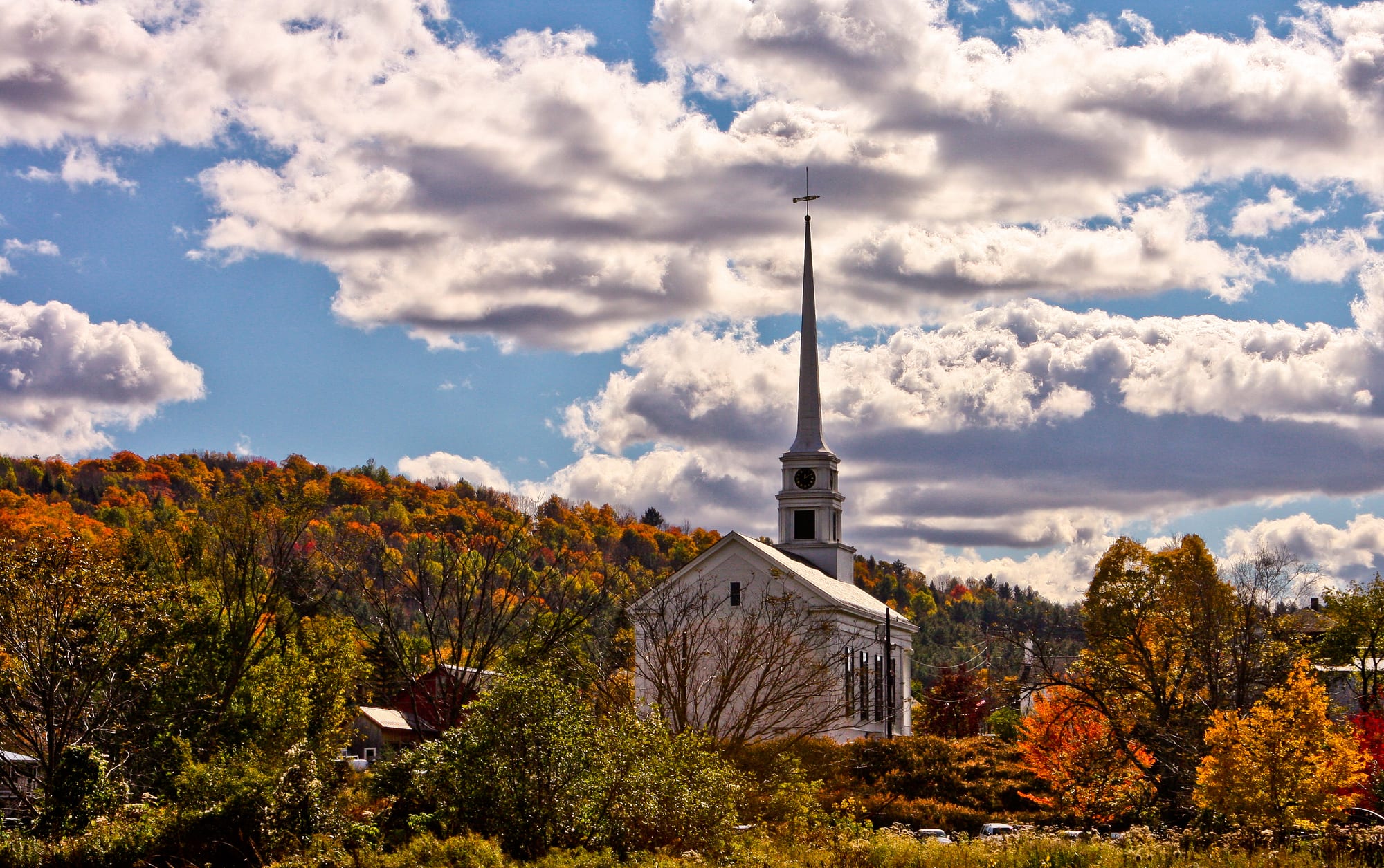
A white church with a tall slender spire rising among trees in orange and yellow autumn colour, under a sky of white clouds

New England, United States

Stowe

Stowe Community Church, completed in 1863, among the autumn colour of the village. (Patrick from Barrington, RI, Moretown, VT, United States / Wikimedia Commons · CC BY 2.0)

A Vermont town of about 5,200 people in a broad valley below Mount Mansfield, the state's highest peak. Chartered in 1763 and a summer resort by the 19th century, it became one of the first centres of American downhill skiing in the 1930s, and today lives on skiing in winter and walking, cycling and autumn colour the rest of the year.

Neighbourhoods

  • Stowe Village
    • First-time visitors
    • Historic district
    • Shops and restaurants

    The old village on the Little River, where Main Street (Route 100) is lined with shops, the white-steepled community church and the ski museum. The recreation path starts here, and most places are within a short walk.

    Open in Maps
  • Mountain Road
    • Restaurants
    • Recreation path
    • Access to the slopes

    Route 108 runs about 5 miles from the village up the valley to the ski area, lined with places to stay, restaurants and shops, with the recreation path running alongside for much of the way.

    Open in Maps
  • Mountain base: Mansfield and Spruce Peak
    • Skiing
    • Hiking
    • Winter sports

    The foot of the ski area, where lifts climb Mount Mansfield and Spruce Peak and the toll road leads up the mountain in summer. Beyond it, Route 108 narrows and climbs into Smugglers' Notch.

    Open in Maps

Things to do

The village

  • Stowe Community Churchlandmark

    The white church on Main Street, completed in 1863 and said to be one of the most photographed churches in the country; its congregation joined four Protestant churches into one in 1918.

    Open in Maps
  • Vermont Ski and Snowboard Museummuseum

    A museum of the history of skiing and snowboarding in Vermont, founded in 1988 and based in Stowe since 2000.

    Open in Maps
  • Stowe Recreation Pathtrail

    A 5.3-mile greenway for walking, cycling and skating, built in the 1980s, running from the village up the valley parallel to the Mountain Road.

    Open in Maps
  • Gold Brook Covered Bridgelandmark

    A small wooden covered bridge of 1844, also called Emily's Bridge, crossing Gold Brook outside the village and the subject of a local ghost story.

    Open in Maps

The mountains

  • Stowe Mountain Resortattraction

    The ski area on Mount Mansfield and Spruce Peak, with more than 100 trails; it was the second area in New England to install a chairlift and has been owned by Vail Resorts since 2017.

    Open in Maps
  • Mount Mansfieldviewpoint

    Vermont's highest mountain at 4,393 feet, whose ridge looks like a human profile; a steep 4.5-mile toll road climbs towards 'the Nose', the Long Trail follows the ridge, and the summit has rare alpine tundra.

    Open in Maps
  • Smugglers' Notch State Parkpark

    A state park on Route 108, named for the pass that separates Mount Mansfield from Spruce Peak and the Sterling Range, with large boulders, caves and a trail up to Sterling Pond.

    Open in Maps
  • Mount Mansfield State Forestpark

    The largest block of land owned by Vermont's forests and parks department, covering the slopes around the mountain, with Route 108 through it a designated scenic byway.

    Open in Maps

Short trips from the town

  • Waterburyattraction

    The town about 10 miles south, home of the Ben & Jerry's ice-cream factory, whose tours are one of Vermont's most popular attractions, and of the nearest Amtrak station.

    Open in Maps

Eat and drink

Long-standing places and food districts in Stowe. Hours, ratings and directions come from your maps app, always current.

Stowe classics

  • Mountain Roadneighborhood

    The road to the ski area holds most of the town's restaurants, brewpubs and breakfast places, busiest after a day on the slopes.

    Open in Maps
  • Stowe Villageneighborhood

    Cafés, restaurants and food shops along Main Street in the old village centre.

    Open in Maps

Cider, cheese and ice cream

  • Stowe Ciderrestaurant

    A cider maker in Stowe serving food, with indoor and outdoor seating.

    Open in Maps
  • Cold Hollow Cider Millmarket

    A cider mill near Stowe, on many visitors' lists of favourite stops in the area.

    Open in Maps
  • Ben & Jerry's factorycafe

    The ice-cream company's factory in Waterbury, open for public tours since 1986.

    Open in Maps

Experience Stowe

History

The Abenaki, Algonquian-speaking people, lived in and travelled through the valleys of what is now Vermont before British settlers arrived in numbers after the French and Indian War and pushed them aside. Stowe was chartered on 8 June 1763 by Benning Wentworth, the royal governor of New Hampshire, and grew slowly as a farming town in the valley between Mount Mansfield and the Worcester Range; by about 1800 it had just over 300 people.

Summer visitors began arriving in the 19th century, drawn by the mountain air and the climb up Mount Mansfield, and a large hotel dominated the village before the Civil War. An electric railway ran the 11 miles from Waterbury, carrying passengers and freight until 1932. Summer tourism kept the town going through the First World War. Stowe Community Church, finished in 1863, still gives the village its best-known view.

Winter changed the town's fortunes. Stowe held its first Winter Carnival in 1921, with ski jumping and skating, and during the Great Depression the Civilian Conservation Corps cut ski trails on Mount Mansfield, making Stowe one of the earliest centres of downhill skiing in the United States. The Nose Dive trail opened in 1934, and the first chairlift followed in 1940, the second in New England. In 1942 the Trapp family, whose story later inspired The Sound of Music, settled in Stowe. The ski area was owned by AIG from 1988 and sold to Vail Resorts in 2017, and the Vermont Ski Museum moved to the village in 2000.

Culture & Customs

Stowe calls itself the "Ski Capital of the East", and skiing shapes its identity: a winter academy trains young snow-sports athletes, the ski museum keeps the history of the sport in Vermont, and the town has produced Olympic racers, among them Billy Kidd, the first American man to win an Olympic medal in alpine skiing. In winter the life of the town moves up the Mountain Road; cross-country skiing and snowshoeing are popular too.

The rest of the year belongs to walkers, cyclists and leaf peepers. The recreation path was built in the 1980s across land whose owners donated easements to the town. Autumn brings the classic Vermont scene of white steeples, red barns and covered bridges against maples turning orange and red.

The Trapp family's Austrian heritage is part of the town's story, with summer concerts held in a meadow on their property, while the town's character is otherwise firmly Vermont: a place of town meetings, local farms and a strong attachment to conservation. The Stowe Land Trust, founded in 1987, has protected thousands of acres of fields and forest, many of them open to the public.

Daily Life

The town had 5,223 residents at the 2020 census, spread across about 73 square miles of valley and mountainside in southern Lamoille County. The village sits on the Little River where its West Branch joins it, with the smaller village of Moscow to the south.

Tourism is the base of the economy — the ski area, places to stay, restaurants, shops and the many services around them — and the town fills in the ski season and the foliage weeks, while late spring and November are quiet. Much of the work follows the seasons.

Daily routines follow the weather. Winter mornings start with snow clearing and the drive up the Mountain Road; summer evenings bring cyclists, runners and dog walkers onto the recreation path. Conservation is an active local cause: the Cady Hill Forest on the western edge of the village was protected in 2012 and passed to the town, giving residents a network of trails close to home.

Food

Vermont's farm products set the tone. The state is the largest producer of maple syrup in the country, and maple appears on breakfast tables, in sweets and in drinks. Sharp Vermont cheddar is the local cheese, and the Cabot cheese outlet, the Ben & Jerry's ice-cream factory in Waterbury and the Cold Hollow Cider Mill are among the most popular stops in the area.

Autumn brings apple cider from the orchards of the region, and Stowe has its own cider maker, serving food in town. Vermont has several microbreweries, and brewpubs along the Mountain Road are part of the après-ski routine.

Restaurants cluster along the Mountain Road and in the village, from breakfast places serving pancakes with maple syrup to brewpubs, and dining is generally relaxed and casual. Hearty food suits the climate after a day on the slopes or the trails, and in summer and autumn farm stands sell local produce, cheese and syrup.

Planning tools

Budget

Stowe is a resort town and prices follow the seasons: the ski season from December to March and the autumn foliage weeks in late September and October are the most expensive, and holiday weeks fill early. Lift tickets are the biggest single cost for skiers. Summer is busy but generally cheaper, and late spring and November are the quietest times.

Daily Budget Midrange
USD 260–500 (mid-range room, restaurant dinners with tax and tip, rental car, a lift ticket or toll-road and gondola trips)
Daily Budget Shoestring
USD 120–190 (budget motel or shared rental, breakfast places and pub meals, the free recreation path and hiking)

Book foliage and holiday ski weeks months ahead; the recreation path, the covered bridges and most hiking trails cost nothing.

Best Time to Visit

Late September to mid-October brings the autumn colour that Vermont is famous for, and the busiest weeks outside winter. December to March is ski season. June to August is the time for hiking on Mount Mansfield, cycling the recreation path and driving through Smugglers' Notch, which is usually closed to cars from late October until May. Late spring, when snow melts into mud, is the quietest season.

Suggested Number of Days

Two or three days suit a first visit in summer or autumn. A ski holiday usually runs to four days or a week, and four or five days allow time for the surrounding valleys and towns. Bad weather on the mountain can add a day.

First Visit
2–3 days
With Surroundings
4–5 days

Transportation

A car is the practical way to get around Stowe and the surrounding valleys. Route 100 runs north–south through the village, and Route 108, the Mountain Road, leads about 5 miles from the village to the ski area and continues through Smugglers' Notch towards Jeffersonville. Within the village and along the valley, the recreation path is a good way to walk or cycle.

The road through Smugglers' Notch is usually closed to cars from late October until May; in winter the notch is left to snowmobilers and skiers.

Airport & Station Connections

Patrick Leahy Burlington International Airport, Vermont's only airport with mainline commercial flights, is about 40 minutes away by car. The nearest Amtrak station is at Waterbury, about 10 miles south, on the Vermonter route to New York and Washington. Most visitors drive, coming up Route 100 from Interstate 89 at Waterbury.

Walkability

The village centre is small and easy to walk, and the recreation path gives a safe, flat route for walkers and cyclists up the valley. Beyond it, the Mountain Road, the ski area and the trailheads are spread out and need a car or shuttle.

Safety

For most visitors the US is safe, with the main risks being petty theft and car break-ins in tourist areas of some cities, road accidents over long distances, extreme weather, and the hazards of the outdoors. In Stowe the practical risks are winter driving and sudden weather changes on Mount Mansfield.

Check the mountain forecast before hiking the ridge, stay on marked trails to protect the alpine tundra, and drive slowly at night. Check current official travel advice before travelling.

Climate

The village has a continental climate with warm summers, cold winters and precipitation all year. Mount Mansfield, above it, is much colder and wetter, with long, snowy winters lasting from November to April.

Summer
warm and mostly comfortably humid in the village, with occasional spells of heat and humidity when the heat index passes 92°F; cool nights on the mountain
Winter
long, cold and snowy — on Mount Mansfield nights fall to 32°F or below on nearly 200 nights a year and snowfall averages about 235 inches

Local Customs

Tipping of roughly 18–22 per cent is expected in restaurants, as elsewhere in the United States. Dress is casual and outdoor-minded even at dinner. Vermont is proud of its local products, from maple syrup to cheddar, cider and craft beer, and many visitors come for the autumn 'leaf peeping'.

Stay on marked trails and respect private land and farm gates. Identification is asked for when buying alcohol (the legal age is 21).

Common Payment Methods

The currency is the US dollar. Cards and contactless payment are accepted almost everywhere, including at the ski area. A little cash is useful for small purchases, tips and farm stands.