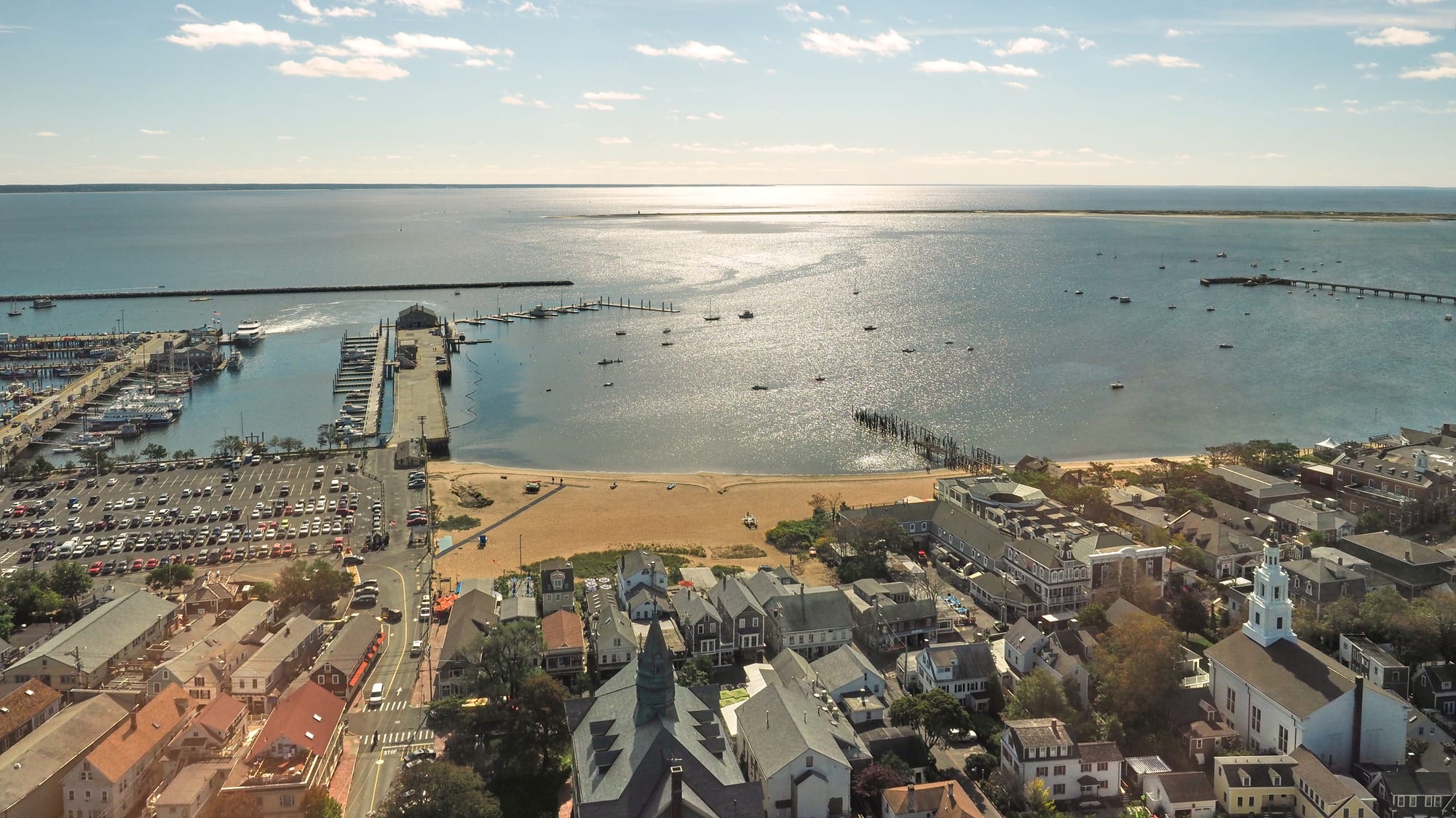
Rooftops and church steeples of a seaside town above a sandy beach, with long piers and moored boats in a wide sunlit harbour

New England, United States

Provincetown

Provincetown and its harbour, looking south-east from the top of the Pilgrim Monument towards Long Point. (RoySmith / Wikimedia Commons · CC BY-SA 4.0)

A small town at the very tip of Cape Cod, where the Pilgrims first anchored in 1620. A fishing and whaling port settled by Azorean Portuguese sailors became an art colony around 1900 and later perhaps the best-known gay summer resort on the East Coast, ringed by the dunes and beaches of the Cape Cod National Seashore.

Neighbourhoods

  • Town centre and MacMillan Pier
    • First-time visitors
    • Nightlife
    • Best for food

    The middle stretch of Commercial Street around Town Hall and the pier, where the ferries, whale-watch boats and fishing fleet tie up. Restaurants, bars, galleries and shops line the narrow street, which fills with people on summer evenings.

    Open in Maps
  • East End
    • Galleries
    • Quieter streets

    The eastern end of Commercial Street, quieter than the centre, with many of the town's galleries, the Provincetown Art Association and Museum and old captains' houses along the harbour.

    Open in Maps
  • West End
    • Quiet and residential
    • Beaches

    Mainly residential streets of shingled cottages at the western end of town, on the way to Herring Cove beach on the national seashore.

    Open in Maps
  • Province Lands
    • Dunes
    • Cycling
    • Beaches

    The area of dunes and small ponds north of town, part of the national seashore, stretching from Mount Ararat in the east to Race Point in the west, crossed by a paved bike trail.

    Open in Maps

Things to do

In town

  • Pilgrim Monumentlandmark

    A granite tower about 253 feet tall, built in 1907–10 to mark the Pilgrims' first landfall and the signing of the Mayflower Compact in the harbour — the tallest all-granite structure in the United States, with views over the whole Cape tip.

    Open in Maps
  • Provincetown Art Association and Museummuseum

    Founded in 1914 to collect and show the work of Cape Cod artists, with a permanent collection of more than 4,000 works and several exhibitions a year.

    Open in Maps
  • Commercial Streetneighborhood

    The narrow main street along the harbour, laid out in 1835 as Front Street, where most of the town's restaurants, shops, galleries and bars are found.

    Open in Maps
  • Whale watching from MacMillan Pierattraction

    Several whale-watch boats sail from the town pier in season to Stellwagen Bank, a protected marine sanctuary at the mouth of Massachusetts Bay known for its whales.

    Open in Maps

Dunes, beaches and lighthouses

  • Cape Cod National Seashorepark

    Created in 1961, the seashore protects nearly 40 miles of Atlantic beach, dunes, ponds and woods along the outer Cape, including most of the land around the town.

    Open in Maps
  • Race Point Lightlandmark

    An iron-plated lighthouse of 1876 on the dunes at the north-western tip of the Cape, replacing a tower first lit in 1816.

    Open in Maps
  • Long Point Lightlandmark

    A white square tower at the tip of Long Point, marking the south-western edge of the entrance to the harbour.

    Open in Maps
  • Dune shacks of Peaked Hill Barsattraction

    A historic district of shacks among the dunes of the national seashore, listed on the National Register of Historic Places.

    Open in Maps

Short trips from the town

  • Highland Lightlandmark

    A lighthouse and museum in neighbouring Truro, reached by car or by the summer bus from town.

    Open in Maps

Seasonal events

  • Portuguese Festival and Blessing of the Fleetsummer

    A celebration of the town's Portuguese fishing heritage, with a parade and the blessing of the fishing boats.

  • Bear Weeksummer

    One of the town's best-established summer festival weeks.

  • Carnival Weeksummer

    The Provincetown Business Guild's summer festival week, one of the busiest of the year.

  • Women's Weekmid-October

    Held since 1984 and described as the longest-running lesbian cultural event in the Northeast.

Eat and drink

Long-standing places and food districts in Provincetown. Hours, ratings and directions come from your maps app, always current.

Provincetown classics

  • The Lobster Potrestaurant

    A seafood restaurant on Commercial Street serving lobster and all manner of seafood.

    Open in Maps
  • Provincetown Portuguese Bakerycafe

    A bakery on Commercial Street that keeps the town's Portuguese baking tradition alive.

    Open in Maps
  • Seafood on Commercial Streetneighborhood

    Clam shacks, oyster bars and seafood restaurants along the harbour, from fried fish to raw oysters on the half shell.

    Open in Maps

Experience Provincetown

History

An early English explorer named the outermost tip of land Cape Cod after catching a great store of codfish there, and on 9 November 1620 the Pilgrims aboard the Mayflower sighted the Cape. Anchored in what is now Provincetown Harbor, they drew up and signed the Mayflower Compact before moving on to settle across the bay at Plymouth. The deep, sheltered harbour and rich fishing grounds remained valuable: the land was kept for the benefit of Plymouth Colony, which leased fishing rights to visiting fishermen, and it was later renamed the Province Lands.

The town was hit hard by the British blockade during the Revolution. Afterwards it grew quickly as a fishing and whaling centre, and many Portuguese sailors, mostly from the Azores, settled here after being hired onto American ships. By the 1890s the town was booming and beginning to attract writers, artists and summer visitors. When the Portland Gale of 1898 severely damaged the fishing industry, artists took over abandoned buildings; Charles Webster Hawthorne opened the Cape Cod School of Art the same year, and the art association followed in 1914.

In 1915 and 1916 the Provincetown Players staged experimental theatre here before moving to New York. The Pilgrim Monument was finished in 1910 and the Cape Cod National Seashore created in 1961. A gay presence had existed since the early art colony; by the 1970s the town had a large gay population, and in 1978 local businesses formed the Provincetown Business Guild to promote gay tourism.

Culture & Customs

Provincetown grew into an art colony from the 1890s, and art is still everywhere: galleries line Commercial Street, the Provincetown Art Association and Museum has shown Cape Cod artists since 1914, and the Fine Arts Work Center, founded in 1968, gives ten young writers and ten visual artists seven-month residencies each year. Theatre has deep roots too, from the Provincetown Players to summer productions of Eugene O'Neill, and the Provincetown International Film Festival honours independent film.

The town is perhaps the best-known gay summer resort on the East Coast. More than 200 businesses belong to the Provincetown Business Guild, the 2010 census found the highest rate of same-sex couples in the country, and the Atlantic House is considered the oldest gay bar in the United States. The summer calendar is built around theme weeks such as Bear Week and Carnival Week, and Women's Week in October has been held since 1984.

The Portuguese fishing heritage lives on alongside, in family names, the bakery on Commercial Street and the Portuguese Festival, when the fishing fleet is blessed. The town's tone is tolerant, playful and theatrical, with drag shows and street performers on summer nights.

Daily Life

Provincetown had about 3,700 year-round residents at the 2020 census, but its summer population has been estimated at up to 60,000. Housing units far outnumber the people who live in town all year, and the year-round population is older than the national average. Affordable housing for workers is a recurring local concern; in 2014 the town considered adding homes above a town facility, and the housing bust of 2005–2012 cut property values by 10 per cent or more in under a year.

Tourism is the economy: guesthouses, restaurants, bars, galleries and boats. The commercial fishing fleet still works from MacMillan Pier, which in summer also handles ferries carrying thousands of passengers a day and whale-watch boats making several trips each. In winter many businesses close and the town returns to its residents, artists and fishermen.

Daily life is lived on foot and by bicycle along the narrow streets — about 14 per cent of year-round workers commute by bike, the highest rate in Massachusetts — and the dunes and beaches of the national seashore begin at the edge of town.

Food

Seafood from the bay is the heart of the menu: lobster, clams, scallops, cod and oysters served raw on the half shell. Clam shacks and fry shops serve fried fish and clams, and the Lobster Pot on Commercial Street serves lobster and all manner of seafood. New England staples — clam chowder, the lobster roll and the clambake — appear on menus all summer.

The Portuguese community that came with the fishing and whaling fleets left its mark on local cooking, and the Provincetown Portuguese Bakery on Commercial Street keeps that tradition in the centre of town. Coffee shops, bakeries and ice cream counters fill the gaps between meals along the main street.

Evenings revolve around restaurants and bars on and near Commercial Street, from casual beer-and-oyster bars to formal dining rooms with harbour views, and many places close or shorten their season in winter. Several restaurants describe their cooking as New American or regional New England, built on the seafood of Cape Cod.

Planning tools

Budget

Provincetown is expensive in July and August and during the big theme weeks, when rooms fill and prices peak; from late autumn to spring prices fall and many businesses close. A ferry or a flight from Boston adds to the cost of a visit without a car, but once in town everything can be reached on foot or by bike.

Daily Budget Midrange
USD 280–500 (guesthouse room, seafood dinners with tax and tip, a whale watch, the ferry from Boston)
Daily Budget Shoestring
USD 120–190 (campground or shared room, takeaway seafood and bakery meals, bike hire)

Book summer and theme-week rooms well ahead; May, June and September are calmer and cheaper.

Best Time to Visit

June to September is the high season, with the ferries running, warm sand and the busiest nights on Commercial Street. Late spring and early autumn are quieter, with mild weather and whale watching still on. In winter the town is small and quiet, and many businesses close.

Suggested Number of Days

Two or three days suit a first visit. Allow four or five to see more of the outer Cape as well. Visitors arriving by ferry without a car can manage with fewer days, as the town and the dunes are close together.

First Visit
2–3 days
With Surroundings
4–5 days

Transportation

The town is compact and best seen on foot or by bicycle; Provincetown has the highest rate of year-round bicycle commuting in Massachusetts. Bike hire shops open in summer, and the Province Lands bike trail loops through the dunes. Cape Cod Regional Transit Authority buses run from MacMillan Pier to other Cape towns, and a shuttle serves Truro. Parking is scarce in summer.

Ferries carry bicycles, so a visit from Boston without a car is easy in season.

Airport & Station Connections

Provincetown is about 45 miles from Boston across the bay but about 115 miles by road, a drive along Route 6 down the length of the Cape. Ferries from Boston run seasonally, from late spring to mid-autumn, with high-speed boats crossing in about 90 minutes. Provincetown Municipal Airport, near Race Point north-west of the town centre, has Cape Air flights of about 20 minutes to Logan.

Walkability

Very walkable: Commercial Street runs along the harbour and most guesthouses, restaurants and galleries are within a few minutes of it. The street is narrow and shared with cars and bikes. The beaches and lighthouses are a bike ride or a long sandy walk away.

Safety

For most visitors the US is safe, with the main risks being petty theft and car break-ins in tourist areas of some cities, road accidents over long distances, extreme weather, and the hazards of the outdoors. New England has some of the lowest crime rates in the country, and Provincetown is a small, relaxed town. The practical risks are outdoors: cold water and currents on the ocean beaches, heat on the open dunes and the tides on the flats.

Swim at guarded beaches, carry water on the dunes, and check for ticks after walks in the grass. Check current official travel advice before travelling.

Climate

Humid continental, close to an oceanic climate. The surrounding sea keeps temperatures milder than inland in every season — cooler summers and less severe winters — and the ocean off the outer Cape stays cool all year.

Summer
mild to warm — July on Cape Cod averages around 68°F, and the sea on the eastern shore rarely passes 60°F
Winter
cold, though milder than inland; the town's average yearly extreme minimum, the plant-hardiness measure, is about 5°F

Local Customs

Tipping is expected: roughly 18–22 per cent in restaurants and about a dollar a drink at a bar, and sales tax is added at the till. The town is one of the most openly LGBTQ+ places in the country, and same-sex couples and drag performers are part of everyday street life; visitors of every kind are welcome and are expected to be relaxed about it. Dress is casual.

Identification is asked for when buying alcohol (the legal age is 21). Ride bicycles carefully on crowded Commercial Street.

Common Payment Methods

The currency is the US dollar. Cards and contactless payment are accepted almost everywhere; a little cash is useful for small takeaway stands and tips. ATMs are on Commercial Street.