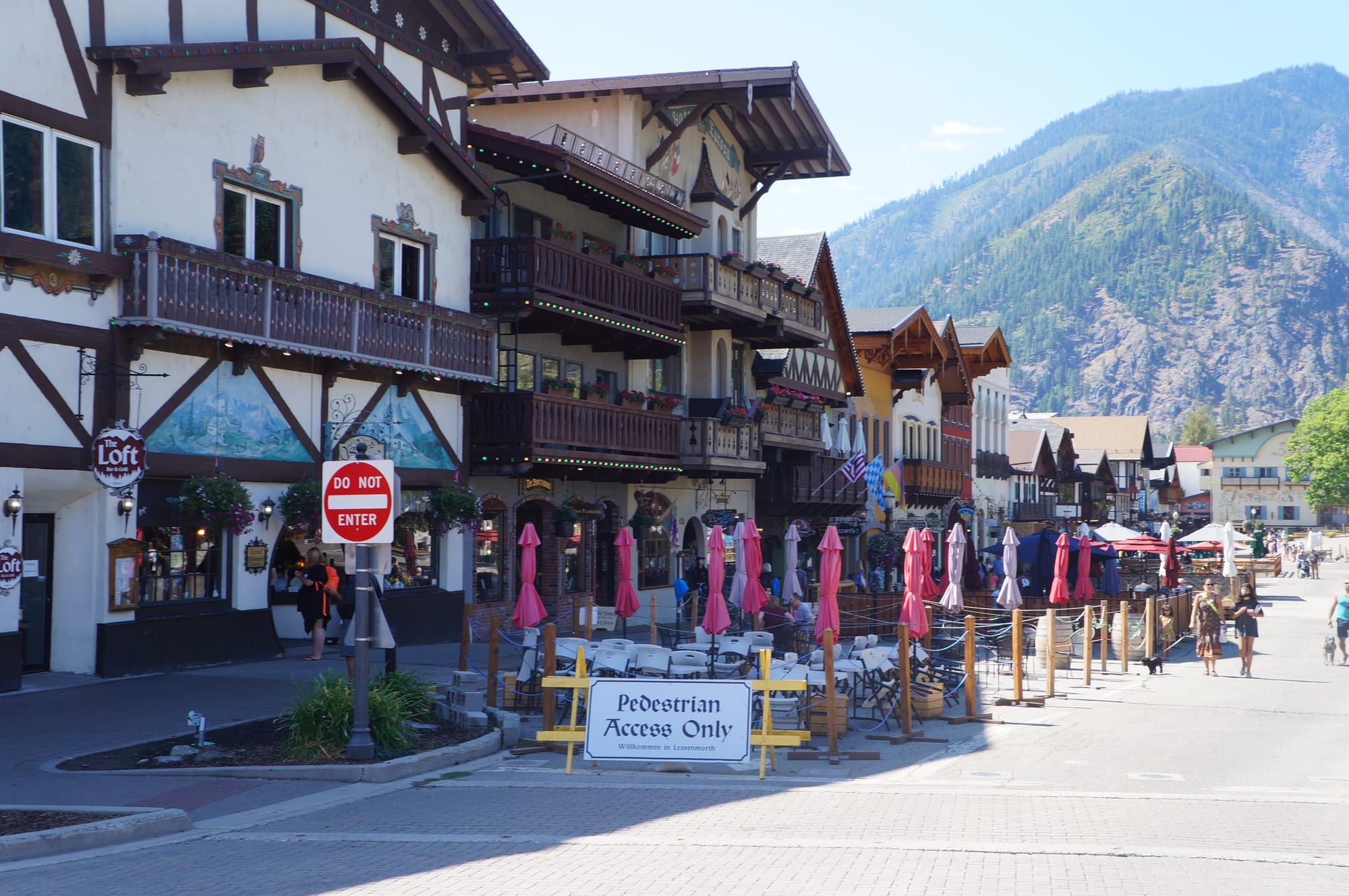
Bavarian-style buildings with carved wooden balconies and outdoor café tables on a pedestrian street below forested mountains

The Pacific Northwest, United States

Leavenworth

The pedestrian section of Front Street in Leavenworth, with the Cascade foothills behind. (SounderBruce / Wikimedia Commons · CC BY-SA 4.0)

A small town on the Wenatchee River on the dry eastern side of Washington's Cascade Range. Founded as a railway and sawmill town, it lost both and reinvented itself in the 1960s as a Bavarian-style village, and is now a year-round resort for festivals, Christmas lights, hiking, climbing and river trips beneath steep forested mountains.

Neighbourhoods

  • Front Street and downtown
    • First-time visitors
    • Best for food
    • Festivals

    The few blocks of Bavarian-style buildings facing Front Street Park, with painted façades, wooden balconies and window boxes. Most of the town's shops, beer halls, restaurants and festival stages are here, and part of the street is closed to traffic.

    Open in Maps
  • The riverside
    • Walks
    • Quiet evenings
    • Families

    Just below downtown, Waterfront Park follows the Wenatchee River, and a footbridge leads to Blackbird Island, a quiet wooded spot in the river. It is a short walk from Front Street but feels much further from the crowds.

    Open in Maps
  • Icicle Road and the Icicle Valley
    • Hiking
    • Climbing
    • Outdoor activities

    The road south-west of town along Icicle Creek into the mountains, lined with boulders and crags used by climbers, campgrounds and trailheads, including the route towards the Enchantments. The fish hatchery is near its lower end.

    Open in Maps
  • Lake Wenatchee and Plain
    • Cabins and lake
    • Winter sports
    • Quiet and rural

    A rural valley north of town around the hamlet of Plain and Lake Wenatchee, with the lake's beaches and campgrounds in summer and about 15 miles of cross-country ski and snowshoe trails at Plain in winter.

    Open in Maps

Things to do

The town

  • Leavenworth Ski Hillattraction

    A small community ski area on the edge of town, with two small downhill slopes, about 16 miles of cross-country trails, a tubing hill and a ski jump first built in 1930; summer theatre is staged there.

    Open in Maps
  • Leavenworth National Fish Hatcheryattraction

    A federal salmon hatchery on Icicle Creek built in 1939–40, raising spring Chinook salmon in rearing ponds and fish ladders, beside the Icicle Creek Nature Trail.

    Open in Maps
  • Wenatchee Riverpark

    The river that runs past the town, used for rafting through Class III and IV rapids and for floating on tubes, paddleboards and kayaks.

    Open in Maps

Short trips into the mountains

  • The Enchantmentstrail

    A high region of more than 700 alpine lakes and ponds below the Cashmere Crags, about 15 miles south-west of town in the Alpine Lakes Wilderness, regarded as one of the most spectacular parts of the Cascades and protected by a permit system.

    Open in Maps
  • Alpine Lakes Wildernesspark

    A wilderness of more than 400,000 acres spanning the Central Cascades, the largest near the cities of Puget Sound.

    Open in Maps
  • Peshastin Pinnacles State Parkpark

    A small park of sandstone slabs and spires above the orchards down the valley near Cashmere, used for rock climbing, hiking and birdwatching.

    Open in Maps

Short trips from the town

  • Lake Wenatchee State Parkpark

    A park on the lake where the Wenatchee River begins, with swimming, camping and trails in summer and cross-country skiing in winter.

    Open in Maps
  • Stevens Passattraction

    The mountain pass on US Route 2 west of town, home to a ski area and crossed by the Pacific Crest Trail.

    Open in Maps
  • Cashmereattraction

    An orchard town down the valley, home of Liberty Orchards, which makes the Aplets and Cotlets fruit-and-nut sweets.

    Open in Maps

Seasonal events

  • MaifestMay

    A spring festival, one of the many annual weekend festivals the town has held since the Bavarian makeover.

  • OktoberfestOctober

    The Chamber of Commerce's Oktoberfest at the Festhalle; the original festival, begun in 1998, moved to Wenatchee in 2022.

  • Christmas lightslate November to mid-February

    The town centre is strung with lights from Thanksgiving to around Valentine's Day, and a Christmas tree-lighting celebration in December draws thousands of visitors.

Eat and drink

Long-standing places and food districts in Leavenworth. Hours, ratings and directions come from your maps app, always current.

Leavenworth classics

  • Munchen Hausrestaurant

    One of the best-known and busiest of the town's German-style eateries.

    Open in Maps
  • Front Street's beer halls and bakeriesneighborhood

    German-style restaurants and beer halls serving schnitzel, sausages, pork hock, pretzels and red cabbage along the main street.

    Open in Maps

Orchards and wineries

  • Liberty Orchardsmarket

    The Cashmere confectioner that makes Aplets and Cotlets, jelly-like apple and apricot sweets with walnuts first developed in 1918.

    Open in Maps
  • Valley fruit stands and tasting roomsmarket

    The orchards down the valley around Cashmere grow apples and pears, and the town's cellars and shops pour locally produced eastern Washington wines.

    Open in Maps

Experience Leavenworth

History

The meeting of Icicle Creek and the Wenatchee River lies within the traditional territories of the Wenatchi and Yakama peoples, who fished for salmon in the rivers and hunted in the mountains. A reservation around the fishery at the confluence, promised to the Wenatchi in the 1855 Treaty of Walla Walla, was never surveyed. Settlement grew after the Great Northern Railway bought land here for a division point on its line over Stevens Pass in 1892, and Leavenworth was laid out in 1893, named after Charles Leavenworth, a Portland land investor. In 1903 the second-largest sawmill in Washington was built here.

Both supports went within a generation. The railway relocated to Wenatchee in 1925, and the population declined well into the 1950s as the lumber mills closed and stores moved away. The town looked to recreation as early as 1929, when it opened a ski jump.

In 1962 residents formed a renewal committee known as Project LIFE (Leavenworth Improvement For Everyone), in partnership with the University of Washington, and adopted a Bavarian alpine theme proposed by two Seattle businessmen who ran a café nearby. The first building was remodelled in 1965, more followed, and by 1970 the town held several annual festivals and had a design review board to enforce the style. The plan worked: tourism became the economy, and Leavenworth drew 3.4 million visitors in 2024. Large wildfires have burned around the town in recent decades, among them the Rat Creek Fire of 1994, which put the town under an evacuation alert.

Culture & Customs

The Bavarian theme shapes almost everything visible in the centre: half-timbered and painted façades, carved balconies and German-style names and lettering on shop signs. A design review board approves the plans of every new business, so even chain restaurants wear Alpine dress, though the wide streets and large car parks are anything but Bavarian. The year runs from festival to festival — by 2001 the town had 19 annual weekend festivals and events, among them Maifest in spring, Oktoberfest in autumn and the Christmas lights in winter — with Front Street Park as the stage.

Behind the theme is a small eastern Washington town of orchard workers, outdoor guides, retirees and people who commute down the valley. Many residents work in hospitality, and about a tenth of the population is Hispanic or Latino.

The mountains form the other half of local identity. The crags along Icicle Creek Road draw rock climbers, the Cashmere Crags of the Enchantments rank among the best climbing in the western United States, and the Enchantments are a goal for hikers from across the Northwest. Winter brings cross-country skiing, tubing and the ski-jumping tradition of the Ski Hill. Residents are friendly but conscious of the strain that heavy weekend traffic puts on a town of a couple of thousand people; at the December peak its daytime population rises to around 33,000.

Daily Life

About 2,300 people live in Leavenworth at the 2020 census, with several thousand more in the surrounding valleys of the upper Wenatchee. The economy rests on tourism — lodging, restaurants, shops and festival work — supported by fruit growing, the hatchery, the national forest and services for second-home owners.

Life follows the seasons. Summer and December weekends bring traffic jams on the highway, full car parks and crowds on Front Street; midweek in the shoulder seasons the town is quiet. Many residents live in modest houses on the streets above and around the centre, on rural lots up the Icicle and Chumstick valleys or down the valley towards Peshastin and Cashmere.

The main local issues are housing for the people who work in town, traffic, water and the threat of wildfire, which has burned around the town several times since the 1990s. In December 2025 a major flood on the Wenatchee River and a widespread power outage forced the holiday events to be rescheduled.

Food

Leavenworth's restaurants mostly follow the Bavarian theme. Sausages — bratwurst, knackwurst and others — grilled and served with mustard and sauerkraut, are the staple, alongside schnitzel, pork hock, spaetzle (soft egg noodles), soft pretzels and red cabbage. Beer halls and gardens serve German-style lagers and wheat beers along with beer from Washington breweries.

The valley around the town is fruit country, in a state that had become the leading producer of apples in the United States by the 1920s. Wenatchee, down the valley, calls itself the "Apple Capital of the World" for the orchards around it, and pears are grown widely as well, with Bartlett and D'Anjou varieties around Cashmere. There, Aplets and Cotlets — jelly-like sweets of apple or apricot with walnuts, dusted in powdered sugar — have been made since they were first developed by apple farmers in 1918.

Eastern Washington's wine country is close, and the town's cellars, tasting shops and distilleries pour locally produced bottles, often alongside cheeses from eastern Washington farms.

Planning tools

Budget

Leavenworth is a resort town and rooms are its main cost, rising steeply on festival and Christmas-lighting weekends, when they can sell out well ahead. Weekdays outside the main festivals are noticeably cheaper. Restaurants are mid-priced, and the mountains and river are free apart from parking passes and wilderness permits.

Daily Budget Midrange
USD 220–420 (mid-range lodging, sit-down meals, a rafting trip or tasting, fuel)
Daily Budget Shoestring
USD 90–150 (campground or shared cabin, sausages and bakery food, own car)

Visit midweek to avoid the crowds and weekend rates; trailheads on national forest land need a parking pass, and overnight trips into the Enchantments need a permit from a lottery.

Best Time to Visit

Summer (July to September) is warm and dry for hiking, climbing and the river, though wildfire smoke can affect visits in August and September. Late September and October bring autumn colour and Oktoberfest. December is the season of snow and Christmas lights, with the heaviest crowds. Spring brings melting snow, high rivers for rafting and the orchards in blossom.

Suggested Number of Days

The town itself takes a day or two. Three or four days allow for longer hikes, climbing, the river and the lakes and orchards of the surrounding valleys. Multi-day backpacking trips into the mountains need more.

First Visit
1–2 days
With Surroundings
3–4 days

Transportation

A car is the practical way to reach trailheads, lakes and the orchard towns. The centre is small enough to walk, and a regional bus service links Leavenworth with Wenatchee and other towns in the valley. In winter the roads over the passes need snow tyres or chains.

US Route 2 over Stevens Pass can close or slow for snow, avalanche control and wildfire; check pass conditions before driving.

Airport & Station Connections

Most visitors drive from Seattle, about 120 miles west — roughly two and a half hours over Stevens Pass on US Route 2, longer on winter and festival weekends. Pangborn Memorial Airport near Wenatchee, about 40 minutes east, has flights to Seattle. Amtrak's Empire Builder between Seattle and Chicago stops daily at Icicle Station, about 2 miles north-east of downtown.

Walkability

Downtown is compact and flat, and the riverside park and Blackbird Island are a few minutes' walk from Front Street. Lodging along the main highway is within walking distance of the centre, but the Icicle Valley, the lakes and the trailheads need a car or a bicycle. Pavements can be icy in winter.

Safety

Crime is low. The real risks are outdoors: fast, cold rivers in spring and early summer, steep trails and changeable mountain weather, winter driving over the passes, and wildfires and smoke in the dry months.

Carry layers, water and a map on hikes, wear a life jacket on the river, follow fire restrictions and evacuation notices in summer, and store food properly when camping. Check current official travel advice before travelling.

Climate

Being east of the Cascade crest, Leavenworth is much sunnier and drier than Seattle, with hot summers and cold, snowy winters. Summers can go weeks without rain, and winter brings about 90 inches of snow a year.

Summer
hot, sunny and dry — July highs average about 87°F, with chilly nights near 51°F
Winter
cold and snowy — January highs average about 34°F and nights about 19°F, and snowfall averages about 90 inches

Local Customs

The Bavarian theme is taken seriously: building fronts and signs in the centre are approved by a design review board. Tipping is expected, roughly 18–20 per cent in restaurants. Outdoors, people follow wilderness etiquette — staying on trails, carrying out rubbish and keeping dogs under control.

The legal age for buying alcohol is 21. Cannabis is legal for adults in Washington but not on national forest land or in public places.

Common Payment Methods

The currency is the US dollar. Cards and contactless payment are accepted almost everywhere, and the town has several ATMs. Cash is handy for roadside fruit stands and some festival stalls.