History · United States
How did a railroad to Key West become the Overseas Highway?
A hurricane wrecked Henry Flagler's railroad across the sea in 1935, and Florida bought what was left and paved over its bridges for cars.
By Globeway Editorial · 13 October 2026
The short answer
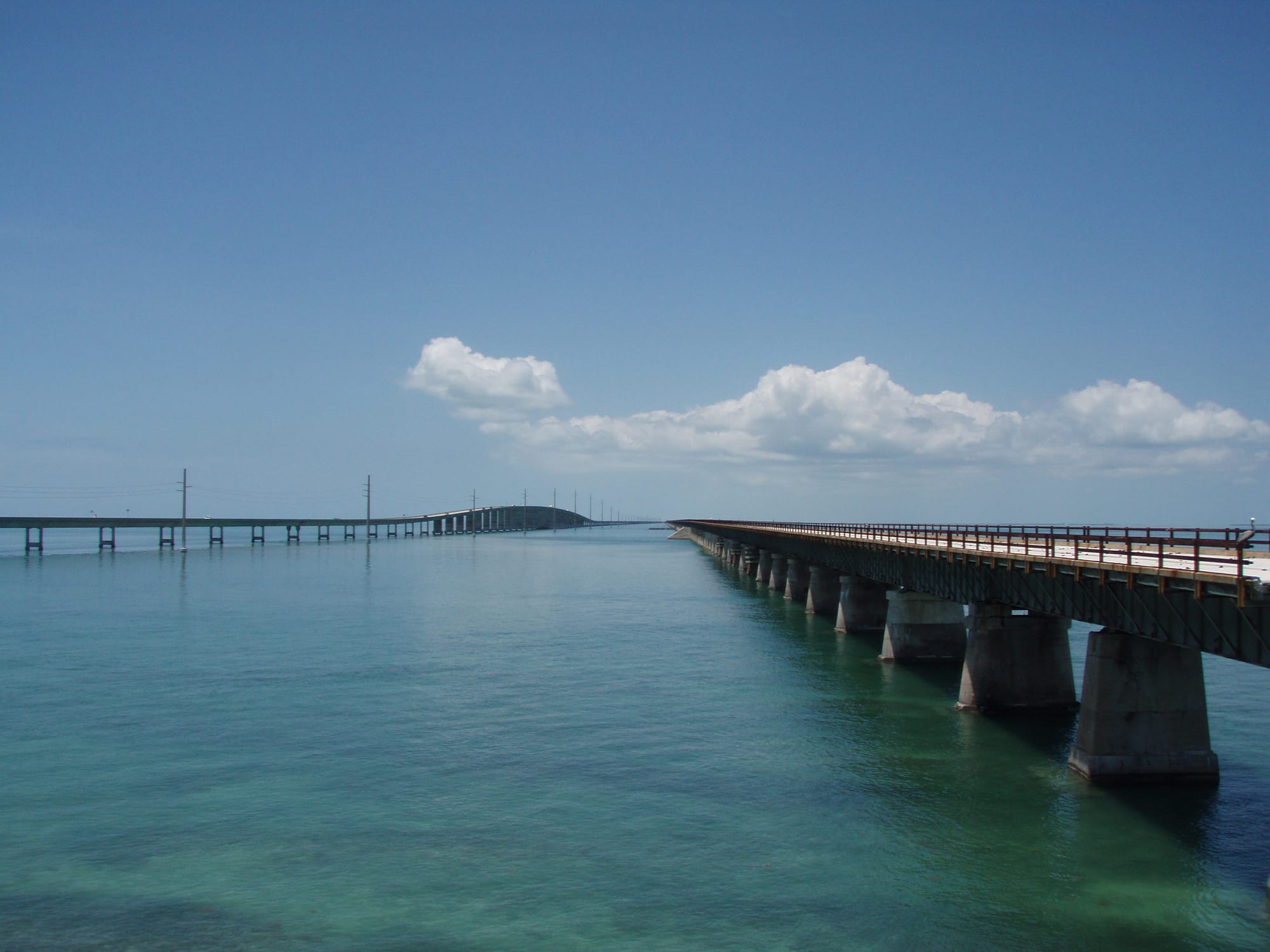
The road to Key West is, for much of its length, a railroad with the tracks taken up. Henry Flagler's Florida East Coast Railway pushed a line 128 miles beyond the end of the Florida peninsula, across the chain of islands called the Keys, and opened it in 1912. On 2 September 1935 the Labor Day hurricane, one of the most intense storms ever to strike land, washed away more than 40 miles of track in the Middle and Upper Keys.
The railway was already bankrupt and could not afford to rebuild. The State of Florida bought the right of way and the surviving bridges for $640,000, laid two-lane concrete roadways across them, and linked them to roads that already existed on some of the islands. The finished Overseas Highway opened on 29 March 1938 and became the southern end of US Route 1.
Flagler's Folly
Flagler had made his fortune as a founder of Standard Oil and then spent it building hotels and railways down Florida's east coast. By 1904 his line had reached Homestead, south of Miami. The next year the United States announced it would build the Panama Canal, and Flagler set his sights on Key West. It had been Florida's largest and wealthiest city as late as the 1880s, and it was the closest deep-water port in the United States to the canal. A railway, he reasoned, could feed it trade from Cuba, Latin America and the new shipping routes, and carry coal for the steamships that stopped there to refuel.
His engineer first considered a route through the Everglades to Cape Sable and then 25 miles of open sea, but chose to hop down the Keys instead. Work began in 1905. At its peak some 4,000 men were employed, and three hurricanes, in 1906, 1909 and 1910, threatened the project; the 1906 storm alone killed 135 of the workers. Critics called it Flagler's Folly. It cost about $50 million and the lives of hundreds of labourers, and there were many reports of harsh conditions and of workers forced into debt to the company, though a congressional investigation in 1909 found no peonage in the Keys camps.
On 22 January 1912 Flagler, then in his eighties, rode the first passenger train into Key West. The line was widely called the Eighth Wonder of the World. He died the following year.
A wonder that never paid
The trade Flagler had counted on never arrived. Panama Canal cargo did not flow through Key West, and by the time the line was finished, ships could travel far enough that they no longer needed to stop there for coal. Freight on the single track was mostly coal, fruit, building materials and tank cars of drinking water for the island city.
Passengers came instead. The Havana Special ran from New York to Key West, with a ferry on to the Cuban capital. Limited to 15 miles per hour on the long bridges, trains took about four and a half hours between Miami and Key West. The Florida land boom of the 1920s brought the railway a few good years, but by September 1931, early in the Great Depression, the company was bankrupt and in receivership.
Meanwhile motorists wanted in. The Miami Motor Club proposed a highway in 1921, and a first road, State Road 4A, opened on 25 January 1928. It came in two pieces, joined by a car ferry across a 41-mile gap of open water between Lower Matecumbe Key and No Name Key. To close that gap, a New Deal relief programme hired hundreds of First World War veterans to build bridges in the Upper Keys.
The storm that settled it
The Labor Day hurricane made landfall near Long Key late on 2 September 1935, with sustained winds of about 185 miles per hour and a central pressure of 892 millibars, the lowest ever officially recorded on land. A storm surge of roughly 18 to 20 feet swept over the low islands and destroyed nearly every building between Tavernier and Marathon.
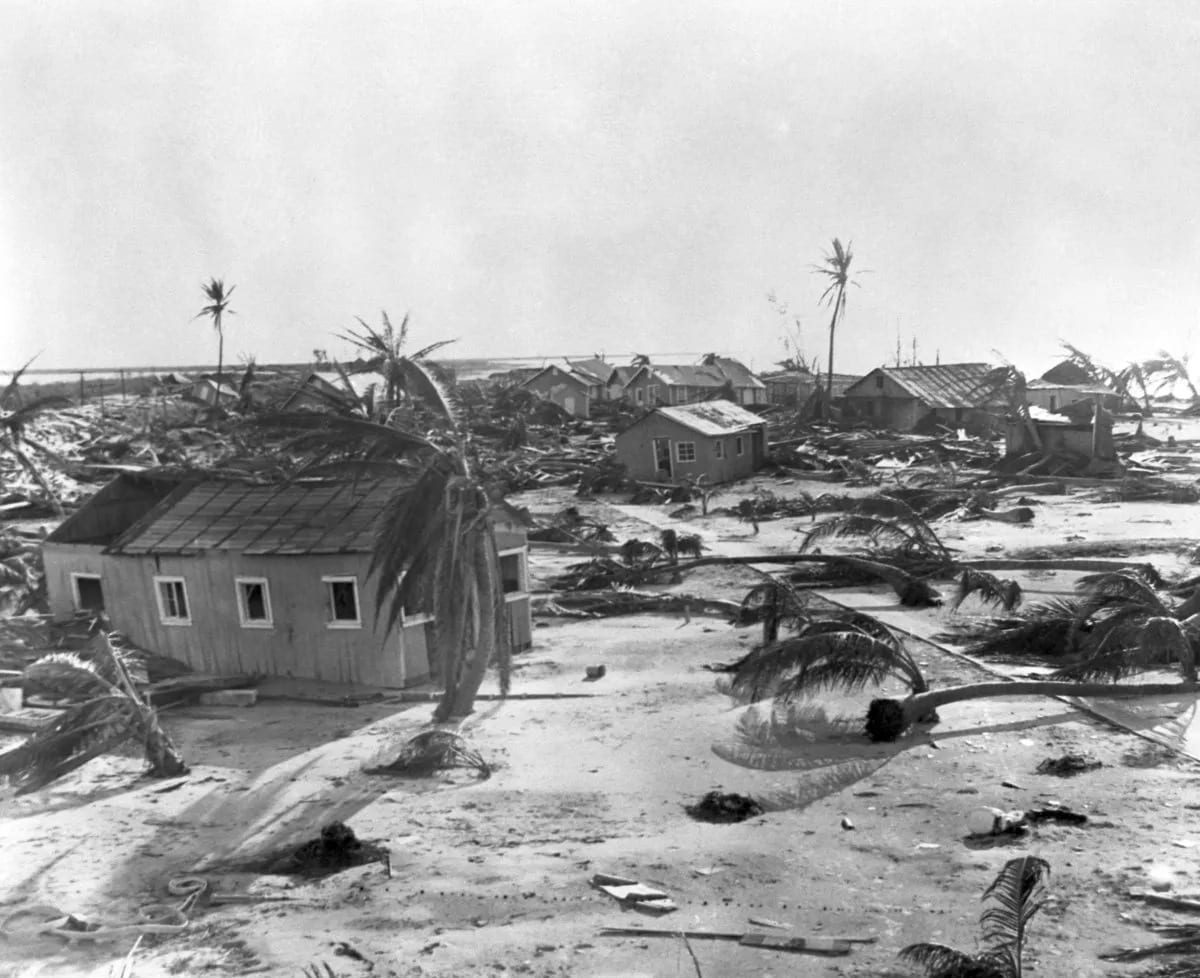
The surge flattened almost everything in its narrow path through the Upper and Middle Keys, including the village of Islamorada.
A rescue train sent from Miami to evacuate the veterans' work camps was slowed by a drawbridge, debris and poor visibility, and reached Islamorada at about 8.20 in the evening, just as the surge arrived. Eleven cars were swept off the rails; only the locomotive and its tender stayed upright, and everyone on board survived. The National Weather Service estimated 408 deaths in all, and more than half of the dead were veterans and their families, which led to a Congressional investigation.
The railway lost more than 40 miles of track. Two miles of it ended up washed ashore on the mainland at Cape Sable, the very place the line's first survey had considered as a route.
Rails into guardrails
For a bankrupt railway the damage was final. For the state it was an opportunity. Florida dropped its original plans and bought the entire right of way south of Florida City, with its bridges, for $640,000. Most of the bridges had come through the storm in good condition, and they were topped with two-lane concrete roadways. On the Seven Mile Bridge, extra sections widened the deck and lengths of old track, painted white, became the guardrails. On the Bahia Honda bridge, a steel truss whose inner deck was too narrow for cars, the road was built on top of the trusses instead.
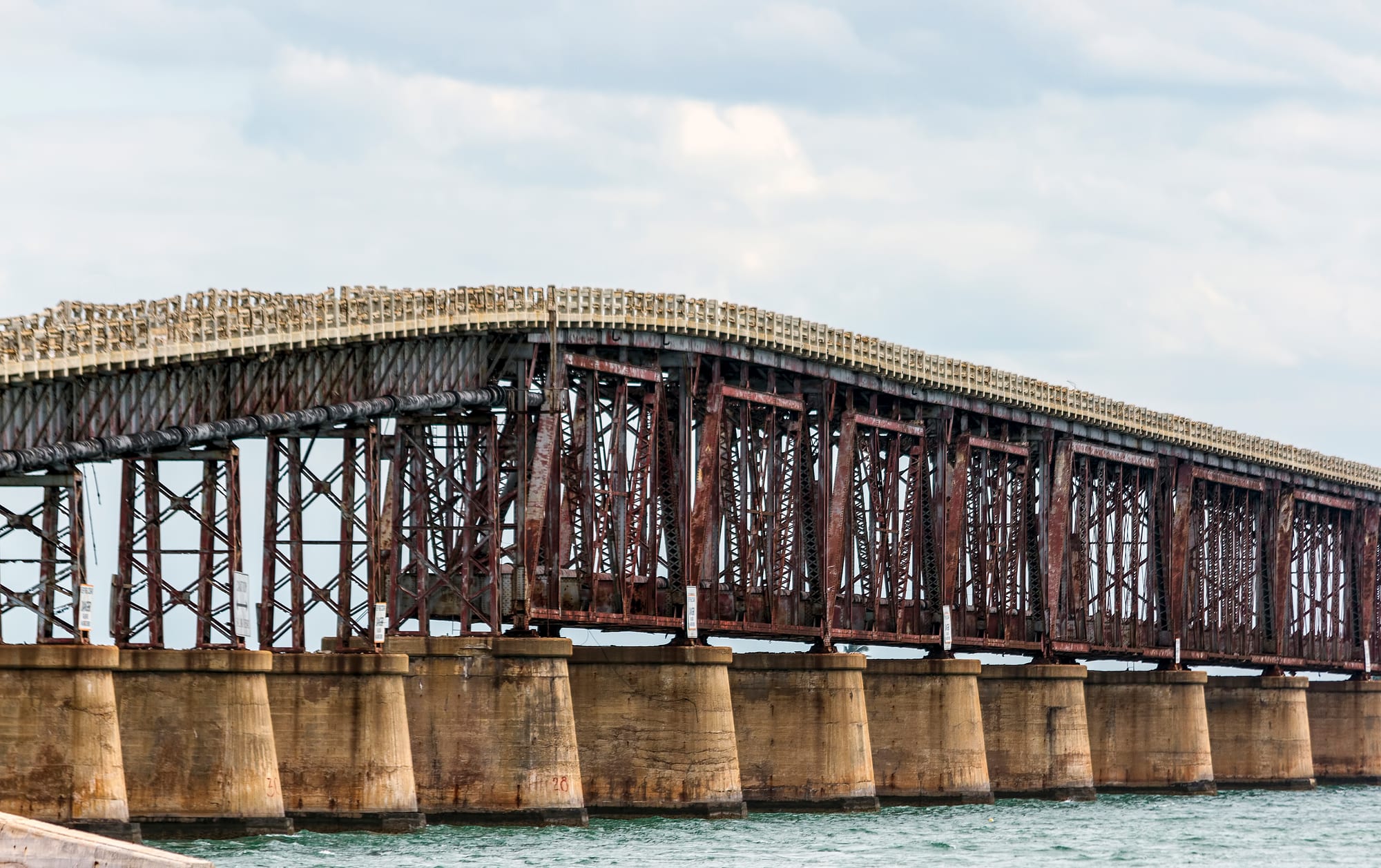
Trains once ran through the steel frame; cars drove across its roof until a new bridge opened alongside in 1972.
The new stretch ran from Lower Matecumbe Key to Big Pine Key and joined the two halves of the 1920s road. The continuous highway to Key West opened on 29 March 1938, and President Franklin D. Roosevelt toured it the next year. During the Second World War the navy, wanting quicker access to its air station near Key West, pushed for the remaining winding sections and their wooden bridges to be moved onto the old rail bed as well. That work, finished in 1944, cut 17 miles off the drive.
- 1905
Work begins on Flagler's Key West Extension.
- 22 January 1912
Henry Flagler rides the first passenger train into Key West.
- 25 January 1928
The first highway into the Keys opens, broken by a ferry gap.
- September 1931
The Florida East Coast Railway is bankrupt and in receivership.
- 2 September 1935
The Labor Day hurricane destroys much of the line.
- 29 March 1938
The Overseas Highway opens on the old railway bridges.
- 1944
The rest of the road moves onto the former rail bed.
- 1982
The new Seven Mile Bridge replaces Flagler's original.
Driving the old line today
The Overseas Highway now runs 113 miles through the Keys, the last stretch of US Route 1 from Fort Kent in Maine. In the 1970s and early 1980s many of the converted railway bridges were replaced by wider modern ones, including a new Seven Mile Bridge. The old Seven Mile, Bahia Honda and Long Key bridges were kept, and in 1979 they were listed on the National Register of Historic Places.
Many old concrete spans survive beside the road as fishing piers and as parts of the Florida Keys Overseas Heritage Trail, a walking and cycling route from Key Largo to Key West; 23 of the railway bridges still exist. A 2.2-mile section of the old Seven Mile Bridge, reopened in 2022 after repairs, leads to Pigeon Key, the tiny island that housed a work camp for Flagler's builders.