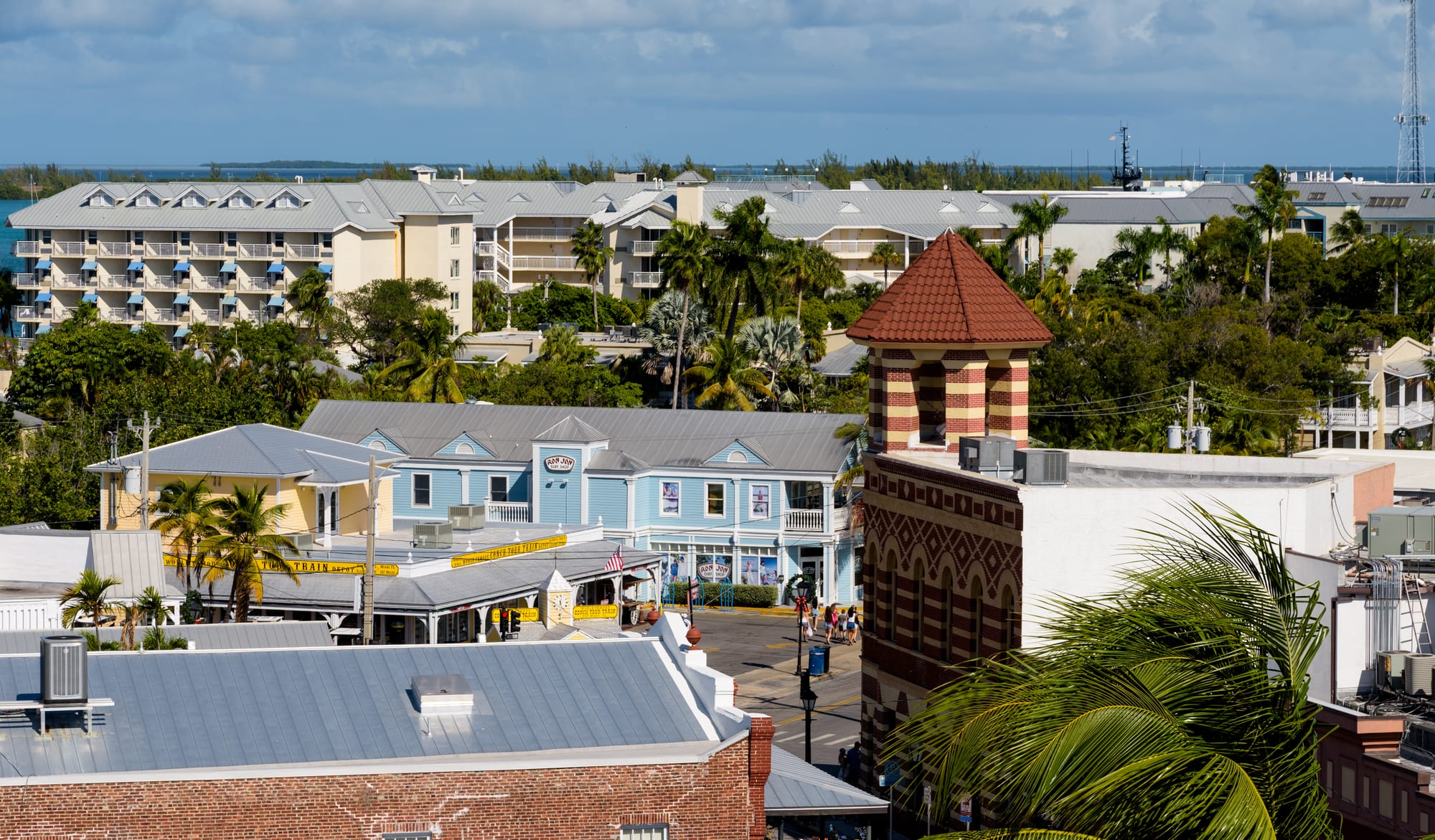
Pastel wooden buildings with tin roofs and palm trees at the corner of Duval and Front Streets, with a striped brick tower and the sea beyond

Florida, United States

Key West

Buildings at the corner of Duval Street and Front Street in Key West's Old Town. (Julian Lupyan / Wikimedia Commons · CC0)

A small coral island at the end of the Florida Keys, closer to Havana than to Miami, that grew rich on shipwreck salvage, cigars and the navy. Its Old Town of wooden houses with porches and gingerbread trim, Duval Street, the sunset gatherings at Mallory Square and Hemingway's former house now draw visitors along the Overseas Highway and by cruise ship.

Neighbourhoods

  • Old Town
    • First-time visitors
    • Historic district
    • Nightlife

    The western half of the island and its historic district, where most of the sights, bars and guesthouses are. Streets of wood-frame houses raised on piers, with metal roofs, shutters and porches, many built between 1886 and 1912, surround Duval Street, Mallory Square and the Truman Annex.

    Open in Maps
  • Bahama Village
    • Local life
    • Best for food

    A corner of Old Town south-west of Whitehead Street, settled by Black Bahamian immigrants, with houses, churches and sites tied to its Afro-Bahamian history, a few steps from the Hemingway House and the lighthouse.

    Open in Maps
  • Casa Marina and the south shore
    • Beaches
    • Quiet and residential

    The Atlantic side of the island east of Duval Street, named after a landmark hotel of 1921, with Higgs Beach, the Reynolds Street and White Street piers and the West Martello Tower along the shore.

    Open in Maps
  • New Town
    • Budget stays
    • Close to the airport

    The eastern half of the island, built largely on salt ponds filled in during the late 1950s, with shopping centres, homes, schools, Smathers Beach and the airport. Less atmospheric than Old Town but closer to the road out of town.

    Open in Maps

Things to do

Famous landmarks

  • Ernest Hemingway Housemuseum

    The house of 1851 on Whitehead Street where Hemingway lived in the 1930s, the island's most popular attraction, still home to dozens of cats, about half of them polydactyl, said to descend from a six-toed cat given to the Hemingways.

    Open in Maps
  • Key West Lighthousemuseum

    The lighthouse across the street from the Hemingway House, now a museum with the keeper's quarters.

    Open in Maps
  • Harry S. Truman Little White Housemuseum

    The house in the Truman Annex where President Truman spent 175 days of his presidency on working holidays, kept as a museum.

    Open in Maps
  • Southernmost Point buoylandmark

    A painted concrete buoy at South and Whitehead Streets marking the 'Southernmost point continental U.S.A.', put up by the city in 1983 and the most photographed sight in the Keys — though a few nearby spots lie further south.

    Open in Maps
  • San Carlos Institutemuseum

    A Cuban heritage centre and museum on Duval Street, founded in 1871 by Cuban exiles, where José Martí rallied support for Cuban independence.

    Open in Maps
  • Audubon House and Tropical Gardensmuseum

    A historic house on Whitehead Street with an acre of tropical gardens and 28 first-edition works by John James Audubon, recalling his visit to the Keys in 1832.

    Open in Maps
  • Key West Cemeterylandmark

    A 19-acre cemetery at the foot of Solares Hill, the island's historic city cemetery.

    Open in Maps

Streets and the waterfront

  • Duval Streetneighborhood

    The main street, running for just over a mile from the Gulf of Mexico to the Atlantic, lined with bars, shops, restaurants and Victorian houses.

    Open in Maps
  • Mallory Squareattraction

    The waterfront plaza beside the cruise port at the north end of Old Town, where crowds, street performers and vendors gather every evening to watch the sun set over the Gulf.

    Open in Maps

Beaches

  • Fort Zachary Taylor Historic State Parkpark

    A brick fort built between 1845 and 1866 that helped keep Key West in Union hands in the Civil War, now a state park with a beach.

    Open in Maps
  • Smathers Beachbeach

    The largest public beach on the island, about half a mile of sand on the Atlantic side, where Diana Nyad came ashore after swimming from Cuba in 2013.

    Open in Maps

Short trips from the island

  • Dry Tortugas National Parkpark

    Remote islands about 68 miles west, reached by boat or seaplane, with coral reefs, seabird colonies and Fort Jefferson, the largest brick masonry structure in the Western Hemisphere.

    Open in Maps

Seasonal events

  • Conch Republic Independence CelebrationApril

    A week of events marking the island's tongue-in-cheek 'secession' of 23 April 1982, staged in protest at a Border Patrol roadblock.

  • Hemingway DaysJuly

    Three days around Hemingway's birthday on 21 July, with a look-alike contest at Sloppy Joe's, a fishing tournament, a street fair and a short story competition.

  • Fantasy Festlast week of October

    A costumed street party and parade that fills Duval Street every autumn.

Eat and drink

Long-standing places and food districts in Key West. Hours, ratings and directions come from your maps app, always current.

Key West classics

  • El Siboneyrestaurant

    A Cuban restaurant on a quiet residential corner of Catherine Street, away from the main tourist streets.

    Open in Maps
  • Sloppy Joe's Barrestaurant

    The bar at the corner of Greene and Duval Streets since 1937, one of Hemingway's haunts and home to the Hemingway look-alike contest.

    Open in Maps

Food streets

  • Duval Street cafésneighborhood

    Outdoor cafés along the main street serving Cuban coffee, in the town where conch fritters and Key lime pie are the classic snacks.

    Open in Maps

Experience Key West

History

Peoples related to the Calusa and Tequesta lived on the island at various times, and the island's Spanish name, Cayo Hueso, "bone cay", is said to come from human remains found there; the last Native residents were taken to Cuba when Spain handed Florida to Britain in 1763. For decades few people lived on the Keys, which were visited by Cuban and Bahamian fishermen and wreck salvagers. In 1815 the Spanish governor of Cuba granted the island to Juan Pablo Salas, who sold it in 1822 to the American businessman John Simonton. The same year the US Navy claimed the Keys, and in 1823 Commodore David Porter ran the island under martial law as a base against piracy.

Its deep harbour beside the Straits of Florida made Key West a maritime centre. Salvaging wrecks from the reef made it the wealthiest city per capita in the United States by the 1830s, and salt making, fishing and turtling followed. In the Civil War it stayed in Union hands, helped by Fort Zachary Taylor and the Martello towers. Cubans fleeing the war of 1868–78 brought cigar factories, and by 1890 Key West, with about 18,800 people, was the largest and richest city in Florida; but after the Great Fire of 1886 some factory owners moved to Ybor City in Tampa.

Henry Flagler's Overseas Railroad reached the island in 1912. After the Labor Day hurricane of 1935 destroyed much of it, the route was rebuilt as the Overseas Highway, completed in 1938. The navy, Hemingway in the 1930s and Truman's winter stays after 1946 raised the island's profile, and tourism took over. In 1982 a Border Patrol roadblock prompted the mock secession of the "Conch Republic". Hurricane Wilma flooded about 60 per cent of homes in 2005, and Irma struck the Keys in 2017.

Culture & Customs

Key West has long thought of itself as a place apart. Its residents are Conchs — originally the white Bahamian settlers who came after 1830, many descended from Loyalists who had fled the American Revolution — and the name now covers anyone born on the island, with long-term newcomers called "freshwater Conchs". Black Bahamians settled in Bahama Village, and Cuban exiles shaped the town from the 1860s: Key West had Cuban mayors, and José Martí founded the Cuban Revolutionary Party during his visits in the 1890s.

Writers have been drawn here for a century. Hemingway wrote some of his best-received works in his Whitehead Street house and set To Have and Have Not on the Depression-era island; Tennessee Williams lived in a modest New Town bungalow from 1949 until his death in 1983. The town's motto, One Human Family, reflects an open, tolerant reputation, and it has one of the country's best-known gay communities, with two pride festivals a year.

Public life is theatrical. Every evening crowds gather at Mallory Square for the sunset, with jugglers, musicians and food stalls; in July Hemingway Days brings a look-alike contest at Sloppy Joe's Bar; in April the Conch Republic celebrates its "independence"; and in the last week of October Fantasy Fest fills Duval Street with costumes and parades.

Daily Life

About 26,400 people lived in the city at the 2020 census, on an island only about 4 miles long and 1 mile wide, with an average height of about 8 feet above the sea. The city also takes in neighbouring keys and part of Stock Island, and it is the county seat of Monroe County.

Tourism dominates the economy, from guesthouses, bars and boat trips to the cruise ships that dock beside Mallory Square, and Naval Air Station Key West is the other large employer. Old Town, with its wooden houses and guesthouses, holds most of the visitor life; New Town, built on filled salt ponds in the late 1950s, has the shopping centres, schools, ball parks and many of the homes of working residents.

Daily life is shaped by water and weather. Many residents work in the visitor trade, and the rhythm of the year follows the winter season, when the population and prices swell. Hurricanes are a constant concern: Wilma's storm surge in 2005 left a "car graveyard" across the lower Keys, and Irma made landfall in the Keys as a Category 4 storm in 2017.

Food

Key lime pie is the island's best-known dish and the official state pie of Florida: the tart juice of small Key limes set with sweetened condensed milk in a crumb crust, sold in slices all over Old Town. Conch fritters, fried balls of batter with chopped conch, a large sea snail, are the other classic, as across the Keys and the Bahamas.

The Cuban influence is strong. Cuban coffee — strong, sweet espresso — is sold from outdoor cafés along Duval Street, and Cuban restaurants such as El Siboney serve Cuban home cooking. Fresh local fish is widely served.

Drinking is part of the island's image. Sloppy Joe's Bar on Duval Street, at its present corner since 1937, trades on its link with Hemingway, and the bars along Duval Street fill late into the night. Sunset drinks by the water, at Mallory Square or along the harbour, are a daily ritual.

Planning tools

Budget

Key West is one of the most expensive places to stay in Florida, because the island is small and rooms are limited. Prices are highest from December to April and on festival weekends, and lower in the hot, stormy late summer and autumn. Eating and drinking cost more than on the mainland, while the sunset at Mallory Square, the beaches and walks around Old Town cost nothing.

Daily Budget Midrange
USD 300–500 (guesthouse or mid-range hotel with resort fees, restaurant meals with tax and tip, a museum or boat trip)
Daily Budget Shoestring
USD 130–200 (hostel bed or room in New Town, Cuban cafés and conch fritters, a bicycle and walking)

Book well ahead for winter, spring break and Fantasy Fest; a car is more trouble than help on the island, where parking is scarce and costly.

Best Time to Visit

November to April is the dry, sunny season and the busiest and most expensive time to visit. May to October is the wet season, with brief but heavy showers, more often in the early morning than in the afternoon; September is the wettest month and the peak of the hurricane season, which runs from June to November.

Suggested Number of Days

Two or three days cover Old Town, the museums and a beach. Allow four or five to add a full-day boat trip to the national park offshore, time on the reef, or a slower drive down through the Keys.

First Visit
2–3 days
With Surroundings
4–5 days

Transportation

The island is about 4 miles long and 1 mile wide, and most visitors get around on foot or by bicycle, with taxis and buses for longer trips. Old Town's streets are narrow and parking is limited. U.S. Route 1, the Overseas Highway, ends here, carrying traffic over 113 miles of bridges and islands from the mainland.

Lock bicycles securely and use lights after dark; Duval Street is crowded on weekend nights.

Airport & Station Connections

Key West International Airport is about 2 miles east of the main commercial centre, with flights from a few large US airports; its short runway limits the size of aircraft. Many visitors fly to Miami or Fort Lauderdale and drive the Overseas Highway, about 165 miles from Miami by road. Greyhound buses stop at the airport, passenger ferries link the island with Florida's south-west coast in about three and a half hours, and cruise ships dock beside Mallory Square.

Walkability

Old Town is very walkable: Duval Street runs just over a mile from the Gulf to the Atlantic, and the Hemingway House, the lighthouse, Mallory Square and Fort Zachary Taylor are all within a short walk of it. The beaches and New Town are an easy bicycle ride away. Summer heat and humidity make midday walking tiring.

Safety

Key West is a small, busy tourist town and generally safe. The usual problems are bicycle theft, drunkenness on Duval Street late at night, strong sun and heat, and the sea; hurricanes are the main natural hazard, and Irma in 2017 and Wilma in 2005 caused heavy damage and flooding.

For most visitors the US is safe, with the main risks being petty theft and car break-ins in tourist areas of some cities, road accidents over long distances, extreme weather, and the hazards of the outdoors. Use plenty of sun protection, swim where it is safe to do so, and follow evacuation orders when a hurricane threatens the Keys. Check current official travel advice before travelling.

Climate

Tropical savanna, similar to the Caribbean islands, and the driest city in Florida. Trade winds and sea breezes keep temperatures steadier than on the mainland: the difference between the coolest and warmest months is small, and summer heat rarely becomes extreme.

Summer
hot and humid — about 56 days a year reach 90°F, but the temperature rarely reaches 95°F, and nights often stay above 80°F
Winter
warm and mostly dry — the sea averages 75–77°F from December to February, the warmest winter water on the US mainland, and the lowest temperature ever recorded is 41°F

Local Customs

The island's motto is 'One Human Family', and it has long been known for welcoming artists, gay and lesbian visitors and people of every lifestyle. Dress is very casual. Tipping is expected: roughly 18–22 per cent in restaurants. Residents call themselves Conchs, pronounced 'conks'.

Identification is asked for when buying alcohol (the legal age is 21). Coral and sea life in the surrounding marine sanctuary are protected, so do not touch or take coral when snorkelling.

Common Payment Methods

The currency is the US dollar. Cards and contactless payment are accepted almost everywhere, and some places no longer take cash at all. Small bills are useful for tips, bicycle hire and street performers at Mallory Square; ATMs are easy to find in Old Town.