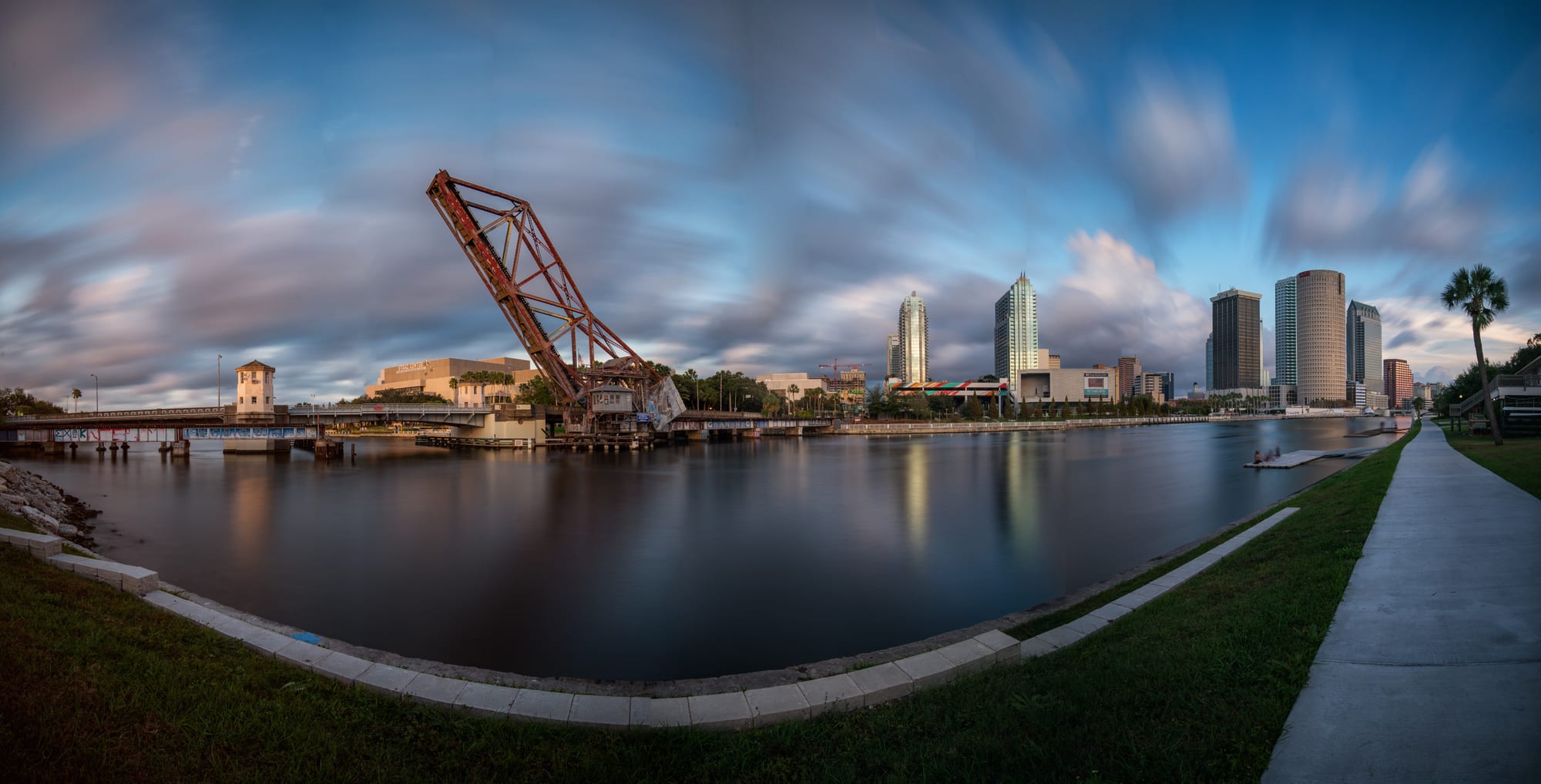
A wide view of the calm Hillsborough River with a raised red bascule bridge on the left and downtown Tampa's towers on the right

Florida, United States

Tampa

The Hillsborough River and the towers of downtown Tampa, seen from across the river. (Gregory Urbano from St. Petersburg, Florida, USA / Wikimedia Commons · CC BY 2.0)

Florida's third-largest city, on the north shore of Tampa Bay, which grew from an army fort into the 'Cigar Capital of the World' after Cuban, Spanish and Italian immigrants built Ybor City in the 1880s. Today it is a port, banking and military city with a riverside downtown, the Busch Gardens theme park and a food culture built on the Cuban sandwich.

Neighbourhoods

  • Downtown and the Channel District
    • First-time visitors
    • Museums
    • Close to public transport

    The business centre on the Hillsborough River, with the Riverwalk, the art and history museums and the performing arts centre, and to the east the Channel District, a residential and entertainment area beside the cruise terminals, the aquarium and the arena. The TECO streetcar links it to Ybor City.

    Open in Maps
  • Ybor City
    • Historic district
    • Nightlife
    • Best for food

    The National Historic Landmark district just north-east of downtown, founded in the 1880s around cigar factories and settled by Cuban, Spanish and Italian immigrants. Brick factories and social clubs stand around 7th Avenue, the main street and now the heart of a nightlife district.

    Open in Maps
  • Hyde Park and SoHo
    • Quiet and residential
    • Shopping and dining
    • Waterfront walks

    A historic district of old houses and bungalows south-west of downtown, taking in the Hyde Park Village shopping area, the restaurants and bars of South Howard Avenue (SoHo) and the long promenade of Bayshore Boulevard.

    Open in Maps
  • Seminole Heights
    • Best for food
    • Local life

    An early 20th-century neighbourhood of bungalows north of downtown along the Hillsborough River, known for its independent restaurants and bars, with the zoo on its edge.

    Open in Maps
  • Davis Islands
    • Quiet and residential
    • Waterfront

    Man-made islands in Hillsborough Bay just south of downtown, developed during the 1920s land boom, with Mediterranean Revival houses.

    Open in Maps

Things to do

Ybor City and history

  • Ybor City Museum State Parkmuseum

    The story of the cigar industry and its immigrant workers, told in a former Cuban bread bakery, with gardens and restored casitas, the small houses of cigar workers.

    Open in Maps
  • Centro Asturiano de Tampalandmark

    One of Ybor City's grand early 20th-century social clubs, built for immigrants from Asturias in Spain and their descendants.

    Open in Maps
  • Henry B. Plant Museummuseum

    A museum in the minaret-topped former Tampa Bay Hotel, the 511-room resort that the railway builder Henry Plant opened in 1891, now the main building of the University of Tampa.

    Open in Maps
  • Tampa Theatrelandmark

    An atmospheric movie palace of 1926 by John Eberson, now a non-profit cinema showing independent, foreign and documentary films.

    Open in Maps

Museums and the waterfront

  • Tampa Riverwalktrail

    A 2.6-mile path along the Hillsborough River and the downtown waterfront, from the Channel District to Tampa Heights, linking parks, museums and restaurants.

    Open in Maps
  • Curtis Hixon Waterfront Parkpark

    An eight-acre riverside park downtown, beside the art and children's museums, used for festivals and events.

    Open in Maps
  • Tampa Museum of Artmuseum

    Modern and contemporary art alongside Greek, Roman and Etruscan antiquities, in a riverside building downtown.

    Open in Maps
  • Tampa Bay History Centermuseum

    A Smithsonian affiliate covering 12,000 years of Florida history over three floors, from the first inhabitants and the conquistadors to the cigar era.

    Open in Maps
  • Florida Aquariumattraction

    A large aquarium in the Channel District with Florida's coastal and reef habitats.

    Open in Maps
  • Bayshore Boulevardtrail

    A waterfront road on Hillsborough Bay whose 4.5-mile sidewalk is the second-longest continuous sidewalk in the United States, popular with walkers, runners and cyclists.

    Open in Maps

Theme parks, zoo and sport

  • Busch Gardens Tampa Bayattraction

    An African-themed animal park and theme park opened in 1959, with large roller coasters such as SheiKra, Cheetah Hunt and Iron Gwazi and an annual attendance of more than four million.

    Open in Maps
  • ZooTampa at Lowry Parkpark

    A 63-acre non-profit zoo in Seminole Heights, at its present site since 1957.

    Open in Maps
  • Raymond James Stadiumattraction

    The large open-air stadium of the Tampa Bay Buccaneers, the city's NFL team.

    Open in Maps

Short trips from the city

  • Salvador Dalí Museummuseum

    Across the bay in St. Petersburg, a museum devoted to the work of the Spanish surrealist Salvador Dalí.

    Open in Maps
  • Clearwater Beachbeach

    White sand and clear water stretching for 2.5 miles on a barrier island in the Gulf, regularly ranked among the best beaches in the United States.

    Open in Maps
  • Tarpon Springsattraction

    A town on the Gulf coast north of Clearwater, known for its Greek community and the sponge docks of its Greek sponge divers.

    Open in Maps

Seasonal events

  • Gasparilla Pirate Festivallate January or early February

    A mock pirate invasion by Ye Mystic Krewe of Gasparilla, held most years since 1904: a pirate ship sails across the bay, followed by the Parade of Pirates along Bayshore Boulevard, one of the largest parades in the country.

  • Florida State FairFebruary

    The official state fair, with agricultural exhibits, rides, shows and unusual fair food at the fairgrounds east of the city.

  • Tampa Riverfestearly May

    A festival on the Riverwalk with live music and stalls from local restaurants.

  • Guavaweenaround Halloween, October

    A night-time Halloween street celebration in Ybor City, named after the guava, with a Latin flavour.

Eat and drink

Long-standing places and food districts in Tampa. Hours, ratings and directions come from your maps app, always current.

Tampa classics

  • Columbia Restaurantrestaurant

    The oldest continuously operated restaurant in Florida and the oldest Spanish restaurant in the United States, filling an entire city block of Ybor City with 15 dining rooms.

    Open in Maps
  • Cuban sandwiches in Ybor City and West Tampaneighborhood

    The city's official signature sandwich — roast pork, ham, Genoa salami, Swiss cheese, pickles and mustard pressed in Cuban bread — sold in cafés and bakeries across the old cigar districts.

    Open in Maps

Food districts

  • Seminole Heightsneighborhood

    Independent restaurants, bars and breweries in old bungalows and storefronts along Florida Avenue and nearby streets.

    Open in Maps
  • SoHo and South Tampaneighborhood

    South Howard Avenue's restaurants and bars, close to Hyde Park Village and Bayshore Boulevard.

    Open in Maps

Experience Tampa

History

People have lived around Tampa Bay for thousands of years. At European contact the Tocobaga, Pohoy and other Safety Harbor chiefdoms held the shores; the expeditions of Pánfilo de Narváez and Hernando de Soto landed nearby but did not stay, and by about 1600 disease and conflict had destroyed the local cultures. After the United States acquired Florida, the army founded Fort Brooke in 1824 at the mouth of the Hillsborough River, in what is now downtown. Tampa was incorporated in 1849 but remained a small frontier town; it suffered during the Civil War, lost residents to yellow fever, and briefly abolished its own government in 1869.

Three things transformed it in the mid-1880s: phosphate found south-east of the city, Henry Plant's railway, which reached the port in 1883, and the cigar industry. In 1885 Vicente Martinez Ybor moved his factory from Key West and built Ybor City for thousands of Cuban, Spanish and Italian workers; West Tampa followed. By 1929 more than 500 million cigars a year were rolled by hand, and Tampa called itself the "Cigar Capital of the World". Plant's Tampa Bay Hotel of 1891 brought winter tourists, and the illegal bolita lottery fed organised crime until the 1950s.

The Depression and machine-made cigars ended the cigar boom. The Second World War brought MacDill Field, still a major air base, and the 1950s and 60s saw record growth, Busch Gardens and the University of South Florida. In 2024 Hurricane Helene brought the area's worst storm surge in a hundred years, and Milton, which made landfall at Siesta Key two weeks later, also hit Tampa hard.

Culture & Customs

Ybor City gives Tampa a Latin heritage unlike any other city of the American South. Its immigrant social clubs — El Centro Español, the Centro Asturiano and L'Unione Italiana among them — were mutual aid societies for the immigrant workers, and their buildings still stand in Ybor City. Fiesta Day celebrates the city's Cuban, Spanish, Italian, German, Jewish, African-Cuban and other immigrant roots.

The great civic festival is Gasparilla, held most years since 1904, when Ye Mystic Krewe of Gasparilla "invades" the city aboard a pirate ship and leads a parade along Bayshore Boulevard that draws hundreds of thousands of people. Other events fill the calendar from the Florida State Fair in February to Guavaween in Ybor City at Halloween, and Ybor's GaYbor district hosts one of the region's LGBTQ street parties.

Tampa has an unexpected place in music history as a centre of death metal: from the late 1980s bands such as Death, Obituary, Morbid Angel and Deicide worked here, many recording at Morrisound studio. The city is also a base for professional wrestling, and sport is followed closely, with the Buccaneers in American football, the Lightning in ice hockey and the Rays in baseball.

Daily Life

About 403,000 people lived in Tampa at the 2020 census, making it the third-largest city in Florida, and the Tampa Bay metropolitan area had about 3.42 million. Since the 1960s the city has spread outwards, most recently into New Tampa, a largely rural area annexed in 1988 that is now suburban.

The economy is broad: finance, insurance, healthcare, technology and cybersecurity sit alongside tourism, construction and the port. Port Tampa Bay is Florida's largest by tonnage and still exports phosphate, and MacDill Air Force Base houses the headquarters of United States Central Command. The University of South Florida in North Tampa and the University of Tampa downtown add tens of thousands of students.

Neighbourhoods range from the high-rise flats of downtown and the Channel District to the bungalows of Seminole Heights and the older houses of Hyde Park and Davis Islands. Life is largely car-based, with commuting on the interstates and bridges across the bay. Summer afternoons are shaped by thunderstorms, and hurricanes are a growing concern after the double blow of Helene and Milton in 2024.

Food

Tampa claims the Cuban sandwich as its own — the city council has made it the city's official signature sandwich. The Tampa version layers roast pork, ham, Swiss cheese, pickles and mustard with Genoa salami, a mark of the Italian immigrants who lived beside Cubans and Spaniards in Ybor City, and presses it in long loaves of Cuban bread; the Ybor City Museum is housed in a former bakery known for that bread. The city is also the birthplace of the Florida deviled crab, a croquette of spiced crab meat in breadcrumbs.

Spanish and Cuban cooking still define Ybor City. The Columbia Restaurant, the oldest continuously operated restaurant in Florida and the largest Spanish restaurant in the world, fills a whole city block. Colombian, Puerto Rican, Vietnamese and barbecue restaurants reflect newer arrivals, and Greek food is prominent around Tarpon Springs on the coast.

Seafood from the Gulf is everywhere, and food trucks are popular — the area holds the record for the world's largest food truck rally. Several restaurant chains, including Outback Steakhouse, began here, and Seminole Heights and South Tampa are the districts residents name first for eating out.

Planning tools

Budget

Tampa is generally cheaper than Miami or Orlando's resort areas. Hotel prices rise in the winter season and for big events such as Gasparilla and home football games, and fall in the hot, wet summer. A Busch Gardens ticket is usually the largest single cost; the Riverwalk, Bayshore Boulevard and Ybor City's streets are free.

Daily Budget Midrange
USD 230–420 (mid-range hotel, restaurant meals with tax and tip, a rental car or ride-hailing, one paid attraction)
Daily Budget Shoestring
USD 100–160 (hostel or motel, Cuban sandwiches and food trucks, the streetcar and buses)

Book early for Gasparilla weekend; the streetcar is the easiest way to combine downtown, the Channel District and Ybor City without parking.

Best Time to Visit

October to May is the pleasant season, dry and warm, though cold fronts can bring a few cool days in winter. The rainy season runs from late May to early October, with hot, humid days and frequent afternoon thunderstorms, and the hurricane season from June to November. Gasparilla in late January or early February is the city's biggest celebration.

Suggested Number of Days

Two or three days cover downtown, Ybor City and the waterfront. Allow four to six to add a theme park day and time across the bay in St. Petersburg or on the Gulf beaches.

First Visit
2–3 days
With Surroundings
4–6 days

Transportation

Tampa is a spread-out, car-oriented city, and a car or ride-hailing is the usual way to get around. HART runs the buses, including a rapid bus line between downtown and the University of South Florida, and the TECO Line Streetcar, with wooden-interior cars, runs 2.7 miles between Ybor City, the Channel District, the convention centre and downtown. A Cross-Bay ferry links downtown with St. Petersburg.

Bridges and causeways across the bay can be slow at rush hour; leave plenty of time when heading for the beaches or the airport.

Airport & Station Connections

Tampa International Airport, which has non-stop flights to around 100 destinations, is about 6 miles west of downtown. St. Pete–Clearwater International Airport across the bay serves mainly low-cost flights. Amtrak's Floridian calls at Tampa Union Station between Miami and Chicago, Greyhound and FlixBus stop downtown, and cruise ships sail from terminals in the Channel District.

Walkability

Downtown and the Riverwalk are pleasant on foot, Ybor City's 7th Avenue is a compact walking street, and Bayshore Boulevard has one of the longest continuous sidewalks in the country. Between districts the distances and wide roads make walking less practical; the streetcar fills the gap between downtown and Ybor. Summer heat and storms make midday walking hard.

Safety

Downtown, the waterfront and the main visitor areas are generally safe. Ybor City is crowded and lively on weekend nights. The main natural hazards are lightning — the region is known as the lightning capital of North America — heat and hurricanes: in 2024 Helene brought the area's worst storm surge in a century, and Milton followed two weeks later.

For most visitors the US is safe, with the main risks being petty theft and car break-ins in tourist areas of some cities, road accidents over long distances, extreme weather, and the hazards of the outdoors. Take shelter indoors when thunder sounds, keep away from lakes and ponds where alligators live, and follow evacuation orders when a hurricane approaches. Check current official travel advice before travelling.

Climate

Humid subtropical, close to tropical, moderated by Tampa Bay and the Gulf. Average highs range from about 71°F in winter to 91°F in summer. Summer afternoons bring frequent thunderstorms; winters are dry and mild, with occasional cold fronts and rare frosts. The city's official temperature reached 100°F for the first time in July 2025.

Summer
hot and humid — highs around 91°F, lows in the mid to upper 70s °F, with afternoon thunderstorms most days
Winter
dry and mild — highs in the low to mid 70s °F and nights in the low to mid 50s °F, with brief cooler spells after cold fronts

Local Customs

Tipping is expected: roughly 18–22 per cent in restaurants and about a dollar a drink at a bar. Dress is casual. Tampa takes its sports seriously, with the Buccaneers, the Lightning and the Rays, and its Latin heritage is a source of pride, celebrated on Fiesta Day and in Ybor City's social clubs.

Identification is asked for when buying alcohol (the legal age is 21). Gasparilla crowds are huge and boisterous; arrive early and expect road closures along Bayshore Boulevard.

Common Payment Methods

The currency is the US dollar. Cards and contactless payment are accepted almost everywhere, and some places no longer take cash at all. A little cash is useful for small cafés, bakeries and tips; ATMs are easy to find.