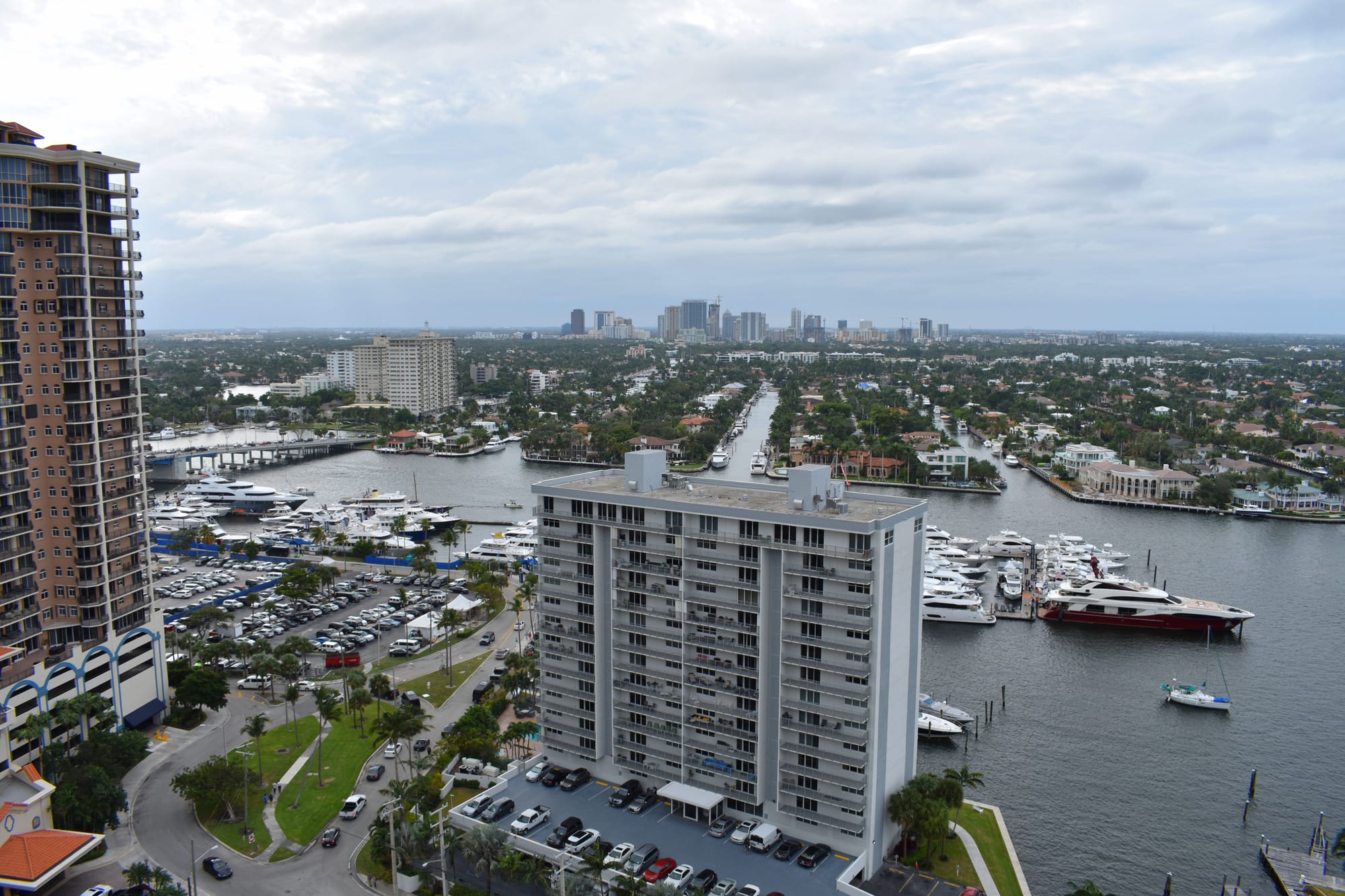
A view from the beach side of Fort Lauderdale towards the towers of downtown

Florida, United States

Fort Lauderdale

The skyline of Fort Lauderdale, seen from the beach. (Tamanoeconomico / Wikimedia Commons · CC BY-SA 4.0)

A coastal city 30 miles north of Miami, named after Second Seminole War forts on the New River and laced with 165 miles of inland waterways. Once the country's spring-break capital, it now lives from yachts, cruise ships and conventions, with a high-rise downtown along Las Olas Boulevard, a long Atlantic beach and Port Everglades on its southern edge.

Neighbourhoods

  • Downtown and Las Olas
    • First-time visitors
    • Best for food
    • Arts and culture

    The largest downtown in Broward County, rebuilt with towers since the early 2000s, beside the New River. Las Olas Boulevard's shopping and restaurant district runs east from here, the Riverwalk follows the water, and the Broward Center and the museums anchor the arts district.

    Open in Maps
  • Fort Lauderdale Beach
    • Beaches
    • Nightlife
    • Families

    The barrier island strip along State Road A1A, where hotels, bars and restaurants face the sand. The junction of Las Olas and A1A, with the Elbo Room bar, was the heart of the spring-break years; further north are quieter stretches beside Hugh Taylor Birch State Park.

    Open in Maps
  • Wilton Manors
    • LGBTQ travellers
    • Nightlife
    • Best for food

    A small separate city on Fort Lauderdale's northern edge, about a mile and a half north of downtown, well known as a centre of gay and lesbian life, with bars, restaurants and guesthouses along Wilton Drive.

    Open in Maps
  • Lauderdale-by-the-Sea
    • Quiet and residential
    • Beaches

    A small beach town just north of the city, with a smaller scale than the main strip, a fishing pier and restaurants a block from the sand.

    Open in Maps

Things to do

History and the river

  • Stranahan Housemuseum

    The oldest surviving building in Broward County, built in 1901 as Frank Stranahan's trading post and later the family home, now a museum on the New River.

    Open in Maps
  • Riverwalktrail

    A riverside walk of more than a mile along the New River, from Sailboat Bend past the arts district to near the Stranahan House, with a park used for festivals.

    Open in Maps
  • Las Olas Boulevardneighborhood

    The city's best-known street, running from downtown over the Intracoastal Waterway and through the canal-side Isles to the beach, with a shopping and dining district at its heart.

    Open in Maps
  • Water Taxitransit hub

    A hop-on, hop-off boat service with stops along the Intracoastal Waterway and the New River — an easy way to see the canals, waterfront houses and yachts.

    Open in Maps

Museums and the arts

  • Bonnet Housemuseum

    A historic estate between the beach and the Intracoastal, given in 1919 to the Chicago artist Frederic Clay Bartlett and his wife Helen, now a house museum with gardens.

    Open in Maps
  • NSU Art Museum Fort Lauderdalemuseum

    The city's art museum, founded in 1958, with ceramics and prints by Picasso and a large collection of Latin American and Cuban art.

    Open in Maps
  • Museum of Discovery and Sciencemuseum

    A hands-on science museum in the downtown arts district, with an IMAX cinema.

    Open in Maps
  • Broward Center for the Performing Artsattraction

    A theatre complex opened in 1991 on the New River, staging opera, ballet, touring musicals and concerts.

    Open in Maps

Beaches and parks

  • Hugh Taylor Birch State Parkpark

    A state park on Hugh Taylor Birch's former estate between the ocean and the Intracoastal Waterway, with canoeing, cycling and a visitor centre in his former house.

    Open in Maps
  • Dr. Von D. Mizell-Eula Johnson State Parkbeach

    A beach park in Dania Beach, south of the port, that opened in the early 1950s as the 'Colored Beach', the first beach open to Black residents of Broward County, though no road reached it until 1965.

    Open in Maps

Port and markets

  • Port Evergladestransit hub

    The county-owned port on the city's southern edge, opened in 1928 and now one of the world's busiest cruise ports, as well as a major cargo and fuel terminal.

    Open in Maps
  • Fort Lauderdale Swap Shopmarket

    A sprawling 80-acre indoor and outdoor flea market with a drive-in cinema of 14 screens.

    Open in Maps

Short trips from the city

  • Everglades Holiday Parkattraction

    Airboat tours across the sawgrass of the Everglades at the western end of Griffin Road — a private park, not part of Everglades National Park.

    Open in Maps

Seasonal events

  • Fort Lauderdale International Boat ShowOctober

    The world's largest in-water boat show, with hundreds of yachts on display.

  • Fort Lauderdale Air Showaround Memorial Day, late May

    Display teams such as the Thunderbirds flying in formation over the beach.

  • Holiday boat paradeDecember

    A parade of boats decorated with lights along the Intracoastal Waterway during the holiday season.

Eat and drink

Long-standing places and food districts in Fort Lauderdale. Hours, ratings and directions come from your maps app, always current.

Fort Lauderdale classics

  • Mai-Kairestaurant

    A Polynesian-themed restaurant and tiki bar that opened in 1956 in Oakland Park, just north of the city, and reopened in November 2024 after a renovation, keeping the original drink recipes of Don the Beachcomber.

    Open in Maps
  • Elbo Roomrestaurant

    A beach bar at the corner of Las Olas and A1A since 1938, made famous by the 1960 spring-break film Where the Boys Are.

    Open in Maps

Food districts

  • Las Olas Boulevardneighborhood

    The city's main dining street, with pavement tables, wine bars and restaurants of many cuisines.

    Open in Maps
  • Wilton Driveneighborhood

    Wilton Manors' main street of casual restaurants, bars and nightclubs.

    Open in Maps

Experience Fort Lauderdale

History

The Tequesta lived along this coast for at least 2,000 years before Spanish contact brought disease and decline; by the time Spain gave Florida to Britain in 1763, surviving Native groups were reported to have left for Cuba. In the 1830s about 70 settlers lived along the New River. In January 1836, during the Second Seminole War, a Seminole raid killed the family of the farmer and wrecker William Cooley. The army built the first stockade named Fort Lauderdale in 1838, after Major William Lauderdale, and two more forts followed; all were abandoned when the war ended in 1842.

Settlement returned in the 1890s. Frank Stranahan began running a ferry across the New River in 1893 and opened a trading post, and the Florida East Coast Railway arrived soon after. The city was incorporated in 1911 and became the seat of the new Broward County in 1915. The land boom of the 1920s ended with the hurricane of 1926 and the Depression. In 1935 a white mob lynched Rubin Stacy, a Black man accused of robbery. In the Second World War a naval air station trained pilots on the site of today's airport.

After the war the population soared, reaching about 140,000 by 1970. Fort Lauderdale's beaches were reserved for white people until 1961, when Black residents began wade-in protests. The 1960 film Where the Boys Are made the city famous for spring break, which drew an estimated 350,000 students in 1985 before strict new rules cut numbers to about 20,000 by 1989. Since then the city has courted wealthier visitors, and downtown has filled with towers since 2002.

Culture & Customs

Water defines Fort Lauderdale. The city's 165 miles of canals and rivers have earned it the name "Venice of America", and with tens of thousands of registered yachts and about 100 marinas it also calls itself the "yachting capital of the world". The Fort Lauderdale International Boat Show each October, the largest in-water boat show in the world, brings over 125,000 people to the city, and in December a parade of illuminated boats sails the Intracoastal Waterway.

The spring-break past survives in memory and in the Elbo Room at Las Olas and A1A, but the beach scene today is calmer. The Riverwalk Arts and Entertainment District along the New River gathers the Broward Center, the art museum and the science museum, and the city's restaurants and nightclubs cluster along Las Olas and the beach.

Fort Lauderdale is one of the country's best-known destinations for LGBTQ travellers, centred on neighbouring Wilton Manors and its pride celebrations. Like much of Florida, the city changes with the seasons, as "snowbirds" from the northern United States, Canada and Europe arrive for the winter and spring.

Daily Life

About 183,000 people lived in the city at the 2020 census, making it the largest city in Broward County and the third largest in the Miami metropolitan area, which has more than six million people. Growth since 1970 has mostly happened in the suburbs to the west, and the city has gained residents in recent decades partly by annexing neighbourhoods.

The economy rests on tourism, cruises and boats. Port Everglades handled close to 4.8 million cruise passengers in fiscal year 2025 and is also Florida's deepest port and a major fuel terminal, while the boating industry, including yacht building and repair, accounts for over 109,000 jobs in the county. Finance, insurance, real estate and aviation add to the mix, and the convention centre near the beach draws business visitors.

Life is lived around the water: boats tied up behind waterfront houses and walks on the beach promenade. The rhythm follows the seasons, with crowded winters and quieter, stormier summers. Flooding is a growing worry in a low-lying city of canals; the storm of April 2023, when nearly 26 inches of rain fell in a single day, caused historic flooding.

Food

Seafood leads in a city on the ocean and the Intracoastal Waterway. Waterfront restaurants serve grilled fish and shrimp and Florida stone crab claws, a regional delicacy. Some restaurants on the Intracoastal have boat slips, so diners can arrive by water.

South Florida's Cuban cooking is easy to find: Cuban sandwiches pressed in Cuban bread, strong sweet coffee and pastries filled with guava. Key lime pie, the state pie, ends many meals. Las Olas Boulevard is the main dining street, with pavement tables and restaurants of many cuisines, and the beach strip and Lauderdale-by-the-Sea add casual seafood spots near the sand.

The area also has a long tiki tradition. The Mai-Kai in neighbouring Oakland Park, opened in 1956 and reopened in 2024 after a renovation, is one of the few grand Polynesian-themed restaurants of its era still in operation, serving rum drinks made to the original recipes of Don the Beachcomber. Closer to the sand, the Elbo Room at Las Olas and A1A, open since 1938, remains the best-known beach bar, a survivor of the spring-break years.

Planning tools

Budget

Fort Lauderdale is usually a little cheaper than Miami Beach but still expensive in the winter season, when snowbirds from the north fill the beach hotels and rates peak between Christmas and spring break. Cruise passengers push up hotel prices near the port on sailing days. Summer and early autumn bring lower rates, more heat and the risk of storms.

Daily Budget Midrange
USD 250–450 (mid-range hotel with resort and parking fees, restaurant meals with tax and tip, a water taxi pass or rental car)
Daily Budget Shoestring
USD 100–170 (hostel or motel away from the beach, casual food, buses and the trolley, public beaches)

Check parking and resort fees when booking a beach hotel; the beaches, the Riverwalk and walking Las Olas cost nothing.

Best Time to Visit

November to April is the dry season, warm, sunny and the most popular and expensive time. From May to October it is hot and humid, with brief afternoon or evening thunderstorms on more than half of summer days, and the hurricane season runs from June to November, with the greatest risk in September and October. The boat show fills the city in October.

Suggested Number of Days

Two or three days are enough for the beach, the waterways and downtown. Allow four or five to add the Everglades or a day in Miami; many visitors simply add a night or two before or after a cruise.

First Visit
2–3 days
With Surroundings
4–5 days

Transportation

Most residents drive, and a car is useful for reaching the wider county. Without one, Broward County Transit buses and the Sun Trolley cover the centre and the beach, and the Water Taxi links stops along the Intracoastal Waterway and the New River. There are bike lanes on A1A along the beach and on Las Olas Boulevard between downtown and the sea. Tri-Rail commuter trains and Brightline connect the city with Miami and the Palm Beaches.

Drawbridges over the canals and the Intracoastal open for boats, so allow extra time when crossing to the beach by car.

Airport & Station Connections

Fort Lauderdale–Hollywood International Airport, a busy hub for low-cost and Caribbean flights, is about 3 miles south-west of downtown, a short taxi or ride-hailing trip; Miami International Airport is further south. Brightline trains stop downtown on the line between Miami and Orlando, Amtrak's east coast trains call at Fort Lauderdale station, and Port Everglades handles cruise ships and a ferry to Freeport in the Bahamas.

Walkability

Downtown, the Riverwalk and the Las Olas shopping district are pleasant on foot, and the beach promenade along A1A is good for long walks. The distance between downtown and the beach, about two miles along Las Olas, is manageable by bicycle, trolley or water taxi; most of the rest of the city is suburban and built for the car.

Safety

The beach, Las Olas and downtown are busy and generally safe for visitors. The common problems are theft from cars and from bags left on the sand, rip currents and strong sun. Heavy rain can flood streets quickly: in April 2023 more than two feet of rain fell in a day and the airport closed for a time, and hurricanes hit the city directly in 2005 and 2017.

For most visitors the US is safe, with the main risks being petty theft and car break-ins in tourist areas of some cities, road accidents over long distances, extreme weather, and the hazards of the outdoors. Swim near lifeguards, never drive through flooded streets, and follow official instructions if a hurricane approaches. Check current official travel advice before travelling.

Climate

Tropical, with no fully dry season, though most of the rain falls from May to October. The Gulf Stream flows close to the shore, keeping the sea warm in winter: water temperatures are lowest, around 74°F, in January. Cold fronts reach the city only occasionally, for a day or two.

Summer
hot, humid and wet — highs of 86–90°F, lows of 73–78°F, with frequent afternoon or evening thunderstorms
Winter
warm, dry and sunny — highs of 75–83°F and lows of 60–70°F, with occasional brief cool spells

Local Customs

Life is casual and outdoor, centred on the beach and on boats. Tipping is expected: roughly 18–22 per cent in restaurants. The city's population swells each winter with snowbirds from the northern US, Canada and Europe, and it is a well-known destination for gay and lesbian travellers.

Identification is asked for when buying alcohol (the legal age is 21). Sea turtles nest on the beaches in summer: keep away from marked nests and avoid lights on the sand at night.

Common Payment Methods

The currency is the US dollar. Cards and contactless payment are accepted almost everywhere, and some places no longer take cash at all. Small bills are useful for tips and beach vendors; ATMs are easy to find.