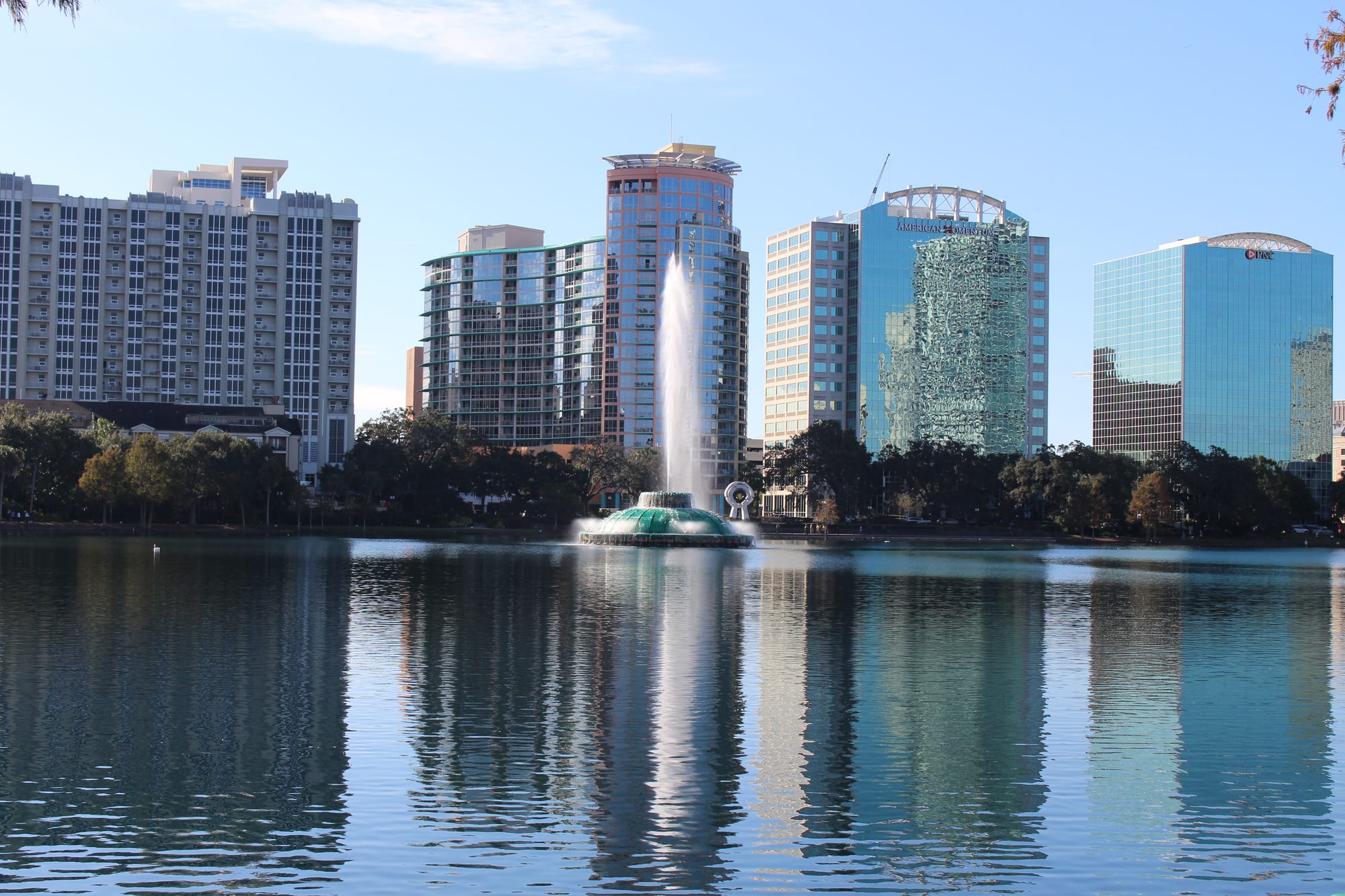
The fountain in Lake Eola sending up a tall jet of water in front of downtown Orlando's glass towers under a clear blue sky

Florida, United States

Orlando

The fountain in Lake Eola, with the towers of downtown Orlando behind it. (Michael Rivera / Wikimedia Commons · CC BY-SA 4.0)

An inland city of lakes in central Florida that grew from a cattle and citrus town into the centre of an area nicknamed the 'Theme Park Capital of the World' after Walt Disney World opened in 1971. Universal Orlando lies inside the city and Disney's resort to the south-west, while a compact downtown of towers around Lake Eola, older lakeside neighbourhoods and a large university complete the picture.

Neighbourhoods

  • Downtown
    • First-time visitors without a car
    • Nightlife
    • Arts and culture

    The historic core and business district, where most of the city's high-rises stand. Church Street keeps the oldest buildings, the Dr. Phillips Center and the Kia Center host shows and the Magic, and Lake Eola Park, with its fountain and swans, is the city's front garden.

    Open in Maps
  • International Drive
    • Theme parks
    • Hotels and restaurants

    An 11-mile tourist strip south-west of downtown, lined with hotels, chain restaurants, outlet malls, the convention centre and attractions such as a giant Ferris wheel. Universal Orlando and SeaWorld lie in the same area.

    Open in Maps
  • Lake Buena Vista and the Disney area
    • Families
    • Theme parks

    The cluster of resorts, shops and roads around Walt Disney World, about 14 miles south-west of downtown. Convenient for days at the parks and for Disney Springs, but almost entirely a visitor district, built for the car.

    Open in Maps
  • Mills 50
    • Best for food
    • Local life

    A neighbourhood just north of downtown, named after the junction of Mills Avenue and Colonial Drive and also known as Little Saigon or Little Vietnam. Vietnamese and other Asian restaurants, grocers and shops line its streets.

    Open in Maps
  • Thornton Park and College Park
    • Quiet and residential
    • Cafés and bars

    Two older residential districts close to downtown. Thornton Park, just east of Lake Eola, has a small cluster of bars and restaurants; College Park, to the north-west, takes its name from streets called after universities and has some of the city's oldest homes.

    Open in Maps
  • Winter Park
    • Museums
    • Shopping and dining
    • Historic homes

    A separate city just north-east of Orlando, home to Rollins College, large historic houses and Park Avenue, a pedestrian-friendly street of shops, restaurants and wine bars.

    Open in Maps

Things to do

Theme parks

  • Walt Disney Worldattraction

    The resort that transformed the region when it opened in October 1971, in Bay Lake about 21 miles south-west of the city, with four theme parks — Magic Kingdom, Epcot, Hollywood Studios and Animal Kingdom — two water parks and the Disney Springs shopping district.

    Open in Maps
  • Universal Orlandoattraction

    The resort that grew from Universal Studios Florida, opened in 1990, and the only theme park resort inside the city limits, with Islands of Adventure, the Volcano Bay water park and the CityWalk entertainment area.

    Open in Maps
  • Epic Universeattraction

    Universal's fourth Orlando park, opened in May 2025 a few miles south of the resort's other parks, with five themed areas including a Super Nintendo World.

    Open in Maps
  • SeaWorld Orlandoattraction

    A marine animal park combined with roller coasters, beside the Aquatica water park and Discovery Cove, just outside the city.

    Open in Maps
  • Gatorlandattraction

    A park founded in 1949 that bills itself as the 'Alligator Capital of the World', with thousands of alligators and crocodiles, a breeding marsh boardwalk and alligator wrestling shows.

    Open in Maps

Downtown and the lakes

  • Lake Eola Parkpark

    The downtown lake and park with its lit fountain, a Chinese pagoda, swans and the Walt Disney Amphitheater, which hosts community events and performances through the year.

    Open in Maps
  • Harry P. Leu Gardenspark

    Botanical gardens of nearly 50 acres beside a lake north-east of downtown, known for their camellias, around a historic house.

    Open in Maps
  • Dr. Phillips Center for the Performing Artsattraction

    The downtown performing arts centre, the main stage for touring Broadway shows and concerts.

    Open in Maps
  • Kia Centerattraction

    The downtown arena of the Orlando Magic basketball team and the Solar Bears ice hockey team, formerly the Amway Center.

    Open in Maps

Museums

  • Orlando Museum of Artmuseum

    The city's art museum in Loch Haven Park, with American paintings and art of the ancient Americas.

    Open in Maps
  • Orlando Science Centermuseum

    A large hands-on science museum in Loch Haven Park with a giant-screen dome theatre and an observatory.

    Open in Maps
  • Orange County Regional History Centermuseum

    Central Florida's history from the Seminole and the citrus groves to the theme parks, in a former county courthouse downtown.

    Open in Maps
  • Charles Hosmer Morse Museum of American Artmuseum

    A museum in Winter Park holding the most comprehensive collection of works by Louis Comfort Tiffany anywhere, alongside American art pottery and paintings.

    Open in Maps

Short trips from the city

  • Wekiwa Springs State Parkpark

    A state park of 7,000 acres north of the city around the spring that feeds the Wekiva River, used for swimming, canoeing and walks.

    Open in Maps
  • Kennedy Space Center Visitor Complexmuseum

    NASA's visitor centre on Merritt Island on the Atlantic coast, with historic spacecraft, the Space Shuttle Atlantis, IMAX theatres and bus tours of the spaceport.

    Open in Maps

Seasonal events

  • Orlando FringeMay

    A two-week open-access theatre festival in Loch Haven Park, founded in 1992 and the oldest still-running fringe festival in the United States.

  • Epcot International Food & Wine Festivalmid-July to mid-November

    Food and drink kiosks themed on countries around the world, set up around Epcot's World Showcase.

  • Halloween Horror Nightsautumn, around Halloween

    Universal Orlando's long-running night-time Halloween event of haunted houses and scare zones, held since 1991.

Eat and drink

Long-standing places and food districts in Orlando. Hours, ratings and directions come from your maps app, always current.

Food districts

  • Mills 50neighborhood

    Orlando's Little Saigon, with pho, bánh mì sandwiches and other Vietnamese and Asian cooking in family-run restaurants.

    Open in Maps
  • Park Avenue, Winter Parkneighborhood

    A walkable street of restaurants, wine bars and cafés in the separate city just north-east of Orlando.

    Open in Maps
  • Disney Springsneighborhood

    Walt Disney World's open-air shopping and dining district, with restaurants of every kind.

    Open in Maps
  • Downtown and Thornton Parkneighborhood

    Bars, brunch places and restaurants around Lake Eola and along the streets just east of it.

    Open in Maps

Experience Orlando

History

The land around Orlando lay within a Seminole reservation created in 1823. During the Second Seminole War the US Army built Fort Gatlin in 1838 between three small lakes just south of today's city, and after the Armed Occupation Act of 1842 the first settlers, the cattleman Aaron Jernigan and his family from Georgia, arrived near Lake Holden. The settlement was first called Jernigan; in 1857 its post office reopened under the name Orlando, whose origin is uncertain — the best-known stories link it to a soldier's grave or to the hero of one of Shakespeare's comedies. The town was laid out around a courthouse square in 1857, incorporated in 1875 and became a city in 1885.

From 1875 to 1895 Orlando was the hub of Florida's citrus industry, until the Great Freeze of 1894–95 ruined many growers. It became a winter resort in the early 20th century and boomed during the land rush of the 1920s, which ended with hurricanes and the Great Depression. The Second World War brought air bases, and in 1956 the defence company Martin Marietta, now Lockheed Martin, opened a plant. McCoy Air Force Base later became Orlando International Airport, which still uses the code MCO.

The decisive moment came in 1965, when Walt Disney announced plans for a resort; Walt Disney World opened in October 1971, followed by SeaWorld, Universal Studios Florida in 1990 and many other parks, and the metropolitan area grew into one of the most visited cities in the United States. On 12 June 2016, 49 people were killed in a mass shooting at Pulse, a gay nightclub in the city; Orlando bought the site in 2023 and is developing a permanent memorial. Universal's Epic Universe opened in 2025.

Culture & Customs

For most of the world, Orlando means theme parks, and the area calls itself the theme park capital of the world. The industry shapes local life too: many residents work in the parks, hotels and restaurants, and locals visit the parks on annual passes. The Orange County Convention Center, the second-largest convention complex in the United States, brings large trade shows and fan conventions such as MegaCon.

Beyond the parks, the city has a lively arts scene centred on Loch Haven Park, home to the art museum and the science centre, and to the Orlando Fringe each May — the oldest fringe theatre festival still running in the United States. The Backstreet Boys and NSYNC were formed in Orlando, and the city also has a prominent metal scene and active hip hop scenes. The Orlando Magic play basketball downtown and Orlando City play football in Major League Soccer.

The population is diverse. Large Puerto Rican and other Latin American communities have made Spanish a common second language, Mills 50 grew around Vietnamese immigrants, and Parramore, west of downtown, is the city's historic African American neighbourhood, built as a segregated community in the 1880s. Since 2016 the city has also been closely identified with the memory of the Pulse victims and with its LGBTQ community.

Daily Life

About 308,000 people lived in the city at the 2020 census, a modest number because the city limits form a patchwork with unincorporated Orange County; the metropolitan area across Orange, Seminole, Osceola and Lake counties had about 2.67 million. Growth has been rapid for decades, and new suburbs keep spreading towards the south and east.

Tourism and conventions dominate the economy, but Orlando is also a centre for military simulation and training, aerospace and defence, and health research at Lake Nona's medical city. The University of Central Florida, on the east side, is one of the largest universities in the country by enrolment, and Darden Restaurants, owner of Olive Garden, has its headquarters here.

Life is suburban and car-based: commuting on Interstate 4 and the toll roads, shopping in large malls and lifestyle centres, and weekends at springs, lakes and the coasts, each about an hour's drive away. The rhythm follows the seasons — mild, dry winters spent outdoors, and summers organised around air conditioning and the daily afternoon storm. Housing costs, traffic and low wages in the service industries are recurring concerns, as are hurricanes: Irma in 2017, Ian in 2022 and Milton in 2024 all caused damage.

Food

Orlando has no single signature dish; its food reflects the people who have settled here and the millions who visit. Mills 50 is the place for Vietnamese cooking — pho, the beef noodle soup, and bánh mì, baguette sandwiches — alongside other Asian restaurants. The large Puerto Rican community has brought mofongo (mashed fried plantain with garlic), pernil (slow-roasted pork) and rice with pigeon peas, and Cuban sandwiches and strong Cuban coffee are easy to find, as across Florida.

Central Florida was once the heart of the citrus industry, and orange juice is still a breakfast staple, while Key lime pie appears on menus everywhere. Near the lakes and swamps, fried alligator tail turns up on Southern-style menus.

Much of the eating happens in the visitor districts. International Drive and the roads around the parks are lined with chain and themed restaurants, and Disney Springs gathers restaurants of every kind. The food festivals inside the parks, above all Epcot's long-running food and wine festival, have become events in their own right. Downtown, Thornton Park and Winter Park's Park Avenue are where residents go out for dinner and drinks.

Planning tools

Budget

Orlando's prices are set by the theme parks: multi-day park tickets are usually the largest single cost, followed by hotels near the parks, which often add resort and parking fees. Rooms on International Drive and in Kissimmee are cheaper than those inside the Disney or Universal resorts, and prices rise during school holidays. Downtown, the lakes and the neighbourhood restaurants cost far less than the parks.

Daily Budget Midrange
USD 250–500 (mid-range hotel with resort fees, restaurant meals with tax and tip, rental car and tolls, one park or attraction a day)
Daily Budget Shoestring
USD 100–170 (motel or hostel away from the parks, Vietnamese and Puerto Rican food, buses, free parks and lakes)

Compare park-ticket options well before travelling, check resort and parking fees when booking, and remember that sales tax and tips are added on top of listed prices.

Best Time to Visit

The weather is best from about November to April, when days are warm, dry and sunny; March and April are particularly pleasant. The busiest times at the parks are the summer holidays, spring break and the weeks around Christmas. From May to October it is hot and humid with almost daily afternoon thunderstorms, and the hurricane season runs from June to November.

Suggested Number of Days

Three or four days covers the city and a park or two. Families visiting several theme parks usually stay a week or more, since each large park fills a whole day, and a trip to the Space Coast adds another.

First Visit
3–4 days
With Surroundings
6–8 days

Transportation

Orlando is spread out and built around the car, and most visitors drive or use ride-hailing; the main roads include Interstate 4 and several toll expressways. LYNX buses cover the metropolitan area, and the SunRail commuter train runs north–south through downtown between DeLand and Poinciana. Walt Disney World and Universal run their own buses and other transport between their hotels and parks.

Rental cars can be fitted with a toll transponder; theme-park car parks charge for parking, so check whether a hotel's own transport is included.

Airport & Station Connections

Orlando International Airport, the busiest airport in Florida, is about 6 miles south-east of downtown, roughly 20–30 minutes by car or taxi, and further from the Disney resort. Brightline trains link the airport with Miami, and some charter and low-cost flights use Orlando Sanford International Airport to the north. Many visitors also arrive by car on Interstate 4 or Florida's Turnpike.

Walkability

Downtown is walkable, from Church Street to Lake Eola and the Thornton Park streets, and Park Avenue in Winter Park is pleasant on foot. Elsewhere the city is a sprawl of wide, busy roads where walking between sights is rarely practical; inside the theme parks, however, visitors walk many miles a day. Summer heat and afternoon storms make long walks tiring.

Safety

The theme parks, resort areas and downtown are busy and generally safe for visitors. The usual risks are theft from cars and hotel rooms, heavy traffic, heat exhaustion in the summer parks, lightning and the occasional hurricane; alligators live in the region's lakes and ponds.

For most visitors the US is safe, with the main risks being petty theft and car break-ins in tourist areas of some cities, road accidents over long distances, extreme weather, and the hazards of the outdoors. Drink plenty of water in the parks, take shelter when thunder sounds, keep away from the edges of lakes and ponds, and follow official instructions if a hurricane approaches. Check current official travel advice before travelling.

Climate

Humid subtropical, with two main seasons: a hot, rainy season from May to late October, with strong afternoon thunderstorms almost every day, and a mild, dry season from November to April. The city is more than 40 miles from either coast, so hurricanes usually weaken before reaching it, but some, such as Milton in 2024, still cause damage.

Summer
hot and humid — highs typically in the low 90s °F, with afternoon thunderstorms
Winter
mild and sunny — January averages about 61°F, with occasional brief cold snaps and frost on only one or two nights a year

Local Customs

Tipping is expected: roughly 18–22 per cent in restaurants and about a dollar a drink at a bar, and many visitors also tip hotel housekeeping and drivers. Sales tax is added at the till. Dress is casual almost everywhere. Spanish is widely heard, reflecting the region's large Puerto Rican and other Latin American communities.

Identification is asked for when buying alcohol (the legal age is 21). Theme parks set their own rules on bags and costumes, so check them before visiting.

Common Payment Methods

The currency is the US dollar. Cards and contactless payment are accepted almost everywhere, and some venues no longer take cash at all. A little cash is useful for tips and small purchases; ATMs are easy to find.