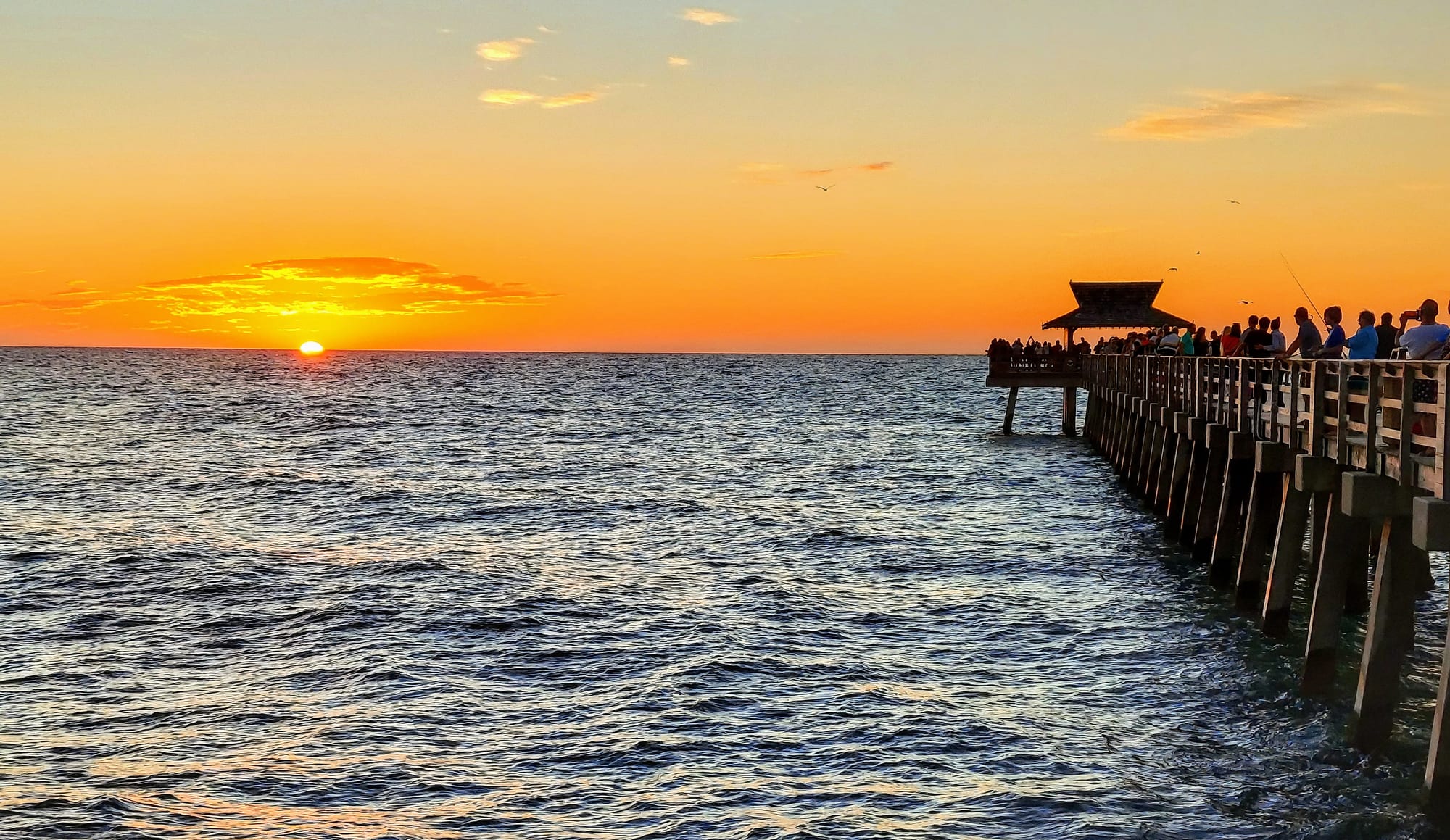
The sun setting into the calm Gulf of Mexico beside a long wooden pier lined with people watching from the rail

Florida, United States

Naples

Sunset over the Gulf of Mexico from the beach beside the Naples Pier. (P. Hughes / Wikimedia Commons · CC BY-SA 4.0)

A small, wealthy city on Florida's south-west Gulf coast, founded in 1886 by Kentucky investors who compared its bay to the Bay of Naples in Italy. Long white beaches, a historic pier, palm-lined shopping streets and dozens of golf courses draw winter visitors and retirees, and the mangroves and swamps of the western Everglades begin just south and east of town.

Neighbourhoods

  • Old Naples
    • First-time visitors
    • Beaches
    • Historic district

    The oldest part of town, between the Gulf beach and Naples Bay, around the pier and Palm Cottage, the town's oldest house. Fifth Avenue South and Third Street South hold most of the boutiques, galleries and restaurants, and the beach is a few blocks' walk away.

    Open in Maps
  • Naples Bay, Port Royal and Tin City
    • Boating
    • Waterfront
    • Quiet and residential

    The sheltered bay east of Old Naples, where Port Royal was dredged in the 1950s into peninsulas of waterfront houses on streets with pirate names such as Rum Row and Galleon Drive. Tin City, built as a fishermen's wharf on the river, is now also a cluster of shops and seafood restaurants.

    Open in Maps
  • Park Shore and Pelican Bay
    • Arts and culture
    • Shopping
    • Beaches

    Affluent districts of high-rise condominiums and waterfront homes north of the centre, built up from the 1960s onward. The Artis—Naples arts campus with the Baker Museum, the Waterside Shops and the mangrove boardwalk to Clam Pass beach are here.

    Open in Maps
  • Vanderbilt Beach and North Naples
    • Beaches
    • Families

    A beach community about nine miles north of the centre, with a long public beach, beachfront towers and the Mercato shopping and dining complex inland. Delnor-Wiggins Pass State Park lies at its northern end.

    Open in Maps

Things to do

Beaches and the Gulf

  • Naples Pierlandmark

    The town's best-known landmark, first opened in 1888 and rebuilt several times, a favourite place for fishing and for watching dolphins and the sunset; it was badly damaged by Hurricane Ian in 2022.

    Open in Maps
  • Lowdermilk Beach Parkbeach

    One of the city's public beaches, part of a run of white sand more than ten miles long.

    Open in Maps
  • Clam Pass Parkbeach

    A beach reached by a boardwalk of about three-quarters of a mile through red, white and black mangroves, in a park protecting 35 acres of coastal habitat.

    Open in Maps
  • Vanderbilt Beachbeach

    A long public beach in North Naples with lifeguards, showers and an observation tower, running north towards Wiggins Pass.

    Open in Maps
  • Delnor-Wiggins Pass State Parkbeach

    A state park on a barrier island, with a beach, access to the Cocohatchee River and the Gulf, and a hard-bottom reef.

    Open in Maps

Gardens, zoo and museums

  • Naples Botanical Gardenpark

    A 170-acre botanical garden of tropical and subtropical plants, about 50,000 of them, given the American Public Gardens Association's Award for Garden Excellence in 2017.

    Open in Maps
  • Naples Zoo at Caribbean Gardensattraction

    A 43-acre zoo set in a tropical garden first planted in 1919, where primates live on islands in a lake and are seen from boats.

    Open in Maps
  • Baker Museummuseum

    The art museum of the Artis—Naples campus, opened in 2000, with American modernism, 20th-century Mexican art and sculpture, beside the hall of the Naples Philharmonic.

    Open in Maps
  • Palm Cottagemuseum

    The oldest house in Naples, built in 1895 of tabby mortar a block from the pier, now a house museum of the Naples Historical Society with gardens beside it.

    Open in Maps
  • Naples Depotmuseum

    The former Seaboard Air Line Railway station on Fifth Avenue South, where passenger trains stopped until 1971, now the Naples Depot Museum.

    Open in Maps

Streets and the waterfront

  • Fifth Avenue Southneighborhood

    The main street of Old Naples, lined with palms, shops, galleries, sidewalk cafés and restaurants a few blocks from the beach.

    Open in Maps
  • Third Street Southneighborhood

    A second historic shopping street near the Gulf, with clothing and gift shops, galleries, fountains and sculptures.

    Open in Maps
  • Tin Citymarket

    A fishermen's wharf on the river near Naples Bay, now also an open-air cluster of shops selling antiques and local crafts, with seafood restaurants by the water.

    Open in Maps
  • Baker Parkpark

    A riverside park near Fifth Avenue that opened in 2019, linked to the Gordon River Greenway path.

    Open in Maps

Short trips into the Everglades and the islands

  • Corkscrew Swamp Sanctuarypark

    A National Audubon Society sanctuary protecting one of the largest remaining stands of bald and pond cypress in North America, part of it old-growth forest.

    Open in Maps
  • Rookery Bay National Estuarine Research Reservepark

    About 110,000 acres of coastal land and water at the northern end of the Ten Thousand Islands, one of the few undisturbed mangrove estuaries left in North America.

    Open in Maps
  • Collier–Seminole State Parkpark

    Mangrove and cypress swamp and salt marsh on the Tamiami Trail south of Naples, with a canoe trail through the mangroves and the walking dredge used to build the road.

    Open in Maps
  • Marco Islandbeach

    The largest barrier island of the Ten Thousand Islands area, about 14 miles south of Naples, a beach town whose population more than doubles in winter.

    Open in Maps
  • Fakahatchee Strand Preserve State Parkpark

    A long forested swamp strand in the Big Cypress Swamp, running down to the mangroves and salt marshes of the Ten Thousand Islands.

    Open in Maps
  • Big Cypress National Preservepark

    A 720,000-acre preserve of cypress swamp and prairie, one of the first two national preserves in the country when it was created in 1974.

    Open in Maps
  • Everglades National Parkpark

    The national park protecting the southern fifth of the original Everglades; its western coast and the Ten Thousand Islands are reached only by boat, and a visitor centre near Everglades City serves the west side.

    Open in Maps

Seasonal events

  • U.S. Open Pickleball ChampionshipsApril

    A pickleball tournament held every year since 2016 at East Naples Community Park, drawing thousands of players and tens of thousands of spectators.

  • CME Group Tour ChampionshipNovember

    An LPGA women's golf tournament with one of the largest purses in the women's game, held in Naples since 2012 and played at the Tiburón Golf Club.

  • Swamp buggy racesthree times a year

    Races of high-wheeled swamp vehicles through mud at the Florida Sports Park — the swamp buggy was invented in Naples, and the races began in 1949.

Eat and drink

Long-standing places and food districts in Naples. Hours, ratings and directions come from your maps app, always current.

Naples classics

  • Tin City seafood restaurantsneighborhood

    Seafood restaurants on the old fishermen's wharf by the river, with Gulf fish and shellfish served beside the boats.

    Open in Maps
  • Stone crab clawsrestaurant

    Cold stone crab claws served with mustard sauce, a Florida speciality in season from October to May.

    Open in Maps

Food districts

  • Fifth Avenue Southneighborhood

    The town's main dining street, with sidewalk bistros, pubs and seafood and steak houses under the palms.

    Open in Maps
  • Third Street Southneighborhood

    Cafés and restaurants among the galleries and boutiques of Old Naples, a short walk from the beach.

    Open in Maps
  • Mercatoneighborhood

    A shopping and dining complex in North Naples at Vanderbilt Beach Road and the Tamiami Trail, busy in the evenings.

    Open in Maps

Experience Naples

History

For thousands of years before European colonisation the Calusa lived along this coast, from Charlotte Harbor to Cape Sable. Juan Ponce de León met them in 1513, and they resisted the first Spanish attempts to settle Florida. In the early 18th century slave raids by Muscogee and Yamasee raiders allied with Carolina's settlers drove most of the remaining Calusa south and east.

Naples was founded in 1886 by John Stuart Williams, a former Confederate general and senator from Kentucky, and the Louisville newspaper publisher Walter N. Haldeman. Magazines of the 1870s and 1880s had praised the area's mild climate and abundant fish and compared it with Italy, and promoters claimed the bay surpassed the Bay of Naples, so the name stuck. In 1888, with about 80 residents, the town opened its pier. Collier County was created in 1923, the railway arrived in 1927 and the Tamiami Trail linked Naples to Miami in 1928, but the expected boom was delayed by the Depression and the Second World War, when the army built an airfield that is now the town's airport.

Naples became a city in 1949. In the 1950s the Chicago advertising pioneer John Glenn Sample dredged Naples Bay into the canals of Port Royal, and similar waterfront districts followed. Passenger trains stopped in 1971. Hurricanes have marked recent decades: Wilma in 2005, Irma in 2017, which came ashore at Marco Island, Ian in 2022, which hit Naples hard, wrecked the pier and caused close to a billion dollars of damage in the city, and Milton in 2024.

Culture & Customs

Naples calls itself the "Golf Capital of the World", with more golf holes than any other city in Florida and the second most per head in the country, and the LPGA's CME Group Tour Championship has been played here since 2012. Pickleball has spread so fast that the U.S. Open Pickleball Championships have been held at East Naples Community Park every year since 2016, earning the town the title of the sport's world capital. An older, homegrown sport is the swamp buggy race: the high-wheeled vehicles were invented in Naples for crossing the Everglades, and racing them through mud began after a parade in 1949.

The town supports an arts scene unusually large for its size. The Naples Philharmonic and the Baker Museum share the Artis—Naples campus, and the Naples Players, Gulfshore Playhouse, Opera Naples and a Shakespeare festival stage seasons; Gallery Row and the streets of Old Naples are lined with commercial galleries.

The tone is set by retirees and winter visitors, the snowbirds who have long shaped Florida's Gulf Coast. Life is quiet, outdoor and orderly — beach walks at sunset, boating, fishing and golf — and wealth is evident in the waterfront estates and the many charitable organisations. The nearness of the Everglades and the Ten Thousand Islands also makes the town popular with ecotourists.

Daily Life

About 19,000 people lived in the city at the 2020 census, and about 376,000 in the wider Naples–Marco Island metropolitan area, which takes in the suburbs of Collier County. The city's population is among the oldest in the country: the median age was 67, more than half of residents were 65 or over, and nearly half of all housing units were recorded as vacant — seasonal homes empty for much of the year.

Tourism is the economic base, as real estate and farming once were. Collier County is one of the wealthiest areas in the United States — a 2012 report ranked Naples second in the country for its share of millionaires — and that wealth supports many small non-profit organisations. Two hospital systems serve the area, and inland Immokalee, in the east of the county, is home to many migrant farmworkers and their families.

The year has two rhythms. From December to April roads, restaurants and golf courses are crowded; in summer the heat and afternoon storms empty the town. Hurricanes are the defining worry, and soaring home-insurance costs after repeated storms weigh on residents across Florida.

Food

Seafood from the Gulf is the core of eating in Naples. Grouper, served grilled, blackened or fried in a sandwich, shrimp and smoked fish dip appear on menus all along the Gulf coast. Stone crab claws, cracked and served cold with a mustard sauce, are the luxury of the season from October to May.

Tin City, the old fishermen's wharf on the river, keeps waterside seafood restaurants, and boats still bring in catches from the Gulf and the mangrove waters to the south. Fifth Avenue South and Third Street South hold many of the town's restaurants, from pubs and sidewalk bistros to steak houses and fine dining, and a beach bar at sunset is a local habit.

Florida's own desserts and drinks are everywhere: Key lime pie, the state pie, made with the juice of small, tart limes set with condensed milk in a crumb crust, and fresh orange juice.

Planning tools

Budget

Naples is an expensive town. Prices are highest from December to April, when winter visitors and part-year residents fill the town, and fall in the hot, stormy summer. Beachfront rooms cost far more than motels inland along the Tamiami Trail, and a hire car is close to essential.

Daily Budget Midrange
USD 260–500 (mid-range hotel with resort fees, restaurant meals with tax and tip, hire car and parking, one attraction a day)
Daily Budget Shoestring
USD 120–200 (inland motel, diners and casual seafood, public beaches, shared hire car)

Visit in late spring or autumn for lower room rates; the beaches, the pier area and the walk along Fifth Avenue South cost nothing.

Best Time to Visit

November to April is the dry season, with sunshine and daytime highs around the mid-70s °F, and it is also the busiest and dearest time. From May to October it is hot and wet, with afternoon thunderstorms, but the beaches are quieter; this is also the hurricane season.

Suggested Number of Days

Two or three days cover the town and its beaches. Allow four to six for boat and swamp trips into the Everglades and the Ten Thousand Islands, or for a beach holiday at an easier pace. Without a car, more time is needed.

First Visit
2–3 days
With Surroundings
4–6 days

Transportation

The town is spread along US 41, the Tamiami Trail, and Interstate 75 runs inland parallel to the coast. A hire car is the practical way to get around; Collier Area Transit runs local bus routes seven days a week, and many main roads have bike lanes. Old Naples itself is easy to manage on foot or by bicycle.

Beach car parks fill early in the high season, above all at Delnor-Wiggins Pass State Park; arriving early saves a long wait.

Airport & Station Connections

Most visitors fly into Southwest Florida International Airport, south-east of Fort Myers in neighbouring Lee County, which serves the whole region with domestic and international flights; the drive south on Interstate 75 takes roughly 45 minutes to an hour. Naples Airport, close to the centre, has no scheduled airline service. Many visitors drive from Miami across the Everglades on the Tamiami Trail.

Walkability

Old Naples is pleasant on foot: the pier, the beach, Fifth Avenue South and Third Street South are a few blocks apart on shaded streets. Beyond it the city is long and low, and the beaches, gardens and shopping districts to the north are a drive apart. Summer heat makes long walks hard in the middle of the day.

Safety

For most visitors the US is safe, with the main risks being petty theft and car break-ins in tourist areas of some cities, road accidents over long distances, extreme weather, and the hazards of the outdoors. In Naples the main hazards are natural. Hurricanes have struck the area repeatedly — Ian in 2022 hit the city hard and caused close to a billion dollars of damage there — and lightning, rip currents, strong sun and alligators in lakes and canals are the everyday risks.

Follow evacuation orders during hurricanes, swim at lifeguarded beaches, keep away from the edges of freshwater ponds and canals, and leave the beach when thunder sounds. Check current official travel advice before travelling.

Climate

A tropical savanna climate, normally frost-free. There are two seasons: a hot, wet season from May to October with frequent thunderstorms, and a dry, sunny season from November to April. Hurricane season runs from June to November.

Summer
hot and wet — average highs around 92°F, with frequent afternoon thunderstorms
Winter
dry and sunny — daily highs around 74°F, with cooler evenings

Local Customs

Tipping of 18–22 per cent is expected in restaurants, and sales tax is added at the till. Dress is casual-smart: beachwear stays on the beach, and the restaurants of Fifth Avenue and Third Street are a step more formal than the beach bars. Many residents are retirees and seasonal residents, and the town is quiet in the evenings outside the main dining streets.

Identification is asked for when buying alcohol (the legal age is 21). Fishing from the beach and the pier is popular; check local rules on licences and protected wildlife such as sea turtles and manatees.

Common Payment Methods

The currency is the US dollar. Cards and contactless payment are accepted almost everywhere, and some places no longer take cash. ATMs are easy to find; a few small bars and fishing shops prefer cash.