Attractions & Natural Wonders · Norway
What causes the northern lights?
Energy from the Sun's wind, stored in Earth's magnetic field, fires electrons into the upper air, where oxygen and nitrogen glow green, red and violet.
By Globeway Editorial · 13 October 2026
The short answer
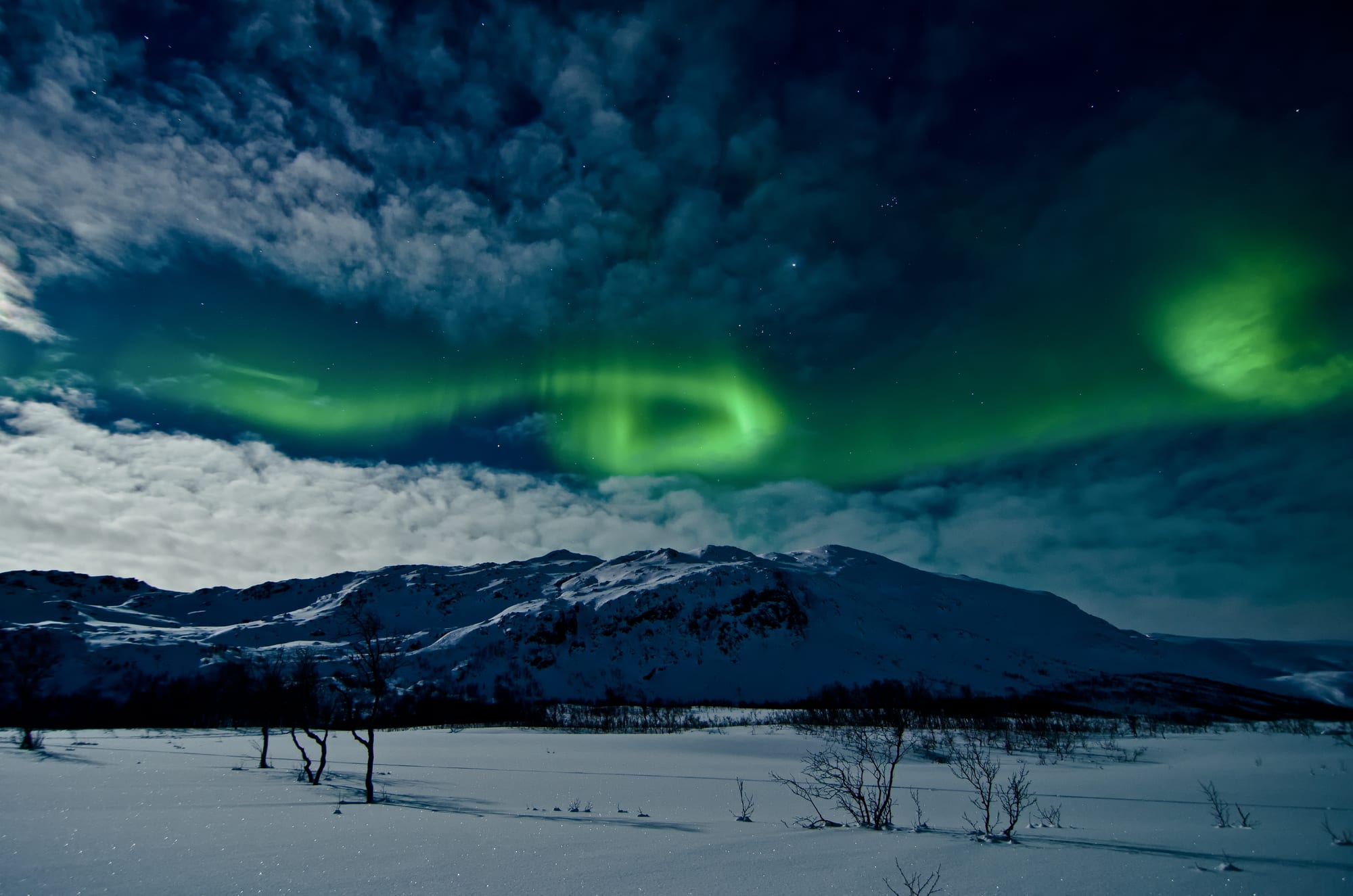
The northern lights are a glow in the upper atmosphere, usually around 100 kilometres up, made when fast-moving electrons crash into oxygen and nitrogen. The collisions give those gases extra energy, which they release as light: oxygen glows green or red, nitrogen blue, purple or red. The energy behind it all comes from the Sun, which constantly blows a stream of charged gas, the solar wind, past the Earth.
Earth's magnetic field shields the planet from most of that wind, but it captures some of its energy, especially when the Sun throws out bursts of material. That stored energy accelerates electrons already trapped in the magnetic field and steers them down along the field lines into the atmosphere near the magnetic poles. That is why the lights appear mostly in a ring around the Arctic, the auroral zone, and why places such as Tromsø in northern Norway, which lies inside it, see them so often.
A wind from the Sun
The Sun's outermost layer, the corona, is so hot, about one to three million degrees, that it boils off a steady flow of electrically charged gas, or plasma, in all directions. This solar wind reaches Earth at typically around 400 kilometres a second, carrying the Sun's magnetic field with it. Earth is immersed in it all the time.
The wind is not steady. Faster streams pour out of coronal holes, open regions in the corona, and coronal mass ejections fling huge clouds of plasma into space. When such a disturbance hits Earth, it causes a geomagnetic storm, and auroras grow brighter and spread further from the poles. Auroras are more frequent and brighter in the busy phase of the Sun's roughly 11-year cycle of activity, when coronal mass ejections are common.
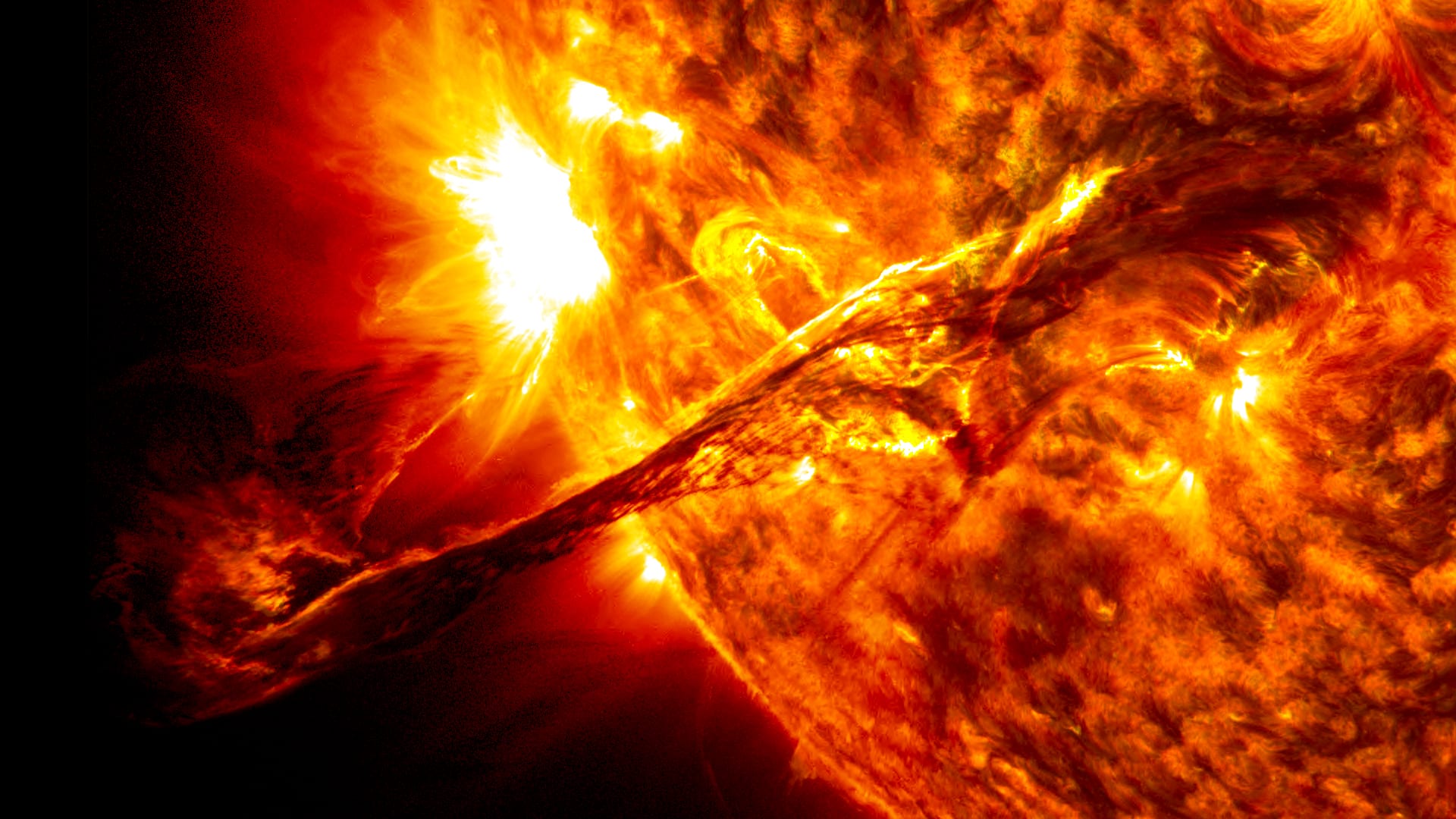
This eruption sent out particles and a shock wave that travelled near Earth. Disturbances of this kind in the solar wind are what set off geomagnetic storms and the brightest auroras.
Earth's magnetic shield, and its leaks
Earth's magnetic field forms a protective bubble, the magnetosphere, which diverts the solar wind at an average distance of about 70,000 kilometres on the side facing the Sun. On the night side the wind stretches the field into a long tail extending more than 200 times Earth's radius into space.
The shield leaks most when the magnetic field carried by the solar wind points southward. Its field lines then join up with Earth's, a process called magnetic reconnection, and the solar wind drags magnetic energy around to the night-side tail. Eventually part of the stretched tail breaks apart: some of its plasma is carried away, and some is squeezed back towards Earth, feeding strong outbursts of aurora, mostly around midnight. In February 2008 the THEMIS space probes caught this trigger for the first time, measuring a reconnection event 96 seconds before the aurora brightened.
A common simplification is that particles from the Sun hit the air directly. In fact the electrons that light up the sky do not travel straight from the solar wind. They start out trapped in Earth's magnetic field, bouncing back and forth along its field lines. In the brightest, sharpest displays, electric fields 4,000 to 12,000 kilometres up accelerate many of them down the field lines at much higher energy, and they slam into the atmosphere; in softer, diffuse auroras, waves in the plasma knock them out of their trap. The Sun supplies the power, but the electrons reach the air by way of Earth's magnetic field rather than straight from the Sun.
Why green, and sometimes red or purple
When an electron hits an oxygen atom or a nitrogen molecule, it lifts it into an excited state, and the atom or molecule gives the energy back as a flash of light of a particular colour. From 1911 the Norwegian scientist Carl Størmer and his colleagues photographed and triangulated more than 12,000 auroras. They found none below 70 kilometres, only 6.5 per cent above 150 kilometres, and the most around 100 kilometres.
Height decides the colour. Green, the most common, comes from oxygen atoms at around 100 kilometres and above. Higher still, where the air is thinnest, oxygen glows red, but it takes up to two minutes to release that red light, so it only appears where atoms are too few to bump into each other first. Lower down, the air is too dense even for green, and nitrogen produces the blue and purple seen on the lower edges of the brightest curtains, mainly when solar activity is at its highest. Pink and yellow are mixtures of these.
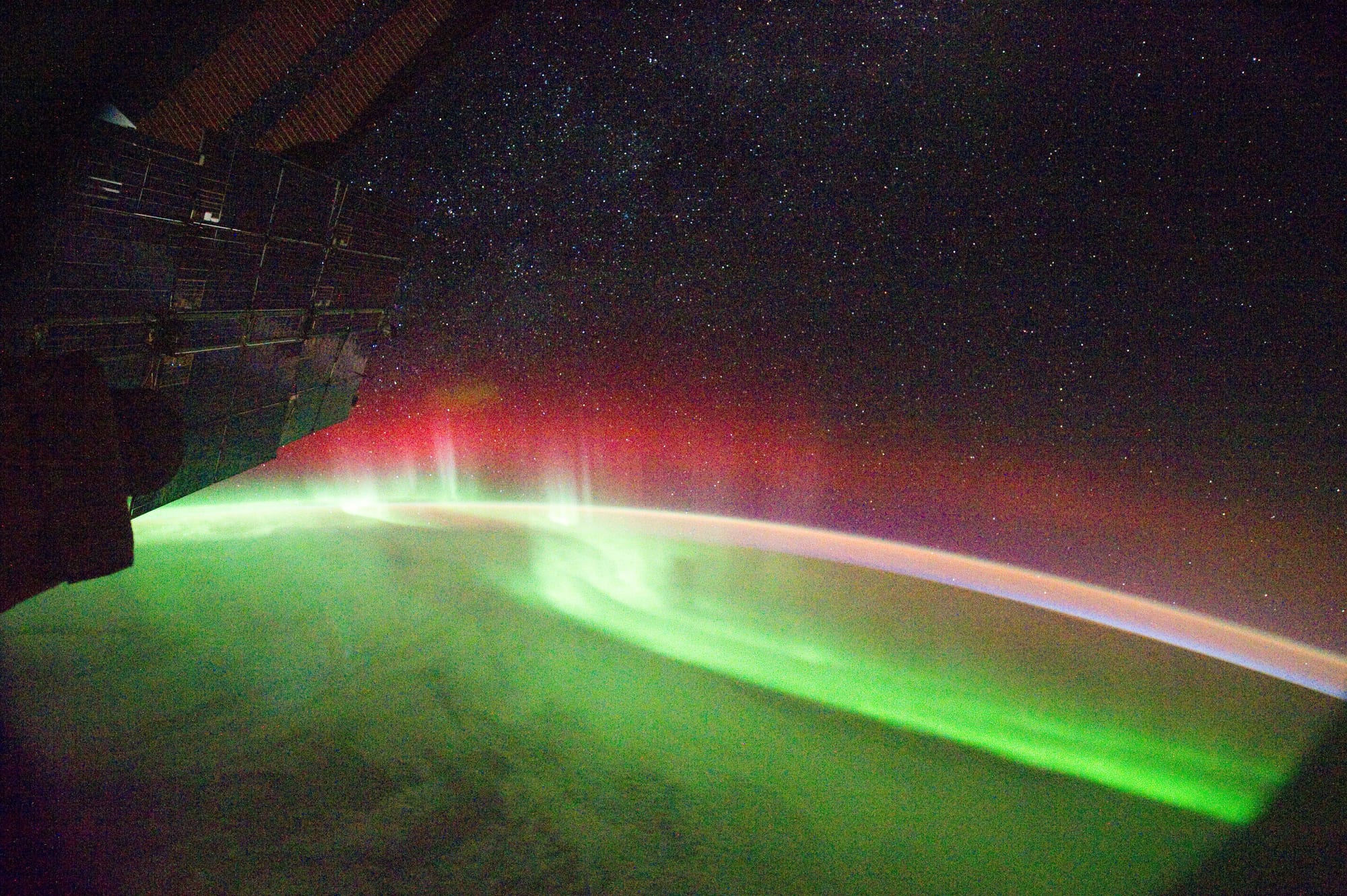
Seen from orbit, the layers are obvious: the green band sits lower in the atmosphere, with the fainter red of high-altitude oxygen above it.
The Norwegian who worked it out
People have offered explanations for a very long time. A Norwegian text from around 1230, the King's Mirror, which contains the first Scandinavian mention of the northern lights, suggested they might be fires surrounding the ocean, sunlight reaching round to the night side, or glaciers giving off stored energy. In Sami belief the lights were caused by the blood of the dead spilling across the sky.
The modern answer owes most to Kristian Birkeland, a physicist in Kristiania, now Oslo. In his experiments he fired a beam of electrons at a terrella, a magnetised model Earth inside a vacuum chamber, and saw rings of light form around its poles. He proposed that electrons from the Sun were guided by Earth's magnetic field to the polar regions, essentially the theory accepted today, and that currents flowed along the field lines into and out of the polar atmosphere. Many leading scientists dismissed the idea for half a century. It was confirmed only in 1967, when data from a US Navy satellite launched in 1963 revealed the field-aligned currents, now called Birkeland currents.
Seeing the lights from Tromsø
The aurora is most often seen in the auroral zone, a band about 6 degrees of latitude wide centred on 67 degrees north and south. Tromsø, on the island of Tromsøya more than 300 kilometres north of the Arctic Circle, sits inside it, and its Northern Lights Observatory was founded in 1927. The lights are there all year, but summer nights are too bright to show them: between late April and mid-August no aurora is visible. The polar night, when the Sun stays below the horizon, lasts from 28 November to 14 January. Being on the coast, Tromsø is often cloudy, which can hide a display even when one is happening.
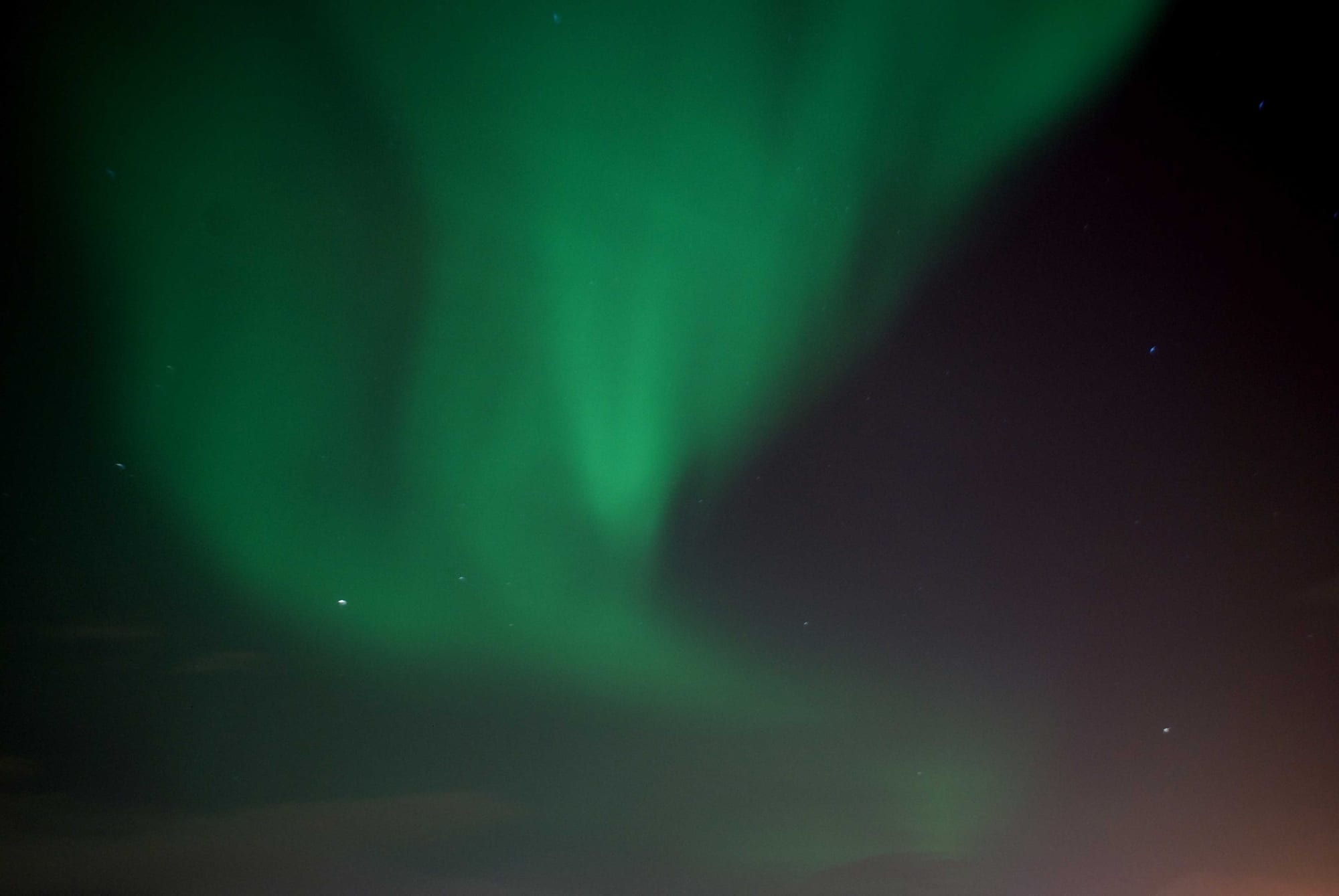
Large geomagnetic storms are most common at the peak of the solar cycle and in the three years after it. The current cycle peaked in October 2024, and in May 2024 a series of solar storms made the northern lights visible as far south as Ferdows in Iran. Storms may also be more frequent in the months around the equinoxes.