History · Mauritius
What happened to the dodo of Mauritius?
Within a lifetime of the first Dutch landing in 1598 the dodo was gone, finished less by hungry sailors than by the pigs, monkeys and axes they brought.
By Globeway Editorial · 13 October 2026
The short answer
The dodo died out. It was a large, flightless relative of pigeons that lived only on Mauritius, an island east of Madagascar in the Indian Ocean. Dutch sailors first recorded it in 1598, and the last sighting most experts accept was in 1662. By 1700 at the latest, about a century after people first saw it, the species was gone.
Hunting played a part, but it was not the main cause. The few people who lived on Mauritius brought pigs, macaque monkeys, dogs, cats and rats, which raided the dodo's nests on the ground and competed for its food, while settlers cut down the forests it lived in. A bird that laid a single egg and had never needed to fear anything could not survive that combination.
A pigeon that stopped flying
The dodo's closest living relative is the Nicobar pigeon of Southeast Asia, and its closest relative of all was the Rodrigues solitaire, another extinct flightless bird from a neighbouring island. Their ancestors could fly, and probably reached the Mascarene Islands, a young volcanic chain less than 10 million years old, by hopping from island to island.
On Mauritius there were no mammal predators and no large plant-eating mammals competing for food. With plenty to eat on the ground and nothing to flee from, the bird grew big and gave up flight. Bones show it stood about 62.6 to 75 centimetres tall and probably weighed 10.6 to 17.5 kilograms in the wild. It nested on the ground, and one account says it laid only one egg at a time.
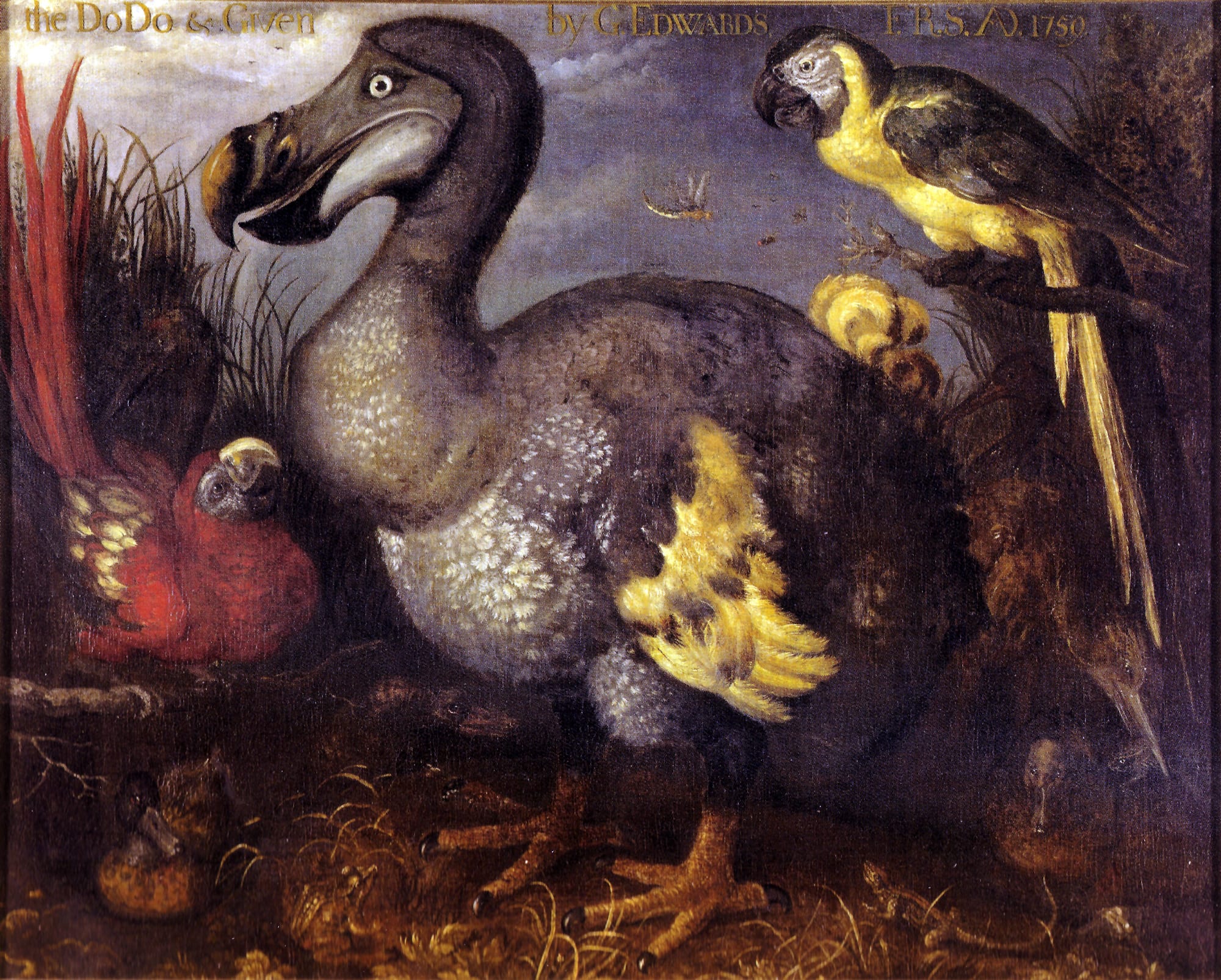
The famous image of a fat, clumsy bird is probably wrong: many European paintings were based on overfed captive birds or badly stuffed specimens, and its leg bones suggest it could run quite fast.
Sailors, pigs and monkeys
Arab and Portuguese ships had called at Mauritius before, but nobody settled there and no record of the dodo survives from those visits. The Dutch claimed the island in 1598 and used it to resupply ships of the Dutch East India Company. The crews had been at sea for months, and their interest in the big birds was mostly culinary. One journal from 1602 records 24 or 25 dodos taken for food on a single visit, the meat preserved with salt. The Dutch nickname walghvogel roughly meant "tasteless bird".
Like many animals that evolved without predators, the dodo had no fear of people, and it could not fly away. Even so, archaeologists have found little evidence of large-scale hunting. In the 17th century the human population of Mauritius, an island of 1,860 square kilometres, never rose above 50 people.
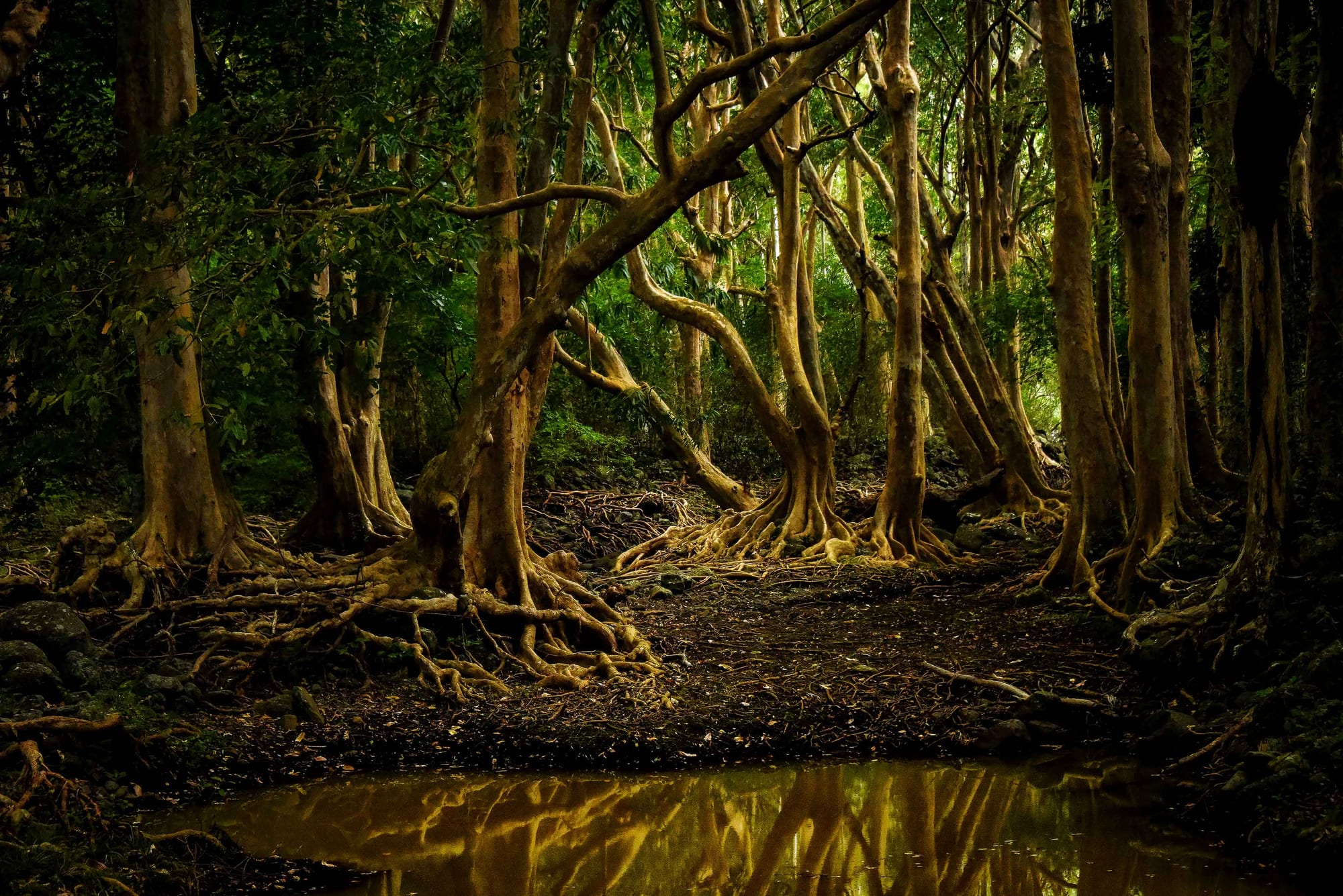
The real damage came from what those people brought with them. Pigs and crab-eating macaques plundered nests and competed for the limited food, and their impact is now considered more severe than that of hunting. At the same time, settlers felled the island's forests, which once covered all of Mauritius. The dodo may already have been rare or confined to a small area before people arrived. Its remains suggest it lived mainly in the drier coastal woods of the south and west, and a species with a small range has little room to retreat.
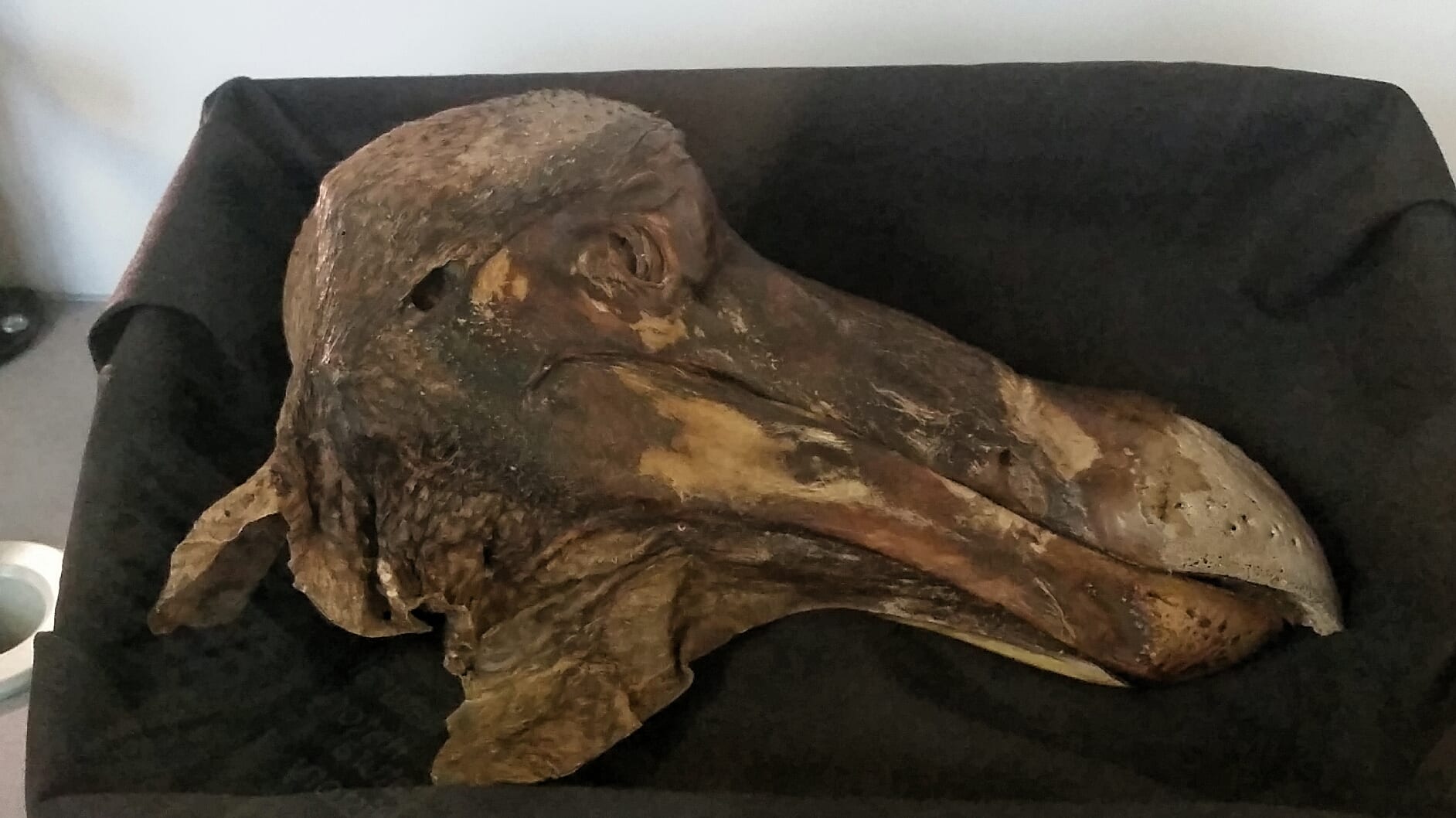
Some live dodos were shipped abroad. At least eleven probably reached their destinations alive, in Europe and in Asia, and one was exhibited in a London chamber around 1638, where its keeper fed it pebbles. The Oxford head comes from the last known stuffed dodo, recorded in a collection in 1656. Scans reported in 2018 found lead shot in its skin and bone, so that bird was shot, although nobody knows where.
When did the last one die?
Nobody can say exactly. The last widely accepted sighting is the 1662 account of Volkert Evertsz, a shipwrecked sailor from the Dutch ship Arnhem, who described birds caught by hand on a small islet off Mauritius, now thought to be Amber Island. Later reports exist, the last from the hunting records of the Dutch governor Isaac Johannes Lamotius in 1688, and one statistical study estimated extinction in 1693.
The difficulty is the name. After the dodo vanished, settlers seem to have transferred the word "dodo" to the red rail, a smaller flightless bird of Mauritius. The researchers Anthony Cheke and Jolyon Parish argued in 2020 that every later mention of dodos really refers to red rails, and that the dodo was finished off by feral pigs while the Dutch had left the island, between 1658 and 1664. The returning settlers expected flightless birds and gave the old name to the one they found. The IUCN Red List accepts 1662 as the last credible record.
- 1598
Dutch ships reach Mauritius; the first written accounts of the dodo follow.
- 1638
The Dutch East India Company founds its first permanent settlement.
- 1658
The settlers abandon the island for several years.
- 1662
Volkert Evertsz describes dodos on an islet, the last widely accepted sighting.
- 1688
The last claimed sighting, in Governor Lamotius's hunting records.
- 1710
The Dutch leave Mauritius for good; the dodo is long gone.
From myth to icon of extinction
Strangely, nobody noticed at the time. Rarity had been reported in the 17th century, but the extinction was not recognised until the 19th. Many people then did not believe a species could vanish, until the naturalist Georges Cuvier showed that it could, and many scientists doubted the dodo had ever been real. It seemed too odd a creature to be true.
The evidence was thin: a dried head and foot in Oxford, a foot in London, a skull in Copenhagen and part of a jaw in Prague. That changed in 1865, when George Clark, a schoolmaster at Mahébourg, found masses of bones in the Mare aux Songes, a swamp near the sea in south-eastern Mauritius. It eventually yielded the remains of more than 300 dodos. The same year, Lewis Carroll put a Dodo into Alice's Adventures in Wonderland, and the bird became famous as a symbol of extinction, as in the phrase "dead as a dodo".
The dodo in Mauritius today
The dodo is everywhere in Mauritius except the forest. It stands on the national coat of arms as a supporter holding up the shield, and the national football team is nicknamed the Dodos. The Natural History Museum in Port Louis has a gallery called The World of the Dodo, and it holds the only known complete skeleton of a single dodo, discovered in 1904 in a cave near Le Pouce mountain by the amateur naturalist Louis Étienne Thirioux.
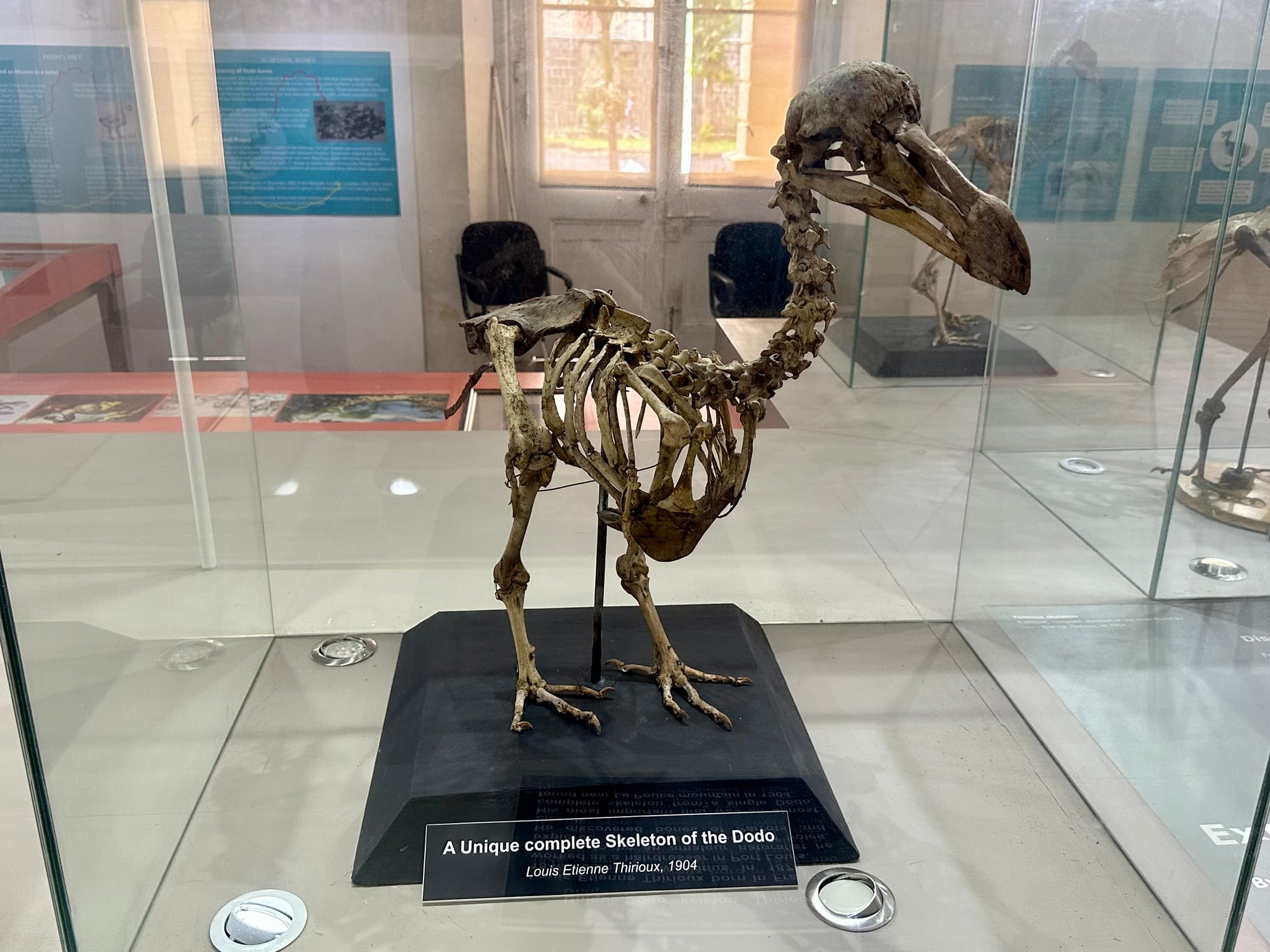
Most dodo skeletons in museums around the world are composites, assembled from the loose bones of several birds. Excavations at the Mare aux Songes since 2005 suggest that many of those animals became stuck in the mud while searching for water during a long, severe drought about 4,200 years ago, long before any person set foot on the island.
The red rail, the broad-billed parrot, two species of giant tortoise and many other animals unique to Mauritius vanished too, and very little of the original forest survives.
The dodo also left a gap: as a large fruit-eater, it probably helped spread the seeds of native plants, a job no introduced animal has taken over in the same way.