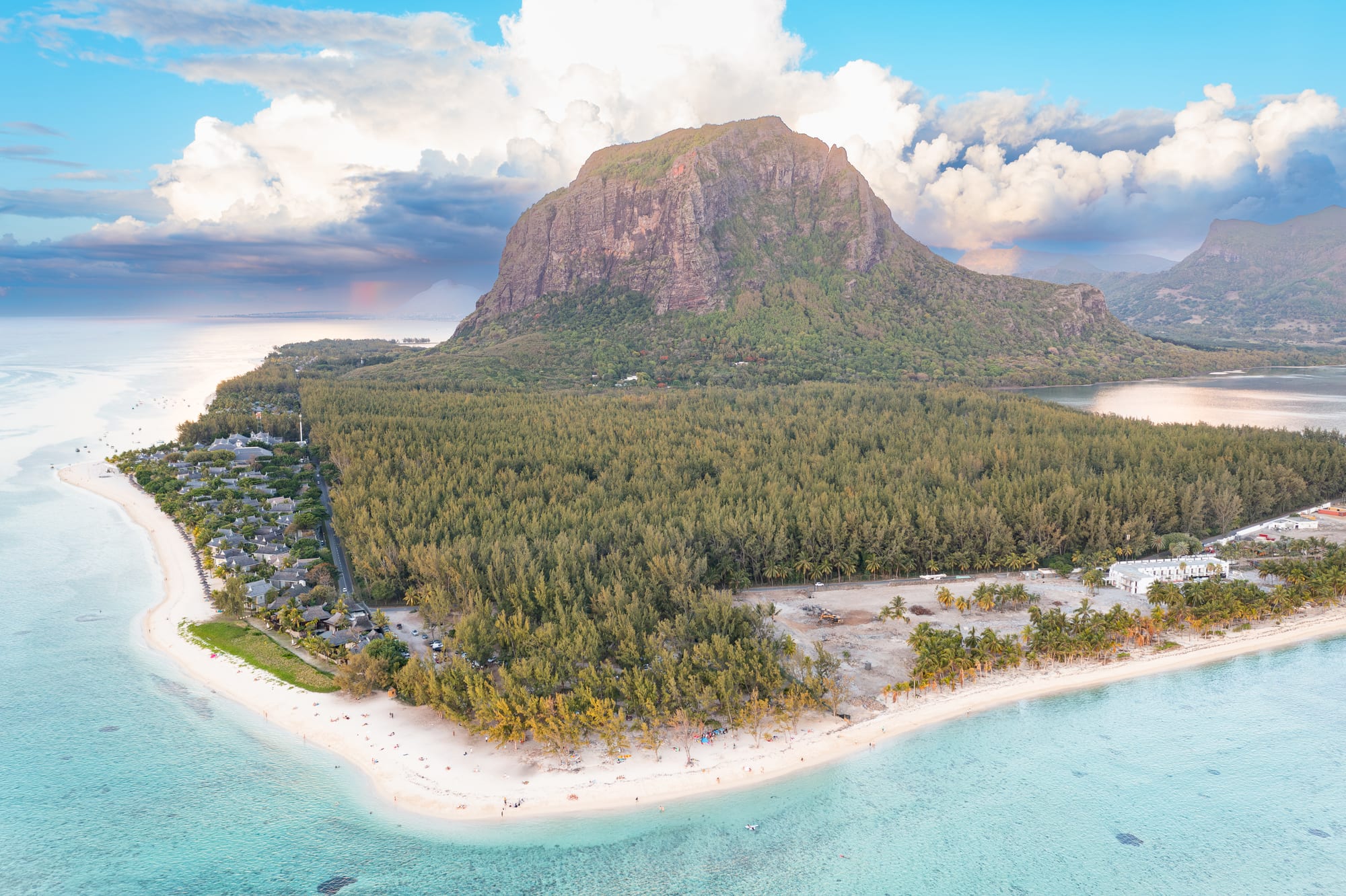
An aerial view of a dark basalt mountain on a green peninsula ringed by brilliant turquoise lagoon and pale reef

Mauritius

Le Morne Brabant, the UNESCO-listed mountain in the southwest long remembered as a refuge for runaway slaves, above its lagoon. (dronepicr / Wikimedia Commons · CC BY 2.0)

A volcanic island in the Indian Ocean, ringed by coral lagoons, with no indigenous population — a plural society built by Dutch, French, and British colonisation, African slavery, and Indian indenture, and one of Africa's steadiest democracies.

Explore Mauritius

History

Mauritius had no human population until the modern era. A Dutch squadron claimed the island in 1598 and named it after Prince Maurice of Nassau; the Dutch settled it from 1638, cut its ebony forests, introduced sugarcane and Javanese deer, and saw the flightless dodo hunted and driven to extinction before abandoning the island in 1710. France took over in 1715 as Isle de France, and under Mahé de La Bourdonnais built Port Louis, a plantation economy, and a society founded on the labour of enslaved Africans and Malagasy.

Britain captured the island in 1810 and kept it as Mauritius. Slavery was abolished in the mid-1830s, and planters replaced the enslaved workforce with indentured labourers shipped from India — nearly half a million people over the following decades, processed through the immigration depot at Aapravasi Ghat in Port Louis, now a World Heritage Site. This is the origin of modern Mauritius's make-up: an Indo-Mauritian majority, a Creole population of African and Malagasy descent, and smaller Sino-Mauritian and Franco-Mauritian communities.

Independence came in 1968 under Seewoosagur Ramgoolam, and Mauritius became a republic in 1992. It has kept a stable multiparty democracy with regular changes of government, and has moved from a sugar monocrop to a diversified high-income economy of textiles, tourism, financial services, and information technology. A long-running dispute with Britain over the Chagos Archipelago, which the United Kingdom split off in 1965, three years before independence, moved towards resolution after the International Court of Justice ruled in Mauritius's favour: on 22 May 2025 the two countries signed a bilateral agreement recognising Mauritian sovereignty over the islands while the United Kingdom keeps Diego Garcia and its joint UK–US base for 99 years. The treaty still awaits ratification: in April 2026 it was announced that it would not be approved before the end of the UK parliamentary session, after US President Donald Trump criticised the deal. In the general election of November 2024 the opposition Alliance du Changement won a landslide and Navin Ramgoolam returned as prime minister.

  • Mauritius: The Made Society — An uninhabited island where the Dutch killed the dodo, the French built a slave-sugar economy, and the British filled it with indentured Indians — now one of Africa's most prosperous democracies, still seeking the return of Chagos

Culture & Customs

Mauritius is strikingly plural and, for the most part, harmonious. Public holidays run across the calendars of Hinduism, Islam, Christianity, and the Chinese tradition: Divali, Holi, Maha Shivaratri, Eid, Cavadee, Ougadi, the Spring Festival, Christmas, and the pilgrimage to the tomb of Père Laval. The sacred crater lake of Grand Bassin, renamed Ganga Talao, draws hundreds of thousands of Hindu pilgrims on foot each Shivaratri.

The island's own art form is sega: a music and dance of drum, rattle, and call-and-response singing that grew out of the songs of enslaved people, now recognised by UNESCO. Its modern offshoot, seggae, fuses sega with reggae. Food, language, and family life all mix inheritances, and most Mauritians move easily between Creole, French, and English.

Everyday customs lean toward hospitality, respect for elders, and strong family ties. Horse racing at the Champ de Mars in Port Louis, one of the oldest tracks in the southern hemisphere, and football are the popular spectator passions.

  • Mauritius: Sweets Over the Garden Wall — Hindu, Christian, Muslim and Chinese calendars kept side by side, elders greeted as aunt and uncle, and a habit of sharing other people's festivals that has become part of what it means to be Mauritian

Daily Life

Mauritius has near-universal literacy, free schooling and health care, and one of the highest living standards in Africa. Most people live on the cooler central plateau — Curepipe, Vacoas, Quatre Bornes, Rose Hill — and around Port Louis, the capital and port. Sugarcane still covers much of the countryside but now employs few; the workforce has moved into services, manufacturing, tourism, and offshore finance.

Tourism is concentrated on the coast, in resort belts at Grand Baie in the north, Flic en Flac in the west, Belle Mare in the east, and Le Morne in the southwest, while daily life for most residents happens inland. Rodrigues, the small autonomous island 560 kilometres to the east, is poorer, Creole-speaking, and lives from fishing and farming.

The rhythm of the year is set by the weather — the humid, cyclone-prone summer and the drier, breezier winter — and by the festival calendar, which gives the country a major public celebration every few weeks.

  • Mauritius: A Day That Answers to Several Calendars — A plateau of Indo-Mauritian, Creole, Sino-Mauritian and Franco-Mauritian households living side by side, a working week that runs to French, English and Creole in the same conversation, and a festival calendar so full that a major public holiday is never far away

Food

Mauritian cooking is a genuine fusion of Indian, Creole, Chinese, and French kitchens. The national street food is dholl puri: a soft split-pea flatbread wrapped around bean curry, tomato rougaille, and chilli or coriander chutney. Alongside it are farata (flaky paratha), gâteaux piments (chilli-and-split-pea fritters), and boulettes, the local dumplings served in broth.

Home and restaurant meals include rougaille (a tomato-based stew of fish, sausage, or corned beef), vindaye (mustard-and-turmeric pickled fish or octopus), cari of chicken or seafood with fresh chutneys and brèdes (leafy greens), briani, and fried noodles and bouillon from the Chinese tradition. Octopus curry is a Rodrigues speciality, and heart-of-palm salad is made from palms grown on the island.

To drink there is alouda (a cold, sweet milk drink), strong tea grown on the island, Phoenix lager, and locally distilled rum, often infused with fruit and spices as rhum arrangé.

  • Mauritius: Food and the National Dish — A thin split-pea flatbread sold from street stalls across an Indian Ocean island where Indian, Creole, Chinese and French cooking share the same table

Attractions & Natural Wonders

Le Morne Brabant, a basalt mountain on a peninsula in the southwest, is the island's emblem and a World Heritage Site: escaped slaves are said to have taken refuge on its cliffs, and it stands over a turquoise lagoon that is now a kitesurfing centre. Inland, the Black River Gorges National Park protects most of the island's remaining native forest and rare endemic birds — the Mauritius kestrel and the pink pigeon — both brought back from the edge of extinction.

The southwest also has Chamarel, with its dunes of seven-coloured volcanic earth, a waterfall, and a rum distillery, and a viewpoint over the "underwater waterfall" illusion created by sand moving off the shelf near Le Morne. In the centre, Curepipe sits beside the Trou aux Cerfs crater, and Grand Bassin holds its sacred lake, its temples, and a towering statue of Shiva.

Port Louis has the Caudan waterfront, the bustling Central Market, the Aapravasi Ghat, and the Blue Penny Museum, which holds examples of the 1847 "Post Office" stamps. Offshore lie Île aux Aigrettes, a restored islet reserve of ebony forest and giant tortoises, and the Blue Bay marine park; the Pamplemousses botanical garden, with its giant water lilies, is one of the oldest in the tropics.

Planning basics

Budget

Mauritius spans a wide range: cheap local eateries, buses, and guesthouses at one end; large beach resorts at prices to match the Maldives at the other. Self-catering apartments and table d'hôte guesthouses inland keep costs moderate. Cards are widely accepted and ATMs are common.

Daily Budget Midrange
MUR 6,000–13,000 / USD 130–290 (mid-range hotel or villa, restaurants, a hire car, excursions)
Daily Budget Shoestring
MUR 2,000–3,500 / USD 45–75 (guesthouse, dholl puri and local restaurants, buses)

Staying a little inland or in a village near the coast is far cheaper than a beachfront resort, with buses or a hire car to the sand.

Visa Requirements

Most visitors — including citizens of the EU, the UK, the US, Canada, Australia, New Zealand, India, and South Africa — enter visa-free for up to 90 days per visit, within a maximum of 180 days in a calendar year for tourism. All arrivals must complete the Mauritius All-In-One Travel Form, online or on arrival, and proof of onward travel and accommodation is expected.

Typical Stay
90 days per visit visa-free for most nationalities, up to 180 days a year

Safety

Mauritius is a safe destination, with low levels of violent crime against visitors. The common problems are theft from beaches, cars, and holiday rentals, and occasional burglary. Natural hazards are cyclones in summer and strong currents at reef passes and on the wilder south coast.

Don't leave valuables unattended on the beach, lock hire cars and rentals, and check for cyclone warnings between November and April.

Climate

Tropical, cooled by trade winds. Summer, roughly November to April, is hot, humid, wetter, and carries a cyclone risk. Winter, May to October, is drier, breezier, and pleasantly warm on the coast. The central plateau is several degrees cooler and noticeably wetter than the coast; the east is the windiest side.

Summer
November–April, 25–33°C on the coast, humid, cyclone season
Winter
May–October, 18–26°C on the coast, cooler and wetter on the plateau

Transportation

Sir Seewoosagur Ramgoolam International Airport is in the southeast. A modern Metro Express light rail links Port Louis with the plateau towns. Buses are cheap and cover the island but are slow. Many visitors hire a car; driving is on the left, and mountain and village roads are narrow.

Allow more time than the distance suggests — cross-island trips are slow by bus and traffic around Port Louis is heavy at peak times.

Best Time to Visit

May–June and September–December give warm, drier weather outside the worst of the cyclone season. The Hindu festival of Maha Shivaratri, in February or March, fills the roads with white-clad pilgrims walking to the sacred crater lake at Grand Bassin and is a remarkable time to visit.

Events
Maha Shivaratri (Feb–March); Cavadee; Divali; Chinese Spring Festival; Eid; Père Laval pilgrimage (September)

Currency

The currency is the Mauritian rupee (MUR). Cards are accepted in hotels, supermarkets, and most restaurants; carry cash for buses, markets, street food, and small shops. ATMs are widespread.

Symbol
Rs (Re for a single rupee)
Currency Code
MUR — Mauritian rupee

Language

The constitution names no official language; English is the language of Parliament, government, and schooling. French dominates the media and much of daily middle-class life. Mauritian Creole (Kreol Morisien), a French-based language, is the mother tongue of most Mauritians and the true common language; Bhojpuri and various Indian and Chinese heritage languages are also spoken.

Lingua Franca
Mauritian Creole
Also Widely Used
French
Official Language
None by law; English in Parliament and government