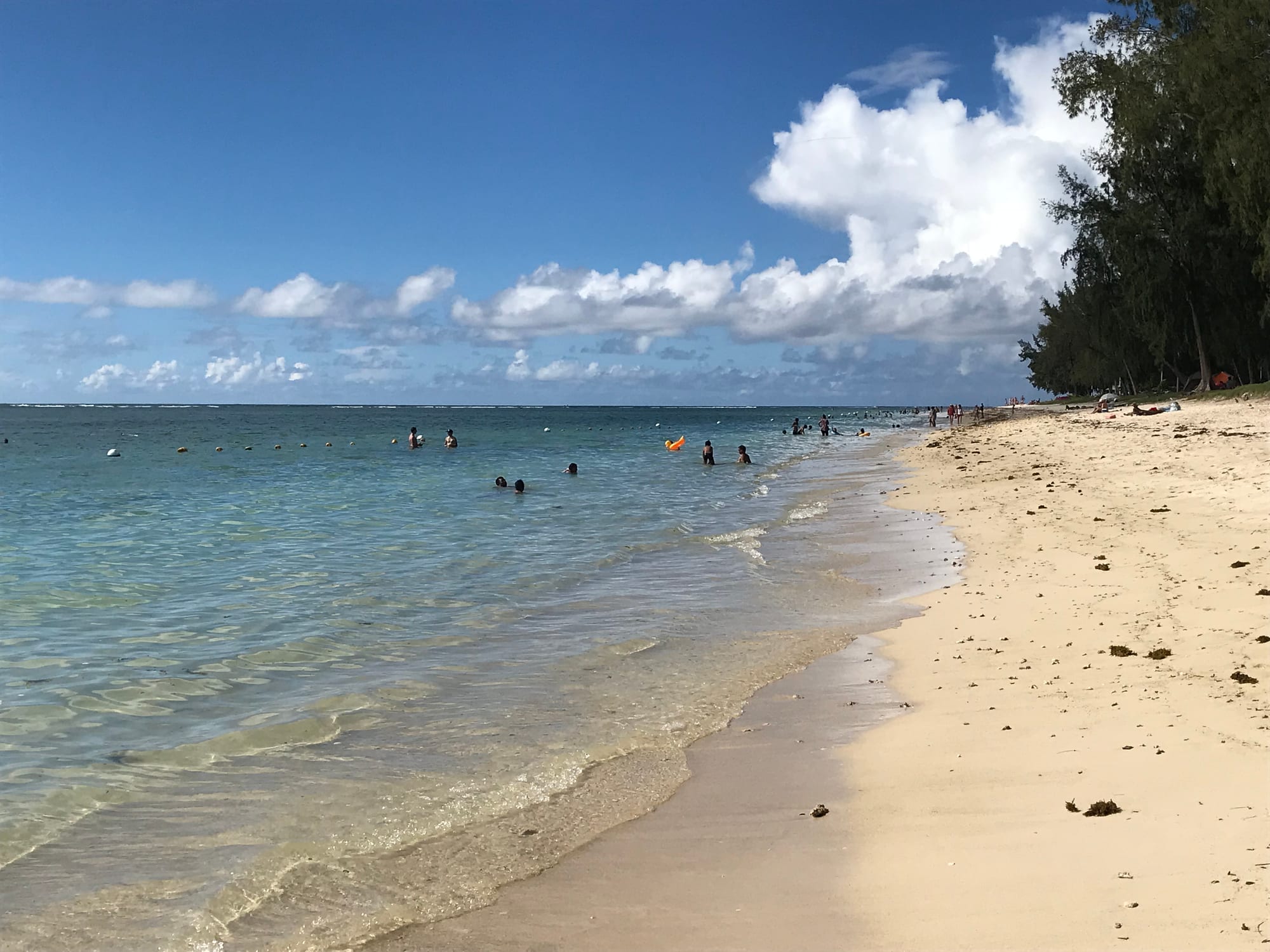
The long public beach and lagoon at Flic-en-Flac under a clouded sky

Mauritius

Flic-en-Flac

The public beach at Flic-en-Flac on the west coast of Mauritius. (Benoît Prieur / Wikimedia Commons · CC0)

A west-coast village in Mauritius strung along one of the island's longest beaches, where casuarina trees shade white sand and coral reefs enclose the lagoon. A weekend gathering place for Mauritian families as well as a resort, it mixes hotels, self-catering flats and dive centres facing the sunset.

Neighbourhoods

  • The public beach and the village centre
    • First-time visitors
    • Beaches
    • Best for food

    The long stretch of public sand backed by casuarina trees, with the main road behind it holding supermarkets, snack counters, restaurants, dive shops and most of the self-catering flats. Families from across the island fill the shade here at weekends.

    Open in Maps
  • The southern end of the beach
    • Beaches
    • Quiet and residential

    The southern end of the beach, where the large hotels stand in their own grounds behind walls of palms and the sand is quieter. Public access points remain between the properties.

    Open in Maps
  • The inland streets
    • Quiet and residential
    • Close to public transport

    The grid of residential streets a few hundred metres back from the water, where most residents and long-stay visitors actually live. Guesthouses, small shops and the bus route are here, and the sea is a short walk away.

    Open in Maps

Things to do

The coast and the lagoon

  • Tamarinattraction

    A village and bay a few kilometres south known for its salt pans, its surf breaks and the morning boat trips that go out to watch dolphins.

    Open in Maps
  • Albionattraction

    A coastal village to the north whose lighthouse at Pointe aux Caves, completed in 1910, gives a wide view over the region.

    Open in Maps
  • Martello Tower at La Preneusemuseum

    A squat British coastal tower of the 1830s on the shore south of the village, built against a French return and restored in 1992 as a museum of the island's military and colonial history.

    Open in Maps

Short trips from the village

  • Black River Gorges National Parkpark

    The island's largest national park, proclaimed in 1994, protecting most of its remaining rainforest and all of its endemic bird species, with about 60 kilometres of trails.

    Open in Maps
  • Seven Coloured Earthsattraction

    Dunes of volcanic clay near Chamarel whose bands of red, brown, violet and blue come from the weathering of basalt, with the Chamarel waterfall nearby.

    Open in Maps
  • Chamarelattraction

    An upland village above the south-west coast, reached by a winding road, known for its coloured earths, its waterfall, rum distilling and coffee growing.

    Open in Maps
  • Ganga Talaolandmark

    A crater lake in the southern highlands held sacred by Mauritian Hindus, ringed by temples and giant statues of Shiva and Durga, and the goal of the Maha Shivaratri pilgrimage.

    Open in Maps
  • Le Morne Brabantlandmark

    The basalt mountain on the south-western peninsula remembered as a refuge for people escaping slavery, inscribed as a UNESCO World Heritage Site in 2008.

    Open in Maps

Seasonal events

  • Maha ShivaratriFebruary or March

    Pilgrims walk from their homes across the island to the sacred lake at Ganga Talao, many carrying hand-made kanwars, in the island's most important Hindu festival.

  • Thaipoosam CavadeeJanuary or February

    Tamil devotees carry decorated arches to the kovils after days of fasting and prayer, a public holiday in Mauritius.

  • DivaliOctober or November

    Oil lamps and strings of lights along the village streets, with sweets shared between neighbours, in the Hindu festival of lights.

Eat and drink

Long-standing places and food districts in Flic-en-Flac. Hours, ratings and directions come from your maps app, always current.

Flic-en-Flac classics

  • The beach-road snack countersmarket

    Vans and small counters along the road behind the sand sell dholl puri, gâteaux piments, boulettes, samosas and fresh juices, busiest at weekends when island families come for the day.

    Open in Maps
  • Seafood restaurants of the villageneighborhood

    Creole kitchens along the main road serve grilled fish, octopus curry and vindaye, prawns, and rougaille, with tables under the trees or across the road from the water.

    Open in Maps

Nearby

  • Tamarinneighborhood

    The neighbouring village on the surfing bay has cafés and small restaurants of its own.

    Open in Maps

Experience Flic-en-Flac

History

Flic-en-Flac takes its odd name from the Dutch period of the island's history: it is generally explained as a corruption of an old Dutch phrase describing free, flat land, adapted by later French and Creole speakers into the form used today. Whatever the exact origin, the coast it describes is the same — a long, low shore of sand and casuarina backed by dry plains, with the Black River mountains standing behind.

For most of its recorded history this was a marginal place. The west coast was dry and difficult to farm compared with the wetter centre, and the settlement lived from fishing, the salt pans at Tamarin to the south and sugar cane, which still covers part of the village's land. British fortifications went up along this coast in the 1830s — the Martello tower at La Preneuse, a few kilometres to the south, survives — built against a possible French return that never came.

The change came with tourism. The beach, one of the longest on the island, became a place where families from across Mauritius spend their weekends. Hotels followed, concentrating at the southern end, while blocks of flats and guesthouses filled the streets behind the public beach. The result is unlike the resort enclaves elsewhere on the island: a working village and a holiday strip sharing the same sand.

Culture & Customs

The defining local ritual is the Sunday picnic. From early morning, families arrive with cool boxes, folding tables, pots and speakers, claim a patch of shade under the casuarinas, and stay until evening, cooking, swimming, singing and dancing to sega as the sun goes down over the lagoon. It is one of the clearest demonstrations of how thoroughly Mauritians use their own beaches, and visitors are simply part of the crowd.

The village reflects the island's mix. Hindu temples, churches, mosques and kovils stand in the settlement and the villages behind it, and the festival calendar runs through the year: Cavadee in January or February, Maha Shivaratri, when pilgrims walk towards the sacred lake in the highlands, Eid, Divali, and Christmas on the beach in the middle of summer. Creole is the everyday language, French is spoken by most people and dominates the media, and English is used in government and education.

The sea supports a second local culture. Divers come for the caves and wrecks off the reef, and there is a long-standing trade in boat skippers, dive guides and fishermen who work the lagoon at dawn. Dolphins are seen regularly in the bay at Tamarin to the south, which has made early-morning boat trips to watch and swim with them a fixture of this coast.

Daily Life

Flic-en-Flac is a village rather than a town, with a modest resident population, though it swells enormously at weekends and in the holiday season. Most people who work here live in it or in the villages nearby, and much of the plateau's population is within half an hour by road.

The local economy is almost entirely tourism and services: hotels, guesthouses and flats, restaurants, dive and boat operators, supermarkets, and construction. Behind it, the older economy of cane, market gardening and fishing continues on a smaller scale, and a growing number of residents commute to jobs in Port Louis and the plateau towns rather than working on the coast.

The rhythm is set by the sea and the heat: boats out before dawn, the beach quiet in the burning middle of the day, and the shade filling again in the late afternoon for swimming and football on the sand. Weekends are entirely different from weekdays. The village's pressures are those of rapid, unplanned coastal growth — traffic on the single beach road, drainage and water supply, litter after busy weekends, and the health of a lagoon that carries heavy boat traffic, and beach erosion that studies have linked to rising sea levels.

Food

Eating here is Creole and casual. The counters along the beach road sell the island's street food all day: dholl puri, the split-pea flatbreads folded around a curry of large peas and tomato sauce; gâteaux piments, small chilli fritters; samosas and boulettes, fish balls and meatballs served in broth. Alouda, the Mauritian version of the falooda milk drink, and fresh juices are drunk against the heat.

The village's restaurants concentrate on what the boats bring in. Grilled fish of the day, octopus — curried, in salad, or as vindaye, pickled with mustard and turmeric — prawns, and smoked marlin appear on almost every menu, alongside rougaille, the tomato sauce eaten with fish or meat, and fried noodles and bol renversé from the Sino-Mauritian tradition.

Sunday picnic food is a category of its own: briani cooked in large pots at home and carried to the beach, chicken and sausage grilled over portable barbecues, bread and rougaille, and cake for the children. Local rum and Phoenix beer are the usual drinks, with tea, a taste the island took from the British.

Planning tools

Budget

Flic-en-Flac is one of the better-value coastal bases in Mauritius. Blocks of self-catering flats behind the beach are cheap by island standards, there are supermarkets for self-provisioning, and the beach itself is public, while the hotels at the southern end are priced with the resorts elsewhere.

Daily Budget Midrange
USD 130–290 (mid-range hotel or villa, restaurants, a hire car, excursions)
Daily Budget Shoestring
USD 40–80 (self-catering flat or guesthouse, street food and supermarkets, buses)

A flat inland of the main road costs a fraction of a beachfront room and is still a few minutes' walk from the sand; a hire car makes the mountains and the south-west easy to reach.

Best Time to Visit

The west coast is the driest and most sheltered side of the island. May to October is cooler, drier and calmer, and the sunsets over the lagoon are at their best; November to April is hot and humid with heavy showers and a cyclone risk. The beach is crowded on Sundays and during the December and January school holidays.

Suggested Number of Days

Two or three days are enough for the beach and the lagoon. Five to seven suit a stay using the village as a base for the mountains, the south-west and the diving, which depends on sea conditions rather than on any fixed order of visits.

First Visit
2–3 days
With Surroundings
5–7 days

Transportation

Buses run along the beach road to Bambous and Quatre Bornes and on to Port Louis and the plateau towns; they are cheap, slow and stop early in the evening. Taxis wait near the supermarkets and fares are agreed in advance. A hire car is the usual choice for the mountain roads inland, which are narrow and winding.

Everything in the village is within walking or cycling distance of the beach road, so a car is mainly useful for trips into the interior and the south-west.

Airport & Station Connections

Sir Seewoosagur Ramgoolam International Airport lies in the south-east, roughly 55 kilometres away by road and usually about an hour; taxis, hotel transfers and shared shuttles make the run. Port Louis is around 25 kilometres north.

Walkability

The village is flat and strung along a single road, so walking works well from end to end, though the beach itself is long. Pavements are patchy, there is little lighting away from the centre, and the casuarina shade along the sand is the most comfortable way to cover ground in the middle of the day.

Safety

Mauritius is a safe destination, with low levels of violent crime against visitors. On this coast the usual problems are theft from beaches, parked cars and holiday flats, particularly when the beach is crowded. The lagoon is shallow and calm, but currents run hard through the reef passes and the sea beyond the reef is open ocean.

Don't leave valuables unattended on the beach, lock hire cars and rentals, and check for cyclone warnings between November and April. Swim inside the reef, and take care on the unlit stretches of the beach road after dark. Check current official travel advice before travelling.

Climate

Tropical, and on the drier, leeward side of the island: the central plateau takes much of the rain before it reaches this coast, and the trade winds arrive softened. Summer is December to February in the southern hemisphere.

Summer
November–April, about 25–33°C, humid, heavy afternoon showers and the cyclone season
Winter
May–October, about 19–27°C, drier and breezier, with the calmest diving conditions

Local Customs

This is a public beach used by Mauritian families as much as by visitors, and the customs are theirs: swimwear stays on the sand, cover-ups are worn in shops and on the bus, and topless sunbathing is not done. Sunday picnics under the trees are a village institution, with cooking, music and extended families staying all day. Temples and mosques inland expect covered shoulders and knees and shoes left at the door.

Tipping is not obligatory but is welcomed; agree taxi fares and boat prices in advance; take litter away from the picnic areas, and ask before photographing families or fishermen.

Common Payment Methods

The currency is the Mauritian rupee. Supermarkets, hotels and larger restaurants take cards, while buses, beach stalls, small shops and many boat and dive operators want cash. ATMs stand by the supermarkets on the main road.