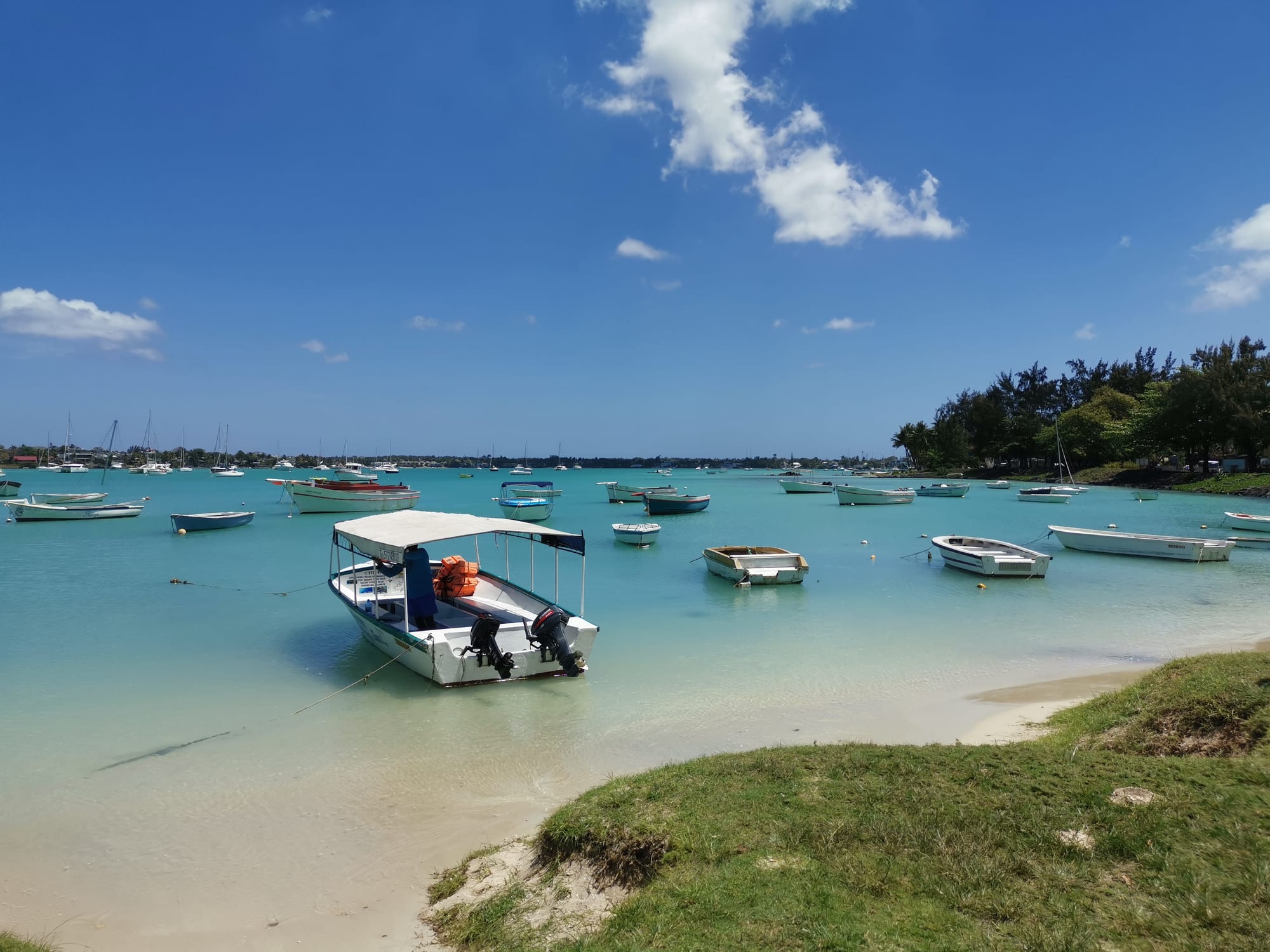
Small boats moored in the pale turquoise shallows of Grand Baie under a blue sky, with a low green shore and the town along the far side of the bay

Mauritius

Grand Baie

Boats moored in the shallow water of Grand Baie on the north coast of Mauritius. (Z thomas / Wikimedia Commons · CC BY-SA 4.0)

The main beach resort of northern Mauritius, built around a wide sheltered bay on the island's calmest coast. A coastal village that grew into a strip of hotels, restaurants, shops and boat operators, it is the base for boat trips to the northern islets.

Neighbourhoods

  • The bay and the village centre
    • First-time visitors
    • Best for food
    • Nightlife

    The coast road along the south side of the bay, lined with restaurants, bars, shops, dive centres and the jetties where catamarans and glass-bottomed boats load. It is the busiest strip in the north and the easiest place to stay without a car.

    Open in Maps
  • Pereybère and the northern shore
    • Beaches
    • Families
    • Quiet and residential

    North of the centre, the eastern shore of the bay runs on towards Pereybère and its beach. Guesthouses and self-catering flats outnumber big hotels here.

    Open in Maps
  • Pointe aux Canonniers
    • Beaches
    • Quiet and residential

    The small cape about 4 km west of Grand Baie, its beaches lined with villas and hotels. It is calmer than the main strip.

    Open in Maps
  • Cap Malheureux and the far north
    • Views
    • Quiet and residential

    The northernmost tip of the island, about five kilometres away, where fishing boats are drawn up near the small chapel of Notre-Dame Auxiliatrice, looking out to the islets. Villages here still feel rural, with vegetable plots and cane fields behind the shore.

    Open in Maps

Things to do

The coast and the islets

  • Cap Malheureuxlandmark

    The village at the island's northernmost point, near which British troops came ashore in 1810, known for its small chapel of Notre-Dame Auxiliatrice and the view out to the northern islets.

    Open in Maps
  • Île Plate and Îlot Gabrielattraction

    A small island 11 km north of Cap Malheureux, with a lighthouse built in 1855 and the smaller Îlot Gabriel close to its shore, popular with snorkellers and reached by chartered yacht and catamaran.

    Open in Maps

Temples and villages

  • Maheswarnath Mandirlandmark

    A Hindu temple dedicated to Shiva at Triolet, a few kilometres inland, founded in 1888 and the biggest Hindu temple on the island, with temples to Vishnu, the Devi and Nataraja beside the main shrine.

    Open in Maps
  • Trioletneighborhood

    The longest village in Mauritius, stretching nearly 5 km along an almost straight main road inland from the coast, with temples, shops and a working life quite separate from the resort strip.

    Open in Maps

Short trips from the town

  • Sir Seewoosagur Ramgoolam Botanical Gardenpark

    The botanical garden at Pamplemousses, laid out from the 1770s, the oldest botanical garden in the southern hemisphere, known for its long pond of giant Amazon water lilies and its palm collection.

    Open in Maps
  • Port Louisattraction

    The capital, about 20 km to the south-west, with its central market, the Caudan waterfront, the Aapravasi Ghat and the racecourse.

    Open in Maps
  • Ganga Talaolandmark

    A crater lake in the highlands held sacred by Mauritian Hindus, surrounded by temples and towering statues of Shiva and Durga, and the destination of the Maha Shivaratri pilgrimage.

    Open in Maps

Seasonal events

  • Maha ShivaratriFebruary or March

    The island's most important Hindu festival, when close to half a million Hindus make the pilgrimage to the sacred lake at Ganga Talao, many walking from home with decorated bamboo kanwars; the first pilgrims set out from Triolet in 1898.

  • Thaipoosam CavadeeJanuary or February

    A Tamil festival of fasting and procession, when devotees carry decorated arches to the kovils of the northern villages.

  • DivaliOctober or November

    The Hindu festival of lights, when oil lamps and strings of lights appear along the village roads and sweets are exchanged between neighbours.

Eat and drink

Long-standing places and food districts in Grand Baie. Hours, ratings and directions come from your maps app, always current.

Grand Baie classics

  • The coast road restaurantsneighborhood

    The strip along the bay holds most of the north's seafood, Creole, Chinese, Indian and Italian kitchens, from beach shacks to sit-down dining rooms, with tables looking over the water.

    Open in Maps
  • Street food stalls and snack vansmarket

    Vans and counters near the bus stop and the beaches sell dholl puri, gâteaux piments, boulettes, samosas and fresh fruit juices through the day.

    Open in Maps

Markets nearby

  • Triolet's village eateriesneighborhood

    Inland village counters and small restaurants serving briani, curries and Indo-Mauritian snacks to a largely local trade.

    Open in Maps

Experience Grand Baie

History

Grand Baie began as a sheltered anchorage rather than a settlement. The wide bay on the north coast, sheltered by reefs and by the cape at Pointe aux Canonniers, gave boats a safe anchorage, and a fishing village grew up behind the beach with cane estates inland.

The decisive event of the area's history happened here. In late November 1810 a British force of several thousand men came ashore at Grand Baie, near Cap Malheureux, and marched south to take the capital, ending French rule over the island within days. For the next century and a half the north remained agricultural — sugar, market gardening and fishing — with Grand Baie a modest weekend retreat for families from the capital and the plateau towns.

Tourism changed it in the later 20th century, when the calm, shallow, reef-sheltered water of the north proved ideal for sailing, diving and day cruises. Hotels spread along the bay and out to the headlands, the fishing jetties filled with catamarans, and shops, restaurants and bars took over the village street. The town now runs on visitors, while Triolet and the inland villages a few kilometres away carry on much as before — a contrast that defines the whole of northern Mauritius.

Culture & Customs

For a resort, Grand Baie is unusually mixed. Its year follows the island's crowded religious calendar rather than a tourist season: Maha Shivaratri in February or March empties the villages as pilgrims walk south to the sacred lake in the highlands; Cavadee brings Tamil processions to the kovils; Divali lights the roads in autumn; Eid and Chinese New Year are marked by the town's Muslim and Sino-Mauritian families; and the Catholic parishes hold their own feast days. The temple at Triolet, a few kilometres inland, is the biggest Hindu temple on the island, and the first pilgrims to Ganga Talao set out from Triolet in 1898.

The sea shapes local identity as much as faith. Fishing families still launch pirogues from the beaches at dawn, and skippers, boatmen and dive instructors are familiar figures on the waterfront. Sega — the drum, rattle and call-and-response music that came out of the songs of enslaved Mauritians — is played in bars and at hotel evenings, and seggae, the local fusion of sega with reggae, is heard alongside it.

Manners are relaxed but not casual. Creole is the everyday language, French the language of business and much of the signage, and English is widely understood. Visitors who greet shopkeepers before asking a question, dress modestly away from the sand and agree prices in advance will find the town straightforward and good-humoured.

Daily Life

Grand Baie itself had a resident population of roughly 12,000 at the 2011 census, though the number of people in the town on any given day is far higher once staff commuting in from Triolet, Goodlands and the surrounding villages, and visitors staying along the coast, are counted. It lies mainly in the Rivière du Rempart district, with its western part in Pamplemousses district.

Almost everything here depends on tourism: hotels and guesthouses, restaurants, dive centres and boat operators, taxi drivers, shops and the building trade that serves them. Around it, the older economy persists — sugarcane and vegetable plots inland, fishing from the beaches, and small businesses along the Triolet road — and a growing number of residential estates house Mauritians working in Port Louis as well as foreign residents.

The day starts early, with fishing boats out before dawn and shops opening by eight; the middle of the afternoon is hot and quiet; the strip fills again in the evening, when the restaurants and bars are at their liveliest. The pressures are those of a small place that grew fast: traffic on a coast road never built for it, pressure on water and drainage, rising land prices, and erosion and coral damage in a bay used heavily by boats.

Food

Eating in Grand Baie divides between what the visitors eat and what the town eats, and the second is the more interesting. Vans and pavement counters sell dholl puri — thin split-pea flatbreads wrapped around bean curry, tomato rougaille and chilli chutney — along with gâteaux piments, the fried split-pea and chilli fritters eaten by the handful, samosas, and boulettes, fish or meat balls with chouchou served in a clear broth. Alouda, a sweet cold milk drink, is the standard answer to the heat.

Seafood is the town's restaurant speciality, brought in by the boats that work the lagoon and the drop-off beyond the reef: grilled fish, octopus salad or vindaye, cooked with vinegar, mustard seed and turmeric, and prawns in garlic. Creole kitchens serve rougaille of fish or sausage, cari with brèdes — the leafy greens that come with almost every meal — and the Chinese-Mauritian staples of fried noodles and bol renversé are found on the same menus.

Fruit is sold from stalls and handcarts: pineapple cut and dusted with chilli salt, mango, lychee in season, and coconuts opened to order. To drink there is island-grown tea, Phoenix beer and local rum, served in the bars along the bay.

Planning tools

Budget

Grand Baie covers a wide range: self-catering flats and guesthouses a street back from the water are among the better-value beds on the island, while the hotels on the headlands are priced with the resorts. Eating is cheaper here than in the resort belts because of the competition along the coast road.

Daily Budget Midrange
USD 130–290 (mid-range hotel or villa, restaurants, a hire car, excursions)
Daily Budget Shoestring
USD 45–85 (guesthouse or self-catering flat, street food and local restaurants, buses)

Rooms a short walk inland cost far less than the same standard on the water.

Best Time to Visit

The north is the driest, most sheltered corner of the island and is pleasant most of the year. May to October is drier and breezier, with calm lagoon water and the best conditions for boat trips; November to April is hotter and wetter and carries the cyclone risk. The strip is busiest in the southern summer holidays around December and January.

Suggested Number of Days

Two or three days cover the bay, the nearby beaches and a boat trip. Five to seven suit a stay using the town as a base for the north and the capital. Anyone here mainly to swim, dive or sail stays longer; weather and sea conditions change the plan more than distance does.

First Visit
2–3 days
With Surroundings
5–7 days

Transportation

Buses run along the coast to Pereybere, Cap Malheureux, Triolet and on to Port Louis, and are cheap but slow and stop in the early evening. Taxis wait at the main junctions and fares are agreed before setting off. Many visitors hire a car or a scooter; driving is on the left and the coast road is narrow and busy.

The centre, the beaches and most restaurants are close enough together that a car is only needed for trips beyond the north.

Airport & Station Connections

Sir Seewoosagur Ramgoolam International Airport is at Plaine Magnien in the south-east of the island, at the far end of the island and well over an hour away by road; hotel transfers, taxis and shared shuttles all make the run. Port Louis, about 20 kilometres to the south-west, is the hub for island buses.

Walkability

The strip along the bay is flat and walkable end to end. Pavements are patchy, there is little shade in places, and the coast road carries steady traffic, so walking after dark calls for care. Pereybere and Cap Malheureux are too far to walk comfortably in the heat.

Safety

Mauritius is a safe destination, with low levels of violent crime against visitors, and the north is no exception. The usual problems are theft from beaches, parked cars and holiday rentals, and occasional bag-snatching along the strip at night. In the water, the lagoon is calm but boat traffic is heavy near the jetties and currents run strongly at the reef passes.

Don't leave valuables unattended on the beach, lock hire cars and rentals, and check for cyclone warnings between November and April. Swim away from the boat channels and take care on the coast road after dark. Check current official travel advice before travelling.

Climate

Tropical, and drier than most of the island: the north lies in the lee of the central plateau and gets less of the rain that falls inland. Summer is December to February in the southern hemisphere.

Summer
November–April, about 25–33°C, humid, short heavy showers and the cyclone season
Winter
May–October, about 19–27°C, drier, breezier and the calmest sea for boat trips

Local Customs

Beachwear belongs on the beach: shirts and cover-ups are expected in shops, restaurants and on the bus. Shoulders and knees should be covered at temples and mosques, and shoes removed. Greetings in French or Creole are appreciated, and asking before photographing fishermen or worshippers is normal courtesy.

Tipping is not obligatory but is welcomed for good service; bargaining is expected for crafts and souvenirs, not for food; agree a taxi fare or a boat-trip price before setting out.

Common Payment Methods

The currency is the Mauritian rupee. Cards are taken in hotels, supermarkets and most restaurants along the strip, but boat operators, market stalls, buses and small shops work in cash. ATMs are clustered around the town centre and the supermarkets.