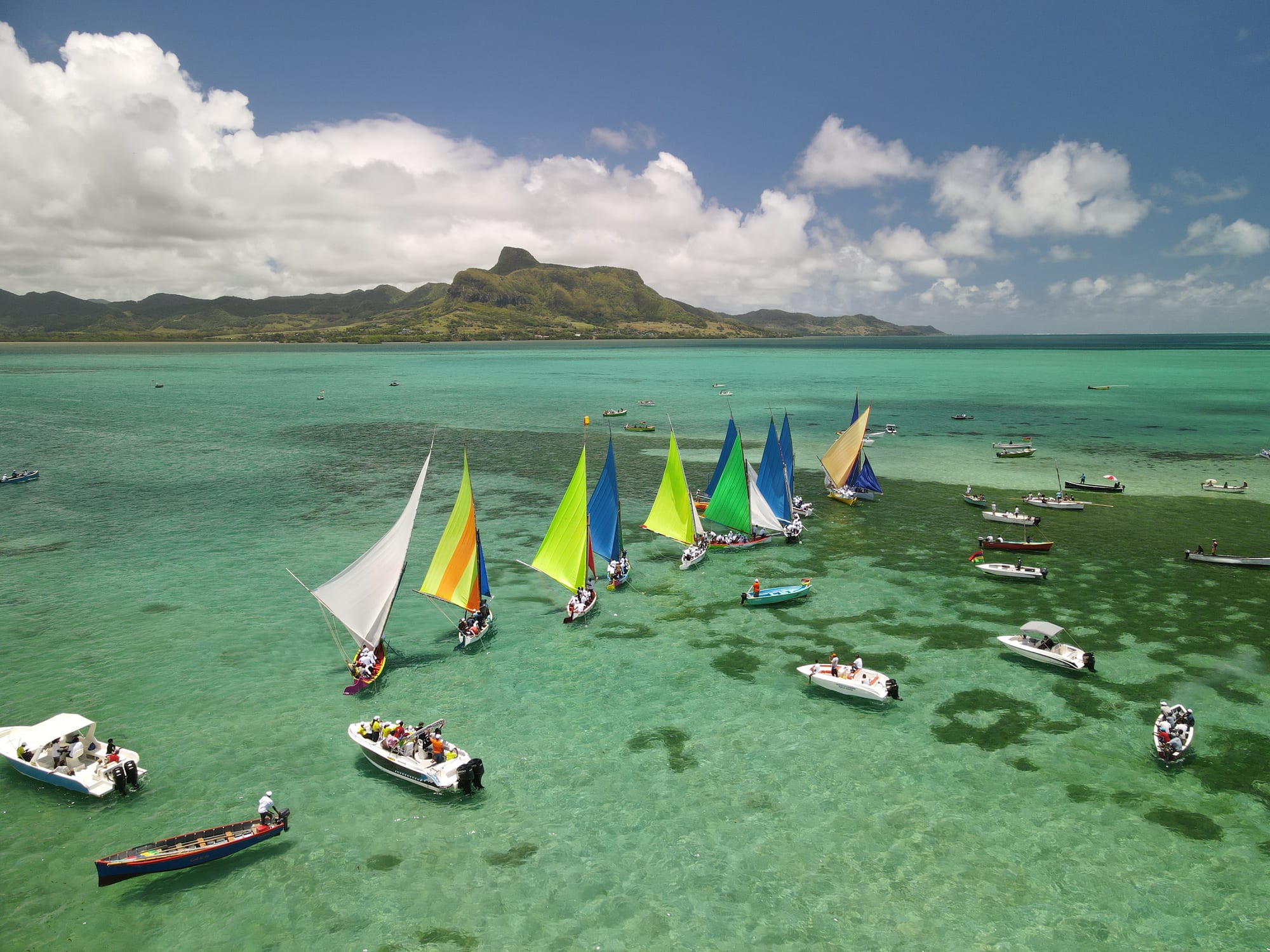
An aerial view of sailing boats racing in the lagoon off the Mahébourg waterfront

Mauritius

Mahébourg

The annual regatta off the Mahébourg waterfront. (Gavish Barosee / Wikimedia Commons · CC BY-SA 4.0)

A harbour town on the south-east coast of Mauritius, on the bay of Grand Port near Lion Mountain. Developed by the French in the early 1800s and the scene of a famous sea battle in 1810, it remained a fishing and trading town rather than a resort, and keeps its wide colonial streets, a history museum and a busy Monday market.

Neighbourhoods

  • The old grid and the waterfront
    • First-time visitors
    • Historic district
    • Markets

    The centre laid out in straight streets between the bay and the main road, with the market, the church and the rebuilt waterfront promenade. Almost everything a visitor comes for is within ten minutes' walk.

    Open in Maps
  • The northern shore
    • Quiet and residential
    • Views

    The shoreline north of the centre, with open ground above the water and views across the bay to the mountains of Grand Port. Residential streets run back from it towards the road to Vieux Grand Port.

    Open in Maps
  • Pointe d'Esny and Blue Bay
    • Beaches
    • Quiet and residential

    The coast a few kilometres south, where a long ribbon of sand and villas faces a clear, shallow lagoon protected as a marine park. Guesthouses and holiday houses outnumber hotels, and boats leave from here for snorkelling trips.

    Open in Maps

Things to do

History and the harbour

  • National History Museum of Mauritiusmuseum

    The island's history museum in an 18th-century colonial house on the edge of the town that served as a field hospital during the Battle of Grand Port in 1810, with relics from naval battles and shipwrecks and a near-complete dodo skeleton.

    Open in Maps
  • Vieux Grand Portlandmark

    The site of the first human settlement in Mauritius, a few kilometres north, where the ruins of the Dutch Fort Frederik Hendrik, built in 1638, now hold the Frederik Hendrik Museum.

    Open in Maps
  • Lion Mountainviewpoint

    A mountain of about 440 metres near Vieux Grand Port, named because it resembles a sleeping lion, rising above the bay of Grand Port.

    Open in Maps

The lagoon

  • Île aux Aigrettesattraction

    A low coral islet in the bay, reached by boat, a nature reserve since 1965 that protects the world's last remnant of Mauritius dry coastal forest, with its own endemic ebony, rare reptiles and Aldabra giant tortoises.

    Open in Maps
  • Blue Bay Marine Parkbeach

    A protected stretch of lagoon a few kilometres south, declared a marine park in 2000 and listed as a Ramsar wetland of international importance in 2008.

    Open in Maps

Short trips from the town

  • Île aux Cerfsattraction

    A privately owned island near the east coast of Mauritius, in Flacq District, with a golf club.

    Open in Maps
  • Ganga Talaolandmark

    A crater lake in the southern highlands, sacred to Mauritian Hindus, surrounded by temples and giant statues of Shiva and Durga, and the goal of the Maha Shivaratri pilgrimage.

    Open in Maps

Seasonal events

  • Maha ShivaratriFebruary or March

    Pilgrims in white walk from the coastal villages up into the highlands to the sacred lake, carrying decorated wooden kanwars, in the island's largest religious observance.

  • Thaipoosam CavadeeJanuary or February

    Tamil devotees carry decorated arches to the kovils of the south-east after days of fasting and preparation.

  • DivaliOctober or November

    Rows of lamps and lights along the streets of the town and the villages around it, with sweets shared between neighbours.

Eat and drink

Long-standing places and food districts in Mahébourg. Hours, ratings and directions come from your maps app, always current.

Mahébourg classics

  • The market food stallsmarket

    Counters in and around the market sell dholl puri, gâteaux piments, boulettes, samosas, fried noodles and alouda.

    Open in Maps
  • The Monday foiremarket

    The weekly Monday market, which locals call the foire, with tropical fruit and vegetables beside medicinal plants, spices, fresh fish, clothes, basketwork and crafts.

    Open in Maps
  • Waterfront snack vans and seafood countersneighborhood

    Vans along the seafront and small Creole restaurants in the grid behind it serve fish of the day, octopus curry and rougaille to a largely local trade.

    Open in Maps

Nearby

  • Blue Bay's beach eateriesneighborhood

    Snack counters and small restaurants behind the public beach at Blue Bay, a few kilometres south, serving grilled fish, curries and cold drinks to day visitors.

    Open in Maps

Experience Mahébourg

History

Mahébourg's wide, well-planned streets date from its colonial past. A settlement first grew here in the Dutch period, but the town took shape under the French: the name first appears on a plan of 1804, it honours Mahé de La Bourdonnais, governor of the island from 1735, and General Decaen built barracks, fortifications and warehouses here. The site already carried the island's oldest European history: the Dutch had sailed into the bay in 1598, naming it Port de Warwick, and in 1638 made the first permanent settlement at Vieux Grand Port, a few kilometres north.

Its moment came soon after. In August 1810 a French squadron defeated a British force inside the reef in the Battle of Grand Port, the only naval battle commemorated on the Arc de Triomphe; a colonial house nearby, now the National History Museum, served as a field hospital for both fleets. The victory changed nothing in the end — a British invasion took the island in December of the same year.

The French had already made Port Louis the main port, and Mahébourg declined into a quiet coastal town, settling into the role it has kept ever since: a trading and fishing town for the south-east and the main town of the Grand Port District. A naval air station begun at Plaisance, near the town, in 1942 became the island's international airport, and the town has grown steadily since, although the tourism that transformed other coasts has mostly gone to the beaches south of it rather than into the town itself.

Culture & Customs

Mahébourg is a Creole town more than a resort, with a mixed population of Indo-Mauritian, Creole, Sino-Mauritian and Franco-Mauritian families, and the public calendar to match: Cavadee processions in January or February, Maha Shivaratri, when columns of pilgrims in white pass through on the way to the highlands, Eid, Divali, Chinese New Year and the Catholic feast days of the parish church.

Boats are central to local identity. Fishermen work the lagoon, the largest in Mauritius, and an annual regatta of sailing boats with brightly coloured sails is raced off the waterfront. The 1810 battle is remembered in a monument raised at the harbour in 1899 to the British and French sailors killed, and in the museum, and the naval past is part of how the town sees itself.

The other institution is the market. Mahébourg is a busy centre of local trade for the south-east, and a trip into town is as much a social occasion as a shopping trip, with people coming in by bus from the villages to meet, eat and talk. Otherwise the pace is slow, the greetings in Creole are unhurried, and visitors who take the time to greet before asking are treated well.

Daily Life

About 15,500 people live in Mahébourg, making it a substantial town by the standards of the south-east but a small one on the island. It is the main service centre for the coastal villages and the Grand Port district: the market, the bus station, secondary schools, clinics, banks and government offices all serve a much larger population than the town's own.

Work comes from fishing, the market trade, the sugar industry — the Omnicane group, whose mill is at La Baraque, is the area's largest employer — the airport, and tourism at Blue Bay and Pointe d'Esny to the south. Many residents commute — to the airport or up to the plateau towns — and the seafront promenade, rebuilt in recent years, has brought more visitors into the centre.

Daily life is governed by the trade winds and the sea: boats out early, the market at its busiest in the morning, a quiet middle of the day, and families along the waterfront in the late afternoon. The town's concerns are those of a coastal community on a windward shore — cyclone damage and flooding in summer, the state of the lagoon and its fisheries, which suffered when the bulk carrier Wakashio ran aground on the reef near Blue Bay in July 2020 and spilled oil along this coast, and the shortage of work for young people that pushes many towards the capital.

Food

Mahébourg eats from its lagoon and its market. The catch — fish of the day, octopus, crab and squid — is cooked simply as grilled fish, octopus curry, or vindaye, made with vinegar, mustard seed and turmeric, and appears in rougaille, the tomato sauce eaten with fish, meat and vegetables. Curry and rice make the usual household meal, and briani is a favourite for larger occasions.

Street food is the town's everyday cooking. Dholl puri — soft split-pea flatbreads folded around a curry of large peas and tomato sauce — is sold from carts around the market and the bus station; with it go gâteaux piments, small chilli fritters, samosas, and boulettes, fish balls and meatballs with chayote served in broth by Sino-Mauritian counters. Mine frite, fried noodles, and bol renversé are found on the same streets.

The market is the place for tropical fruit, vegetables and spices, as well as for alouda, the Mauritian version of the falooda milk drink. To drink there is tea, a taste the island took from the British, Phoenix beer and local rum.

Planning tools

Budget

Mahébourg is one of the cheapest places to stay on the coast. It is a working town rather than a resort, with guesthouses and self-catering rooms rather than hotels, a market for provisions, and street food at village prices; the villas and guesthouses out at Pointe d'Esny cost more.

Daily Budget Midrange
USD 130–290 (mid-range hotel or villa, restaurants, a hire car, excursions)
Daily Budget Shoestring
USD 35–70 (guesthouse room, market food and street snacks, buses)

Staying here and driving to the beaches is considerably cheaper than staying on them, and the museum, the waterfront and the market cost little or nothing.

Best Time to Visit

May to October is drier and cooler, though the south-east is the windward corner of the island and catches the trade winds year round, which keeps it breezy and brings passing showers. November to April is hotter, wetter and carries the cyclone risk.

Suggested Number of Days

A day or two covers the town, the museum and the market. Three or four suit a stay taking in the lagoon, the islet reserve, the beaches to the south and the historic coast to the north; boat trips depend on the weather rather than on any fixed order.

First Visit
1–2 days
With Surroundings
3–4 days

Transportation

Mahébourg is a bus hub for the south-east, with services along the coast, inland to Curepipe and the plateau towns, and on to Port Louis; the airport is a short ride away. Taxis wait near the market and the bus station and fares are agreed in advance. A hire car is useful for the south coast, where buses are infrequent.

The bus station next to the market makes the town an easy base without a car, though services thin out in the evening.

Airport & Station Connections

Sir Seewoosagur Ramgoolam International Airport, at Plaine Magnien, is close by, roughly fifteen minutes by taxi and one of the shortest airport transfers on the island, which makes the town a common first or last night's stop. Port Louis is around 50 kilometres away by road, an hour or so depending on traffic.

Walkability

The centre is flat, laid out on a grid and easily walked: the market, the church, the seafront and the museum are all within about fifteen minutes of one another. Pavements are uneven in places and the coast road is busy. Blue Bay and Pointe d'Esny are several kilometres south, too far to walk comfortably in the heat.

Safety

Mauritius is a safe destination, with low levels of violent crime against visitors, and this is a quiet town where most problems are opportunistic: theft from beaches, parked cars and holiday houses. The lagoon is sheltered, but currents run strongly at the reef passes and the open sea beyond the reef on this windward coast can be rough.

Don't leave valuables unattended on the beach, lock hire cars and rentals, and check for cyclone warnings between November and April. Keep bags closed in the market crowds and swim inside the reef. Check current official travel advice before travelling.

Climate

Tropical and on the windward, south-eastern side of the island, so cooler, breezier and wetter than the west coast, with showers that blow through quickly. Summer is December to February in the southern hemisphere.

Summer
November–April, about 24–31°C, humid, frequent showers and the cyclone season
Winter
May–October, about 18–26°C, breezy with passing rain and cooler evenings

Local Customs

This is a town where people live rather than a resort, and dress is accordingly modest away from the beaches: cover-ups in the market, shops and on the bus. Hindu temples, kovils, mosques and churches all stand within the grid, and covered shoulders and knees and removed shoes are expected at all of them. Creole is the language of the street, with French in shops and English in official use.

Bargaining is normal for crafts and clothes in the market but not for food; tipping is not obligatory; ask before photographing traders, fishermen or worshippers.

Common Payment Methods

The currency is the Mauritian rupee. Cash is needed for the market, buses, street food, boat trips and most small guesthouses; cards work in supermarkets and larger restaurants. ATMs and bank branches stand near the market and the main road.