History · Chile
Who carved the giant statues of Easter Island, and why?
The moai are full-body statues, carved by the Polynesian Rapa Nui between about 1250 and 1500 as the living faces of their deified ancestors.
By Globeway Editorial · 13 October 2026
The short answer
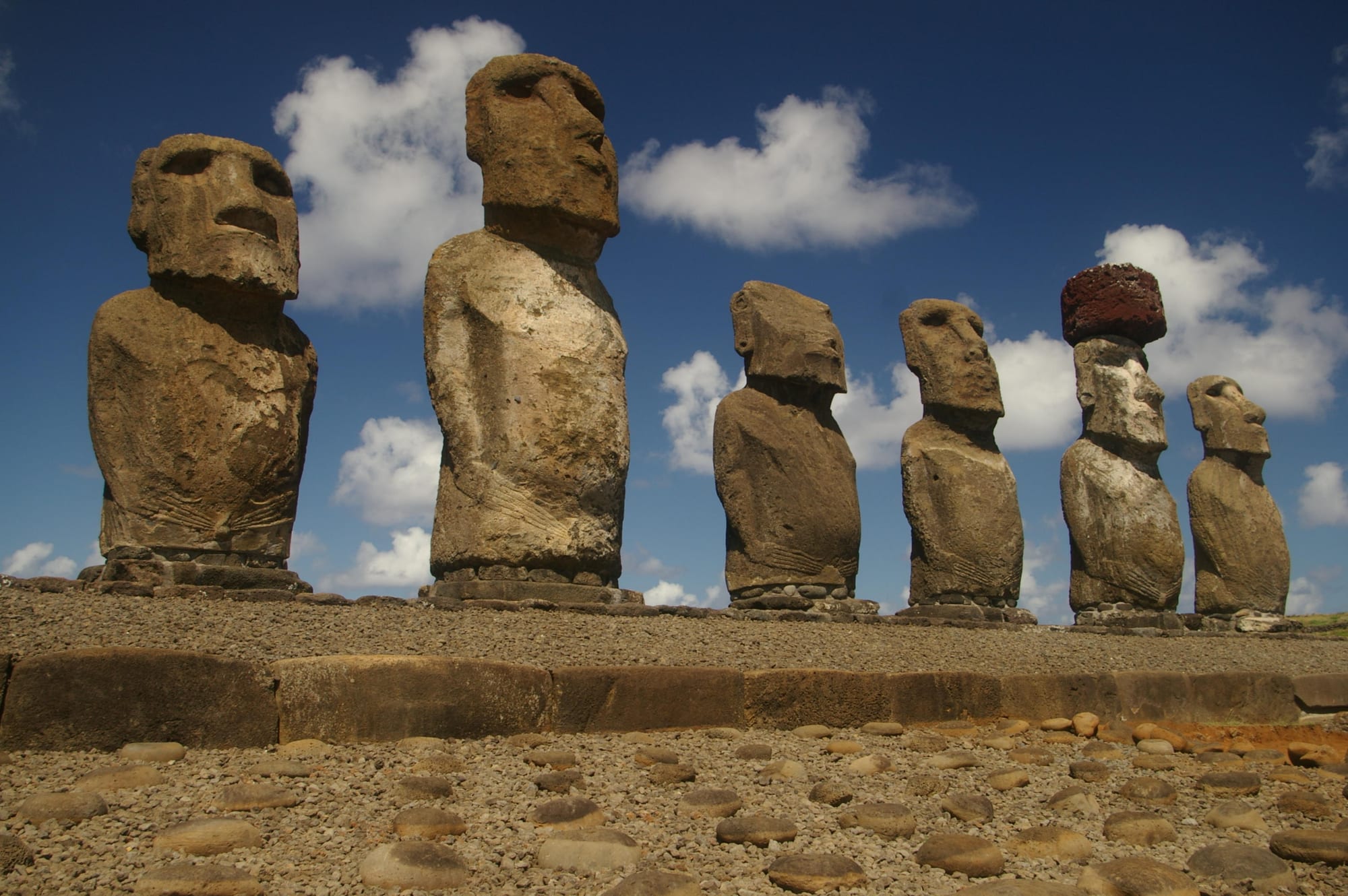
The statues were carved by the Rapa Nui, the Polynesian people of Easter Island, mostly between about 1250 and 1500. They are not just heads. Every moai, as the statues are called, has a torso and arms carved in relief, resting its long-fingered hands on its hips. The "heads" idea comes from the famous statues on the slopes of the Rano Raraku quarry, many of which are buried up to their shoulders in debris. When some were excavated, their bodies were there.
The Rapa Nui carved the moai to honour their ancestors. In their own terms, the statues are the "living faces" (aringa ora) of deified ancestors. Set on stone platforms called ahu, mostly along the coast, they faced inland over the lands of the clan that raised them, and were believed to hold mana, a sacred spiritual power. They were also statements of rank: the bigger the statue a chief could commission, the more mana he was thought to have.
Polynesian voyagers at the edge of the map
Easter Island lies at the south-eastern corner of the Polynesian Triangle, 3,512 kilometres (2,182 miles) from the nearest point of mainland Chile and more than 2,000 kilometres from the nearest inhabited island. It was settled by Polynesians who sailed there in canoes or catamarans, most likely from Mangareva in the Gambier Islands or from the Marquesas. Researchers once dated their arrival to about 800, but newer radiocarbon dating points to about 1200. Rapa Nui oral tradition says the first settlers came in two canoes led by the chief Hotu Matu'a and landed at Anakena.
For a long time some outsiders doubted that islanders could have made such monuments. The evidence answers them. Similar sacred sites with statues, called marae and ahu, are found across eastern Polynesia. Designs on the backs of moai protected from erosion match the islanders' traditional tattoos, a link the Routledge expedition established in 1914, and modern DNA analysis of the islanders and their ancestors points the same way.
Ancestors made of volcanic ash
Almost all the statues came from one place. Of the more than 900 moai known, all but 53 were carved from the tuff of Rano Raraku, a volcanic crater whose walls are compressed volcanic ash. Tuff is soft enough to work with stone tools, and the crater was quarried for about 500 years, until the early eighteenth century. A small number of statues were made of basalt, trachyte or red scoria.
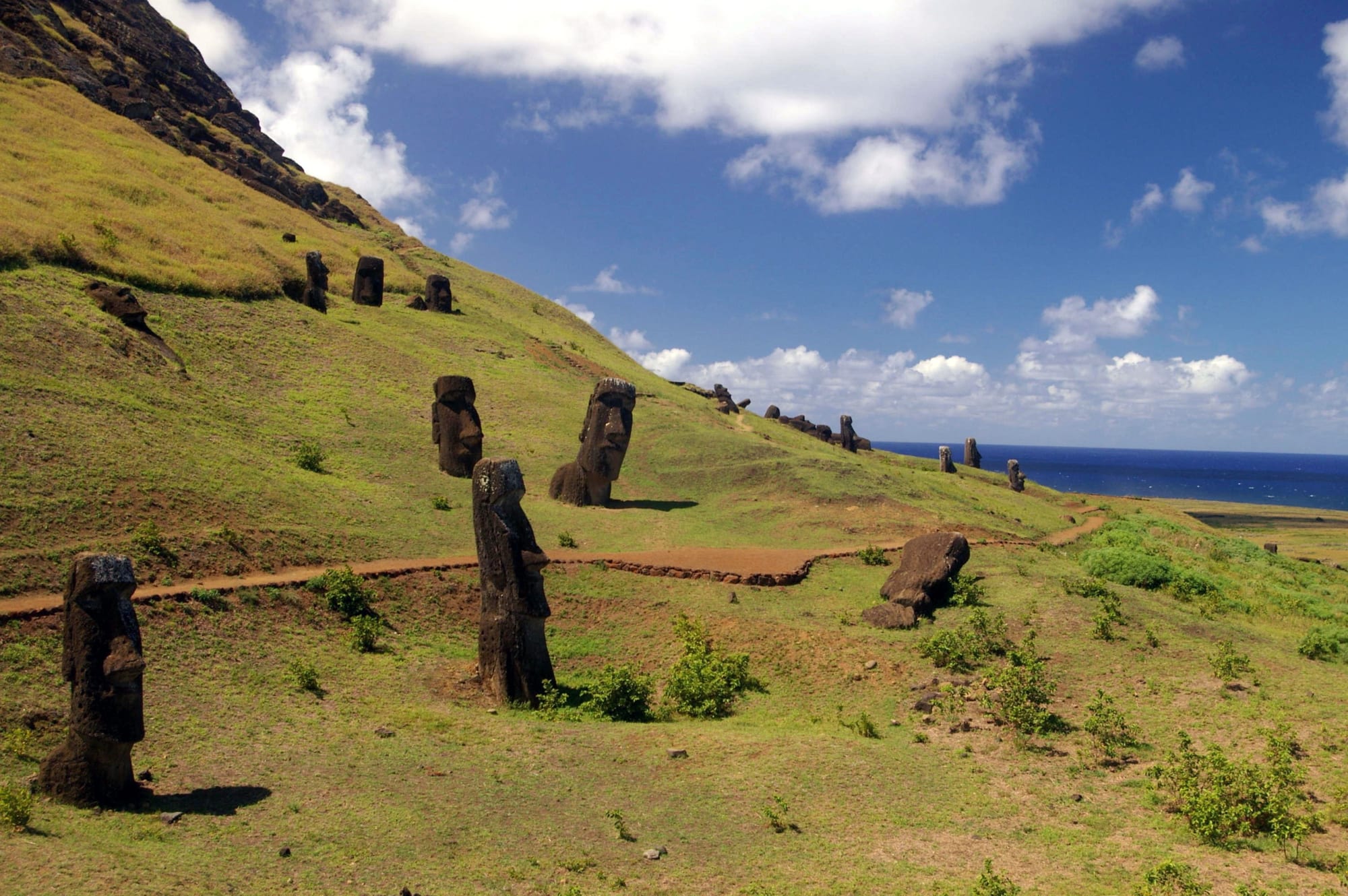
Statues like these, sunk to their shoulders in centuries of spoil, gave rise to the idea that the moai are only heads.
The quarry was divided into territories for each clan. Oral traditions disagree on whether the carving was done by a respected class of professional craftsmen, like the high-ranking guilds of other Polynesian societies, or by members of each clan. The finished figures share a style: oversized heads, about three parts head to five parts body, in keeping with the Polynesian belief in the sacredness of the head, with heavy brows, long noses and nostrils curled like fish-hooks. When new, they were polished smooth with pumice.
Sizes varied enormously. A typical moai weighs around 12.5 tonnes. The tallest ever erected, called Paro, was almost 10 metres (33 feet) high and weighed 82 tonnes, and the heaviest, at Ahu Tongariki, weighs 86 tonnes. An unfinished figure still lying in the quarry would have stood about 21 metres tall.
Eyes, topknots and the power of the dead
A statue was not complete until it reached its ahu. In 1979 the Rapa Nui archaeologist Sergio Rapu Haoa and his team discovered that the eye sockets were designed to hold eyes of coral with pupils of black obsidian or red scoria. It seems that only statues destined for the ahu and ceremonial sites were given eye sockets. Later moai were also crowned with pukao, cylinders of red scoria from a separate quarry at Puna Pau. They represent the topknot of a chief, and tradition held that mana was kept in the hair.
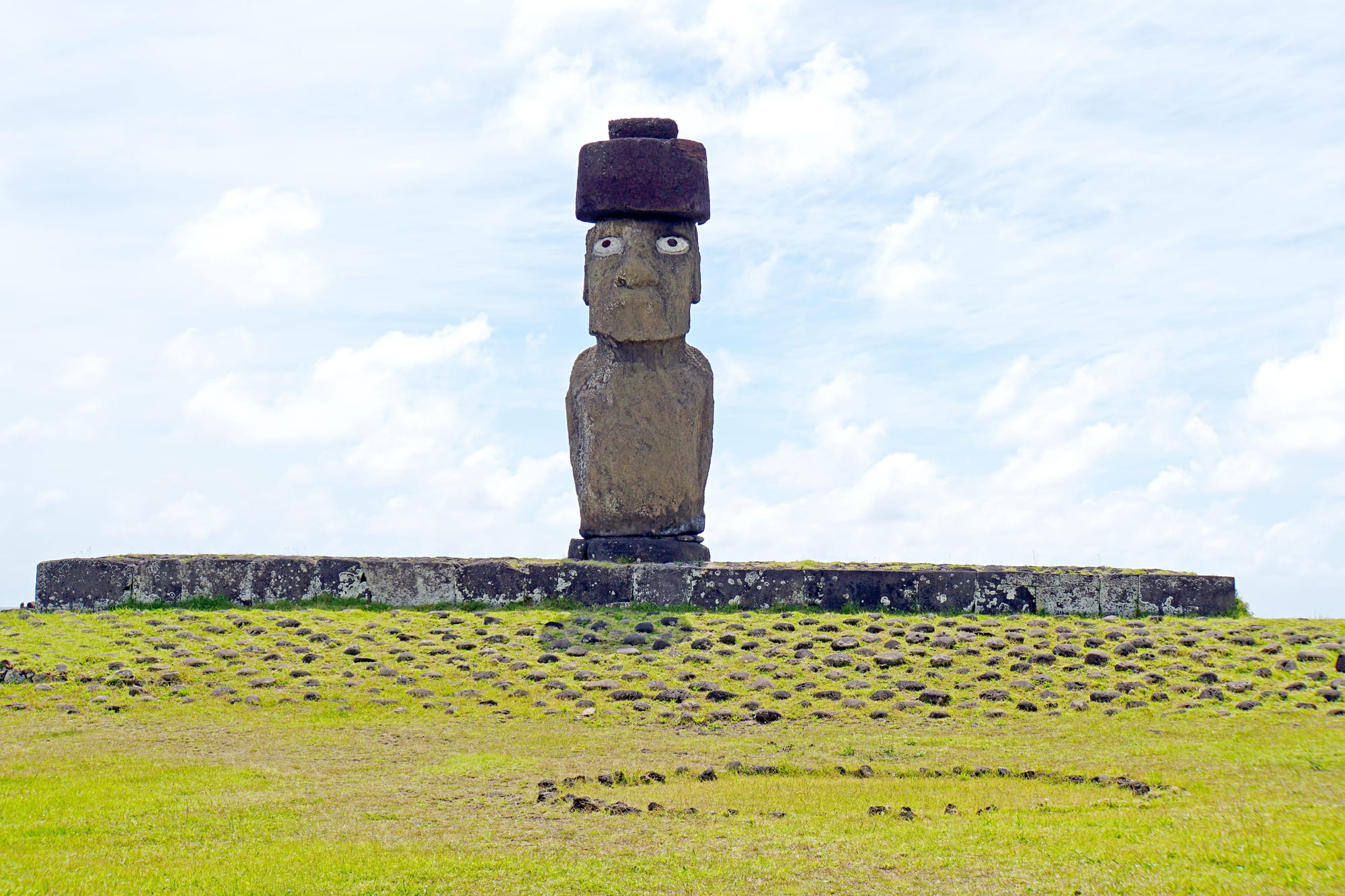
Tahai was restored in 1974 by the American archaeologist William Mulloy. Ko Te Riku is the platform with restored eyes.
In Polynesian religion, carved objects that were properly made and ritually prepared were believed to be charged with mana. A moai on its platform was the presence of an ancestor, and perhaps also of a powerful chief, watching over the community on the land in front of it. That is why most coastal statues stand with their backs to the sea.
How they moved, and why they fell
Because the island was largely treeless when Europeans arrived, how statues weighing many tonnes were moved was a mystery for a long time. Experiments have tried sledges, rollers and ropes. The view most scholars now support is that the moai were "walked" upright. The archaeologists Terry Hunt and Carl Lipo, working with Sergio Rapu, showed that statues abandoned along the ancient roads have wide, curved bases and lean forward, so that teams pulling ropes from both sides could rock them along, one step at a time. Rapa Nui oral histories also say the statues walked, commanded by divine power.
Carving appears to have stopped suddenly. The quarry was left littered with stone tools and with almost as many unfinished statues as were ever set up. Over time power shifted from paramount chiefs to a warrior class, and a new religion, the birdman cult centred on Orongo, took hold; during its height the making of moai seems to have ceased. Every statue on an ahu was toppled between the late eighteenth century and 1868, whether through wars between clans, the upheaval that followed European contact or, in some cases, earthquakes. Why the society changed is still argued over. One theory blames an "ecocide", in which the islanders cut down their forests; critics answer that the population grew steadily until Europeans arrived in 1722, and that it was later slave raids, disease and exploitation that devastated the islanders.
Standing again
The damage of the nineteenth century was severe. Slave raids from Peru in 1862 and 1863 abducted or killed about 1,500 people, and smallpox and emigration followed; by 1877 only 111 native islanders remained. Chile annexed the island in 1888. Some statues were carried abroad, including Hoa Hakananai'a, taken in 1868 and now in the British Museum, though demands have been made for its return to the island.
Today about 50 moai have been re-erected on their platforms or in museums. Ahu Tongariki, swept inland by a tsunami in 1960, was restored in the 1990s in a project involving the Chilean government, the University of Chile and the Japanese crane maker Tadano, and now carries fifteen statues. Much of the island is protected as Rapa Nui National Park, created in 1935 and now a UNESCO World Heritage Site.