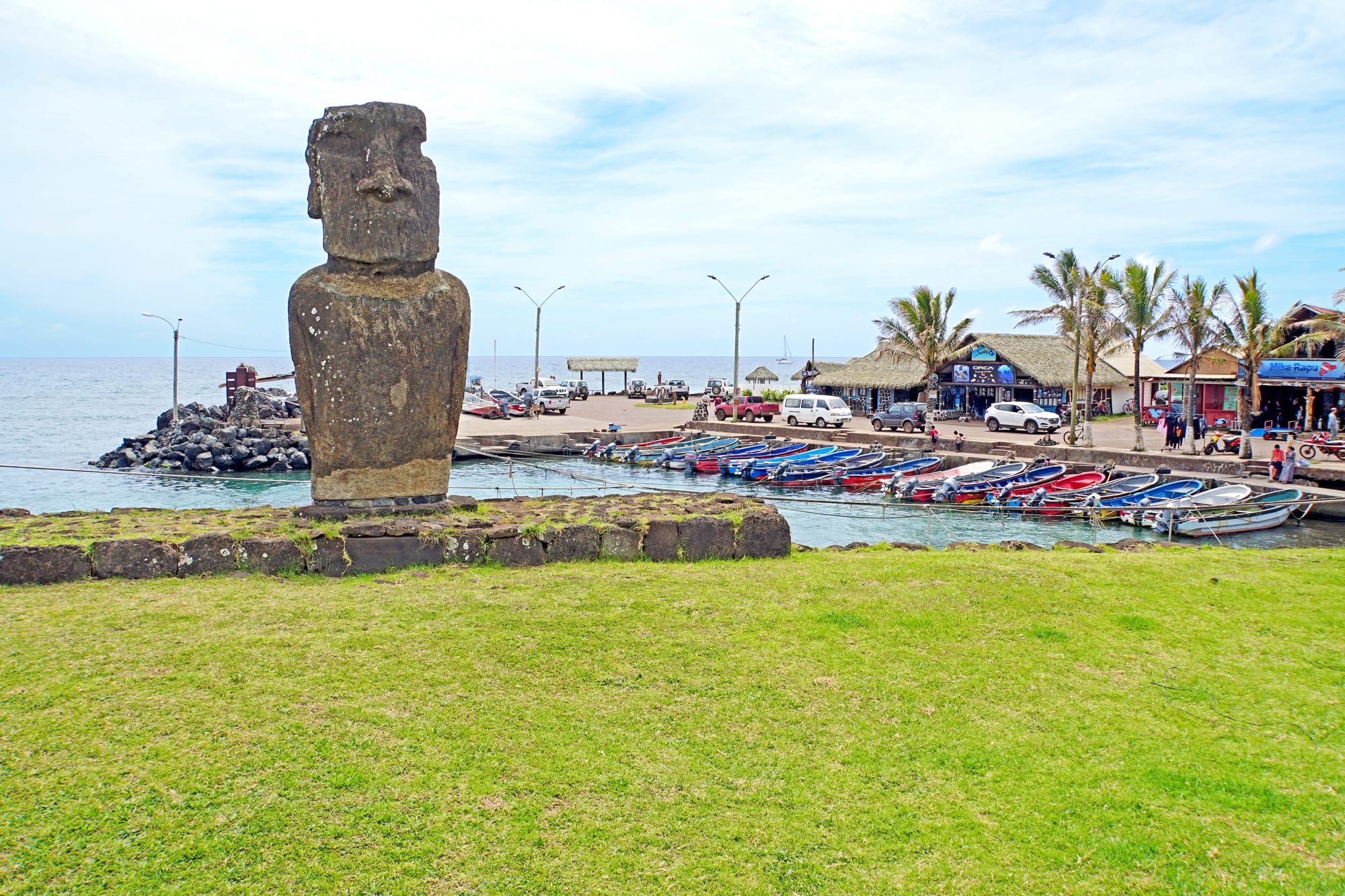
A single weathered moai on a stone platform beside a small harbour lined with colourful fishing boats, palm trees and low buildings

Santiago & Valparaíso, Chile

Hanga Roa

Ahu Hotake and its moai beside the Hanga Roa O Tai harbour in Hanga Roa. (Dennis G. Jarvis / Wikimedia Commons · CC BY-SA 2.0)

The main town, harbour and seat of Easter Island (Rapa Nui), on the island's south-west coast between the extinct volcanoes of Terevaka and Rano Kau. Home to roughly 95 per cent of the islanders, it was for decades the only place the Rapa Nui were allowed to live; today it is the base for visiting the moai of Rapa Nui National Park.

Neighbourhoods

  • Avenida Atamu Tekena and the town centre
    • First-time visitors
    • Best for food
    • Shopping

    The island's main avenue, renamed in 1998 after the 19th-century Rapa Nui king Atamu Te Kena, lined with hotels, restaurants, grocery shops and pharmacies. The Holy Cross Church is in the town centre.

    Open in Maps
  • The harbour and the coves
    • Local life
    • Sea views

    The fishermen's cove of Hanga Roa O Tai, with its colourful boats and a moai on its platform beside the water, and the smaller cove of Hanga Piko, where fishermen can be seen at work.

    Open in Maps
  • Tahai
    • Historic district
    • Sunsets
    • Quiet and residential

    The northern edge of town, within walking distance of the centre, where the restored ceremonial complex of Tahai stands on the shore beside the island's museum.

    Open in Maps
  • Mataveri
    • Close to the airport
    • Quiet and residential

    The southern part of town around the airport, at the foot of Rano Kau, near the sea cave of Ana Kai Tangata and the road up to Orongo.

    Open in Maps

Things to do

In Hanga Roa

  • Tahai Ceremonial Complexlandmark

    Three ahu on the shore — Ko Te Riku, whose moai has restored eyes, Tahai and Vai Ure — restored in 1974 by the archaeologist William Mulloy, who is buried here.

    Open in Maps
  • Father Sebastian Englert Anthropological Museummuseum

    The island's museum, founded in 1973 and devoted to conserving Rapa Nui cultural heritage, a short walk from Tahai.

    Open in Maps
  • Holy Cross Churchlandmark

    The Catholic parish church in the town centre, founded in 1937, where Rapa Nui songs and carvings are woven into Catholic worship.

    Open in Maps
  • Puna Paulandmark

    A small volcanic cone on the outskirts of town, the quarry of the red scoria used for the topknots placed on some moai.

    Open in Maps

Rano Kau and the south-west

  • Ana Kai Tangataattraction

    A sea cave near Mataveri open to the surf, with paintings of terns on its ceiling.

    Open in Maps
  • Rano Kauviewpoint

    The 324-metre extinct volcano forming the island's south-western headland, with a large crater lake.

    Open in Maps
  • Orongolandmark

    The ceremonial stone village on the rim of Rano Kau, with low round-walled houses, centre of the birdman cult; it can be entered only once on a park ticket.

    Open in Maps
  • Ahu Vinapulandmark

    One of the larger ahu on the island, at the end of the airport runway, known for its large, closely fitted basalt slabs.

    Open in Maps

Moai sites around the island

  • Ahu Akivilandmark

    An inland sacred site whose seven identical moai, set up around the 16th century, face the sunset at the spring equinox — an alignment found nowhere else on the island.

    Open in Maps
  • Rano Rarakulandmark

    The volcanic crater that served as a quarry for about 500 years and supplied the stone for about 95 per cent of the island's moai, many still standing unfinished on its slopes.

    Open in Maps
  • Ahu Tongarikilandmark

    The largest ahu on the island, swept inland by a tsunami in the 20th century and restored with fifteen moai, including the heaviest ever erected.

    Open in Maps
  • Anakenabeach

    A white coral-sand beach with a palm grove and two ahu, one of only two sandy beaches on the island's rocky coast.

    Open in Maps
  • Terevakaviewpoint

    The island's highest and youngest volcano, about 507 metres high, with wide views over the whole island.

    Open in Maps

Seasonal events

  • Tapati Rapa Nuiearly February

    A festival held since 1975 to celebrate Rapa Nui culture, built around a competition between two clans in dance, song, sport and traditional skills.

Eat and drink

Long-standing places and food districts in Hanga Roa. Hours, ratings and directions come from your maps app, always current.

Hanga Roa classics

  • Avenida Atamu Tekenaneighborhood

    The main street holds most of the town's restaurants and cafés, alongside grocery shops.

    Open in Maps
  • The fishermen's coveneighborhood

    The harbour where the island's fishing boats come in, the place to see the catch that ends up on local menus.

    Open in Maps

Experience Hanga Roa

History

Polynesian voyagers settled Rapa Nui, most likely from Mangareva or the Marquesas; a 2007 study placed their arrival around the year 1200. Over the following centuries islanders carved hundreds of moai from the quarry at Rano Raraku. Europeans reached the island on Easter Sunday 1722, and in the 19th century slave raids, disease and the collapse of traditional leadership devastated the population. Catholic missionaries arrived in 1864, and in 1868 the British ship HMS Topaze anchored off Hanga Roa.

When Chile annexed the island in 1888, the Rapa Nui were forced into Hanga Roa and the rest of the land was leased for sheep farming, from the early 20th century to the Compañía Explotadora de la Isla de Pascua, a subsidiary of Williamson-Balfour. Islanders were confined to the town and forbidden to leave it, and researchers have compared it to a ghetto; in 1914 it had just 250 people. The parish of Santa Cruz was founded in 1937 under Father Sebastian Englert, who preached in Rapa Nui. From 1953 to 1966 the navy controlled the island.

In 1966 a law created the Department of Easter Island, gave the islanders Chilean citizenship and the vote, and set up a municipality. An airstrip built at Mataveri led to the first commercial flights in 1967, and the village grew into a small town with a school, hotels, a bank and a hospital. The island became a special territory of Chile in 2007. It was closed to tourists from March 2020 to August 2022 during the COVID-19 pandemic, and in October 2022 a fire burned about 60 hectares and damaged some of the moai.

Culture & Customs

Hanga Roa is a Polynesian town within the Chilean state. The Rapa Nui language, an Eastern Polynesian language with similarities to Hawaiian and Tahitian, has survived, though most children now grow up speaking Spanish. Dance and music are central cultural expressions, with performances held around the island through the year.

The great event is the Tapati Rapa Nui, held since 1975 around the start of February. It is built around a competition between two clans, who earn points in dance, song, sport and traditional skills, and much of the island takes part. Church life also carries Rapa Nui identity: in the Holy Cross Church, islanders' songs and carvings are woven into Catholic worship, a fusion encouraged by Father Sebastian Englert, who translated devotions into Rapa Nui.

Land is the deepest issue. Rapa Nui with ancestral claims have occupied hotels and land in town to press their rights, and a police intervention in August 2010 wounded 25 protesters; in 2011 the family that owned the Hanga Roa Hotel gave its land back to the Rapa Nui while keeping a management lease. The moai and ahu are sacred ancestral sites, cared for by islanders as well as the state, and respect for them is the first rule for visitors.

Daily Life

Hanga Roa had 7,322 inhabitants at the 2017 census, more than 95 per cent of everyone on the island, which also counts as the commune of Isla de Pascua. Avenida Atamu Tekena, the main street, holds most of the shops, restaurants and services.

Tourism is the economy. The town had about 2,500 beds in 2022, from campsites to luxury hotels, and most families work in lodging, guiding, transport, crafts or restaurants. Fishing, farming and public administration provide the rest, and the Chilean navy and several government departments keep a presence here. A shipping service links the harbour with Valparaíso, and daily flights from Santiago bring in visitors.

Isolation shapes everyday life: imported goods are expensive, the hospital opened in 2013 has just 16 beds, and the nearest inhabited land is Pitcairn, about 2,000 kilometres away. Current debates concern how many visitors the island can absorb, land rights and self-government, and the protection of the moai from weather, fire and accidents.

Food

Fishing has always fed Rapa Nui. Fishing is still part of the town's economy, and tuna was long the basis of local fishing, though islanders have described how catches fell after 2000. Fish dominates the menus of the restaurants on Avenida Atamu Tekena and around the harbour, along with dishes from mainland Chile. The tuna empanada is the town's favourite snack.

The island's traditional dishes are Polynesian. Po'e, a Polynesian pudding traditionally made with banana and baked in an earth oven, reflects the island's roots in eastern Polynesia, whose settlers crossed thousands of kilometres of ocean by canoe to reach it.

Because imported goods are costly, eating out is expensive by Chilean standards, and the grocery stores along the main avenue are used by visitors who prefer to cook for themselves. Fishermen also work from the smaller cove of Hanga Piko, and the boats coming in to both coves are part of the daily scene in town.

Planning tools

Budget

Easter Island is far more expensive than anywhere on the mainland: imported goods are costly, and the national park ticket, the required guides and the long flight add to the cost. Flights are the largest single expense; they are often cheapest in the cool, rainy months around June.

Daily Budget Midrange
USD 200–380 (guesthouse or hotel, restaurant meals, a hire car or guided tours, plus the park ticket)
Daily Budget Shoestring
USD 80–130 (campsite or simple guesthouse, cooking for oneself, walking and a hired bicycle in town)

Buy the national park ticket at the airport on arrival, keep it for every site, and book guides and lodging well ahead of February.

Best Time to Visit

Any season works for the moai. Early February brings the Tapati festival and the highest prices and busiest flights. Rain is spread fairly evenly through the year, and the cooler, wetter months around June are quieter and cheaper.

Suggested Number of Days

The long flight and the number of sites make a short stay hard, and more time suits anyone walking or cycling, or wanting time for the beaches.

First Visit
4–5 days
With Surroundings
6–7 days

Transportation

Hanga Roa itself is small enough to walk. The rest of the island is reached by tour, hire car, scooter or taxi; taxis are readily available but relatively expensive. Cycling beyond town is hard work, with strong wind, heat and humidity. Since February 2023 a registered local guide must accompany visitors at the park's ticketed sites.

Stay on marked paths at the archaeological sites, particularly at Rano Raraku, where some moai lie buried.

Airport & Station Connections

Mataveri International Airport, the island's only airport, lies on the southern edge of Hanga Roa. LATAM flies from Santiago in about five hours. Travellers need a special entry form and proof of lodging or an invitation from an islander. A 30-day limit on visitor stays, introduced in 2018, was struck down by the Constitutional Court in 2021.

Walkability

The town is compact and easy on foot: the centre, the harbour, Tahai and the museum are all within walking distance of one another. Beyond town, distances to the main moai sites are long, roads are exposed to sun and wind, and walking between them is a full undertaking.

Safety

Easter Island is very safe, though Pacific swells make some coasts dangerous for swimming. The main practical concerns are strong sun, wind and the island's remoteness: the hospital in Hanga Roa, opened in 2013, has just 16 beds.

Swim only at sheltered beaches such as Anakena, and never climb on or touch the moai, which are fragile and protected. Check current official travel advice before travelling.

Climate

Subtropical, humid and warm all year, with rain possible in any month and humidity usually above 80 per cent. Summer is December–February.

Summer
warm and humid, with temperatures toward the top of the island's usual 12–30°C range
Winter
cooler and rainier, toward the lower end of the usual 12–30°C range; the coldest ever recorded is 3°C

Local Customs

Rapa Nui is culturally Polynesian, and its language, an Eastern Polynesian tongue, is still spoken, though most children now grow up speaking Spanish. Ancestral sites are sacred: the moai and ahu must not be touched or climbed. Disputes over land and self-government are live issues, and visitors are expected to respect islanders' rights and customs.

Follow rangers' and guides' instructions at every site, ask before photographing people, and dress modestly in church.

Common Payment Methods

The currency is the Chilean peso (CLP). Hotels, tour operators and many restaurants accept cards, but ATMs are few, so it is wise to bring enough cash from the mainland.