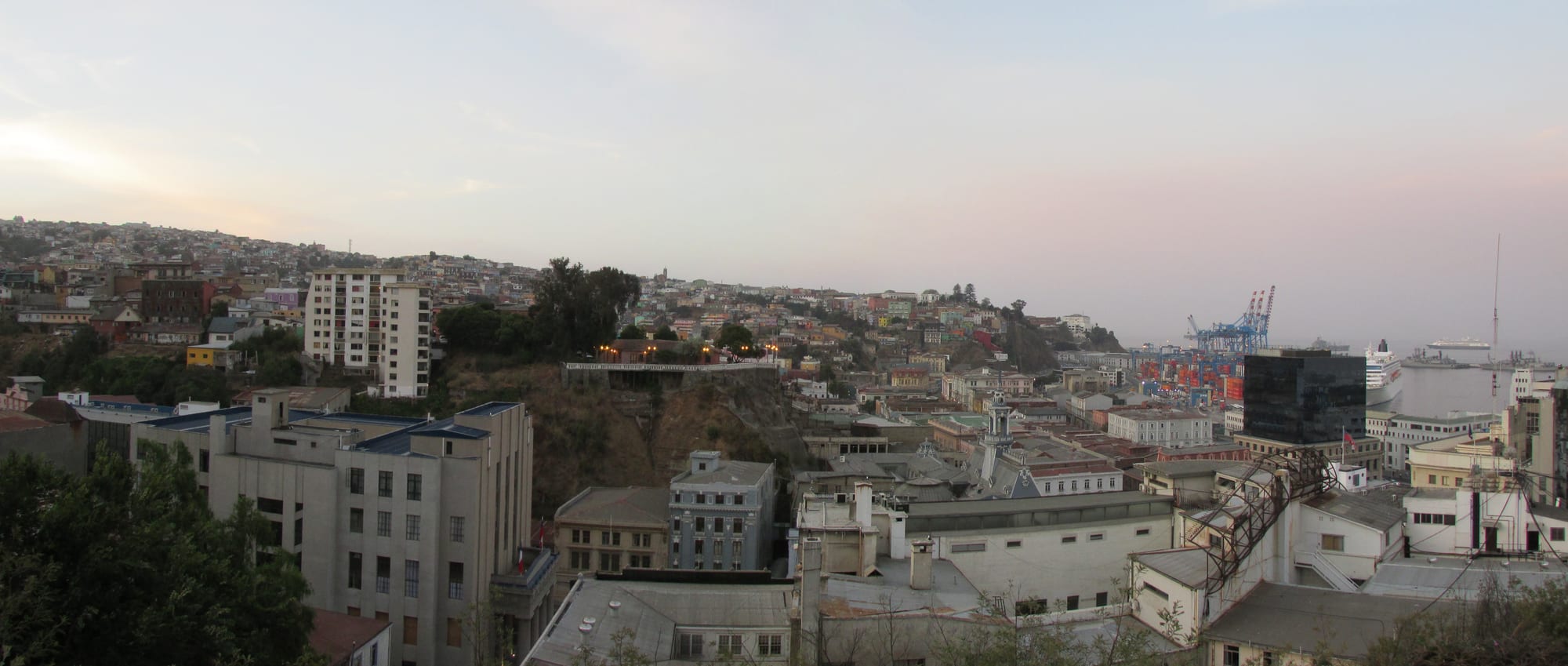
Houses and apartment blocks climbing steep hills above Valparaíso's port, with container cranes and a ship at the water's edge at dusk

Santiago & Valparaíso, Chile

Valparaíso

Valparaíso's hills and port seen from Cerro Alegre. (3BRBS / Wikimedia Commons · CC BY-SA 3.0)

Chile's historic port, about 120 kilometres north-west of Santiago by road, built on a narrow strip of flat land and the steep hills above the Pacific. Once the great stopover for ships passing between the Atlantic and the Pacific, it declined after the Panama Canal opened; its historic quarter of funiculars, painted houses and street art became a UNESCO World Heritage Site in 2003.

Neighbourhoods

  • Cerro Alegre and Cerro Concepción
    • First-time visitors
    • Historic district
    • Best for food

    The two oldest hills, where British merchants settled in the 19th century, with English-style houses, churches, small squares, museums and viewpoints such as Paseo Gervasoni. Many guesthouses, cafés and restaurants are here, linked to the flat below by the Concepción and Reina Victoria funiculars.

    Open in Maps
  • El Plan and the port quarter
    • Historic district
    • Close to public transport

    The flat strip along the bay, much of it reclaimed land, around Sotomayor Square and the navy headquarters. Banks, offices and old commercial buildings fill the streets, busy by day and quieter at night.

    Open in Maps
  • Cerro Artillería
    • Views
    • Museums

    The hill above the port, home to the Paseo 21 de Mayo promenade and the Naval and Maritime Museum. Its Artillería funicular has been out of service since May 2021.

    Open in Maps
  • Cerro Bellavista
    • Arts and culture
    • Quiet and residential

    A residential hill above the centre where Pablo Neruda's house, La Sebastiana, looks out over the bay.

    Open in Maps
  • El Almendral
    • Local life
    • Markets
    • Close to public transport

    The eastern part of the flat, around the Plaza de la Victoria, the cathedral and the National Congress, with the Cardonal market and the main bus terminal nearby.

    Open in Maps

Things to do

Funiculars and lifts

  • Ascensor Concepciónattraction

    The oldest of the city's funiculars, opened on 1 December 1883, climbing from the plan near the Turri clock to the Paseo Gervasoni on Cerro Concepción.

    Open in Maps
  • Ascensor Artilleríaattraction

    The third funicular built in the city, which entered service in 1893 on Cerro Artillería; it has been out of service since May 2021.

    Open in Maps
  • Ascensor Reina Victoriaattraction

    A funicular opened in 1903, linking the plan near Aníbal Pinto Square with Cerro Alegre and the Paseo Dimalow.

    Open in Maps
  • Ascensor Polancoattraction

    A true vertical lift rather than a funicular, entered through a tunnel at street level and rising inside a tower to Cerro Polanco.

    Open in Maps

Landmarks and museums

  • Sotomayor Squarelandmark

    The main square of the port quarter, faced by the former Intendencia building that now houses the headquarters of the Chilean Navy.

    Open in Maps
  • Palacio Baburizzamuseum

    The former mansion of the Croatian businessman Pascual Baburizza, built in 1916 and turned into a museum in 1971.

    Open in Maps
  • La Sebastianamuseum

    One of Pablo Neruda's three houses, on Cerro Bellavista, now a museum with views over the bay.

    Open in Maps
  • Naval and Maritime Museummuseum

    A museum on Paseo 21 de Mayo devoted to Chile's naval history, with a large section on the War of the Pacific.

    Open in Maps
  • National Congresslandmark

    The modern seat of Chile's legislature in El Almendral, built in the last years of the dictatorship and in use since 1990.

    Open in Maps
  • Cathedral of Valparaísolandmark

    The Catholic cathedral of the diocese, on the east side of the Plaza de la Victoria in El Almendral.

    Open in Maps

Trolleybuses and markets

  • Trolleybusestransit hub

    Electric trolleybuses have run in the city since 1952, and the system is considered part of its cultural heritage.

    Open in Maps
  • Mercado El Cardonalmarket

    A food market in El Almendral, in a building raised between 1912 and 1916, with simple restaurants upstairs.

    Open in Maps

Short trips from the city

  • Quinta Vergarapark

    A park in Viña del Mar whose amphitheatre hosts the Viña del Mar International Song Festival each year.

    Open in Maps
  • Wulff Castlelandmark

    A historic castle on the rocks above the sea in Viña del Mar.

    Open in Maps
  • Casablancaattraction

    A town on the road to Santiago at the heart of a cool-climate wine valley known for Sauvignon Blanc and Chardonnay, about 35 kilometres away.

    Open in Maps
  • Isla Negraattraction

    A stretch of coast south of the city where Neruda kept his best-known house, about 70 kilometres away by road.

    Open in Maps

Seasonal events

  • Año Nuevo en el MarNew Year's Eve

    The New Year fireworks show over the bay, described as the biggest in Latin America and watched by about a million people from the coastline and hillsides.

  • Viña del Mar International Song FestivalFebruary

    One of Latin America's largest song festivals, held next door in the Quinta Vergara amphitheatre since 1960.

Eat and drink

Long-standing places and food districts in Valparaíso. Hours, ratings and directions come from your maps app, always current.

Valparaíso classics

  • Chorrillana in the old barsneighborhood

    The dish popularly believed in Chile to have originated in Valparaíso — a heaped platter of chips topped with strips of steak, onion and eggs, shared over drinks in the port's traditional bars.

    Open in Maps
  • Mercado El Cardonalmarket

    The produce market in El Almendral, whose upper floor has inexpensive restaurants serving lunch.

    Open in Maps

Food districts

  • Cerro Alegre and Cerro Concepciónneighborhood

    Cafés and restaurants in old houses along the hilltop streets and promenades, many with views over the bay.

    Open in Maps
  • Viña del Mar seafrontneighborhood

    Restaurants along the coast north of Valparaíso serving seafood empanadas, machas a la parmesana and fresh fish.

    Open in Maps

Experience Valparaíso

History

The Picunche, farmers of the central valley, were the first identifiable people on the bay. Spanish ships first arrived in 1536 with the Santiaguillo, a supply vessel for Diego de Almagro's expedition. After independence it became the base of the new Chilean navy, which has had its headquarters here since 1817, and the town grew quickly as a port of call for ships passing between the Atlantic and the Pacific through the Strait of Magellan. It supplied the California gold rush and drew immigrants from Britain, Germany, France, Switzerland and Italy.

British merchants settled on Cerro Alegre and Cerro Concepción, and the city gained Latin America's oldest stock exchange, the continent's first volunteer fire brigade, Chile's first public library and El Mercurio de Valparaíso, the oldest Spanish-language newspaper still published. The first funicular, the Concepción, opened in 1883, and by the late 19th century the city had more than 160,000 people, spreading houses up the steep hills. An earthquake on 16 August 1906 killed nearly 3,000 people, and the opening of the Panama Canal in 1914 cut the shipping on which the city lived.

The port was rebuilt with large land reclamation between 1910 and 1930. On the morning of the 1973 coup the navy captured Valparaíso. Congress moved into a new building in the city in 1990, and in 2003 the historic quarter was declared a UNESCO World Heritage Site. Fire has struck repeatedly: a brush fire in April 2014 destroyed 2,800 homes and killed 16 people, and in early February 2024 a huge brush fire burned through Valparaíso and central Chile, killing at least 131 people.

Culture & Customs

Valparaíso has a bohemian identity of its own. Artists, musicians and street painters have made its hills an open-air gallery of murals, and the jumble of painted houses, stairways and lanes that earned the city its nickname, the Jewel of the Pacific, was the reason for its listing as a World Heritage Site. In 1996 the World Monuments Fund named its funiculars among the world's 100 most endangered historic treasures; 16 survive of about 30 built since 1883, and since 2022 the city council has managed those owned by the regional government.

Pablo Neruda, who kept houses in Santiago and at Isla Negra, also had La Sebastiana on Cerro Bellavista, and the city's poetry, music and nightlife draw students from its universities and visitors from Santiago. The British past survives in the churches and architecture of the oldest hills.

The New Year's Eve fireworks over the bay, Año Nuevo en el Mar, are described as the biggest in Latin America and draw about a million spectators. Football loyalty belongs to Santiago Wanderers, one of the oldest clubs in the country, recognised in 2007 as part of the city's intangible heritage. The trolleybuses, running since 1952, are treated as an emblem of the city too. Residents call themselves porteños, people of the port.

Daily Life

The commune of Valparaíso had 284,938 inhabitants at the 2024 census. With Viña del Mar, Concón, Quilpué and Villa Alemana it forms Greater Valparaíso, the second-largest urban area in Chile, with about 950,000 people. The city is the capital of the Valparaíso Region and the seat of the National Congress, and since 2024 its mayor has been Camila Nieto Hernández.

The port remains central to the economy. It handles container traffic, copper and fruit exports, and receives about 50 cruise ships and 150,000 passengers a season, though San Antonio, to the south, now moves more containers, and port revenues go to the national treasury rather than the city. Government, the navy, universities and tourism provide much of the rest of the city's work.

Most people live on the hills, climbing home by stairway, bus or funicular from the flat plan where they work and shop, while many commute by train or bus to Viña del Mar. The economic decline of the old centre, crime, housing in fire-prone ravines on the upper hills, and recovery from the wildfires of 2024 are the main current issues.

Food

The dish most associated with Valparaíso is the chorrillana, popularly believed to have originated here: a heaped platter of chips topped with strips of beef, fried onions and eggs, made for sharing over beer or wine in the port's old bars and late at night. The coast supplies the rest of the city's table: seafood empanadas, machas a la parmesana (surf clams baked with parmesan), and fresh fish, served in restaurants along the bay and in neighbouring Viña del Mar.

Everyday lunch is found in the markets. The Mercado El Cardonal in El Almendral sells fruit and vegetables from the valleys inland, and simple restaurants on its upper floor serve set lunches to traders and shoppers. Street stalls sell empanadas de pino, baked beef turnovers, and sopaipillas, fried dough that in central Chile includes pumpkin.

The hilltop quarters of Cerro Alegre and Cerro Concepción have the city's cafés and more ambitious restaurants, many in old merchants' houses with views over the harbour. Wine comes from the Casablanca valley on the road to Santiago, known for Sauvignon Blanc and Chardonnay.

Planning tools

Budget

Valparaíso is a little cheaper than Santiago, though guesthouses and restaurants on Cerro Alegre and Cerro Concepción charge more than elsewhere in the city. The funiculars, buses and trolleybuses are cheap, and walking the hills and viewpoints costs nothing. Prices rise sharply over New Year and in the February holidays.

Daily Budget Midrange
USD 100–210 (guesthouse on the hills, restaurant meals, museum visits, a trip to Viña del Mar or the wine valley)
Daily Budget Shoestring
USD 40–75 (hostel bed, market lunches and chorrillana, buses and funiculars)

Book well ahead for New Year's Eve, when the city fills for the fireworks.

Best Time to Visit

Spring and autumn are mild and good for walking the hills. Summer brings the beach season in nearby Viña del Mar, the song festival in February and the most visitors. Winter is cool and wet, with coastal fog, but quieter and cheaper. New Year's Eve is the city's biggest night.

Suggested Number of Days

Two or three days suit a first visit to the city itself. Four or five allow time for the neighbouring resort and the wine and coast country around it. The steep terrain makes everything slower than it looks on a map.

First Visit
2–3 days
With Surroundings
4–5 days

Transportation

Buses, trolleybuses and the funiculars (ascensores) serve the city, linking the flat plan with the hills; shared taxis (colectivos) run fixed routes. The Limache–Puerto commuter train, known as Merval, runs 43 kilometres along the bay from the port through Viña del Mar to Limache. Sixteen historic lifts survive of about 30 built since 1883; in October 2025 only seven of them were running.

Carry small change for the funiculars and keep bags close on them, as crowded lifts and streets attract pickpockets.

Airport & Station Connections

Arturo Merino Benítez International Airport in Santiago is the nearest airport with commercial flights, about an hour and a half away by road. Buses from Santiago leave many times an hour and take about an hour and a half, longer in traffic; the bus terminal is near the National Congress. Cruise ships dock at the port in season.

Walkability

The flat plan is easy to walk, but the hills are very steep, with stairways, winding lanes and uneven paving, so the funiculars save a great deal of climbing. Cerro Alegre and Cerro Concepción are best explored slowly on foot. Comfortable shoes matter more here than in most cities.

Safety

Chile is one of the safer countries in South America, but petty and opportunistic crime has risen, especially in Santiago and Valparaíso — pickpocketing, bag-snatching, phone theft, and distraction scams in tourist areas, markets, and on transport. The port quarter and some lanes on the hills are best avoided after dark. The city is also exposed to earthquakes and to summer wildfires on its hillsides.

Use app taxis at night, ask locally which streets to avoid after dark, and follow tsunami and fire evacuation signs. Check current official travel advice before travelling.

Climate

Mediterranean and milder than Santiago, with dry summers and cool, wet winters, softened by the ocean and often covered by coastal fog in the mornings. Summer is December–February.

Summer
dry and mild, with a January average of about 17°C
Winter
cool and wetter, with a July average of about 11°C

Local Customs

Residents call themselves porteños, people of the port, and are proud of the city's bohemian, independent identity, its street art and its football club, Santiago Wanderers. A tip of 10 per cent is customary in restaurants. Murals are public art, but houses on the hills are homes.

Ask before photographing residents, and keep voices down on residential stairways and lanes at night.

Common Payment Methods

The currency is the Chilean peso (CLP). Cards are widely accepted in restaurants, hotels and shops, but funiculars, markets and small bars often need cash. ATMs are common in the plan.