Culture & Customs · Greece
Why are the houses of Greece's Cycladic islands white, and their church domes blue?
The look belongs to the Cyclades, and the blue domes crown churches, not homes. Lime, heat, scarce timber and pirates shaped the white villages.
By Globeway Editorial · 13 October 2026
The short answer
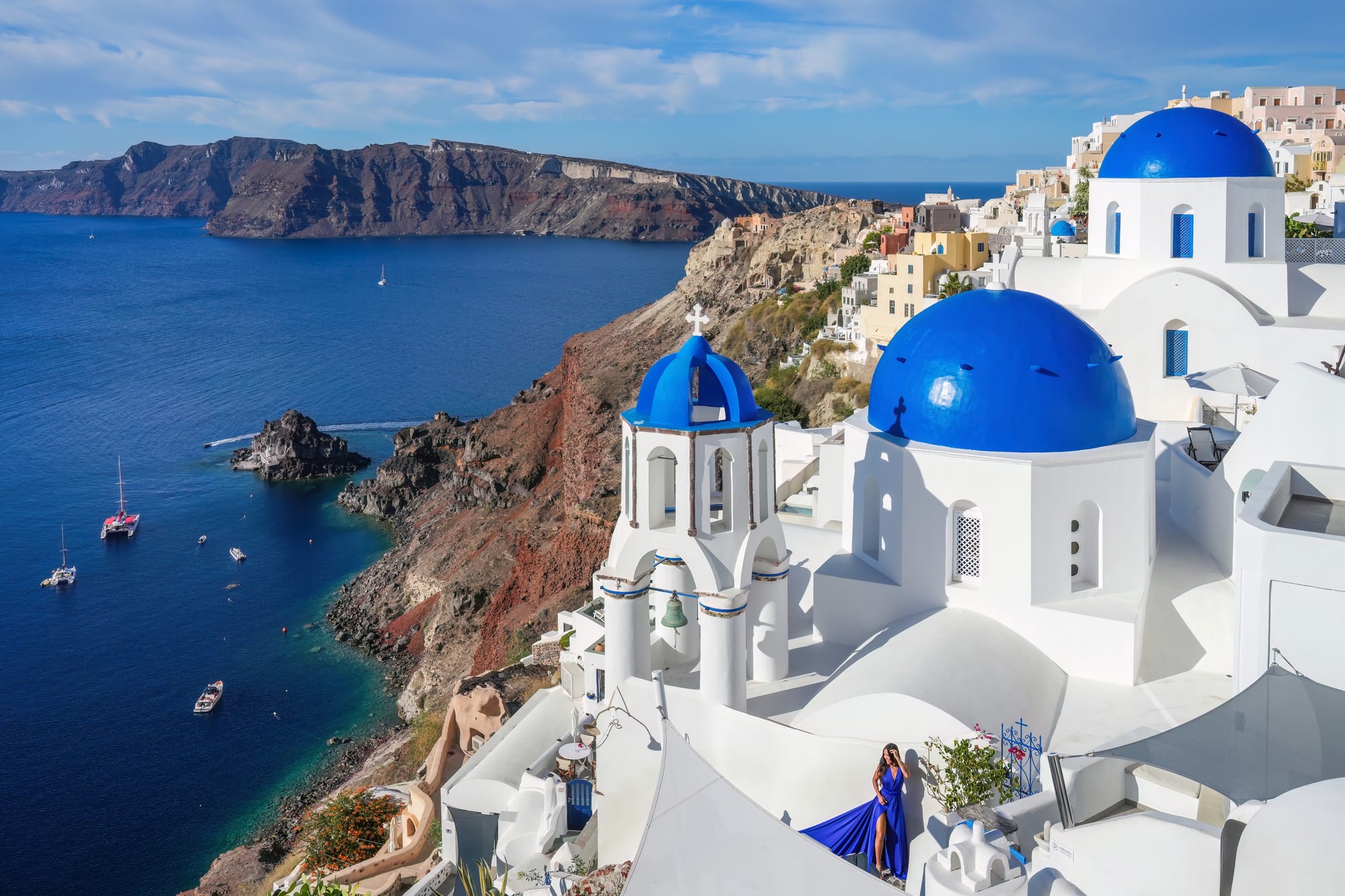
The famous picture needs two corrections. White villages with blue domes are the trademark of one island group, the Cyclades in the middle of the Aegean, not of every Greek island. And the blue domes sit on churches, not on houses. The houses themselves are small, plain cubes of local stone, coated in whitewash.
They are white because whitewash, made from lime, was a simple local finish; it helps keep the sun's heat out, it is mildly antibacterial, and on Santorini it was applied so that rain running off the houses could be collected. Explanations for the blue vary. Blue and white are the colours of the Greek flag, possibly standing for the sky and the sea, and blue church domes against white walls have become the image of the Cyclades.
Built from what the islands had
The shape of a Cycladic house comes from poverty and climate. Islanders built for their own needs with simple means, usually putting up the houses themselves from unworked local materials. Timber was scarce, and beams rarely spanned more than about 3 metres, so the basic unit was a single-room cube of roughly 3 by 4 metres and 2.5 metres high. Walls 60 to 80 centimetres thick held a steady temperature, windows stayed small for the same reason, and houses usually faced southeast to catch the light. An opening on the north side let the summer meltemi, the strong seasonal wind of the Aegean, cool the rooms.
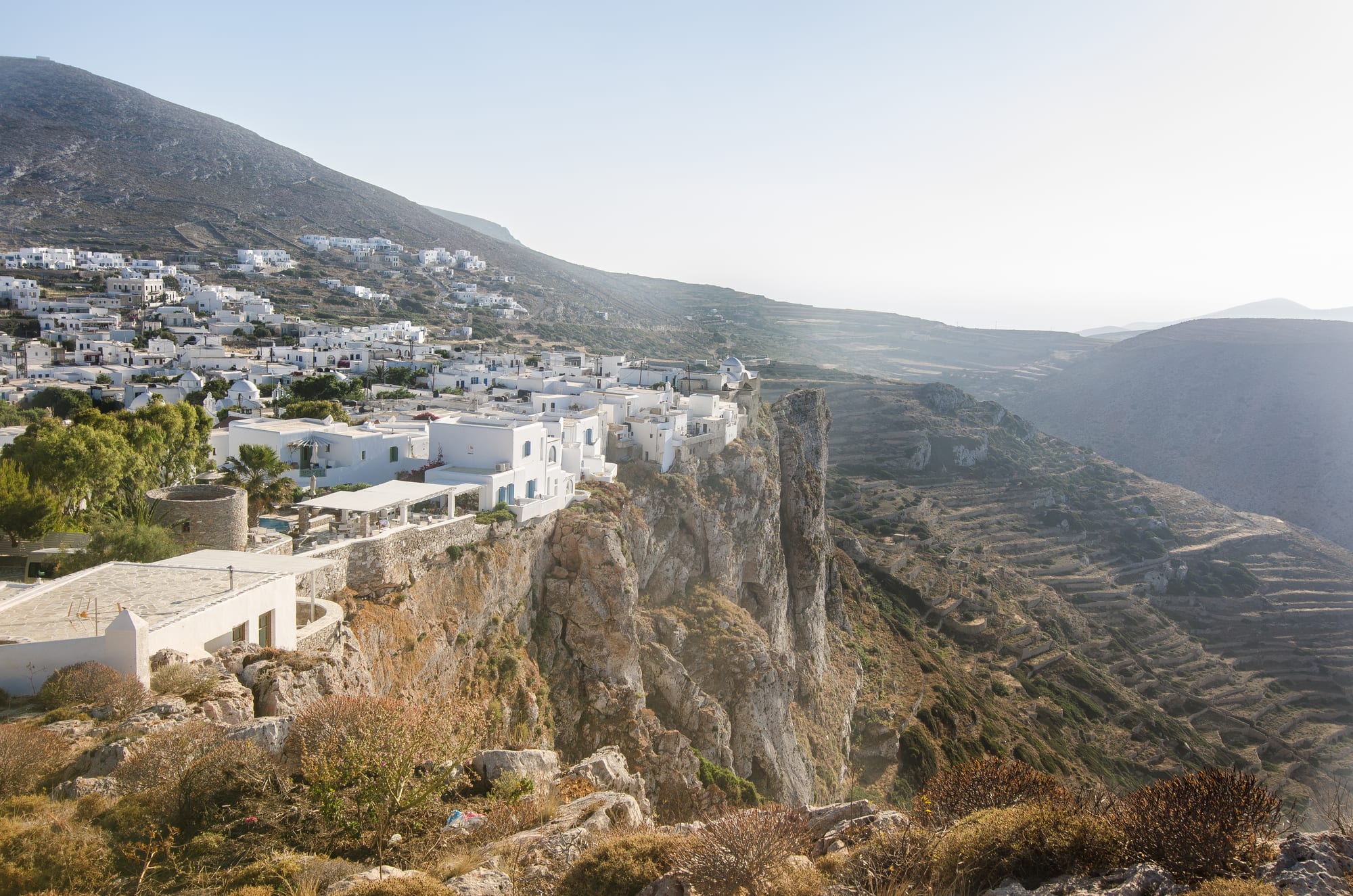
Villages in the Cyclades grew without a plan, following the ground; a village laid out to a design is a rarity on these islands.
Fear shaped the villages too. In the 15th and 16th centuries pirates raided the Cyclades, plundering harvests and carrying off people to sell as slaves. On Santorini, islanders responded by building their settlements on the highest, least accessible points, with houses packed close together or on top of one another and outer walls without openings that formed a protective ring. On Andros and Naxos houses were built inside fortified castles. Piracy gave Cycladic architecture its defensive character.
Why white: the work of lime
Whitewash is a paint made from slaked lime (calcium hydroxide) mixed with water. As it dries it reacts with carbon dioxide in the air and turns back into calcium carbonate, in the form of the mineral calcite. It is easily absorbed by masonry and hardens there.
Its benefits suited the islands. White walls absorb less heat, which matters in a long, dry Aegean summer. Lime is mildly antibacterial, which is why it was used to keep dairies and barns hygienic in other countries too. On Santorini, houses were painted with lime so that rain falling on them would run off clean and could be collected. Another reason given is simply appearance. A romantic story told in Oia holds that islanders painted their village white in defiance of Ottoman rule, when they could not fly a flag of their own.
Where the blue comes from
The domes are the cupolas of the islands' many churches, which stand out in blue against the white houses around them. In Oia the alleys between the houses lead past blue-roofed churches with cupolas, the scene that fills postcards.
The colour pairing is the national one. The Greek flag is popularly called the Galanólefki, the Blue-and-White, and its white and blue may symbolise the sky and the sea. Blue also had a humbler, practical history in whitewash: blue laundry dye, known in Greece as loulaki and used to give white cloth a bright tinge, was a common 19th-century addition to whitewash.
Not every island looks like this
Many Greek islands look nothing like Santorini. On Symi, in the Dodecanese near Rhodes, the slopes above the harbour are covered with colourful neoclassical mansions, built when the island reached the height of its prosperity in the mid-19th century as a shipbuilding and sponge-fishing centre.
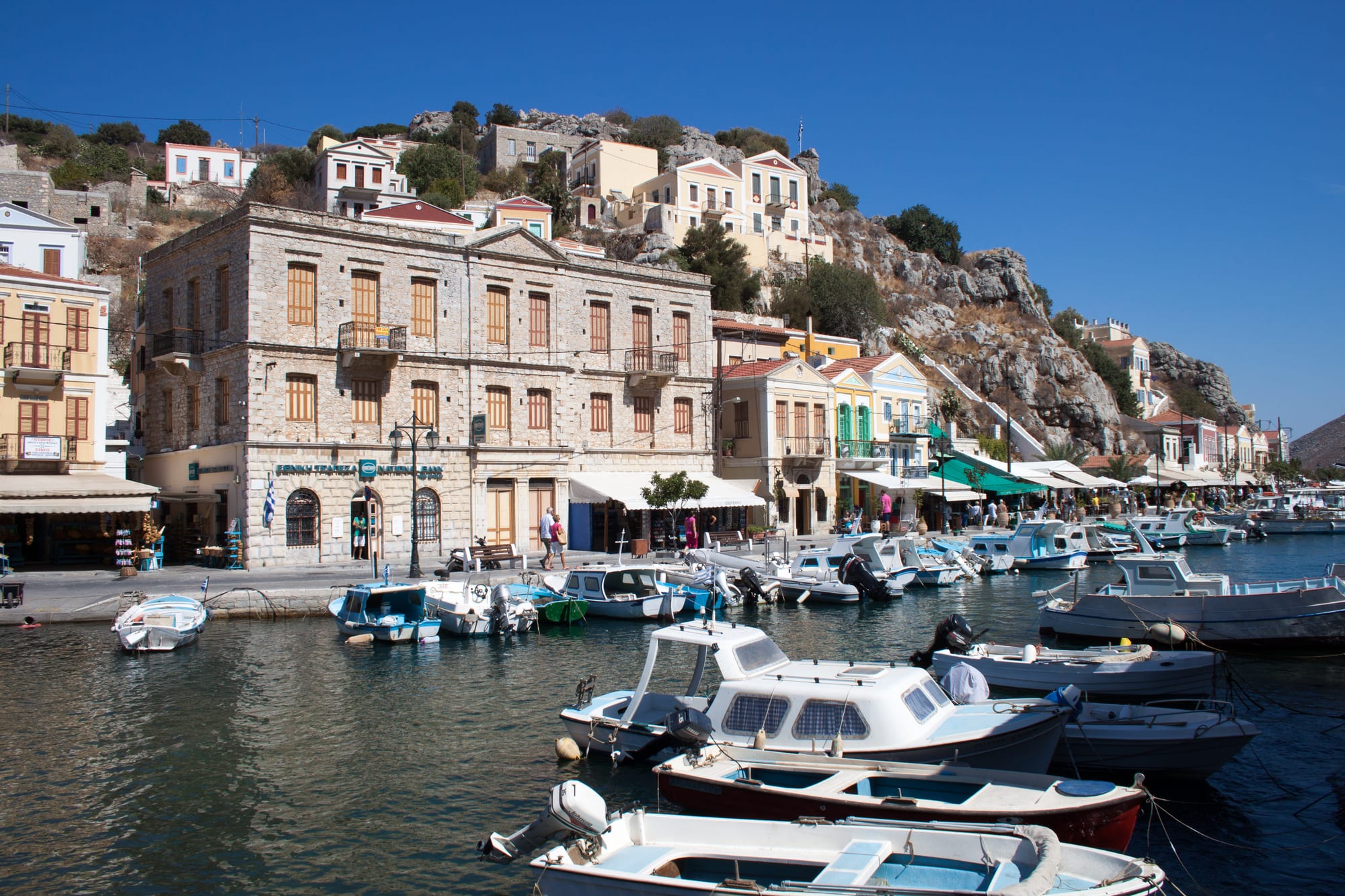
Symi's population peaked at around 22,500 in the 19th century, before steam shipping ended its role as a waypoint for trade.
Even Santorini was not always white. Its traditional houses were whitewashed or limewashed, but often coloured with various volcanic ashes, and in recent years those colours have been coming back to replace white on house fronts, following the island's architecture as it was before the great earthquake of
- That earthquake destroyed half the island's buildings, with the worst
damage along the caldera edge, and most of the population had to move to Piraeus and Athens.
How the postcard was preserved
The white-and-blue Oia of today is partly the result of deliberate conservation. In 1976 the town joined a programme of the Greek National Tourism Organisation, led by the architect Aris Konstantinidis, to preserve traditional settlements. Over 15 years it restored houses and found new uses for them; many simple seamen's cave houses on the caldera edge became guest houses, hotels and restaurants. The work won a Europa Nostra Prize in 1979.
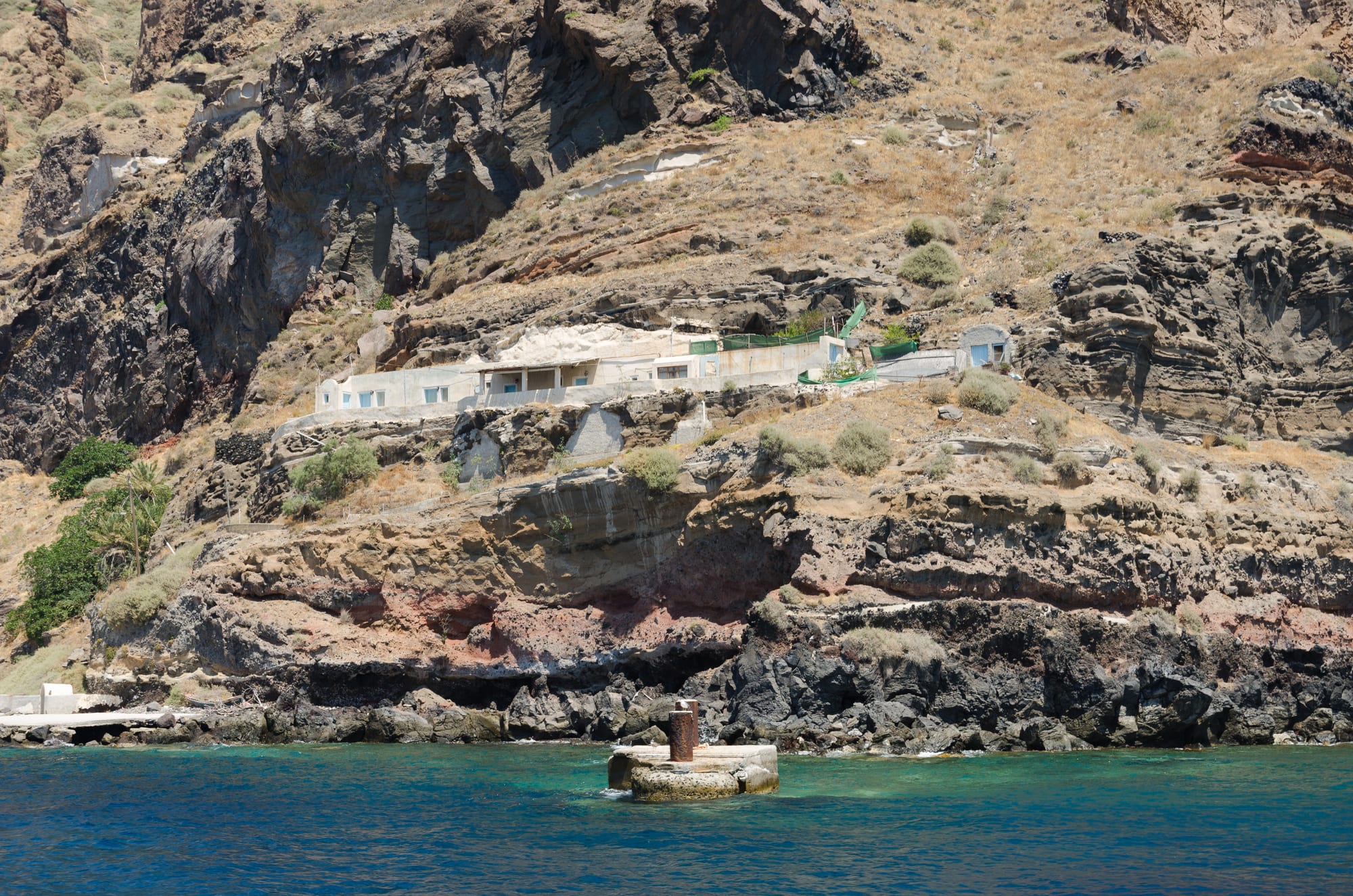
After the 1956 earthquake, many dwellings dug into the ridge above the caldera had to be evacuated, because unstable ground there caused much of the damage.