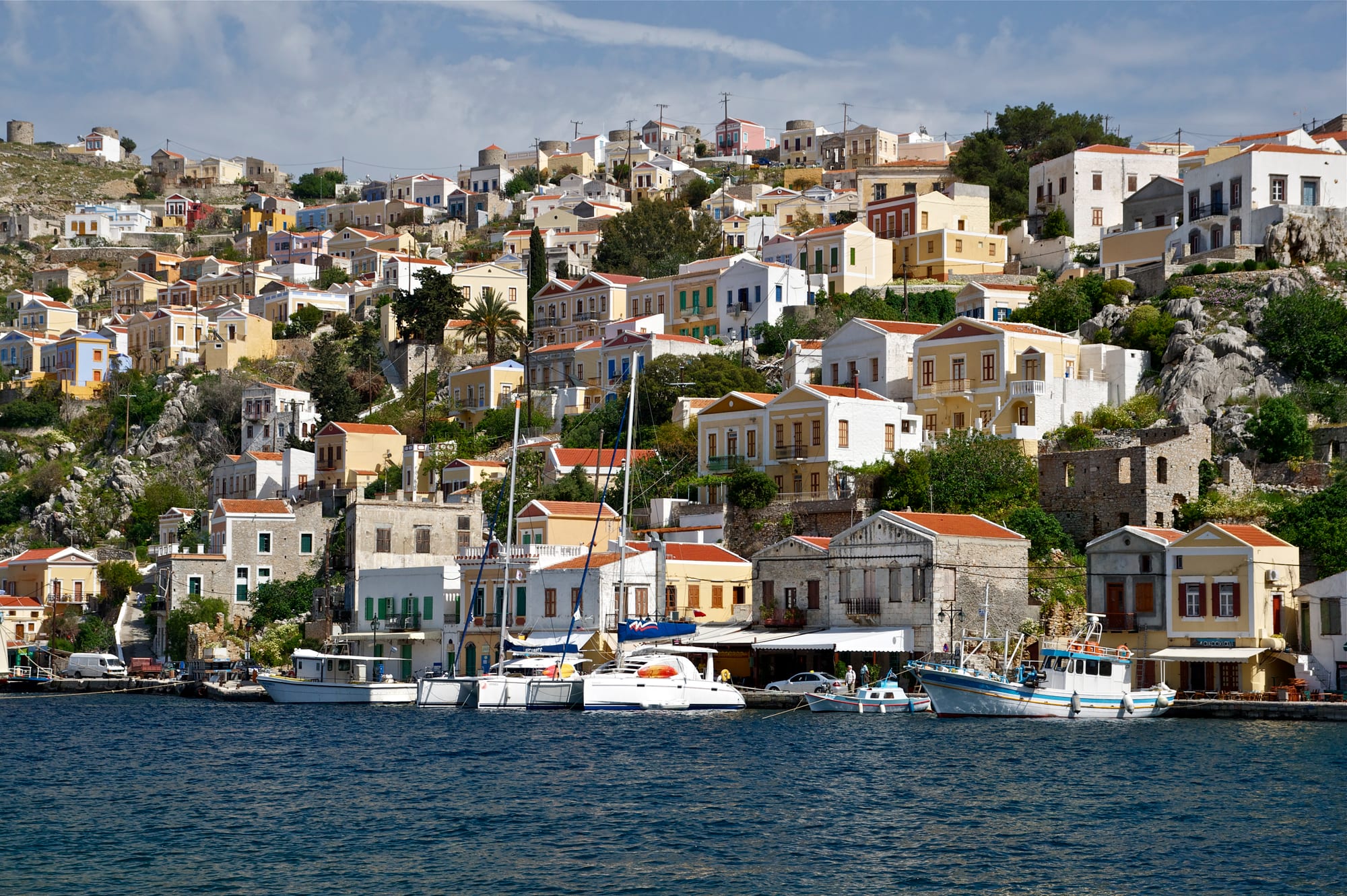
Pastel-coloured neoclassical houses with tiled roofs climbing a rocky hillside above a harbour lined with yachts and fishing boats

Greece

The Cyclades & the Dodecanese

Colourful houses rising above the harbour of Symi in the Dodecanese. (Jebulon / Wikimedia Commons · CC0)

The South Aegean, Greece's great island region, joining the whitewashed Cyclades in the middle of the Aegean — Santorini, Mykonos, Naxos, Paros, Milos — with the Dodecanese strung along the Turkish coast, from medieval Rhodes to Kos and the monastery island of Patmos, where Venetian, crusader and Italian pasts overlay the Greek.

Explore The Cyclades & the Dodecanese

History

The Cyclades take their name from the "circle" they form around Delos. In the third millennium BC their islanders carved the flat, abstract marble figurines of Cycladic art, and in the Bronze Age Santorini's town at Akrotiri, painted with frescoes, was buried by the great eruption that created the caldera. Delos became the religious centre of the Aegean, sacred to Apollo and Artemis, and in 478 BC the treasury of the Athenian-led Delian League. In the Dodecanese, the three cities of Rhodes founded a joint capital in 408 BC, whose bronze Colossus stood until an earthquake toppled it in 226 BC; Kos was the home of Hippocrates, and on Patmos John the Apostle is said to have written the Book of Revelation.

After the Fourth Crusade, the Venetian Marco Sanudo founded the Duchy of the Archipelago on Naxos in 1207, and the Knights Hospitaller took Rhodes in 1310, ruling the Dodecanese from their fortified city until Suleiman the Magnificent drove them out in 1522. The Ottomans also absorbed the Cyclades during the 16th century, though Tinos stayed Venetian until 1715.

The Cyclades joined independent Greece in the 1830s, and Syros's port of Ermoupoli, founded by refugees from Chios and Psara, became the country's busiest harbour for a time. The Dodecanese followed a different path: Italy seized them in 1912 and ruled for three decades. German occupation brought the deportation of the Jews of Rhodes and Kos, and the islands joined Greece in 1947. Tourism later transformed the islands.

Culture & Customs

Island identity is fiercely local. Each island has its own saints, dialect words, dances and rivalries, and the panigyri, the saint's-day festival with free food, wine and dancing through the night, is the heart of the summer calendar. The music is nisiotika, island songs played on violin and lute, with the tsambouna bagpipe on some islands. Syros, home of the rebetiko musician Markos Vamvakaris, has one foot in the city tradition too.

Religion is Orthodox, but the Cyclades hold long-established Catholic communities, a Venetian legacy, on Syros, Tinos and Naxos. Tinos's church of the Panagia Evangelistria draws Greece's biggest pilgrimage on 15 August, with some of the faithful crossing the approach on their knees.

Old ways survive in pockets. The village of Olympos on Karpathos keeps an archaic dialect and women who still wear traditional costume, Kalymnos is proud of its sponge divers, and the whitewashed villages of the Cyclades still hold to a style of building shaped by wind, sun and scarce timber. The Dodecanese carry an Italian flavour in architecture and some words, and older people on Rhodes still remember Italian school.

Daily Life

About 330,000 people live in the South Aegean. Rhodes is the largest island, with around 125,000 people, and Rhodes Town is the biggest city, while Ermoupoli on Syros, a handsome neoclassical port, is the regional capital. Kos, Naxos, Paros and Santorini each have somewhere near 15,000 to 35,000 residents; many of the smaller islands have only a few hundred.

Tourism dominates the economy to a degree unusual even in Greece, and the population of Santorini or Mykonos multiplies many times over in summer. Syros has shipyards and administration, Naxos farming and cheese, Milos mining of bentonite and perlite, and the Dodecanese a long seafaring tradition. Workers from the mainland and abroad arrive each spring to staff hotels and restaurants.

Life swings between a frantic season and a very quiet winter, when ferries thin out, shops close and the young often leave for Athens. The strains of success are the daily talk: water shortages met by desalination, housing priced beyond local workers by short-term lets, cruise-ship crowding on Santorini, building on untouched coastline, and the fragility of island hospitals and schools in winter.

Food

Cycladic cooking was shaped by dry soil and little water. Santorini grows fava, the seeds of a local vetchling cooked into a smooth purée, as well as small intense cherry tomatoes fried into tomatokeftedes, tomato fritters. Sifnos is known for revithada, chickpeas baked slowly overnight in a clay pot.

Cheese differs from island to island. Naxos makes graviera, a hard sweet cheese, and arseniko; Mykonos has kopanisti, a spicy, fermented cheese. Syros is famous for loukoumi, soft jelly sweets, and halvadopites, a local sweet, while Rhodes makes melekouni, a sesame and honey sweet, and pitaroudia, fritters.

Wine is Santorini's pride. The Assyrtiko grape, grown in low baskets on volcanic soil against the wind, makes a crisp, mineral white, and the sweet Vinsanto is made from sun-dried grapes. Naxos distils kitron, a liqueur from the fruit and leaves of the citron tree, and Rhodes has its own wineries. Ouzo with grilled octopus by the harbour is the common island ritual.

Attractions & Natural Wonders

Santorini is built along the rim of its drowned caldera, with the towns of Fira and Oia on the cliffs, the prehistoric site of Akrotiri under a protective roof, Ancient Thera on a ridge above the black-sand beaches of Kamari and Perissa, and boat trips to the volcanic islet of Nea Kameni. Mykonos has its windmills, the Little Venice waterfront and busy beaches, and boats run to Delos, a UNESCO World Heritage Site with its Terrace of the Lions. Naxos has the Portara, the great marble doorway of an unfinished temple, a Venetian kastro, the mountain villages of Halki and Apeiranthos, and unfinished kouroi lying in ancient quarries. Paros has the Byzantine church of the Panagia Ekatontapyliani in Parikia and the harbour of Naoussa, with Antiparos and its cave next door. Milos has Sarakiniko's white rock, the sea caves of Kleftiko, the village of Plaka and the field where the Venus de Milo was found in 1820. Amorgos's cliff-hung Hozoviotissa monastery and Folegandros's Chora reward the extra ferry.

In the Dodecanese, the Medieval Town of Rhodes is a UNESCO World Heritage Site, and Lindos, with its acropolis above a white village, lies down the east coast. Kos has the Asklepieion, the healing sanctuary linked to Hippocrates, and the Knights' castle by the harbour. Patmos's Monastery of St John and Cave of the Apocalypse are UNESCO-listed, Symi has a harbour of neoclassical houses, and Nisyros has a walkable volcanic crater.

Cities in The Cyclades & the Dodecanese

Planning basics

Budget

This is the most expensive part of Greece in summer. Santorini's caldera hotels and Mykonos in July and August reach the prices of the Riviera, while Naxos, Paros, Milos and Rhodes are closer to the national average, and small islands such as Amorgos, Sifnos, Symi and Karpathos can be good value outside August. Ferries are a significant cost, especially the fast boats, and accommodation roughly halves in May and October.

Daily Budget Midrange
USD 170–340 (mid-range hotel, taverna dinners, fast ferries, a hire car or quad for a few days)
Daily Budget Shoestring
USD 70–110 (domatia room or hostel away from the caldera, gyros and bakery food, deck-class ferries)

Sleep in Naxos, Paros or inland Santorini villages rather than on the caldera edge or in Mykonos Town, and use slower conventional ferries where time allows.

Safety

The islands are safe. The main risks are quad and scooter accidents on steep roads, crowds on Santorini's caldera paths when cruise ships are in, rough seas in the meltemi, heat and dehydration on bare islands with little shade, and petty theft and drink-related trouble in the Mykonos and Kos nightlife. The region is volcanic and seismically active; an earthquake swarm near Santorini and Amorgos in early 2025 led many people to leave temporarily.

Wear a helmet, carry water, avoid swimming in strong wind, and follow local instructions on earthquakes. Check current official travel advice before travelling.

Climate

Dry and sunny: the Cyclades see little rain from May to September, and the islands are bare and brown by late summer. The meltemi, a strong northerly wind, blows through July and August, cooling the air but whipping up the sea and cancelling small-boat sailings. The Dodecanese, further south-east, are warmer, and Rhodes is among the sunniest places in Europe.

Summer
hot and dry, 27–33°C, moderated by the meltemi in the Cyclades; hotter and calmer on Rhodes and Kos
Winter
mild and windy, 10–16°C, with occasional storms that stop ferries

Transportation

Ferries from Piraeus and Rafina reach the Cyclades in roughly three to eight hours depending on the island and the boat, and the main islands are linked to each other several times a day in summer. Rhodes is an overnight journey from Piraeus, so most visitors fly; Rhodes, Kos, Santorini, Mykonos, Naxos, Paros and Milos all have airports. Island buses serve the main villages; hire cars, quads and scooters fill the gaps.

Book ferries ahead in summer and leave a spare day before an international flight, as the meltemi can cancel sailings for a day or more.

Best Time to Visit

Late May, June and September are the best months: warm sea, open tavernas, lighter crowds and less wind. July and August bring the strongest meltemi, the highest prices and cruise-ship crowds in Santorini and Mykonos. The 15 August pilgrimage on Tinos is the great religious occasion. From November to March many Cycladic hotels close, though Rhodes and Syros keep a year-round life.