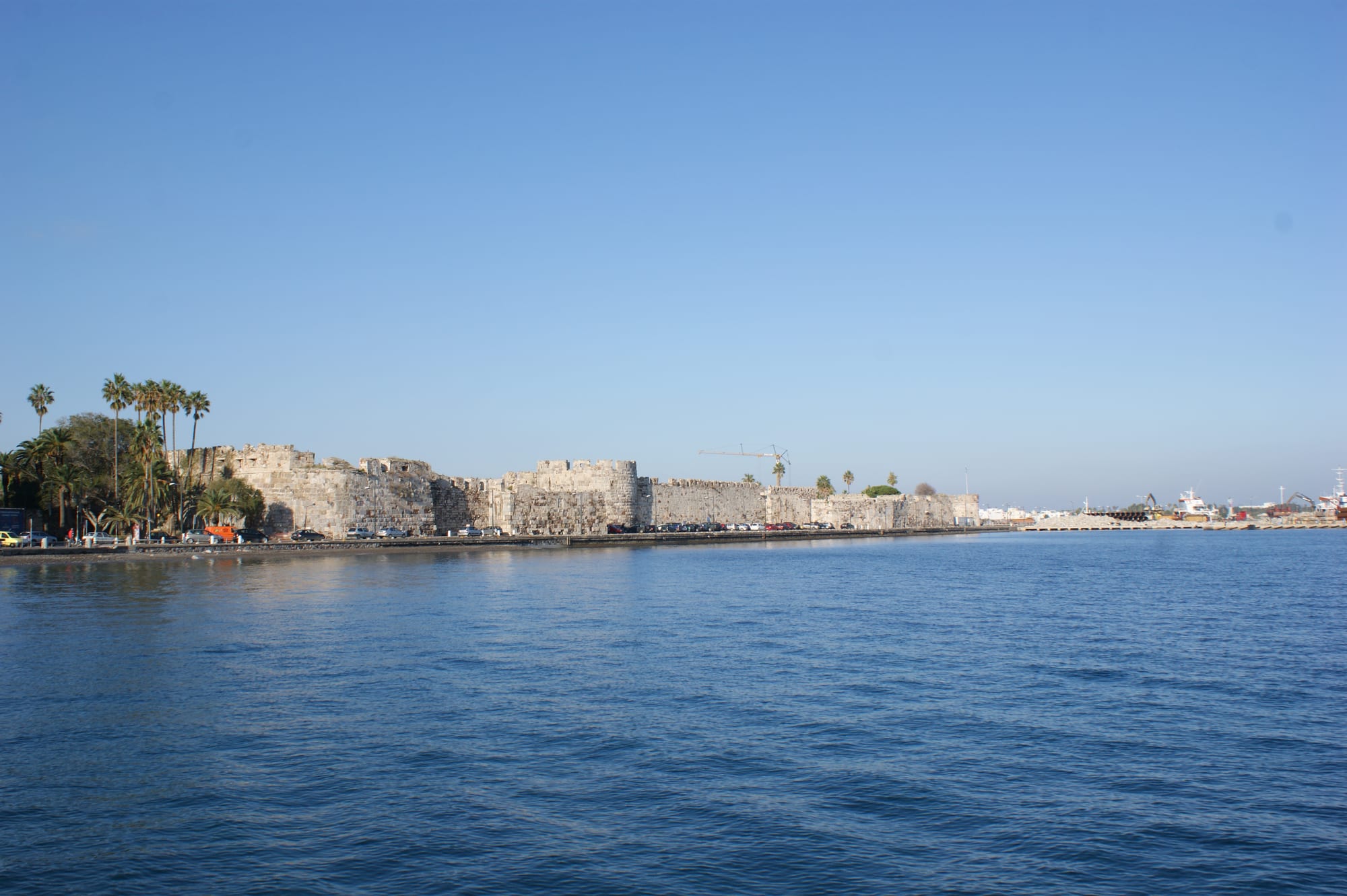
The long stone walls of Neratzia castle beside the harbour of Kos town, with palm trees and calm blue water under a clear sky

The Cyclades & the Dodecanese, Greece

Kos

The Knights' castle of Neratzia on the harbour of Kos town. (Asurnipal / Wikimedia Commons · CC BY-SA 4.0)

The second most populous of the Dodecanese, a long island facing the Turkish coast, described here from Kos town, its port and capital. Founded in 366 BC and tied to Hippocrates and the healing sanctuary of the Asklepieion, the town was rebuilt by the Italians after a 1933 earthquake. Today ruins, a Knights' castle and a lively harbour sit beside long beaches.

Neighbourhoods

  • Old town and harbour
    • First-time visitors
    • Historic district
    • Close to the ferries

    The heart of Kos town around the old harbour and the marina, where the Knights' castle, the Plane Tree of Hippocrates, the Loggia Mosque and the excavated ancient agora lie within a few minutes' walk, among whitewashed buildings, cafés and shops.

    Open in Maps
  • The Italian town and bar street
    • Nightlife
    • Architecture

    The town rebuilt to an Italian plan after the 1933 earthquake, divided into residential, administrative and commercial quarters, with the archaeological park left where the old quarters stood and a 'bar street' of clubs that keeps the centre loud on summer nights.

    Open in Maps
  • Tigaki and Marmari
    • Beaches
    • Families

    Seaside villages on the north coast about 10 km west of the town, with long beaches facing the island of Pserimos.

    Open in Maps
  • Kardamaina
    • Nightlife
    • Beaches

    A resort halfway along the south coast near the airport, popular with young holidaymakers from Britain and Scandinavia for its bars and nightclubs, and the departure point for summer boats to Nisyros.

    Open in Maps

Things to do

Landmarks of Kos town

  • Neratzia Castlelandmark

    The Knights Hospitaller's 14th-century fortress guarding the harbour entrance, the most important part of their fortifications on the island, built partly with stones from the ancient city and the Asklepieion.

    Open in Maps
  • Plane Tree of Hippocrateslandmark

    The old plane tree in front of the castle under which, legend says, Hippocrates taught his pupils; the present tree is about 500 years old and its limbs rest on scaffolding.

    Open in Maps
  • Gazi Hasan Pasha Mosquelandmark

    The Loggia Mosque, a former Ottoman mosque of the late 18th century beside the plane tree, at the centre of the old town.

    Open in Maps
  • Ancient Agoralandmark

    The market place of the ancient city, first built in the 4th century BC near the harbour and one of the largest excavated in Greece, with colonnades of shops around a large courtyard; the earthquake of 469 AD marked the end of the ancient city.

    Open in Maps
  • Kahal Shalom Synagoguelandmark

    An Italian-era synagogue of 1935, abandoned after the deportation of the island's Jews in 1944 and now used by the municipality for cultural events.

    Open in Maps

Museums and Roman Kos

  • Archaeological Museum of Kosmuseum

    An Italian-era building of 1936 on Eleftherias Square, with Hellenistic and Roman sculpture, many statues found at the Roman Odeon including one of Hippocrates, and a sea-floor mosaic from the Casa Romana.

    Open in Maps
  • Casa Romanalandmark

    A restored Roman villa of the late 2nd and early 3rd centuries AD, with 36 rooms around three open courtyards and floor mosaics of panthers, tigers, Nereids and dolphins.

    Open in Maps
  • Roman Odeonlandmark

    The 2nd-century AD odeon of the ancient town, where about 18 hidden marble statues were found, among them the Hippocrates now in the museum; cultural events are held here in summer.

    Open in Maps

Ancient healing

  • Asklepieionlandmark

    One of the most famous sanctuaries of Asclepius in the ancient world, on terraced slopes about 3 km south-west of the town; its surviving ruins date from after the 4th century BC, and it was excavated in 1902.

    Open in Maps
  • Hippocratic Museummuseum

    A museum on the history of the Hippocratic Foundation of Kos, which is dedicated to passing on knowledge about Hippocrates; the ruins of the Asklepieion lie near the foundation's institute.

    Open in Maps

Short trips from the town

  • Old Pylilandmark

    The ruins of a Byzantine settlement, churches and hilltop castle on a 300 m hill about 15 km west of the town, south-east of the village of Pyli.

    Open in Maps
  • Kefalos Baybeach

    A curving bay below the island's westernmost town, with the beach resorts of Kamari, Kampos and Onia, windsurfing schools and beaches such as Paradise and Camel.

    Open in Maps
  • Bodrumattraction

    The Turkish resort town across the strait, reached by passenger boats twice a day all year and an easy day trip.

    Open in Maps
  • Kalymnosattraction

    The neighbouring island of sponge divers to the north, reached by the ferry that leaves Mastichari roughly every two hours.

    Open in Maps

Eat and drink

Long-standing places and food districts in Kos. Hours, ratings and directions come from your maps app, always current.

Kos classics

  • Village tavernasneighborhood

    Tavernas in the inland villages serve local recipes with the island's own wine.

    Open in Maps
  • Harbour tavernas of Kos townneighborhood

    Restaurants and cafés around the old harbour and the marina, in the busiest part of the town.

    Open in Maps

Bars and nights out

  • Bar streetneighborhood

    The street of bars and clubs in the centre of Kos town, the island's main nightlife strip alongside Kardamaina.

    Open in Maps

Experience Kos

History

The town of Kos was founded in 366 BC, when the island's capital moved from Astypalaea, near today's Kefalos, to a new city laid out on a Hippodamian grid by the harbour. Kos had long been settled by Dorians and was a member of the Doric Hexapolis with the cities of Rhodes. It flourished under the Ptolemies of Egypt, who used it as a naval base and a place to educate their princes; Ptolemy II was born here. The town became a centre of learning and of justice, sending judges to settle disputes across the Greek world, and the Asklepieion, the sanctuary of the healing god Asclepius, drew pilgrims. Hippocrates is thought to have been born on the island, and Paul stopped here briefly.

Genoese protection and the Knights Hospitaller followed, and in 1315 the Knights began the castle at the harbour entrance. In January 1523, after the fall of Rhodes, the castle was handed over to the Ottomans, who left the Greeks to live in suburbs outside it. A Russian landing party sent to capture the castle in August 1773 failed.

Italy occupied the island in 1912. After the earthquake of 23 April 1933 destroyed much of the old town, the architect Rodolfo Petracco drew up a new plan, turning the ruined quarters into an archaeological park. In the Second World War the Germans won the Battle of Kos in 1943 and then executed about 100 Italian officers who refused to join them; nearly 100 members of the island's Jewish community were deported on 23 July 1944. Kos joined Greece in 1947.

Culture & Customs

Kos lives with Hippocrates. The plane tree where he is said to have taught stands in front of the castle, the airport is named after him, and the International Hippocratic Foundation and its museum keep up the link between the island and medicine. The Asklepieion, excavated in 1902 by Rudolf Herzog, is the island's most famous site.

The town mixes the layers of its history. Ottoman mosques, among them the Loggia Mosque of the late 18th century, stand beside the plane tree and the Knights' walls; the Italian years left a planned centre and the 1935 synagogue, whose interior the municipality and the Jewish communities commissioned to be restored in 2022 for both worship and cultural use. In the late 1920s about 3,700 Turks lived in Kos town, nearly half its people; today a community of about 2,000 remains, especially in the village of Platani. The Orthodox metropolis of Kos answers directly to the Patriarchate of Constantinople.

The island has given its name to more than history: Cos lettuce, or romaine, is said to have originated here. The comic playwright Epicharmus was born at Astypalea, the island's ancient capital, the Hellenistic poet Philitas made his home here, and the early recording star Marika Papagika was born on Kos in 1890. The 1968 film Signs of Life was shot on the island.

Daily Life

The town had 19,432 inhabitants at the 2011 census, and the island 37,089 at the 2021 census, the second largest population in the Dodecanese after Rhodes. Kos town is the port, the seat of the municipality and the island's tourist and cultural centre.

Tourism is the main industry, built on the beaches. The island's hotel stock has shifted sharply upmarket: between 2014 and 2023 the number of five-star hotels nearly doubled while one- and two-star hotels declined. Farming comes second, with grapes, almonds, figs, watermelons, olives and tomatoes, along with wheat and corn. The airport, run by Fraport, is busiest in summer with charter flights from Germany and Britain.

Life follows the tourist season: the harbour, marina and bar street are crowded from late spring to autumn, while winter is quieter. It is also one of several Greek islands with a closed controlled-access centre for refugees and migrants, with a stated capacity of 2,140. The earthquake of 1933, which reshaped the town, is a reminder that the area is seismically active.

Food

Kos is a farming island as well as a holiday one. Its fields and orchards produce grapes, almonds, figs, watermelons, olives and tomatoes, with wheat and corn, and in antiquity the island was famous for its wines. Cos lettuce, the long-leaved lettuce known in North America as romaine, is said to have come from the island and takes its name from it.

In the inland villages, small tavernas serve local recipes with the island's own wine, made with produce from the surrounding farms. In Kos town the restaurants and cafés gather around the old harbour, the marina and the streets of the old town, where everything from simple gyros to full taverna meals is on offer to visitors arriving off the ferries.

Seafood is part of island life too, from the fishing boats of Mastichari's little harbour to the tavernas along the coast. Evenings in summer stretch late, with meals followed by drinks in the bars of the town centre or Kardamaina.

Planning tools

Budget

Kos is geared to beach holidays, with many hotels and summer charter flights, and the number of five-star hotels nearly doubled between 2014 and 2023. Kos town is cheaper outside July and August, and a hire car or boat trips to neighbouring islands and Turkey add to the bill.

Daily Budget Midrange
USD 150–280 (mid-range hotel, taverna dinners, museum and site tickets, a hire car or a day boat)
Daily Budget Shoestring
USD 60–100 (simple room or studio, gyros and bakery food, island buses)

The harbour, the plane tree, the castle walls and the open ruins of the ancient town cost nothing to walk past and round.

Best Time to Visit

Late May, June and September give warm sea and lighter crowds. July and August are the hottest and busiest months, when the resorts and Kos town's nightlife are at full stretch. Most charter flights run from spring to autumn, and much of the resort trade closes in winter.

Suggested Number of Days

Two or three days cover the town and its ancient sites. Most visitors stay a week, as the coastline runs to 112 km and day boats run to neighbouring islands and Turkey.

First Visit
2–3 days
With Surroundings
5–7 days

Transportation

KTEL buses link the town with every part of the island, though not frequently, and the airport bus runs via Mastichari to Kefalos and the town. Taxis are plentiful, and scooters, quads and cars are easy to hire; roads are mostly asphalted and in good condition. Ferries to Kalymnos leave from Mastichari and, in summer, to Nisyros from Kardamaina.

Check the bus timetable in advance, as services to the villages are spaced out, and wear a helmet on any scooter or quad.

Airport & Station Connections

Kos International Airport, near Antimachia, is about 24 km from the town and mainly serves charter flights from Germany and Britain in summer. Ferries run daily from Piraeus, Rhodes, Patmos and Leros, and several times a day from Kalymnos; passenger boats cross from Bodrum in Turkey twice a day all year.

Walkability

Kos town is flat and compact: the harbour, castle, plane tree, agora, museum and Roman houses are all within a short walk of each other. The Asklepieion lies outside the town on a hillside, and the beach villages and resorts need a bus, taxi or hired vehicle.

Safety

Greece is a safe country for visitors, with low levels of violent crime. Kos is a very safe island; the main risks are scooter and quad accidents, drink-related trouble in the bars of Kardamaina and Kos town in summer, heat at the open archaeological sites, and earthquakes, which have struck the island several times.

Wear a helmet, carry water at the ruins, watch drinks and belongings in the nightlife areas, and follow local instructions after any earthquake. Check current official travel advice before travelling.

Climate

A hot-summer Mediterranean climate, with dry, sunny summers and mild, wetter winters. Kos lies close to the Turkish coast, and conditions are much like those across the water in Bodrum.

Summer
hot and sunny — in nearby Bodrum, summer averages around 34°C
Winter
mild — in nearby Bodrum, winter averages around 15°C

Local Customs

Most people are Orthodox Christians, and the island's metropolis answers to the Patriarchate of Constantinople rather than the Church of Greece. Kos also has a Turkish Muslim community of about 2,000, centred on the village of Platani near the town, and a Roman Catholic church. Churches expect covered shoulders and knees.

Dress modestly in churches and former mosques, ask before photographing people, and keep beachwear for the beach.

Common Payment Methods

The currency is the euro. Cards are accepted almost everywhere in Kos town and the resorts, though some village tavernas and kiosks prefer cash. Turkish lira are needed only for a day trip to Bodrum.