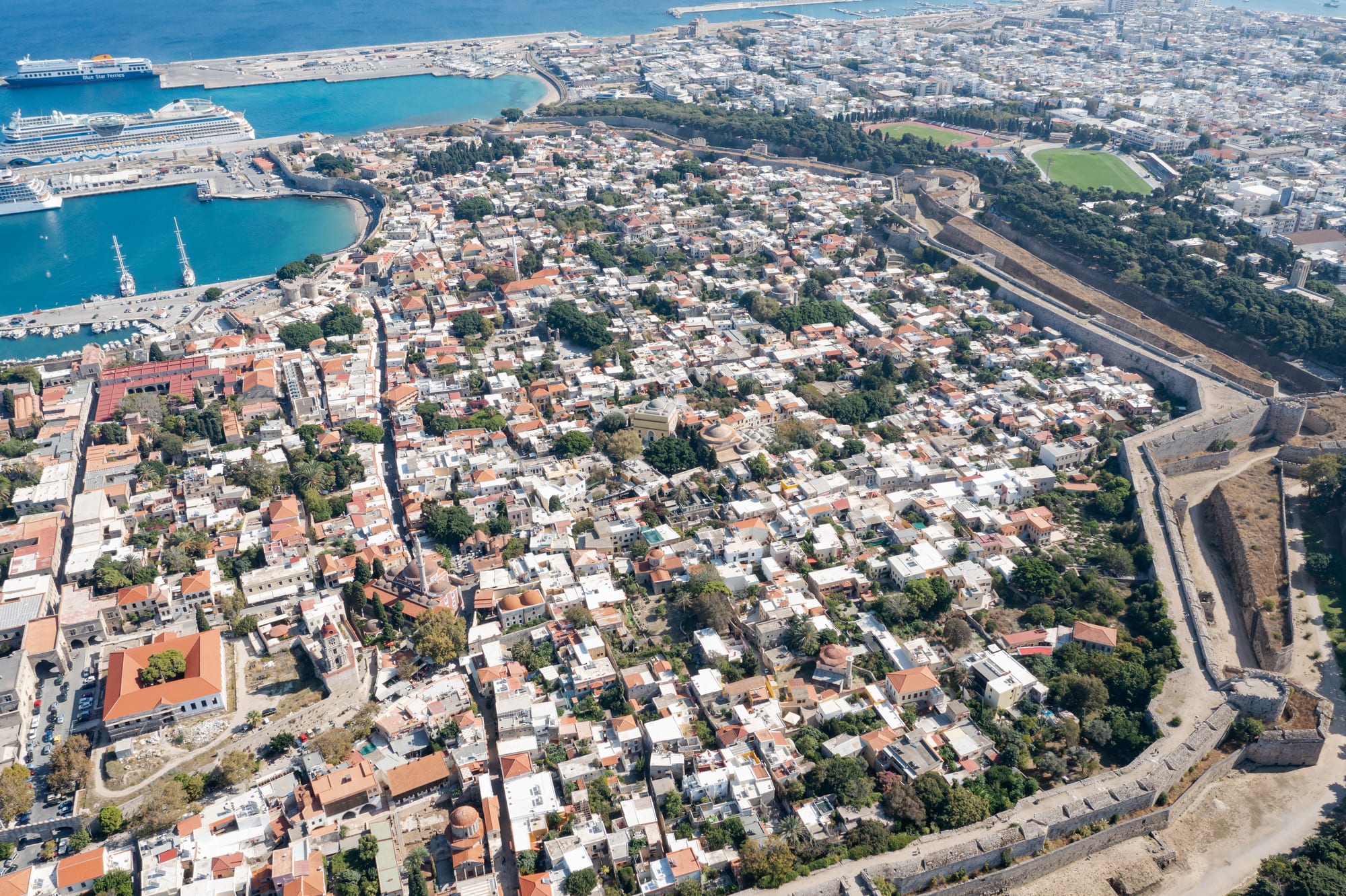
Aerial view of Rhodes Old Town's tiled roofs and white houses inside its medieval walls, with the harbour and cruise ships beyond

The Cyclades & the Dodecanese, Greece

Rhodes

The walled Old Town of Rhodes and its harbours from the air. (dronepicr / Wikimedia Commons · CC BY 2.0)

The largest of the Dodecanese, close to the Turkish coast, seen here from Rhodes town at its northern tip — a city founded in 408 BC, rebuilt by the Knights of St John as a walled stronghold and later remodelled by the Ottomans and the Italians. Today the medieval town is a UNESCO World Heritage Site, and the island is one of Greece's busiest holiday destinations.

Neighbourhoods

  • Old Town
    • First-time visitors
    • Historic district
    • Museums

    The walled medieval city of the Knights, with the high town of the Grand Master's Palace to the north and the lower town of lanes, mosques, fountains and the old Jewish quarter to the south. Thousands of people still live inside the walls, and many of its lanes have no name.

    Open in Maps
  • New Town and Mandraki
    • Close to public transport
    • Beaches
    • Nightlife

    The modern city north and west of the walls. Along Mandraki harbour stand the Italian-era public buildings and the New Market, beside the bus stations and taxi rank; the long Elli beach lines the eastern waterfront.

    Open in Maps
  • Ialysos and Ixia
    • Beaches
    • Windsurfing

    A town and a strip of resort hotels down the west coast towards the airport, with a long organised beach where international windsurfing competitions often take place. Above it rises Filerimos hill, with medieval remains including a monastery.

    Open in Maps
  • Faliraki
    • Beaches
    • Nightlife

    The island's main seaside resort, about 14 km south of the town on the north-east coast, with tavernas, bars and restaurants along the beach front and the largest water park in Greece; the hotels to its north are much quieter.

    Open in Maps

Things to do

The medieval town

  • Palace of the Grand Masterlandmark

    The Knights' castle at the top of the high town, wrecked by a gunpowder explosion in 1856 and rebuilt by the Italians, now a museum.

    Open in Maps
  • Fortifications of Rhodeslandmark

    The crescent of walls, bastions, moats and gates that the Knights built from 1309 on Byzantine foundations, strengthened against cannon after the siege of 1480.

    Open in Maps
  • Suleymaniye Mosquelandmark

    The former mosque first built after the Ottoman conquest of 1522 and named after Suleiman the Magnificent, whose dome and minaret rise above the Old Town.

    Open in Maps
  • Hafiz Ahmed Agha Librarylandmark

    An Ottoman library founded in 1793 by Hafiz Ahmed Agha, an important historic Ottoman building in the walled town.

    Open in Maps
  • Kahal Shalom Synagoguelandmark

    A 16th-century synagogue in La Juderia, the old Jewish quarter, and the oldest synagogue in Greece, used today for holidays and community events.

    Open in Maps

Museums

  • Archaeological Museum of Rhodesmuseum

    Housed in the Knights' former hospital, with finds from across the island, a garden of sculpture and mosaics, and the marble Head of Helios.

    Open in Maps
  • Jewish Museum of Rhodesmuseum

    A museum founded in 1997 beside the Kahal Shalom Synagogue, telling the story of a community that goes back more than two thousand years and was almost destroyed in 1944.

    Open in Maps
  • Aquarium of Rhodesmuseum

    A marine research station, aquarium and museum in a building of the 1930s, put up when the island was under Italian rule.

    Open in Maps

Ancient Rhodes and green spaces

  • Acropolis of Rhodeslandmark

    The upper town of the ancient city on Monte Smith, south-west of the centre, with the partly restored Temple of Pythian Apollo, a small marble odeon and a stadium.

    Open in Maps
  • Rodini Parkpark

    A historical park along a creek gorge, with the Roman water supply system of the ancient city and many birds, including peacocks.

    Open in Maps

Beaches

  • Kallitheabeach

    The coast just north of Faliraki, known for the spa built by the Italians and for snorkelling in small rocky coves.

    Open in Maps

Short trips from the town

  • Lindosattraction

    A fishing village below an acropolis crowned by the Temple of Athena Lindia, one of the three ancient cities that founded Rhodes.

    Open in Maps
  • Petaloudes Valleypark

    The Valley of the Butterflies, where thousands of Jersey tiger moths gather after the wet season ends in late May.

    Open in Maps
  • Kamiroslandmark

    The ruins of one of the island's three ancient cities, near the north-west coast.

    Open in Maps
  • Symiattraction

    A small island of neoclassical harbour houses, once rich from sponge diving and shipbuilding, and one of the daily boat excursions from Rhodes town.

    Open in Maps

Eat and drink

Long-standing places and food districts in Rhodes. Hours, ratings and directions come from your maps app, always current.

Rhodes classics

  • Melekouni and island sweetscafe

    Melekouni, a sesame and honey sweet, is a Rhodian speciality, alongside amygdalota, white almond cookies, and zvigoi, a local kind of loukoumades.

    Open in Maps
  • Old Town tavernasneighborhood

    Tavernas in the lanes and small squares of the Old Town, where fish tavernas grill the local catch.

    Open in Maps

Markets and waterfront

  • New Marketmarket

    The Italian-era market building facing Mandraki harbour, beside the main bus stops, lined with cafés and snack bars.

    Open in Maps
  • Mandraki cafésneighborhood

    Café terraces along the old harbour, where the day boats to Lindos and Symi tie up.

    Open in Maps

Experience Rhodes

History

The city of Rhodes was created in 408 BC, when the island's three older cities — Ialysos, Kamiros and Lindos — joined together and built a new capital on the northern tip, laid out on a plan based on the ideas of the planner Hippodamus. Sea trade and shipbuilding made it rich. After resisting a year-long siege by Demetrius I of Macedon, which ended in 304 BC, the Rhodians raised the Colossus, a bronze statue of the sun god Helios by Chares of Lindos, near the harbour; an earthquake toppled it in about 226 BC. The city came under Roman control in 164 BC, stayed a centre of learning, and the Apostle Paul stopped here on his travels.

In the Middle Ages Rhodes was a Byzantine trading post until the Knights Hospitaller took it in the early 14th century. They rebuilt the town as a fortress, with the Grand Master's Palace, the Street of the Knights and ever stronger walls, which held off a Mamluk attack in 1444 and an Ottoman siege in 1480. In 1522 Suleiman the Magnificent besieged the city again, and on 1 January 1523 the Knights sailed away. Under the Ottomans, mosques and baths were built and the Greeks had to move to suburbs outside the walls.

Italy seized the island in 1912. Its planners cleared the houses built against the walls, rebuilt the Grand Master's Palace and put up a new administrative quarter around Mandraki harbour. In 1944 Allied bombing destroyed part of the old town, and in July that year the German authorities deported more than 1,700 of the island's Jews, of whom about 1,200 were murdered at Auschwitz; the Turkish consul Selahattin Ülkümen saved around 200 people. Rhodes joined Greece in 1947, the medieval town was protected in 1960 and listed by UNESCO in 1988.

Culture & Customs

Rhodes carries the layers of its rulers in plain view. The Gothic buildings of the Knights' high town, Ottoman baths and enclosed wooden balconies, the Kahal Shalom Synagogue and the Italian-era public buildings of Mandraki stand within a few minutes of each other. The island is Orthodox and seat of a metropolis, but it also has a Catholic community of about 2,000, many descended from Italians who stayed after the Italian occupation ended, and a Turkish Muslim minority whose ancestors were not included in the population exchange of the 1920s because the island was then Italian. The Jewish community, which once made up a third of the town, now numbers very few, and its museum keeps the memory of the Sephardic world that the war destroyed.

Rhodians speak a dialect that mainland Greeks describe as sing-song, with Turkish and Italian echoes and words they do not always understand. Sport is followed keenly: Diagoras and AS Rodos are the city's two major football clubs, basketball is equally popular, and the island hosted the Island Games in 2007 and holds the International Tour of Rhodes cycling race.

The town has also lived in the imagination of outsiders. The ancient saying "Hic Rhodus, hic salta!" names the island, The Guns of Navarone was filmed on the island, and Agatha Christie set her story Triangle at Rhodes here.

Daily Life

Rhodes town counted 49,541 people at the 2011 census, though some 65,000–70,000 are estimated to live there permanently, and the island as a whole had 125,113 at the 2021 census, the third-largest population of any Greek island. In summer the town's population reaches about 100,000, as its 25,000–30,000 hotel beds fill and seasonal workers arrive from the mainland.

Tourism drives the economy: the island has more than 550 hotels, most of them two-star. The town is also the administrative capital of the Dodecanese, with courts, the regional police and coastguard headquarters, the general hospital and departments of the University of the Aegean. The old street network of narrow, one-way streets cannot cope with the traffic, parking around the centre is extremely difficult in summer, and plans for a tram network presented years ago have gone no further.

Life follows the season. From spring to autumn cruise ships fill the harbours and the Old Town shops and bars stay open late; in winter the resorts close, but the town carries on with its schools, offices and markets. The scale of tourism is itself the main local issue, alongside the wildfires of 2023, which forced the largest evacuation in the country's history.

Food

Rhodian cooking has its own repertoire. Lakani is goat cooked with chickpeas; matsi is a hand-made pasta used in a traditional dish called koulouria, and synoro a local cheese. Pitaroudia, katimeria pancakes and pies such as tahinopita and pougia pie are part of the tradition.

Sweets are a point of pride. Melekouni, a sesame and honey sweet, is a Rhodian speciality, alongside zvigoi, a local kind of loukoumades, amygdalota, white almond cookies, and fanouropita. Souma, a colourless spirit distilled from grapes, and koriantolino are the island's main traditional drinks, and the local wine is cheap. Citrus fruit, wine grapes, vegetables and olives grow on the island's arable strips of land, and olive oil is a common purchase to take home.

In the town, fish tavernas in the lanes and squares of the Old Town grill the local catch, while the cafés of Mandraki and the New Market fill with people waiting for buses and boats. Tap water is drinkable.

Planning tools

Budget

Rhodes is closer to the Greek average than Santorini or Mykonos, and the island has a very large supply of rooms, many in simple two-star hotels. The walled town and the big coastal resorts cost the most in July and August, prices fall sharply in spring and autumn, and buses, boat trips and taxis to the far side of the island add up.

Daily Budget Midrange
USD 160–300 (mid-range hotel, taverna dinners, museum tickets, a hire car or a boat trip)
Daily Budget Shoestring
USD 70–110 (hostel bed in the Old Town or a simple room, gyros and bakery food, island buses)

The Old Town walls, the lanes, Mandraki and the Acropolis of Rhodes cost nothing to walk; buses reach most of the island from the stops by the New Market.

Best Time to Visit

May, June, September and October bring warm sea, long days and fewer people. July and August are the hottest and busiest months, when cruise passengers crowd the Old Town. Unlike many smaller islands, Rhodes town keeps a year-round life, though many resort hotels close in winter.

Suggested Number of Days

Two or three days cover the town itself. The island is large — about 80 km from north to south — so a week suits anyone who wants its beaches, villages and ancient sites as well, with a car or a lot of bus journeys.

First Visit
2–3 days
With Surroundings
5–7 days

Transportation

All bus lines start in Rhodes town: the municipal RODA buses serve the town, the west coast and the airport, and KTEL buses run down the east coast to the resorts and villages, from separate stops near the New Market. Taxis are dark blue with white roofs and queue at ranks in high season. Hire cars, mopeds and quads fill the gaps, though town streets are narrow, one-way and congested, and parking near the centre is hard in summer.

Buses fill up in summer and run late; leave plenty of time for the airport, and wear a helmet on any moped or quad.

Airport & Station Connections

Diagoras International Airport is at Paradeisi, about 14 km south-west of the town — about 35 minutes by bus. It has flights from Athens and Thessaloniki all year and many seasonal flights from across Europe. Ferries link the town with Piraeus, and boats link the town with the other Dodecanese islands and with Marmaris and Fethiye on the Turkish coast.

Walkability

The Old Town is a place for walking only, a maze of cobbled lanes inside its medieval walls, and the New Town, Mandraki and Elli beach are a short walk from its gates. The Acropolis of Rhodes is about 2 km south-west of the Old Town, uphill, and is easier by town bus.

Safety

Greece is a safe country for visitors, with low levels of violent crime. On Rhodes the main risks are moped and quad accidents, heat on bare hillsides, and drink-fuelled trouble in the clubs of Faliraki, where the police take a zero-tolerance line. In 2023 wildfires forced nearly 19,000 people to evacuate, the largest evacuation in Greek history, and the island lies in an earthquake zone.

Watch bags in the Old Town crowds when cruise ships are in, follow fire warnings in summer, and wear a helmet on two wheels. Check current official travel advice before travelling.

Climate

A hot-summer Mediterranean climate with mild winters and hot, dry summers. The island has 300 or more sunny days a year, and the south-east of the island, around Lindos, is the warmest part of Greece, with a mean annual temperature of about 22°C.

Summer
hot and dry — the airport at Paradeisi has recorded up to 40.2°C, and Lindos holds the island record of 43.6°C
Winter
mild — the town averages 20.9°C across the whole year, and the airport has not dropped below 1.2°C since its station opened in 1977

Local Customs

Rhodians speak a sing-song dialect with Turkish and Italian echoes, and English and German are widely understood in the tourist areas. The island is Orthodox, with a small Catholic community and a Turkish Muslim minority. Churches and monasteries expect covered shoulders and knees, and the synagogue and former mosques of the Old Town are places of memory as well as sights.

Ask before photographing people, dress modestly in churches, and keep beachwear for the beach, not the Old Town lanes.

Common Payment Methods

The currency is the euro. Cards are accepted almost everywhere, though some tavernas, kiosks and village shops still prefer cash, and cash machines are easy to find in Rhodes town and the resorts.