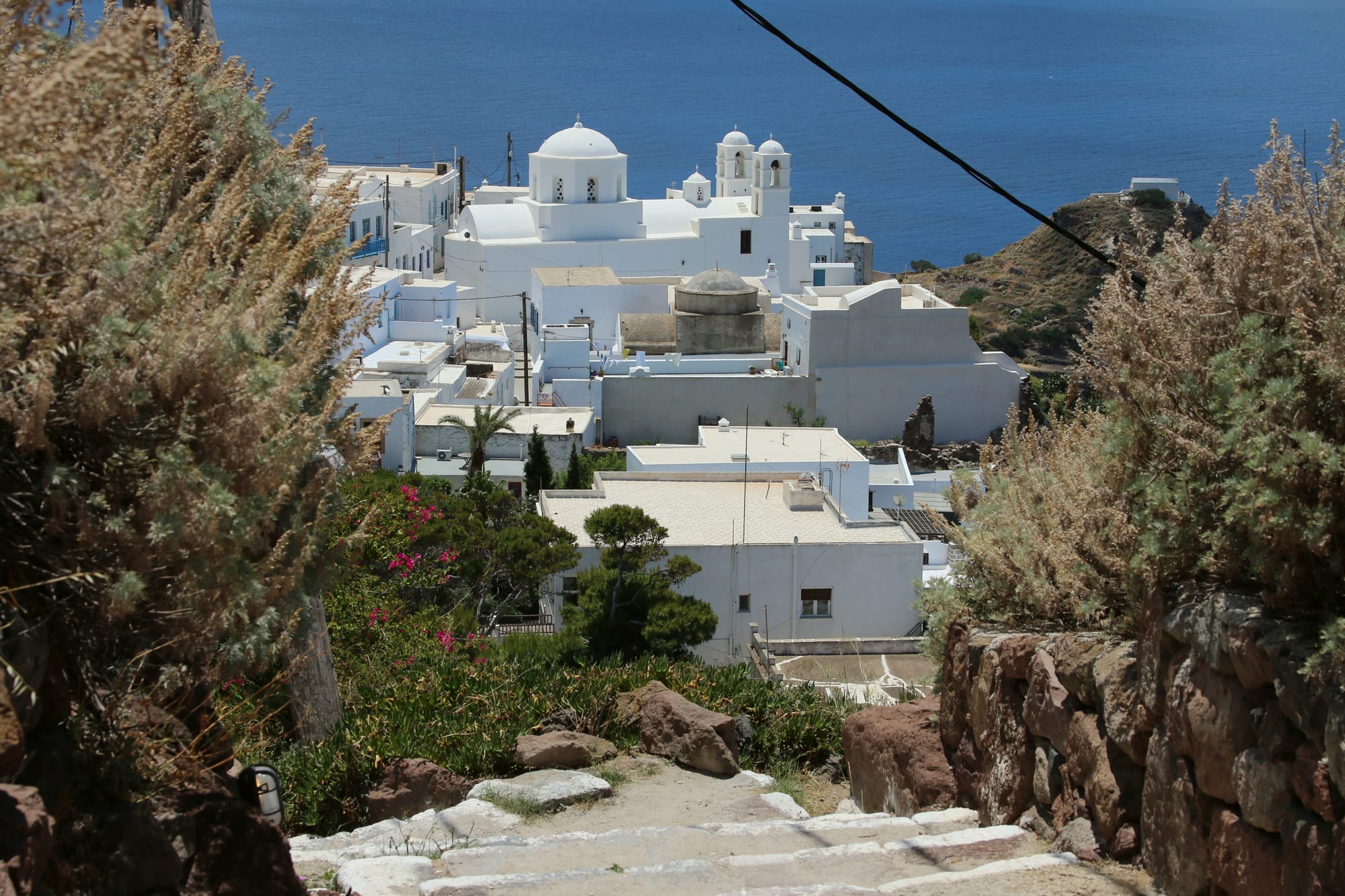
White houses and the domed church of Panagia Korfiatissa in Plaka, seen down a stone path, with the deep blue sea behind

The Cyclades & the Dodecanese, Greece

Milos

The church of Panagia Korfiatissa and the rooftops of Plaka, seen from the path to the Kastro. (Zde / Wikimedia Commons · CC BY-SA 4.0)

The south-westernmost of the Cyclades, a volcanic island described here from Plaka, its hilltop chief town above the great crater bay. Obsidian made Milos a trading centre long before farming, and the Venus de Milo was dug up just below the town in 1820. Today white villages, mining country and a coast of coloured rock draw growing numbers of visitors.

Neighbourhoods

  • Plaka
    • First-time visitors
    • Sunsets
    • Quiet lanes

    The chief town, perched on a large rock above the gulf, its lanes too narrow for cars. A path climbs to the Venetian Kastro at the top, and the museums, small bars and the balcony of the Panagia Korfiatissa face the sea.

    Open in Maps
  • Trypiti
    • Quiet and traditional
    • History

    A neighbouring village of white houses and windmills on the slope towards the sea, its name meaning 'full of holes' for the caves cut in the soft volcanic rock, with the catacombs and the ancient city just below.

    Open in Maps
  • Adamas
    • Close to the ferries
    • Best for food
    • Nightlife

    The harbour town below Plaka and the island's commercial centre, founded by Cretan refugees in 1841, with the ferry quay, waterfront tavernas, bars, the Mining Museum and a church about six centuries old.

    Open in Maps
  • Klima
    • Photography
    • Waterfront

    A tiny seaside village of syrmata, fishermen's houses with brightly painted doors whose ground floors shelter boats in winter, near the site of ancient Milos and the field where the Venus de Milo was found.

    Open in Maps
  • Pollonia
    • Beaches
    • Best for food

    A seaside village and second harbour on the north-east coast, named after a temple of Apollo, with a sandy beach, fish tavernas and a small boat to Kimolos.

    Open in Maps

Things to do

Plaka and ancient Milos

  • Kastro of Plakaviewpoint

    The Venetian castle at the summit of Plaka, home to the church of Panagia Skiniotissa, reached by a path past the church of Panagia Thalassitra and known for its sunsets.

    Open in Maps
  • Archaeological Museum of Milosmuseum

    A neoclassical building of 1870 on Plaka's main square, with Cycladic finds from Phylakopi and a copy of the Venus de Milo.

    Open in Maps
  • Catacombs of Miloslandmark

    An underground early Christian cemetery of the 1st to 5th centuries near Trypiti, beside the agora of the ancient city and among the largest catacombs in Greece.

    Open in Maps
  • Ancient theatre and the Venus de Milo sitelandmark

    The site of ancient Milos above Klima keeps a theatre of Roman date and remains of town walls; a farmer dug up the Venus de Milo nearby in 1820.

    Open in Maps
  • Milos Mining Museummuseum

    A museum in Adamas telling the island's long history of mining, from obsidian to the bentonite and perlite still dug today, with ore samples, maps and tools.

    Open in Maps

Beaches and coast

  • Sarakinikobeach

    A shore of smooth white volcanic rock carved into wave-like shapes, often compared to a lunar landscape, where the closing scenes of the film Bugonia were shot.

    Open in Maps
  • Kleftikobeach

    White sea caves and towering rock arches, once a pirates' hideout, reached mainly by boat.

    Open in Maps
  • Paliochoribeach

    A long beach of sand and fine pebbles below colourful volcanic cliffs, where heat beneath the seabed warms the shallows and is used for cooking food in the sand.

    Open in Maps

Short trips on the island

  • Phylakopilandmark

    The Bronze Age town on the north-east coast where the flying fish fresco and the figurine known as the Lady of Phylakopi were found.

    Open in Maps
  • Kimolosattraction

    The small neighbouring island just off the north-east coast, famous in antiquity for its figs and fuller's earth, reached by the boat from Pollonia.

    Open in Maps

Eat and drink

Long-standing places and food districts in Milos. Hours, ratings and directions come from your maps app, always current.

Milos classics

  • Pitarakia and island tavernasneighborhood

    Tavernas in Adamas, Trypiti and Pollonia serve fresh seafood and local dishes such as pitarakia, small fried cheese pies, and karpouzopita.

    Open in Maps
  • Local preserves and cheesemarket

    Local shops sell white pumpkin spoon sweets, sun-dried tomato paste, capers, kritamo (sea fennel) and manoura cheese kept in olive oil.

    Open in Maps

Bars and evenings

  • Plaka's small barsneighborhood

    Quiet cafés and bars in Plaka's lanes, busy at sunset when people walk up to the Kastro and the Korfiatissa balcony.

    Open in Maps
  • Adamas waterfrontneighborhood

    Cocktail bars with balconies looking over the port.

    Open in Maps

Experience Milos

History

Milos was valued long before it had towns. As early as 15,000 years ago people sailed here to cut obsidian, a sharp volcanic glass, and carried it across the Aegean and beyond. In the Bronze Age a town grew up at Phylakopi on the north-east coast, shaped by Minoan and then Mycenaean influence. Later Dorian settlers built a city on the slope between today's Trypiti and the bay at Klima, just below Plaka, which struck coins stamped with an apple and stayed independent. In 416 BC, during the Peloponnesian War, Athens demanded that neutral Melos join it; when the islanders refused, the Athenians besieged and took the city, killed the men, enslaved the women and children and settled colonists in their place.

After the Fourth Crusade Marco Sanudo took the island into his Venetian Duchy of the Archipelago, and a Catholic bishop was appointed in 1253; the Kastro at the top of Plaka dates from this Venetian world. The Ottomans took over in 1566 but left the islanders much self-government under heavy taxes. Russia occupied Milos for three years from 1771, and in the late 18th century the population collapsed to fewer than 500 before recovering.

In 1820 a farmer dug up the statue later known as the Venus de Milo at the site of the ancient city; it went to the Louvre. Milos was one of the first islands to join the War of Independence, and the war's first naval battle was fought off its coast on 11 April 1821. Cretan refugees founded the port of Adamas in 1841. Under German occupation, 14 civilians were executed in February 1943 for taking goods washed up from a sunken ship.

Culture & Customs

Plaka and its neighbouring villages share the plateau above the harbour, with whitewashed houses, chapels and windmills, and the islanders' Venetian past survives in the Kastro and in the island's history of both a Catholic and an Orthodox bishop. The Kastro and the sea-facing balcony of the Panagia Korfiatissa are the places to watch the sunset.

The island's most famous works of art are elsewhere: the Venus de Milo in the Louvre, the Poseidon of Melos in Athens and the Asclepius of Milos in the British Museum, with a copy of the Venus at the door of Plaka's museum. Milos also gave the ancient world the philosopher Diagoras and the poet Melanippides. Its volcanic landscape has drawn filmmakers, from the Greek film To Fili Tis Zois, shot in Plaka and Adamas, to the closing scenes of Bugonia at Sarakiniko.

Traditions are tied to the sea and the rock. In Klima and a few other coves, families still keep syrmata, two-storey fishermen's houses whose ground floors shelter boats in winter; around Trypiti, caves cut into the soft rock still serve as storerooms and stables. The uninhabited west of the island is a protected Natura 2000 area, and local records of herbal medicine, with Greek sage the most used plant, go back to the 16th century.

Daily Life

Plaka had 902 residents at the 2021 census, Adamas 1,268, and the whole island 5,193 — fewer than at its peak of 6,562 in 1928. Plaka is the seat of the municipality and houses the archaeological museum and most of the island's public services, while Adamas is the port and commercial centre.

Mining has shaped the island's economy for millennia and still does: bentonite, perlite and pozzolana are dug from open pits and sold worldwide, and sulphur was mined in the past. Grapes, cotton and barley are the main crops. Milos is a popular tourist destination in summer.

Life in Plaka is quiet and residential much of the year. In summer the island fills, the roads to Sarakiniko and the beaches grow crowded, and boats take visitors to the sea caves of Kleftiko; in winter many businesses close and the island returns to a small, close community linked to Athens by ferry and plane.

Food

Milos cooking draws on a dry island's resources. Pitarakia, small fried cheese pies, are a local speciality, alongside karpouzopita, and tavernas in Adamas, Trypiti and Pollonia serve fresh fish, octopus and kakavia, the traditional fish stew. Local cheeses include manoura, preserved in olive oil, and anevato, a soft goat cheese used in pies.

The island's pantry is full of preserves: white pumpkin spoon sweets, sun-dried tomatoes and tomato paste, capers, kritamo (sea fennel) and preserved grape hyacinth bulbs, with homemade sesame snaps for something sweet; across Greece, spoon sweets like these are served on a spoon as a gesture of hospitality. Goat appears roasted in a wood oven or cooked in sun-dried tomato paste.

The volcano plays its part too. At Paliochori beach, volcanic heat beneath the seabed is used for traditional meals cooked in the sand. In Plaka the evening is spent in small cafés and bars, and in Adamas along the harbour front. Greek wines and homemade lemon liqueur appear on local menus.

Planning tools

Budget

Milos is a popular summer destination, but it remains closer to the Greek island average than Santorini or Mykonos. Rooms in Plaka and Pollonia cost most in July and August; Adamas and Trypiti have simpler options. A boat trip to Kleftiko and a hire vehicle are the main extra costs.

Daily Budget Midrange
USD 170–320 (mid-range room, taverna dinners, a boat trip, a hire car or quad)
Daily Budget Shoestring
USD 70–110 (simple room, gyros and bakery food, island buses, conventional ferries)

Plaka's lanes, the Kastro at sunset, Klima and most beaches cost nothing to visit.

Best Time to Visit

Late May, June and September are the most pleasant months, with a warm sea, fewer people and calmer conditions for boat trips. July and August are the busiest months, and the meltemi, which blows from about mid-May to mid-September, can stop boat trips in strong wind. Much closes between November and March.

Suggested Number of Days

Two or three days cover Plaka, the villages around it and a few beaches. Four or five allow for a day on the water, the rougher west of the island and a neighbouring island; the wind can cost a day of plans.

First Visit
2–3 days
With Surroundings
4–5 days

Transportation

One bus company links Plaka, Adamas and the main villages and beaches, with timetables that change with the season. Hire cars, scooters, quads and buggies are widely available; most sights are on paved roads, but parts of the west of the island cannot be reached by ordinary vehicles, and parking at popular beaches and villages is hard in summer. Kleftiko is best reached by boat.

Download offline maps, as mobile coverage has gaps, and leave cars outside Plaka, which they cannot enter.

Airport & Station Connections

Milos Island National Airport, about 5 km south-east of the harbour at Adamas, has up to five flights a day from Athens all year. Ferries arrive at Adamas, mainly from Piraeus, and link Milos with many other islands. Plaka is a short drive or bus ride uphill from the port.

Walkability

Plaka is a car-free maze of narrow lanes, easily walked but steep up to the Kastro. Trypiti, the catacombs and Klima are close enough to walk to, downhill, but the climb back is hard work in summer heat. Adamas, the beaches and the rest of the island need a vehicle or the bus.

Safety

Greece is a safe country for visitors, with low levels of violent crime. Milos is a very safe island; the main risks are quad and scooter accidents on steep roads and unpaved tracks, falls or cliff jumps on the rocks at Sarakiniko, heat, and rough seas when the meltemi blows. The island is a dormant volcano with hot springs and fumaroles.

Wear a helmet, carry water, take care on wet or crumbling rock, and avoid swimming or boat trips in strong wind. Check current official travel advice before travelling.

Climate

A Mediterranean climate with mild, rainy winters and warm to hot, dry summers. The meltemi, the strong, dry north wind of the Aegean, blows from about mid-May to mid-September.

Summer
warm to hot and dry — on Mykonos, elsewhere in the Cyclades, average daily highs are around 27°C
Winter
mild and rainy — on Mykonos, elsewhere in the Cyclades, average daily highs are around 15°C

Local Customs

English, French and Italian are widely understood. The island is mainly Orthodox; Catholicism arrived with the Venetians, and churches and chapels are places of worship as well as sights. Plaka is a residential village as well as a sight, quiet late at night.

Cover shoulders and knees in churches, keep noise down in Plaka's lanes at night, and ask before photographing people.

Common Payment Methods

The currency is the euro. Cards are accepted almost everywhere in Adamas, Plaka and Pollonia, though some small tavernas and kiosks still prefer cash; cash machines are concentrated in Adamas and Plaka.