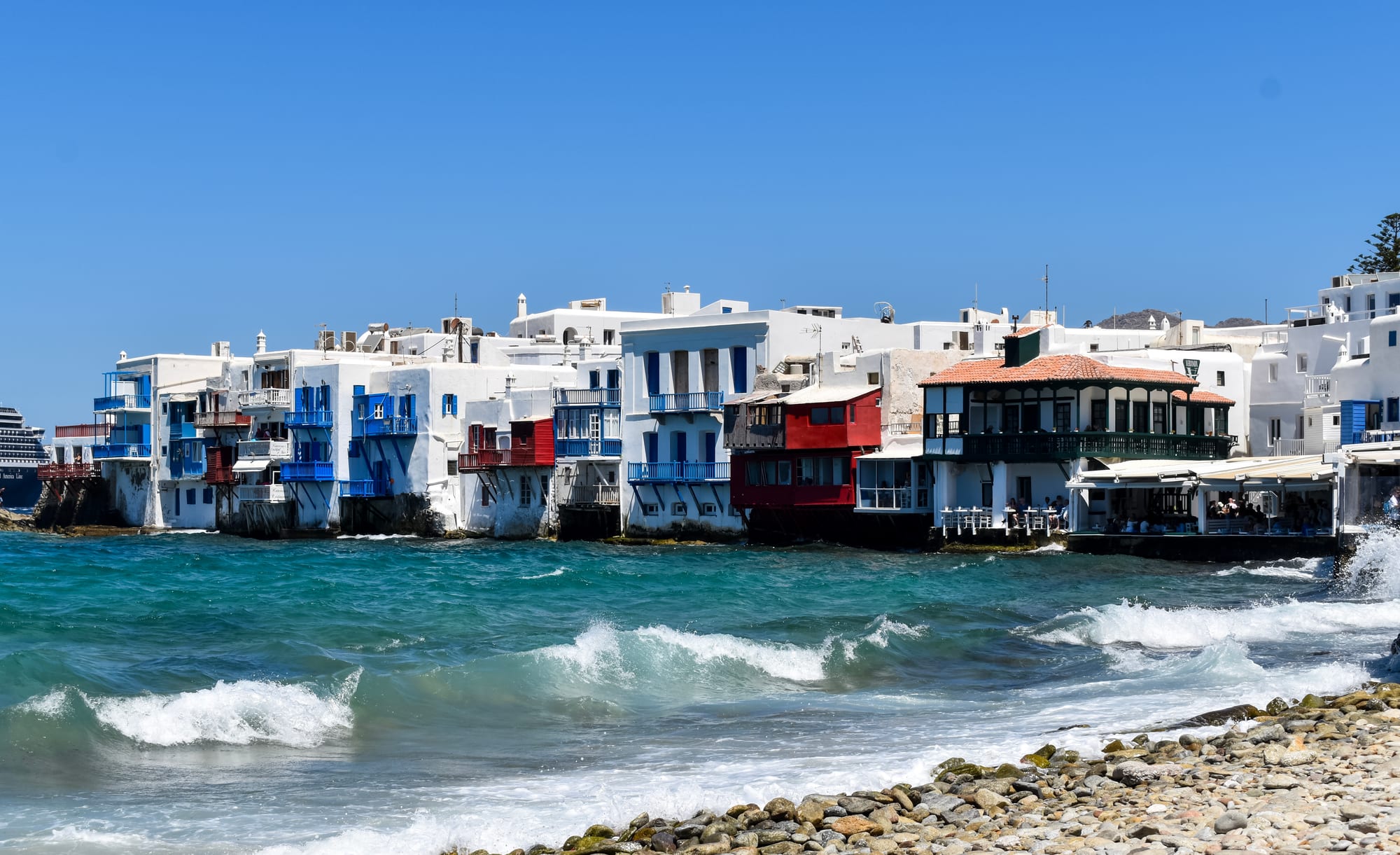
White and red houses with wooden balconies built at the water's edge in Little Venice, with waves breaking on a pebble shore

The Cyclades & the Dodecanese, Greece

Mykonos

The waterfront houses of Little Venice in Mykonos town. (Julian Lupyan / Wikimedia Commons · CC0)

A small, rocky Cycladic island beside sacred Delos, seen from its main town, Chora, a white maze of lanes, churches and windmills on the west coast where most of the 10,700 islanders live. A poor island for most of its history, it became a jet-set destination in the 1960s and a gay destination in the 1980s, and is now one of the most expensive islands in Greece, with at least 1.5 million visitors a year.

Neighbourhoods

  • Chora (Mykonos town)
    • First-time visitors
    • Nightlife
    • Historic district

    The island capital on the west coast, a web of narrow whitewashed lanes around the old port, with the Kastro quarter and Paraportiani church, the Tria Pigadia wells, shops, galleries, bars and most of the island's restaurants. The windmills stand on the ridge above.

    Open in Maps
  • Little Venice
    • Sunsets
    • Bars

    The western edge of Chora, where rows of old houses rise straight out of the sea with balconies hanging over the water. Many are now bars, cafés and galleries, and crowds gather here and below the windmills at sunset.

    Open in Maps
  • Tourlos and the new port
    • Ferries
    • Cruise arrivals

    The harbour north of Chora where most cruise ships dock, private yachts and fishing boats moor in the marina, and some ferries arrive; shuttle buses run into town.

    Open in Maps
  • Ornos and Platys Gialos
    • Beaches
    • Families

    Beach resorts on the south coast within a few kilometres of Chora, with buses to town and small boats onwards to Paradise, Super Paradise, Agrari and Elia. Ornos has its own shops, bakery and pharmacy.

    Open in Maps
  • Ano Mera
    • Village life
    • Quiet stays

    The only inland village on the island, about 7 km east of Chora, built around a large square lined with tavernas and the monastery of Panagia Tourliani.

    Open in Maps

Things to do

In Chora

  • Mykonos windmillslandmark

    The row of windmills of Kato Mili on the hill above Little Venice, built by the Venetians in the 16th century to grind flour and used until the early 20th century; the most popular place on the island to watch the sunset.

    Open in Maps
  • Church of Panagia Paraportianilandmark

    A whitewashed church in the Kastro quarter, begun in 1425 and finished in the 17th century, made of four chapels at ground level supporting a fifth above, and one of the most famous architectural structures in Greece.

    Open in Maps
  • Little Veniceneighborhood

    The row of houses built at the water's edge on the west side of town, their balconies overhanging the sea.

    Open in Maps
  • Archaeological Museum of Mykonosmuseum

    A museum near the old port, established in 1902 for finds from a burial site on the islet of Rhenia; its best-known piece is the large Mykonos vase, showing scenes from the fall of Troy.

    Open in Maps
  • Aegean Maritime Museummuseum

    A museum of Aegean merchant-ship history in a 19th-century house at Tria Pigadia, with the restored Armenistis Lighthouse and ancient sailors' marble gravestones in its garden.

    Open in Maps

Beaches and the island

  • South-coast beachesbeach

    Psarou, Platys Gialos, Paradise and Super Paradise lie between about 5 and 7 km from Chora, reached by bus or by beach boat; Paradise and Super Paradise are known for loud beach-club music from the afternoon.

    Open in Maps
  • Panagia Tourlianilandmark

    The island's most important monastery, founded in 1542 in Ano Mera and named after the island's patron, holding its revered icon of the Virgin.

    Open in Maps
  • Armenistis Lighthouseviewpoint

    A working lighthouse at Fanari, about 6.5 km from Chora, a reminder of the island's seafaring history.

    Open in Maps

Short trips

  • Delosattraction

    The small sacred island about 2 km off Mykonos, birthplace of Apollo and Artemis in myth and a UNESCO World Heritage Site, reached by boat from Chora.

    Open in Maps

Seasonal events

  • Festival of the Virgin at Panagia Tourliani15 August

    A large festival at the monastery in Ano Mera on the Dormition of the Virgin.

  • Main feast of Panagia Tourliani23 August

    The monastery's main feast, on the closing day of the Dormition celebrations.

Eat and drink

Long-standing places and food districts in Mykonos. Hours, ratings and directions come from your maps app, always current.

Mykonos classics

  • Chora's back streetsneighborhood

    The lanes deeper in town have gyros and souvlaki shops and tavernas that are noticeably cheaper than those facing the harbour; most places post their prices at the door.

    Open in Maps
  • Ano Mera squareneighborhood

    The village square inland, lined on three sides with Greek tavernas, away from the crowds of the town.

    Open in Maps

Bars

  • Little Venice barsneighborhood

    Cocktail bars and cafés in the old waterfront houses, crowded at sunset; drinks with this view are among the dearest on the island.

    Open in Maps

Experience Mykonos

History

Herodotus names the Carians as the island's first inhabitants, followed, it seems, by Ionians from Athens in the early 11th century BC. Delos, the religious centre of the Aegean, lies only 2 km away, so Mykonos served as a supply and transit point, but it was a poor island with little farmland. It joined the League of the Islanders after Alexander the Great and passed to Rome and Byzantium. After the Fourth Crusade the Ghisi family took it in 1204 and built a castle in 1207, on the site of today's Kastro quarter; Venice ruled directly from 1390.

In 1537 the Ottoman admiral Hayreddin Barbarossa took the island, which stayed Ottoman until 1830 under a system of local self-government. Until the end of the 18th century it prospered as a trading centre, and in 1794 British and French ships fought a battle in its harbour. In the War of Independence the island was led by Manto Mavrogenous, an aristocrat who spent her family fortune on the Greek cause and whose statue stands in the square named after her.

Sailing and trade revived the economy, but it declined in the late 19th century, especially after the opening of the Corinth Canal and during the First World War, and many islanders emigrated, especially to the United States. In September 1944 the Greek Sacred Squadron raided the German garrison, which surrendered; the island was liberated on 30 September. Visitors came first for the French excavations on Delos, begun in 1873; the jet set arrived in the 1960s, gay travellers in the 1980s, and by the 2000s Mykonos was one of Greece's most expensive islands.

Culture & Customs

Chora is the island's cultural signature: whitewashed cube houses with coloured trim, narrow lanes, windmills on the ridge and a great many chapels, many built because islanders were long expected to build a church on their land before a house. Paraportiani, five churches joined into one, is the best known; the island also has a Catholic church, Our Lady of the Holy Rosary, built in 1668.

Mykonos has a reputation as a gay-friendly island. It became a leading gay destination in the 1980s and remains one of the most popular in Europe, and its nightlife, from Little Venice's cocktail bars to beach clubs on the south coast, is famous. Artists have long been drawn to the light and the coastline, and Chora has many galleries; the Mykonos Biennale, inaugurated in 2013, offers theatre, film, art and music.

Older traditions survive alongside. The monastery of Panagia Tourliani in Ano Mera holds the island's revered icon and celebrates in mid-August. The museums of Chora, among them the folklore museum in the island's oldest house and Lena's House, a preserved 19th-century home of a shipping family, keep the seafaring past alive. A pelican called Petros has been the town's mascot since the 1950s, with successors taking the name.

Daily Life

About 10,700 people lived on Mykonos at the 2021 census, most of them in Chora. The island receives at least 1.5 million visitors a year and can accommodate about 50,000 people a night, so in summer residents are heavily outnumbered. Known as the Island of the Winds, Mykonos covers 85.5 square kilometres of rocky, mostly granite land and rises to 341 metres at its highest point.

Tourism dominates the economy, with luxury hotels still opening; clay and baryte were mined in the east until the late 20th century. There are no rivers, and fresh water comes partly from reservoirs on seasonal streams and partly from desalination plants producing about 4,500 cubic metres a day.

Life swings between a frantic summer and a quiet winter when many businesses close. Shops in town keep long hours in season, closing in the afternoon and reopening into the evening. The pressures of success, from cruise crowds to building on the hillsides, are part of island life.

Food

Mykonos's most famous product is kopanisti, a salty, spicy cheese with a protected designation of origin, made on the island for more than 300 years; its peppery bite comes from the microbial activity encouraged by repeated kneading as it ripens. It is also produced on other Cycladic islands, among them Tinos, Andros, Syros and Naxos.

Island cooking follows the Cycladic pattern of simple ingredients from dry land and sea: fish and grilled octopus by the harbour, and meze with ouzo; an old windmill above the town, the Bonis Mill, houses an agricultural museum of old tools and machinery. Fava, a smooth purée of split peas or vetchling, and village salads with local cheese appear on taverna menus throughout the islands.

Chora has most of the island's restaurants, from gyros and souvlaki shops and creperies in the back streets to expensive waterfront dining in Little Venice. The tavernas around the square in Ano Mera offer a calmer, more local setting, and the town's bars and beach clubs make drinking, often at high prices, a central part of a Mykonos evening.

Planning tools

Budget

Mykonos is one of Greece's most expensive islands, and in July and August Chora's hotels, restaurants and bars reach the prices of the Riviera. Rooms away from town and outside high season cost much less, street food in town is cheap, and buses reach most beaches. Taxis are few, so hire cars, scooters and beach boats add to the bill.

Daily Budget Midrange
USD 200–380 (mid-range hotel, taverna dinners, a Delos trip, a hire car or scooter for a day or two)
Daily Budget Shoestring
USD 80–120 (room or campsite away from town, gyros and bakery food, buses)

Eating in the back streets rather than on the waterfront, and staying in May, June or September, cuts costs sharply.

Best Time to Visit

Late May, June and September give warm weather, open tavernas and lighter crowds. July and August bring the busiest nightlife, cruise crowds and the strongest meltemi, which cools the air but roughens the sea. From November to March much of the island closes.

Suggested Number of Days

Two or three days are enough for a first look at the town, the beaches and the neighbouring sacred island. Longer stays are usually beach holidays, and day trips by ferry to other Cycladic islands add more.

First Visit
2–3 days
With Surroundings
3–5 days

Transportation

Buses run from three depots in Chora: from Fabrika in the south to Ornos, Agios Ioannis, Platys Gialos, Psarou, Paraga and Paradise, and from the old port area to Ano Mera, Elia, Kalafatis, Tourlos and Agios Stefanos. Small boats link the south-coast beaches from Platys Gialos and Ornos. There are only about 30 taxis on the island, so hire cars, quads and scooters are widely used.

Beach boats can be cancelled in strong wind; most beaches, except Super Paradise, can also be reached by bus.

Airport & Station Connections

Mykonos Airport, named after Manto Mavrogenous, is 4 km from the town, a 25-minute flight from Athens, with European flights in summer. High-speed and conventional ferries arrive daily from Athens's ports and the surrounding islands, at the new port of Tourlos or the old port, and cruise ships dock mainly at Tourlos, with shuttles into town.

Walkability

Chora is a walking town: its lanes are too narrow for most traffic, and the windmills, Little Venice, the old port and the museums are a few minutes apart. Beyond town, roads are narrow and the beaches are reached by bus, boat or car.

Safety

Greece is a safe country for visitors, with low levels of violent crime. On Mykonos the main risks are quad and scooter accidents on narrow roads, heat, rough seas when the meltemi blows, and petty theft and drink-related trouble in the busiest nightlife. Bills in bars and restaurants can be very high.

Wear a helmet, carry water, avoid swimming in strong wind, and check prices before ordering. Check current official travel advice before travelling.

Climate

A hot semi-arid climate with Mediterranean traits, known as the island of the winds. The rainy season lasts from October to March; summers are dry and sunny, kept relatively cool by the meltemi and the sea, and winters are mild and wet with many sunny days.

Summer
dry, sunny and windy — daytime highs around 27°C and nights over 24°C
Winter
mild and wet — daytime highs around 15°C and nights around 11°C

Local Customs

Mykonos is a gay-friendly island and has long been one of the most popular gay destinations in Europe. Nudity is accepted on parts of some beaches, such as Paradise and Super Paradise, but not in town. The island has a great many small churches, a legacy of the custom of building a church on one's land before a house.

Shops in town often close in the afternoon and reopen into the evening.

Common Payment Methods

The currency is the euro. ATMs are found throughout Chora, with a concentration near the southern bus station, and cards are widely used.