History
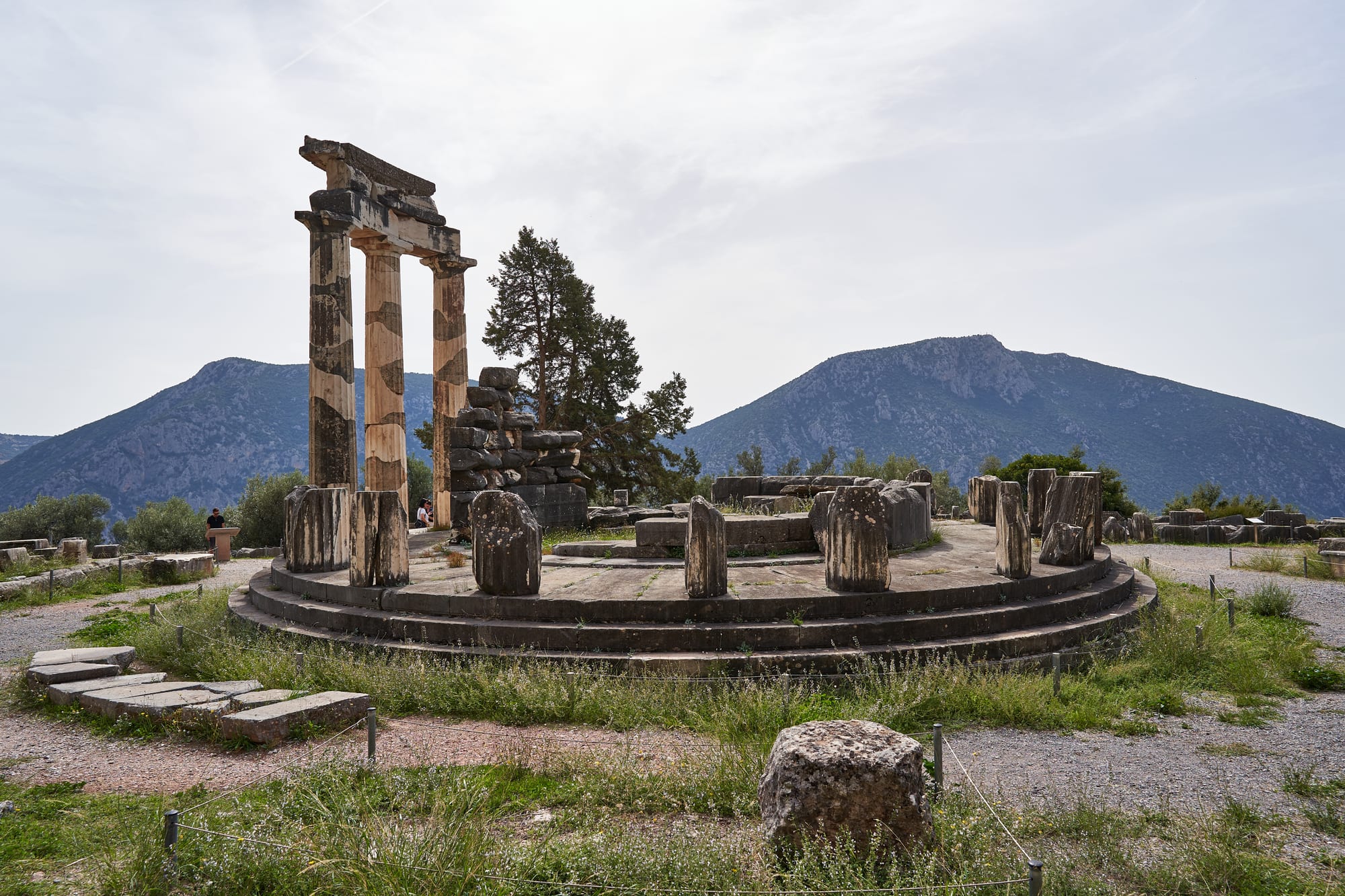
The Acropolis was a Mycenaean citadel long before Cleisthenes' reforms of 508 BC made Athens a democracy. The Athenians beat Persia at Marathon in 490 BC and, with a fleet paid for by the silver of Lavrio, in the strait of Salamis in 480 BC, the same summer that Leonidas' Spartans died at Thermopylae; Pericles then spent the tribute of the city's allies on the Parthenon, finished in 432 BC. Central Greece had powers of its own — Delphi, whose oracle was consulted from the 8th century BC, and Thebes, which broke Sparta at Leuctra in 371 BC — until Philip II of Macedon defeated Athens and Thebes together at Chaeronea in 338 BC and Alexander razed Thebes three years later.
Sulla sacked Athens in 86 BC, Hadrian rebuilt it in the 2nd century AD, Theodosius silenced the oracle in the late 4th century and Justinian closed the philosophy schools in 529. After 1204 a Frankish duchy ruled Athens from Thebes, passing to the Catalan Company in 1311 and to Florentine bankers in 1388, until the Ottomans arrived in 1458 and took Venetian Negroponte, today's Chalkida, in 1470. The Parthenon served as a mosque until a Venetian shell hit the powder stored inside it on 26 September 1687, and Lord Elgin's agents stripped its sculptures between 1801 and 1812.
In 1821 Athanasios Diakos died holding the Alamana bridge near Thermopylae, and the fleets of Hydra and Spetses took to sea. Aegina housed Kapodistrias' first government in 1828–29, and Athens became the capital in 1834. The refugees of 1922–23 nearly doubled the city, the occupation famine of 1941–42 killed tens of thousands there, and the Germans shot more than 200 villagers at Distomo in June 1944; the street fighting of December 1944 and the Polytechnic uprising of 17 November 1973 both played out in the centre. The 2004 Olympics gave Athens its metro and airport; the Mati wildfire of July 2018 killed more than 100 people, and much of northern Evia burnt in August 2021.