History
Thessaly has been farmed for longer than almost anywhere in Europe: the Neolithic villages of Sesklo and Dimini, outside Volos, go back to the seventh millennium BC. Myth launched Jason's Argo from Iolcos on the same bay and put the centaurs on Pelion; history gave the plain to horse-breeding aristocrats whose cavalry rode with Alexander, and saw Caesar beat Pompey at Pharsalus in 48 BC. Across the Pindus the Molossian kings of Epirus guarded Dodona, the oldest oracle in Greece, and the most famous of them, Pyrrhus, won such costly battles against Rome around 280 BC that his name became a byword. Rome repaid Epirus in 167 BC by sacking its towns and enslaving 150,000 people, and Octavian built Nicopolis, near Preveza, to mark his victory at Actium.
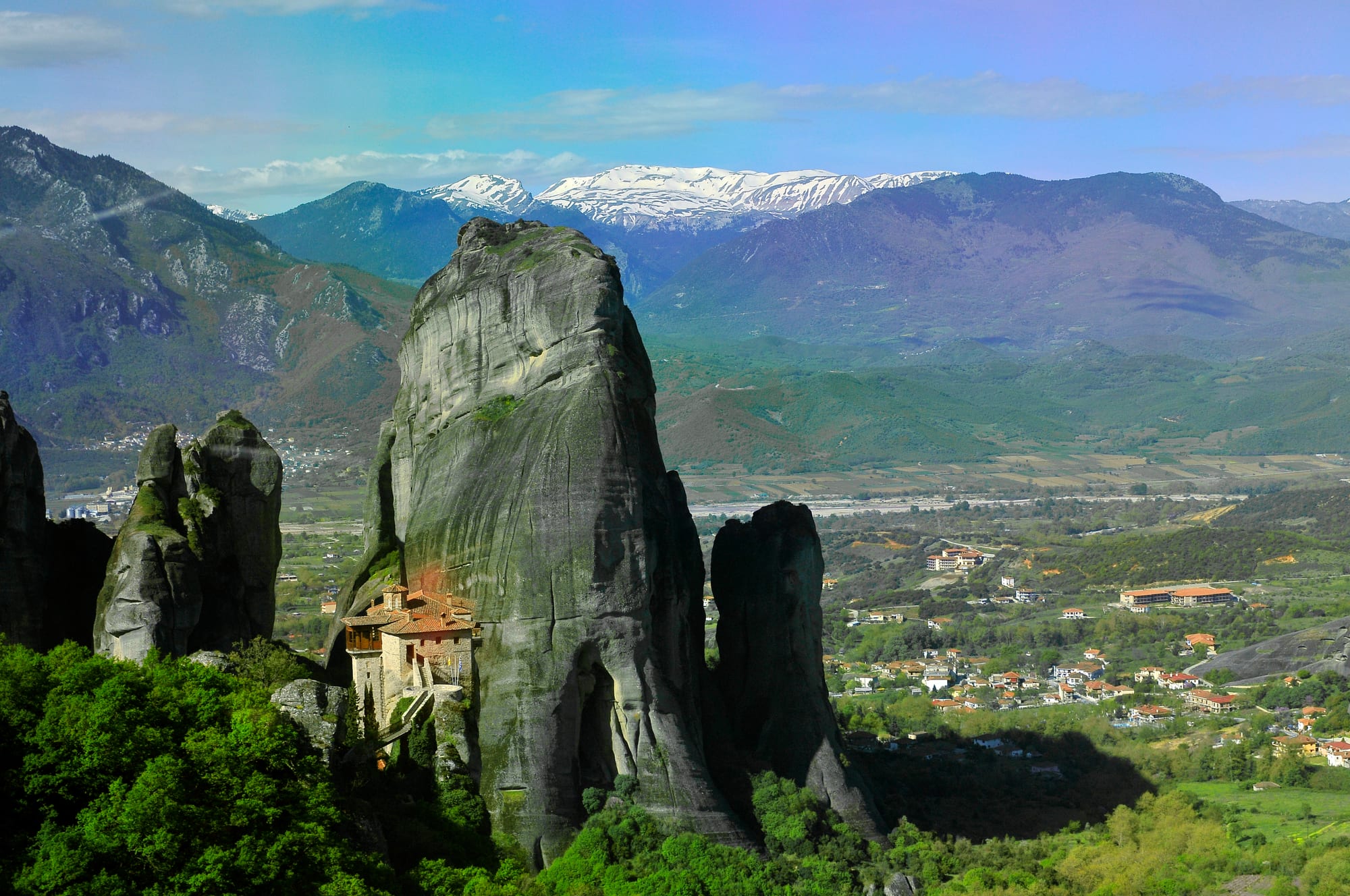
When the crusaders took Constantinople in 1204 a Byzantine nobleman founded the Despotate of Epirus at Arta, and from the 14th century monks escaping the disorder of the plain built the rock-top monasteries of Meteora. The Ottomans took Thessaly from the 1390s and Ioannina, which surrendered on terms, in 1430. Ioannina's great age came under Ali Pasha, the Albanian-born governor who ruled much of Greece and Albania from its citadel from 1788, received Byron in 1809, crushed the Souliot clans — whose women are said to have danced off the cliff of Zalongo in 1803 — and was killed on the lake island on the sultan's orders in 1822.
Thessaly and Arta joined Greece in 1881; Ioannina followed in February 1913, after the fall of the Bizani forts. The great Thessalian estates provoked the farm workers' rising at Kileler in 1910 and the land reforms that followed. In the autumn of 1940 the Italian invasion was stopped in the Epirote mountains at Kalpaki, and in March 1944 the Germans deported Ioannina's ancient Greek-speaking Jewish community to Auschwitz. The Egnatia motorway ended Epirus' isolation in 2009; the Tempi rail crash of February 2023 killed 57 people, and Storm Daniel flooded the Thessalian plain that September.