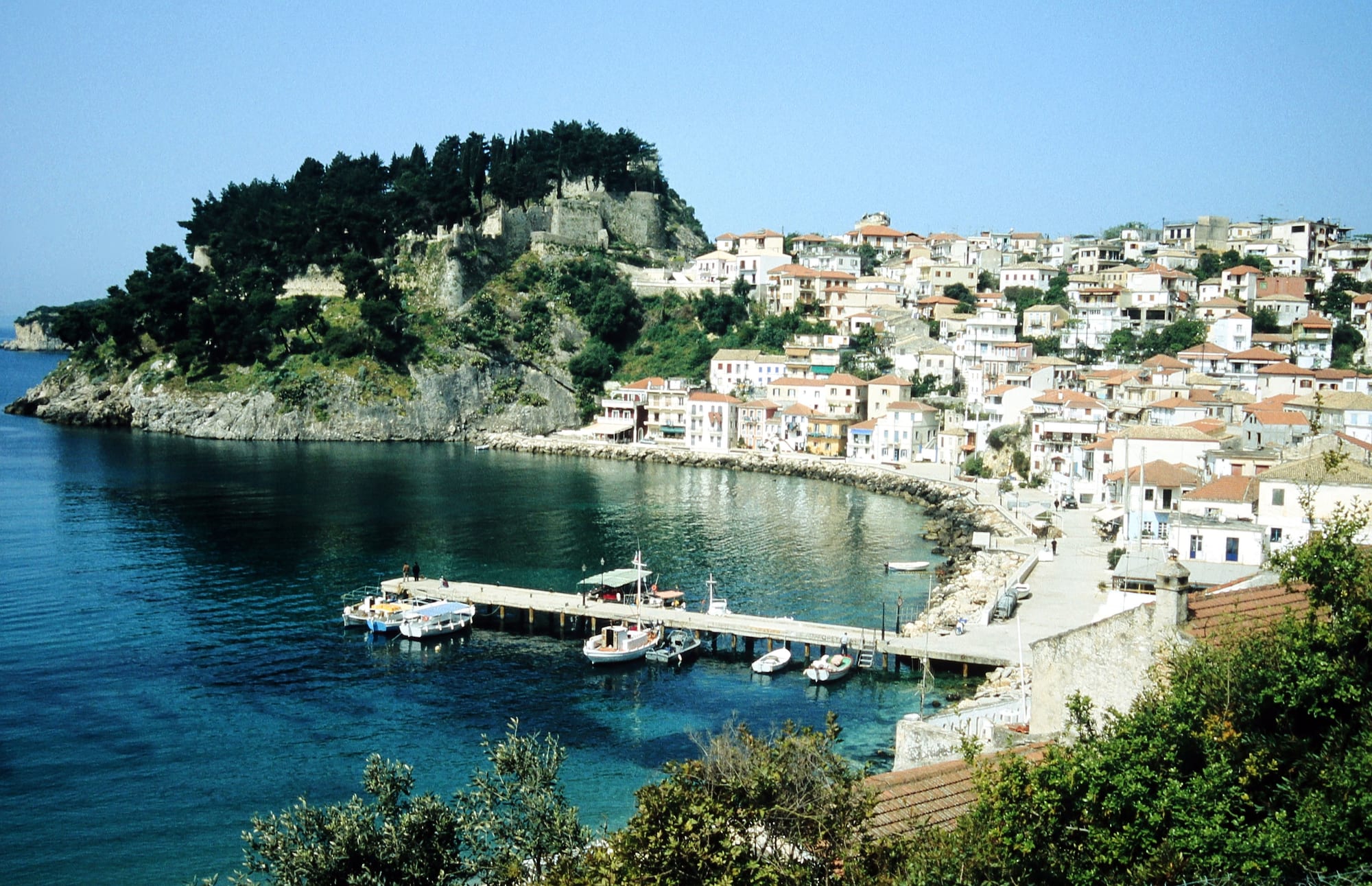
Parga's pastel houses climbing a hillside above a clear blue bay, with a pine-covered castle headland and a jetty of small boats

Thessaly & Epirus, Greece

Parga

Parga and its harbour below the wooded headland of the Venetian castle. (Chrisi1964 / Wikimedia Commons · CC BY-SA 4.0)

A small resort town on the Ionian coast of Epirus, between Preveza and Igoumenitsa, its houses built like an amphitheatre below a Venetian castle. For four centuries a Venetian outpost on the Ottoman mainland, it was handed to Ali Pasha in 1819 and joined Greece in 1913; today it is the busiest resort in Epirus, known as the 'Bride of Epirus', with beaches on either side.

Neighbourhoods

  • The old town and harbour
    • First-time visitors
    • Historic district
    • Best for food

    Houses in the style of the Ionian islands climb from the harbour towards the castle, with narrow alleys of curio shops leading uphill. The waterfront holds tavernas and the jetties for boats to the beaches and islands, with the islet of the Virgin just offshore.

    Open in Maps
  • Krioneri
    • Beaches
    • Families
    • Close to the centre

    The town's main beach, a short walk from the centre, facing the small island of the Virgin across the bay; the tourist train to Anthousa leaves from the road in front of it.

    Open in Maps
  • Valtos
    • Beaches
    • Water sports

    One of the longest beaches of Parga, beyond the castle headland to the west, also reached by boat from the harbour, with clear water and a surf spot at Kastro Point.

    Open in Maps
  • Anthousa and the hills
    • Quiet stays
    • Views

    A village 3 kilometres north-west of the town beneath a hilltop castle attributed to Ali Pasha, surrounded by olive groves and orchards, with views over the coast towards Corfu on clear days.

    Open in Maps

Things to do

Castles and the town

  • Parga Castlelandmark

    The Venetian fortress on the headland above the town, rebuilt more than once by the Venetians and never taken until 1819; the winged lion of St Mark is carved over its gate, and Ali Pasha added a bathhouse and harem quarters at the top.

    Open in Maps
  • Island of the Virginlandmark

    The islet facing the town across Krioneri bay, with a church and medieval Venetian and French buildings, visited by boat on the eve of the August festival.

    Open in Maps
  • Anthousa Castlelandmark

    The ruined hilltop fortress above Anthousa from which Ali Pasha threatened Parga, with views over the coast; a tourist train climbs to it from the town.

    Open in Maps

Beaches

  • Valtos Beachbeach

    A long, clear-water beach west of the castle, close to the town and popular with swimmers and, at Kastro Point, with experienced surfers.

    Open in Maps
  • Krioneri Beachbeach

    The town's main beach, a short distance from the centre, looking out to the island of the Virgin.

    Open in Maps
  • Lichnos Beachbeach

    A beach about 3 kilometres from Parga, also reached by boats from the harbour.

    Open in Maps
  • Sarakiniko Beachbeach

    A beach beside a small river and olive trees west of Agia village, about 12 kilometres from the town, linked to the port by small boats.

    Open in Maps

Short trips along the coast

  • Necromanteion of Acheronlandmark

    The site proposed in 1958 as the ancient oracle of the dead on the Acheron, devoted to Hades and Persephone, at Mesopotamos about 13 kilometres from Parga; the identification is now questioned.

    Open in Maps
  • Acheronpark

    The river that Greek myth made the entrance to the underworld, which flows into the Ionian Sea at Ammoudia, near Parga.

    Open in Maps
  • Syvotaattraction

    A well-developed coastal resort to the north, with beaches on several islets just offshore.

    Open in Maps

Seasonal events

  • Pargina, or Kanareiamid-August, around 15 August

    Cultural celebrations around the feast of the Virgin: boats carry people to the island of the Virgin, and on 15 August boats lit with Venetian lanterns re-enact the return of the people of Parga, welcomed in the harbour with fireworks.

Eat and drink

Long-standing places and food districts in Parga. Hours, ratings and directions come from your maps app, always current.

Parga classics

  • Parga honey and olive oilmarket

    Parga honey is the local speciality, sold by merchants on the road in front of Krioneri beach; the olive groves around the town were planted by order of Venice.

    Open in Maps
  • Harbour tavernasneighborhood

    Tavernas along the waterfront and pier near Krioneri serve traditional Greek food, with views of the bay and the town.

    Open in Maps

Food streets

  • The castle lanesneighborhood

    Family tavernas and restaurants in the alleys climbing from the centre towards the castle gate.

    Open in Maps

Experience Parga

History

In antiquity the Thesprotians lived here; Mycenaean tholos tombs have been found nearby, and the late Hellenistic town of Toryne, "ladle", took its name from the shape of its beach. Parga itself is first mentioned in 1318, with a name probably of Slavic origin. After Byzantine and Albanian rule, its people overthrew an unpopular governor and placed themselves under Venice in 1401, and for almost four centuries the town was a mainland outpost of Venetian Corfu. The castle above it, first built by the townspeople against pirates, was destroyed by the Ottoman admiral Hayreddin Barbarossa in 1537 and rebuilt more than once by the Venetians; their last fortress held out until 1819. A Romaniote Jewish community is recorded in 1496, and the Venetians planted the olive groves that still surround the town.

When Venice fell in 1797 Parga passed to France, and its people turned to Britain for protection in 1815. In 1819 the British handed the town to Ali Pasha of Ioannina in return for a payment — the subject of Francesco Hayez's painting The Refugees of Parga — and almost all its inhabitants left for Corfu rather than live under Ottoman rule. Ali Pasha resettled the town and strengthened its castle; in 1830 the exiles were invited to return.

Parga became part of Greece in 1913. In 1924 about 1,500 of its Albanian-speaking Muslims were sent to Turkey in the population exchange, and the Second World War brought occupation and violence between communities. After the war tourism transformed the town, which preserves its traditional architecture and is now the busiest resort in Epirus.

Culture & Customs

Parga looks west to the Ionian islands as much as east to Epirus: its houses are built in a style clearly influenced by the architecture of the Ionian islands, the winged lion of St Mark still guards the castle gate, and four centuries under Venice brought privileges, prosperity and a role as a bridge between Ottoman-ruled Greece and Venice. Its nickname is the "Bride of Epirus".

The great event of the year is the Pargina, or Kanareia, around the feast of the Virgin in mid-August. On the eve of the feast people go by boat to the islet of the Virgin in front of the town; on 15 August crowds gather in the harbour for the barcarolle, a procession of boats decked with Venetian lanterns, sailing from the castle and from Pavloukes to re-enact the return of the people of Parga to their freed town, welcomed with fireworks.

The surrounding municipality keeps traces of an older linguistic mix: in villages of the Fanari plain and in places such as Anthousa and Kanallaki, a few people still speak Albanian. Scholars such as Andreas Idromenos and the historian Panagiotis Aravantinos came from Parga, and bequests from prominent local families endowed its cultural and educational foundations.

Daily Life

The municipal unit of Parga had about 3,900 people at the 2011 census. The wider municipality, with its seat at the village of Kanallaki, takes in the Fanari plain and villages such as Agia and Anthousa.

Tourism is the economy. Parga is the busiest resort on this coast and the most popular destination in Epirus, and in summer its hotels, rooms, tavernas, shops and boat operators work flat out; visitors arrive by bus from the airport near Preveza, by car along the motorway and by boat from Corfu, Paxos and Antipaxos. Most visitors are Greek, though the town is becoming better known abroad, especially in July and August. The olive groves planted under Venice still surround the town, and honey is a local product.

The rhythm is seasonal. Summer days revolve around the beaches and the boats, evenings around the harbour, and August around the festival of the Virgin. Outside the season the town is quiet and returns to its residents.

Food

Parga eats from the sea and from its olive groves. The tavernas along the harbour and in the lanes towards the castle serve traditional Greek food — grilled fish and seafood, and the meze of the Greek table: tzatziki, grilled octopus, fried cheese saganaki and horiatiki, the village salad of tomato, cucumber, onion, olives and feta. The olive groves around the town were planted by order of the Venetians, after which a large part of the townspeople lived from olives and oil.

As part of Epirus, Parga shares the region's love of pies wrapped in filo — kotopita with chicken and galatopita, a sweet milk pie, among them — and galotyri, a thick, creamy dairy product made from rich sheep's milk.

Parga honey is the local speciality, sold by merchants on the road in front of Krioneri beach. To drink there is tsipouro, the strong grape brandy of Epirus, and ouzo with meze, and the village of Zitsa, inland, is known for its white wine from the Debina grape.

Planning tools

Budget

Parga charges island prices in July and August, when most of its visitors come, most of them Greek. In May, June and September rooms are easier to find and cheaper. Boat trips to the beaches and islands and a hire car or scooter for the coast are the main extras.

Daily Budget Midrange
USD 120–230 (mid-range hotel, taverna dinners, a boat trip to Paxos, a hire car or scooter)
Daily Budget Shoestring
USD 55–90 (simple room or campsite, souvlaki and bakery food, local buses and beach boats)

Book July and August rooms early; outside the peak the town is quieter and cheaper.

Best Time to Visit

June and September are the best months, with warm sea and fewer crowds. July and August are the peak, when Parga and nearby Sivota are at their busiest and the August festival fills the harbour. Winter is mild but wet.

Suggested Number of Days

Three or four days allow time for the town and its beaches. A week suits a beach holiday that also takes in the river, the ancient sites and the islands within reach by boat, which depend on summer sailings.

First Visit
3–4 days
With Surroundings
5–7 days

Transportation

Parga is small enough to cross on foot, though the walks over the hills to the beaches are hot by day. Boats leave the harbour for Valtos, Lichnos and Sarakiniko, and a tourist train climbs to Anthousa. Car and scooter hire covers the surrounding coast, and local KTEL buses run several times a day to Preveza and Igoumenitsa, stopping along the way.

Scooter roads are narrow and steep; ride with care and a helmet.

Airport & Station Connections

Most visitors fly into Aktion National Airport near Preveza, which has seasonal flights from Athens, Thessaloniki and abroad, or into Ioannina or Corfu. KTEL buses link Parga with Igoumenitsa and Preveza, with connections from Athens, Thessaloniki and Ioannina. In summer boats connect the harbour with Paxos, Antipaxos and Corfu.

Walkability

The town centre, harbour and Krioneri beach are all within a few minutes' walk, but the town is built on a slope and the lanes to the castle are steep and stepped. The castle headland separates the centre from Valtos, and a walk of a few kilometres leads down from Anthousa through olive groves.

Safety

Greece is a safe country for visitors, with low levels of violent crime. Parga sees little crime. The castle is partly ruined, with steep drops to the sea and no barriers in places, and the main risks elsewhere are summer heat, scooter accidents and swimming in open water.

Keep to the paths and away from unguarded edges at the castle, take care with scooters on coastal roads, and watch for strong currents and sea urchins when swimming. Check current official travel advice before travelling.

Climate

A hot-summer Mediterranean climate, with mild, wet winters and hot, dry summers; most of the town's rain, about 1,219 mm a year, falls in winter, and the average annual temperature is 16.5°C.

Summer
hot and dry — in nearby Igoumenitsa the highest temperature recorded over 25 years was 40°C
Winter
mild and rainy, with most of the year's rain; the year as a whole averages 16.5°C

Local Customs

Parga's visitors are largely Greek. The feast of the Virgin on 15 August is the high point of the year. Churches expect modest dress, and beachwear belongs on the beach.

Dress modestly when visiting churches, and cover up away from the beach.

Common Payment Methods

The currency is the euro. Cards are accepted in most hotels, shops and restaurants, but small tavernas, kiosks, beach boats and stalls may prefer cash.