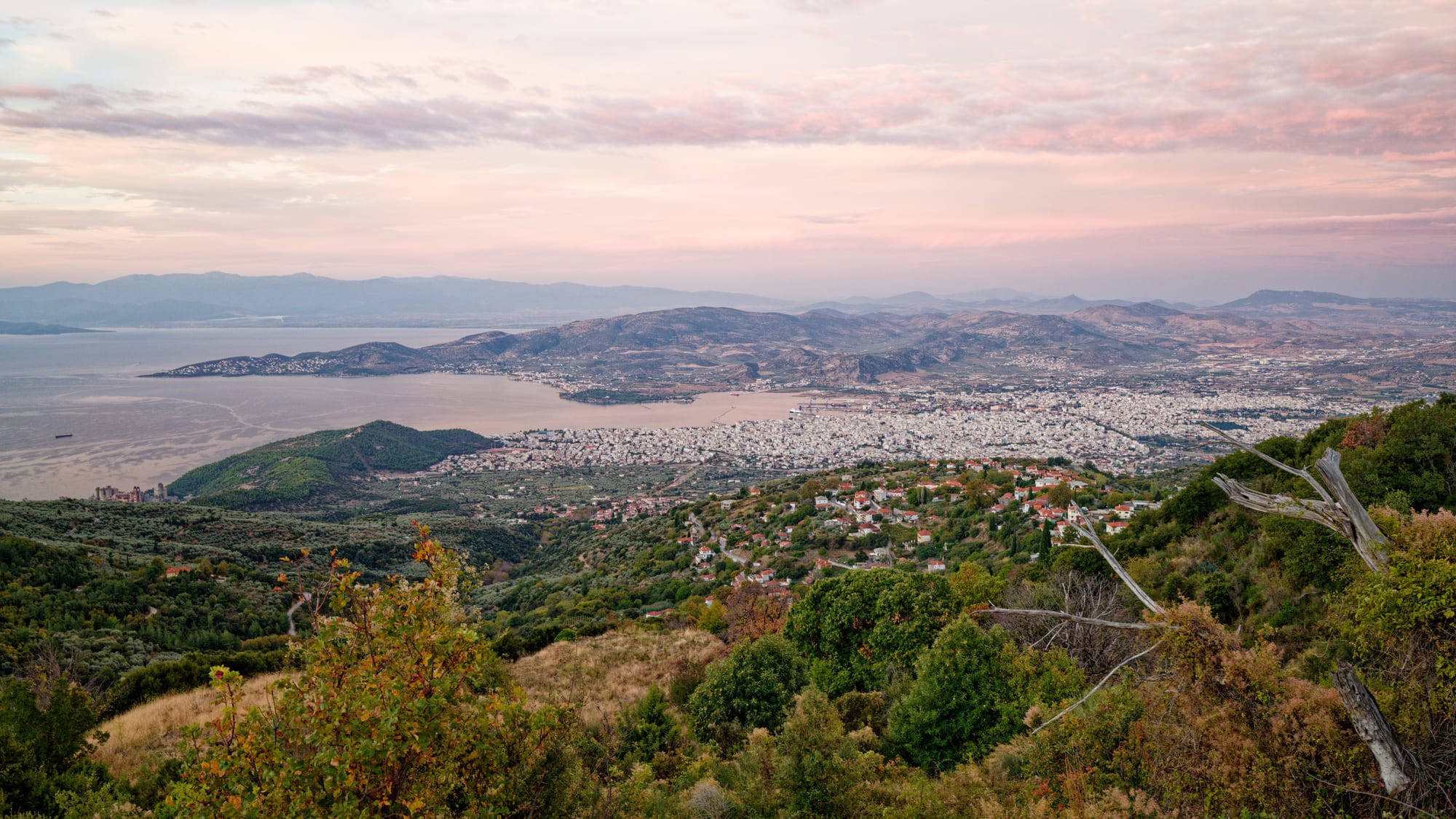
Volos spread along the shore of the Pagasetic Gulf under a pink dawn sky, seen from wooded hillside villages above

Thessaly & Epirus, Greece

Volos

Volos on the Pagasetic Gulf in the early morning. (Holger Adams / Wikimedia Commons · CC BY-SA 4.0)

A port city at the head of the Pagasetic Gulf, below Mount Pelion, and Thessaly's only outlet to the sea. Built over ancient Iolcos, where myth launched Jason's Argo, it grew from a small Ottoman port into an industrial and university city, largely rebuilt after the 1955 earthquakes; it is known for its tsipouro-and-seafood tavernas and as the gateway to Pelion and the Sporades.

Neighbourhoods

  • City centre and the waterfront
    • First-time visitors
    • Best for food
    • Close to public transport

    The streets between the port and the railway station, with the promenade of Argonafton Street along the sea and the long, partly pedestrianised Ermou Street behind it. Shops, cafés and hidden bars cluster around St Nicholas, the city's cathedral, and the bus station, railway station and ferry quay are all close by.

    Open in Maps
  • Palaia
    • Historic district
    • Nightlife

    The oldest part of the city, on the hill where Mycenaean remains and the fortified Ottoman settlement stood; fragments of the old walls survive near the Tsalapatas brickworks museum. In summer its streets near Krokiou Street fill with people in the evening.

    Open in Maps
  • Anavros
    • Parks
    • Swimming
    • Museums

    The eastern end of the waterfront, where Anavros Park runs from behind the church of St Constantine to an open municipal beach.

    Open in Maps
  • Nea Ionia
    • Local life
    • Quiet and residential

    The district across the Krafsidonas river, named New Ionia after the refugees from western Anatolia who settled here after the Greco-Turkish War of 1919–1922.

    Open in Maps
  • Makrinitsa and Portaria
    • Mountain villages
    • Views
    • Winter stays

    Two Pelion villages within the municipality, on the slopes above the city, known for their mansions and traditional Pelion architecture; Makrinitsa is nicknamed the 'balcony of Pelion'.

    Open in Maps

Things to do

Museums and landmarks

  • Archaeological Museum of Volosmuseum

    The Athanasakeio, a neoclassical museum building of 1909, with finds from the Neolithic villages of Dimini and Sesklo and painted Hellenistic grave steles.

    Open in Maps
  • Tsalapatas Brickworks Museummuseum

    A brick and tile factory founded in 1926 and closed in 1978, preserved with its grinders, presses, clay tanks and Hoffmann kiln as a rare surviving Greek industrial plant.

    Open in Maps
  • Volos Town Museummuseum

    A museum of the city's own modern history.

    Open in Maps
  • St Nicholas Cathedrallandmark

    The city's cathedral, dedicated to the patron saint of sailors and designed by the architect Aristotelis Zachos, at the heart of the pedestrianised centre.

    Open in Maps
  • Volos railway stationtransit hub

    The historic station of 1884 near the centre, designed by Evaristo de Chirico, which houses the Thessaly Railway Museum.

    Open in Maps

The waterfront and beaches

  • Argonafton Street promenadetrail

    The seafront promenade, the best area of the flat city for cycling and a place for long walks.

    Open in Maps
  • Anavros Park and beachbeach

    A seaside park leading to an open municipal beach at the southern end of the city.

    Open in Maps
  • Alykes beachbeach

    A municipal beach a short drive south-west of the centre, in the relaxed Alykes district, with cafés and bars on the sand.

    Open in Maps

Ancient sites

  • Diminilandmark

    A Neolithic village west of the city with a ruined acropolis, walls and beehive tombs, beside Mycenaean remains thought by some to belong to ancient Iolcos.

    Open in Maps
  • Sesklolandmark

    A hilltop Neolithic settlement west of Volos with the remains of what is called the oldest acropolis in Greece, around 6000 BC.

    Open in Maps
  • Demetriaslandmark

    The city founded in 293 BC by Demetrius Poliorcetes, King of Macedon, on the edge of modern Volos, whose ancient theatre is preserved.

    Open in Maps

Short trips into Pelion

  • Makrinitsaviewpoint

    A Pelion village full of mansions on the mountainside above the city, nicknamed the 'balcony of Pelion', with a museum of folk art in the Topali Mansion.

    Open in Maps
  • Portariaattraction

    A neighbouring mountain village whose buildings are typical of Pelion architecture.

    Open in Maps
  • Pelion railwayattraction

    A narrow-gauge heritage line running from Ano Lechonia to Milies, on weekends and holidays from mid-April to the end of October and daily in July and August.

    Open in Maps
  • Pelionattraction

    The wooded mountain peninsula of the centaurs, rising to 1,610 metres behind the city, with villages, hiking trails and numerous sandy or pebbly beaches.

    Open in Maps

Eat and drink

Long-standing places and food districts in Volos. Hours, ratings and directions come from your maps app, always current.

Volos classics

  • Tsipouradikarestaurant

    The city's signature eating places, where small bottles of tsipouro come with plates of meze, above all seafood.

    Open in Maps
  • Spetzofairestaurant

    Country sausages cooked in a sauce of long sweet peppers and tomato, a local speciality also known as Pelion spetzofai.

    Open in Maps

Food districts and markets

  • The waterfrontneighborhood

    The seafront and the streets behind it hold many of the tsipouradika, cafés and tavernas.

    Open in Maps
  • Friday food marketmarket

    A weekly market of fresh produce from the plain and the mountain held on Fridays.

    Open in Maps
  • Ermou Street and St Nicholas Squareneighborhood

    The pedestrianised centre, lined with cafés and small bars.

    Open in Maps

Experience Volos

History

Volos stands on the sites of three ancient cities. Iolcos, on the mound of Kastro/Palaia in the west of the city, was a Bronze Age settlement with a Mycenaean palace, and in myth the home of Jason, who sailed from here in the Argo to find the Golden Fleece. Demetrias was founded in 293 BC by Demetrius Poliorcetes, King of Macedon, and Pagasae gave its name to the gulf. Just inland lie the Neolithic villages of Dimini and Sesklo, the latter with the oldest acropolis in Greece.

The town reappears in 1333 as Golos, a name probably of Slavic origin, captured by the Byzantine general John Monomachos. Serbian rulers held it from 1348, and the Ottomans took it definitively in 1423, fortifying it and settling Muslims from Anatolia while the Christians moved up to the villages of Pelion. Volos became the chief port of the Pagasetic Gulf, with a famous twice-weekly fair; Venice briefly captured the fortress in 1665, Pelion rebels failed to take it in 1821, and a Greek fleet under Frank Abney Hastings forced its garrison out in 1827.

Volos joined Greece with the rest of Thessaly in 1881, when it had only 4,900 people, and grew quickly as merchants, craftsmen and sailors arrived; the new port opened in 1893. Refugees from Ionia, Pontus, Cappadocia and Eastern Thrace followed in the 1920s. During the Second World War about 700 of the city's Jews were saved from deportation by the rabbi Moshe Pesach and the Greek authorities. The earthquakes of 1955 destroyed much of the old city, which was rebuilt in modern style, and in September 2023 Storm Daniel flooded it.

Culture & Customs

Volos was shaped by industry and by the refugees who arrived after 1922, whose presence left a mark still visible in the city's food, music, sport and social life. The first labour union in Greece was founded here in 1908, and the Municipal Theatre dates from 1894; renovated and named after the composer Vangelis, who was born in neighbouring Agria, it reopened at Christmas 2023. The painter Giorgio de Chirico was born in Volos, and his father, Evaristo de Chirico, designed the railway station.

Myth is close at hand: Pelion, behind the city, is the mountain of the centaurs and of Chiron, and the port stands on the site of Iolcos, where Jason built the Argo. The University of Thessaly, founded in 1984, gives the city a large student population and draws many foreign students through Erasmus. Volos was a candidate for European Capital of Culture in 2021 and was one of the five cities that hosted events of the 2004 Olympics.

Sport runs deep: the city has a long history in rowing, sailing, swimming and water polo, and its best-known football clubs are Olympiacos Volos and Niki Volos. Above all, though, local identity is bound up with the tsipouradiko, where friends gather over small bottles of tsipouro and plates of seafood.

Daily Life

The city had 85,803 people at the 2021 census, about 86,000, and is the capital of the Magnesia regional unit. Its municipality reaches from Nea Anchialos to Agria and up the slopes of Pelion to Makrinitsa and Portaria.

Volos is one of the most industrialised provincial cities in Greece, thanks to its port and its position between Athens and Thessaloniki. Steel producers have plants in the industrial zones of Volos and nearby Almyros, and a very large cement works with its own port stands next to the city. The port is the third-largest cargo port in Greece, handling the farm and factory products of Thessaly, and it also serves ferries to the Sporades and cruise ships. The university, a research institute for agri-technology and tourism add to the economy.

Life is lived outdoors. The waterfront fills with walkers on fine days, the pedestrian streets around Ermou Street are lined with cafés, and in summer people head for the beaches at Alykes, Agria and along Pelion. The floods of September 2023 caused heavy damage in the city and across Thessaly, and the railway to Larissa still had no regular trains in 2026, with replacement buses running in their place.

Food

Volos is best known for tsipouro, a strong, un-aged brandy of 40 to 45 per cent alcohol distilled from grape pomace, and for the seafood that comes with it. In a tsipouradiko small bottles of tsipouro arrive with plates of seafood meze. The refugees from Asia Minor who settled here after 1922 left a lasting mark on the city's food, and the tsipouradiko remains at the centre of its social life.

Local specialities include spetzofai, country sausages in a sauce of peppers and tomato, boubari, the dessert melachrini and spoon sweets. Pelion adds its orchard fruit, above all the firiki, a small, fragrant and slightly tart apple.

The tavernas also offer the dishes of everyday Greek cooking, many prepared earlier in the day and kept warm in large trays, from baked moussaka to gemista, stuffed vegetables. A weekly food market on Fridays brings in produce from the plain and the mountain, and fast-food grills serve souvlaki and gyros all day long.

Planning tools

Budget

Volos is a working city with fair prices, and a round of tsipouro and seafood meze costs little. City buses and taxis are cheap. Costs rise for a hire car to explore Pelion, for winter weekends and holidays in the Pelion villages, and for ferry trips to the Sporades in summer.

Daily Budget Midrange
USD 110–210 (mid-range hotel, taverna dinners, museum tickets, a hire car for Pelion)
Daily Budget Shoestring
USD 50–85 (simple room, tsipouradiko meals and bakery food, city and KTEL buses)

Stay in the Pelion villages midweek and outside Greek holidays for the best guesthouse rates.

Best Time to Visit

Spring and autumn suit the city itself and walking on Pelion. Summer is the season for the beaches of the Pagasetic Gulf and the Aegean side of the mountain, and for ferries to the Sporades. Winter is the season for the mountain villages, with fireside guesthouses and skiing on the upper slopes of Pelion from Christmas to Easter.

Suggested Number of Days

One or two days are enough for the city itself. Four or five allow time for the mountain villages and beaches beyond it, which are spread across a large, winding peninsula and are far easier to reach with a car.

First Visit
1–2 days
With Surroundings
4–5 days

Transportation

The centre is flat and easy on foot or by bicycle, with a network of cycle lanes and a waterfront ideal for cycling. Twelve city bus lines cover the urban area and nearby villages, and taxis are cheap; KTEL coaches from the bus station near the city hall serve Pelion and the rest of Greece. Rail services to Larissa were suspended after Storm Daniel in 2023, and a replacement bus runs instead.

Check whether trains or replacement coaches are running before relying on the railway, and use a car for the remoter Pelion villages.

Airport & Station Connections

Nea Anchialos National Airport lies about 24 kilometres south-west of the city centre, with scheduled and charter flights and a bus to the Volos bus station. KTEL coaches run from Athens, taking about four hours, and from Thessaloniki. Ferries and fast boats link the port daily with Skiathos, Skopelos and Alonissos.

Walkability

The centre and the waterfront are compact, flat and good for walking, with pedestrianised streets around Ermou Street and St Nicholas, and the promenade runs on to Anavros Park. Rivers running down from Pelion divide the districts, and the hillside villages above are a drive or a bus ride away.

Safety

Greece is a safe country for visitors, with low levels of violent crime. Volos is a calm city. The main risks are natural: Storm Daniel flooded the city in September 2023, and heavy autumn rain can cause sudden floods, while mountain roads can be icy in winter.

Heed weather warnings for heavy rain, check for taxi meter rates at night, and carry snow chains for upper Pelion in winter. Check current official travel advice before travelling.

Climate

A dry climate with neither very high nor extremely low temperatures and fairly low humidity, shaped by Mount Pelion, which shelters the city from north-easterly winds and keeps its rainfall below that of the mountain's eastern side. Rain falls on about 89 days a year.

Summer
hot and fairly dry — across the Magnesia regional unit August temperatures rise to about 37–38°C
Winter
mild by the sea, with snow on a few occasions most years; the lowest temperature on record is −13.6°C

Local Customs

Eating out in Volos means the tsipouradiko, where meze arrives with each small bottle of tsipouro. The city's refugee heritage after 1922 still shows in its food and music. Greek Orthodox feasts, name-days and Easter shape the year.

Dress modestly in churches and monasteries, and drink tsipouro slowly — it is a strong spirit of 40–45 per cent alcohol.

Common Payment Methods

The currency is the euro. Cards are accepted almost everywhere; some small tsipouradika, kiosks and market stalls prefer cash, and cash machines are easy to find in the centre.