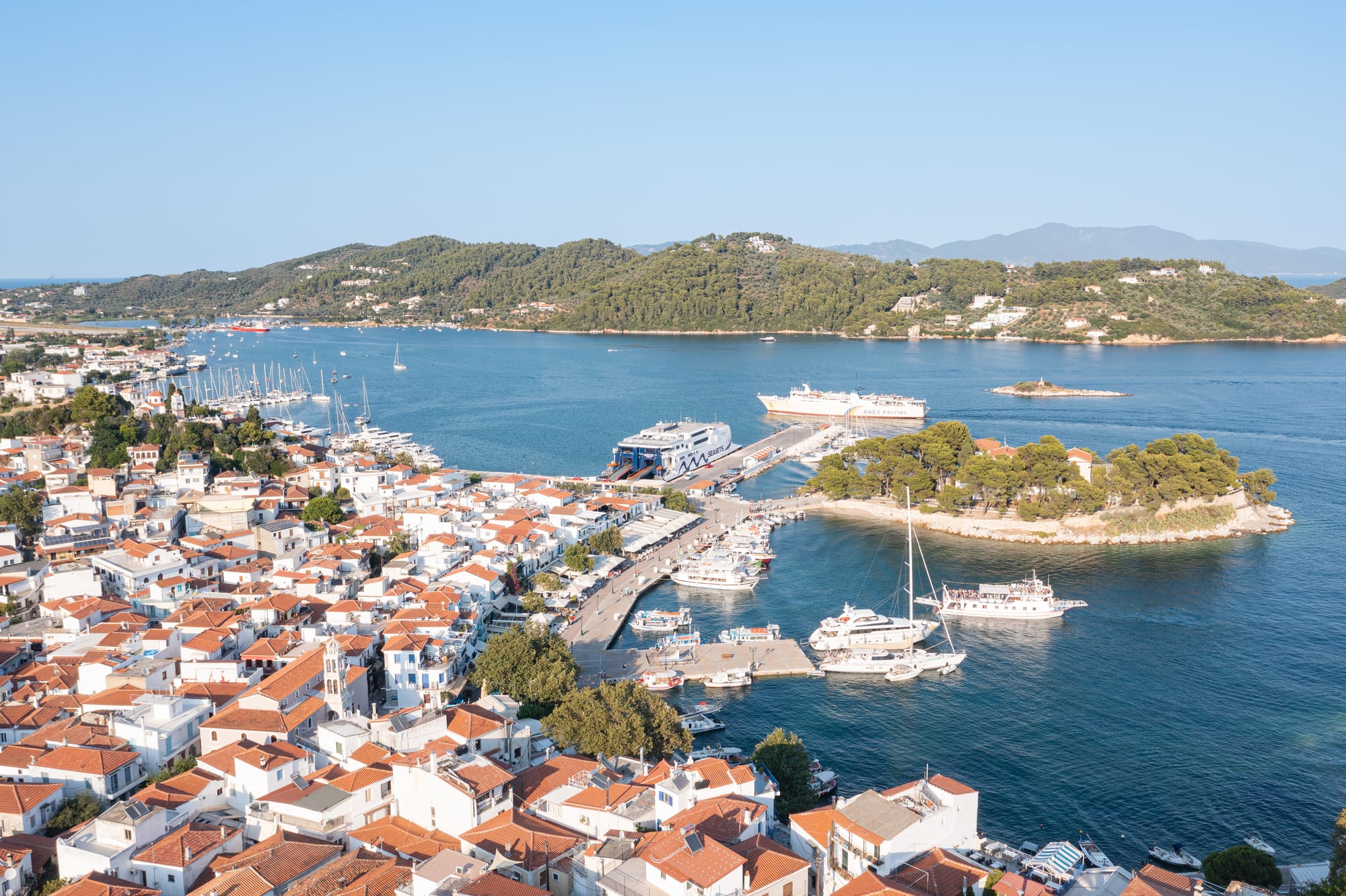
Aerial view of Skiathos town's orange-roofed houses beside the harbour, with ferries, yachts and a pine-covered islet in a blue bay

Thessaly & Epirus, Greece

Skiathos

Skiathos town and its old port, with the pine-covered Bourtzi peninsula and the ferry quay. (dronepicr / Wikimedia Commons · CC BY 2.0)

The westernmost island of the Northern Sporades, about 12 kilometres long, off the tip of the Pelion peninsula. Its pine woods built ships in the 19th century and sheltered the rebels who swore on the first Greek flag; since the 1960s tourism has made it the busiest island of the group, with more than 60 mostly sandy beaches around a harbour town.

Neighbourhoods

  • Skiathos Town
    • First-time visitors
    • Nightlife
    • Close to public transport

    The island's only town, called simply 'the village' by locals, built on the site of the ancient city at the east end of the island. White houses with tiled roofs climb above the old port and the pine-covered Bourtzi; the ferry quay, the bus station, shops, tavernas, bars and the clubs along the shore are all here.

    Open in Maps
  • The south coast
    • Beaches
    • Families

    The paved coast road from the town to Koukounaries passes a string of sandy bays — Achladies, Kanapitsa, Vromolimnos, Troulos — lined with hotels, tavernas and holiday flats built since the 1960s. The island bus stops at each one.

    Open in Maps
  • Koukounaries
    • Beaches
    • Nature

    The south-western end of the island, about 7 kilometres from the town in a straight line, where a stone pine forest on a narrow peninsula separates a lagoon from the sea. Its beach is one of the island's most popular, with Big and Small Banana beaches next to it.

    Open in Maps
  • The north coast
    • Quiet beaches
    • Walks

    The rugged, wooded north side, crossed only by narrow dirt and paved roads, has the ruins of Kastro, the monastery of Evangelistria and less crowded beaches such as Xanemos, where the sea is often rougher.

    Open in Maps

Things to do

Beaches

  • Koukounaries Beachbeach

    Also called Chrysi Ammos, 'golden sand', the long beach backed by stone pines on the seaward side of the Koukounaries peninsula, one of the most popular on the island.

    Open in Maps
  • Lalariabeach

    A beach on the north coast reached only by boat, with large white stones on the shore and very clear water.

    Open in Maps
  • Asselinosbeach

    A pair of beaches, Small and Great Asselinos, among the island's more than 60.

    Open in Maps
  • Banana beachesbeach

    Big Banana and Small Banana, next to Koukounaries at the end of the bus route, popular with younger visitors.

    Open in Maps

History and the town

  • Papadiamantis House Museummuseum

    The two-storey house of 1860 in which the writer Alexandros Papadiamantis grew up and died in 1911, kept with its original furniture and his father's books.

    Open in Maps
  • Bourtziviewpoint

    The pine-covered peninsula beside the old port, where the Ghisi brothers built a small Venetian fortress in 1207 to guard the town against pirates.

    Open in Maps
  • Skiathos Castlelandmark

    The medieval fortified town on a cliff at the northern tip of the island, the main settlement from the mid-14th century until 1829, now abandoned and protected, with restored churches, cisterns and a mosque among the ruins.

    Open in Maps
  • Evangelistria Monasterylandmark

    A monastery on a hillside some 4 kilometres north of the town, where freedom fighters swore an oath in 1807 on a newly designed Greek flag woven on a loom that is still kept there.

    Open in Maps
  • Skiathos airport runwaytransit hub

    The short runway built on land reclaimed from the sea, where an adjacent public road lets plane spotters watch landings and take-offs at very close range.

    Open in Maps

Short trips from the island

  • Tsougriaattraction

    A protected islet off the south-east coast, with several beaches visited by yachts and round-island boat trips.

    Open in Maps
  • Skopelosattraction

    The greener neighbouring island to the east, reached by ferry from the harbour, one of the filming locations of the 2008 film Mamma Mia!.

    Open in Maps

Eat and drink

Long-standing places and food districts in Skiathos. Hours, ratings and directions come from your maps app, always current.

Skiathos classics

  • Old port tavernasneighborhood

    Seafood and Greek tavernas around the old port and in the lanes above it, the centre of eating out on the island.

    Open in Maps
  • Souvlaki standsrestaurant

    Souvlaki sellers are dotted around the town and near the beaches, the cheap everyday meal of the island.

    Open in Maps

Food streets and bars

  • Papadiamanti Streetneighborhood

    The town's main street, leading up from the harbour, with cafés, ice-cream and frozen-yoghurt shops and the Papadiamantis museum.

    Open in Maps
  • Koukounaries tavernasneighborhood

    Tavernas, ouzeris, bars and cafés behind Koukounaries beach.

    Open in Maps

Experience Skiathos

History

In 480 BC the fleet of the Persian king Xerxes was battered by a storm on the rocks off Skiathos, and the Greek fleet then held the seas nearby while the Spartans defended Thermopylae; afterwards the island joined the Delian League. Its ancient city, on the site of today's town, was destroyed by Philip V of Macedon in 200 BC.

In 1207 the Venetian brothers Geremia and Andrea Ghisi took the island and built the Bourtzi, a small fortress on an islet off the town, but it could not stop pirate raids, and in the mid-14th century the islanders moved to Kastro, a fortified settlement on a cliff at the island's northern tip. Skiathos passed back to Byzantium in the 1270s, to Venice after 1453, and to the Ottoman admiral Hayreddin Barbarossa in 1538. The Evangelistria monastery, founded by monks from Mount Athos in the 18th century, became a hiding place for rebels, and in 1807 Theodoros Kolokotronis, Andreas Miaoulis and others swore an oath there on a newly designed Greek flag.

After independence the islanders left Kastro in 1829 and resettled the harbour site. Pine forests made Skiathos an important shipbuilding centre in the 19th century, until steamships ended the trade and the woods, nearly felled, grew back. In 1964 the Greek National Tourism Organisation made the island a development zone for tourism; the coast road to Koukounaries, the first large hotel and, in 1984, the airport followed, transforming Skiathos into one of the best-known resort islands in the Aegean.

Culture & Customs

Skiathos is above all the island of Alexandros Papadiamantis (1851–1911), counted among the greatest Greek authors, whose stories portray country life on Skiathos as well as the poorer neighbourhoods of Athens; the house where he grew up, built by his father in 1860, is a museum. The poet and prose writer Zisis Oikonomou was also a Skiathos resident.

The island's religious life centres on its churches and on the Evangelistria monastery, which keeps the loom on which the first Greek flag was woven and celebrates the Annunciation every 25 March. Families from Asia Minor who settled on the island after 1922 added their own traditions. In 2008 Skiathos and neighbouring Skopelos were filming locations for the film Mamma Mia!.

Tourism shapes the island's character in summer: the town fills with visitors from across Europe, bars and clubs line the shore north-east of the port, and the airport's short runway, where planes pass low over a public road, has become an attraction in its own right. In winter the island returns to its small resident community, and the rhythm becomes that of a quiet Aegean town.

Daily Life

The municipality of Skiathos, which covers the island and its islets, had about 5,800 residents at the 2021 census; the town held about 4,900 people in 2011, and the next largest settlements are hamlets of a few hundred or fewer. In summer the residents are vastly outnumbered by visitors.

Tourism is the island's economy. Hotels, rented rooms, tavernas, boat trips, car and moped hire and shops depend on a season that runs roughly from May to October, and the airport's charter flights and the ferries from Volos and Agios Konstantinos bring most of the visitors. Farmland survives around the town and the villages, and a small shipyard north of the town still builds traditional wooden caiques.

Life in the town follows the season. Summer days are long and busy, with traffic on the coast road, crowded buses and late nights at the port; winter brings a reduced bus service and a slower pace centred on the school, the churches and the cafés of the harbour. Tourist building along the coast road has transformed the island since the 1960s, and in the early 2000s islanders protested against a mining scheme and a power line.

Food

Eating on Skiathos follows the Greek island pattern. Tavernas around the old port and in the lanes above it serve grilled fish and seafood alongside the meze of mainland Greece — tzatziki, grilled octopus, fried cheese saganaki and horiatiki, the village salad of tomato, cucumber, onion, olives and feta. Souvlaki sellers, wrapping grilled meat in pita, are dotted around the town and near the beaches, and frozen yoghurt has become common on Papadiamanti Street.

From the wider Sporades come pies of the kind that every region of Greece makes in filo, and neighbouring Skopelos is known for its coiled, fried cheese pie and its prunes. Baked dishes such as moussaka and gemista, stuffed vegetables, are the staples of the taverna menu. The Evangelistria monastery has planted vineyards for Alypiakos, a red muscat wine.

To drink there is beer and ouzo, poured with meze, and tsipouro, the grape brandy of Thessaly. Desserts are the Greek ones: yoghurt with honey and walnuts, loukoumades and baklava. Tap water is not drinkable on the island, and ice in restaurants is supplied by specialist companies.

Planning tools

Budget

Skiathos charges island prices in July and August, when rooms are dearest and hardest to find; in May, June and September prices fall noticeably. Buses are cheap, taxis inexpensive, and a hired moped is a low-cost way to reach the beaches.

Daily Budget Midrange
USD 130–240 (mid-range hotel, taverna dinners, a round-island boat trip, a hired car or moped)
Daily Budget Shoestring
USD 60–95 (simple room or campsite, souvlaki and bakery food, island buses, deck-class ferry)

Book summer rooms and ferry places early; outside July and August the island is quieter and cheaper.

Best Time to Visit

June and September offer warm sea and fewer people. July and August are the island's peak, with full beaches and busy nights. From late autumn to spring the island is quiet and the bus service is much reduced.

Suggested Number of Days

Three or four days allow time for the town and a good spread of beaches. A week suits a beach holiday or a stay that includes the neighbouring islands, which depends on ferry timetables.

First Visit
3–4 days
With Surroundings
5–7 days

Transportation

The island is about 12 kilometres long, with one main paved road along the south and east coasts. The core bus route runs from the town to Koukounaries with 26 numbered stops, as often as five times an hour in peak season and much less in winter; smaller buses go to the Evangelistria monastery and to Xanemos. Tickets are bought on board in cash. Taxis, hire cars, mopeds and beach boats fill the gaps; the interior roads are mostly dirt tracks.

Helmets are required on mopeds and motorbikes; fill the tank before setting out, as petrol stations are few.

Airport & Station Connections

Skiathos Alexandros Papadiamantis Airport lies about 4.5 kilometres from the town, in the north-east of the island, on land reclaimed from the sea; it has flights from Athens and, in summer, charter and scheduled flights from many European countries. Ferries, including fast catamarans, sail from Volos and Agios Konstantinos on the mainland and continue to Skopelos and Alonissos; some services link Thessaloniki. Cruise ships dock in the town's harbour.

Walkability

The town is compact and easily walked, though its lanes climb steeply from the harbour and are shared with mopeds. Beyond the town, distances and the lack of pavements on the coast road make the bus, boats or a vehicle necessary; old paths cross the forested interior for those who want to walk.

Safety

Greece is a safe country for visitors, with low levels of violent crime. Skiathos sees little crime beyond petty theft in the summer crowds. The main risks are on the roads, where mopeds and narrow, unlit tracks cause accidents, and in the sea, where the north coast is rougher than the sheltered south. Tap water on the island is not drinkable.

Ride mopeds with care and a helmet, watch for currents and sea urchins when swimming, and drink bottled water. Check current official travel advice before travelling.

Climate

A Mediterranean island climate of hot, dry summers and mild, wetter winters; the wind comes mostly from the north, so the north coast is rougher than the south.

Summer
hot and dry — on the facing mainland, in Magnesia, August temperatures rise to about 37–38°C
Winter
mild and wetter; colder on the mainland, where the lowest temperature recorded in nearby Volos is −13.6°C

Local Customs

The Evangelistria monastery remains a place of worship and expects modest dress and respect for services, and its great feast day is 25 March, the Annunciation. Beach clothing belongs on the beach rather than in churches or the town's squares. Greek Orthodox feasts, name-days and Easter shape the local year.

Cover shoulders and knees at monasteries and churches, and keep quiet during services.

Common Payment Methods

The currency is the euro. Cards are accepted almost everywhere in the town, but the island buses take cash only, and some small tavernas, kiosks and beach businesses prefer it.