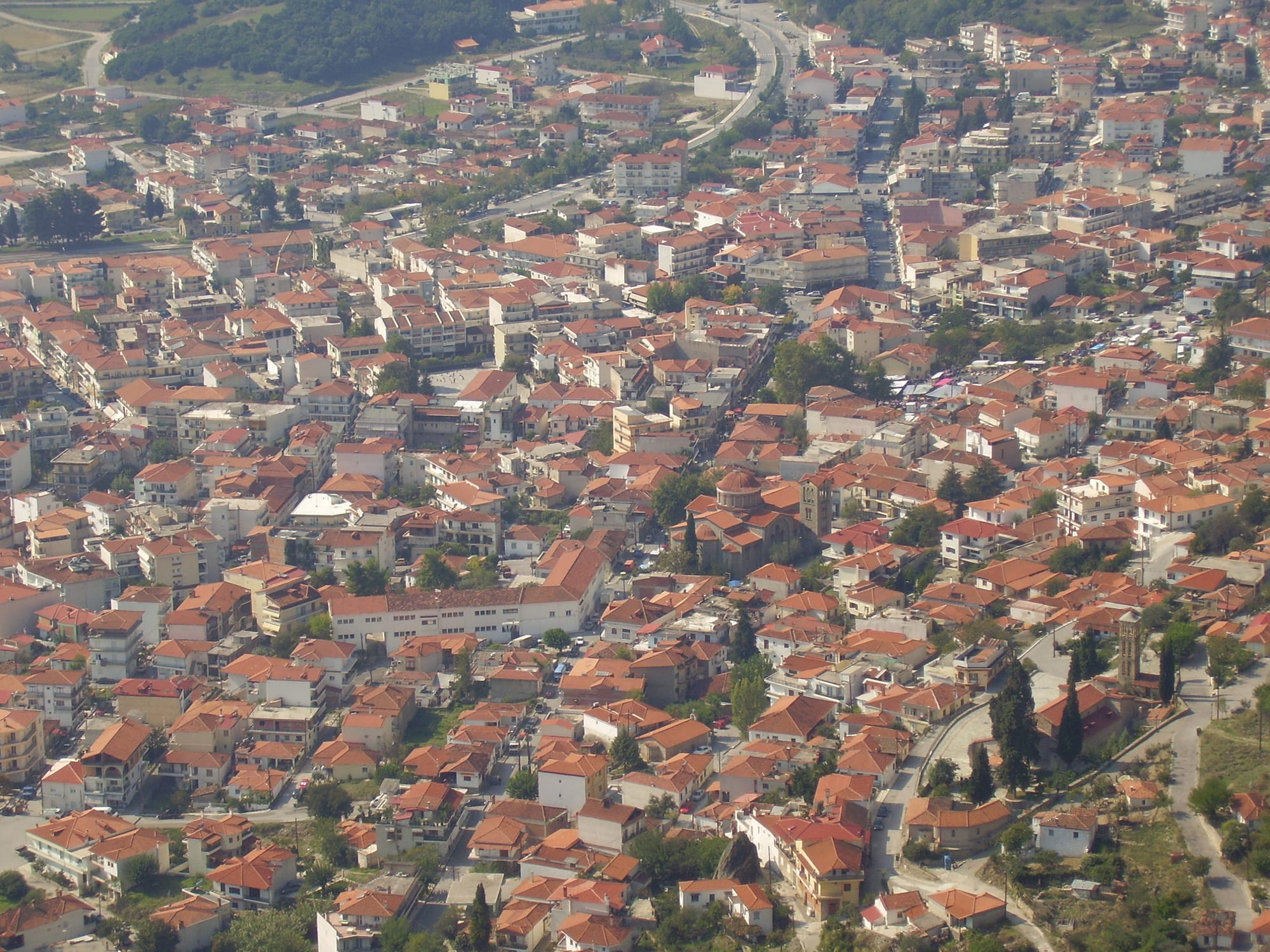
Red-tiled roofs of Kalabaka seen from above, with a domed church among the houses and a road leading out of town

Thessaly & Epirus, Greece

Kalabaka

Kalabaka seen from the Meteora rocks above the town. (WindEwriX / Wikimedia Commons · CC BY-SA 3.0)

A small town at the north-western edge of the Thessalian plain, built at the foot of the sandstone pillars of Meteora. The Byzantine bishopric of Stagoi grew up here, and the monasteries founded on the rocks above from the 14th century made it a pilgrimage and later a tourist town; today it is the main base for visiting the six surviving monasteries.

Neighbourhoods

  • Town centre and Trikalon Street
    • First-time visitors
    • Best for food
    • Close to public transport

    Trikalon Street is the spine of the town, lined for nearly a kilometre with restaurants, shops and tourist services. The bus station, the railway station and most places to stay are within walking distance, and the rocks of Meteora rise directly behind the rooftops.

    Open in Maps
  • The upper town below the rocks
    • Historic district
    • Quiet and residential

    The older streets climb towards the cliffs around the cathedral of the Dormition, the only medieval monument of Stagoi to survive. A footpath leads up from the back of town towards the monasteries, and the views of the rock faces are closest here.

    Open in Maps
  • Kastraki
    • Quiet stays
    • Walking and climbing

    A neighbouring village of about 1,000 people in a small valley opening into the Meteora massif, surrounded by cliffs except on its western side. It is a place of guesthouses, campsites and small shops, closer to the rocks and quieter than the town, though many businesses close in winter.

    Open in Maps

Things to do

The monasteries of Meteora

  • Monastery of Great Meteoronlandmark

    The oldest and largest of the monasteries, founded on the Broad Rock in the mid-14th century by Saint Athanasios the Meteorite, a monk from Mount Athos, and dedicated to the Transfiguration.

    Open in Maps
  • Monastery of Varlaamlandmark

    The second-largest monastery, named after a monk who climbed the rock in 1350 and rebuilt by the brothers Theophanes and Nektarios Apsarades from 1517, with a museum of relics and church treasures.

    Open in Maps
  • Monastery of Rousanoulandmark

    A monastery in the middle of the site, 484 metres above sea level, from which the other monasteries can be seen; its main church is dedicated to Saint Barbara.

    Open in Maps
  • Monastery of St. Nicholas Anapausaslandmark

    The smallest monastery, on a narrow rock and the first that pilgrims reach on the way up, with 14th-century frescoes on the walls of its upper floor.

    Open in Maps
  • Monastery of the Holy Trinitylandmark

    The hardest of the monasteries to reach, with wide views from the top of its rock; it was a filming location for a 1981 James Bond film.

    Open in Maps
  • Monastery of Saint Stephenlandmark

    The most accessible monastery, entered by a small bridge rather than steps, and run as a convent by a community of nuns since 1961.

    Open in Maps

In the town

  • Church of the Dormitionlandmark

    The town's historic cathedral, built on the remains of an early Christian church, with a large stone ambo, fragments of earlier buildings and layers of frescoes from several centuries.

    Open in Maps
  • Natural History Museum of Meteora and Mushroom Museummuseum

    A museum of dioramas of birds and mammals on the ground floor and a whole upper floor given to mushrooms.

    Open in Maps

Short trips from the town

  • Theopetra Caveattraction

    A limestone cave 3 kilometres south of Kalabaka with traces of human presence from the Middle Palaeolithic onwards, and unverified claims of a low wall built in about 21,000 BC.

    Open in Maps
  • Trikalaneighborhood

    The capital of the regional unit, straddling the Lithaios river, with a hilltop fortress, the Osman Shah Mosque by Mimar Sinan and the old quarters of Varousi and Manavika.

    Open in Maps

Eat and drink

Long-standing places and food districts in Kalabaka. Hours, ratings and directions come from your maps app, always current.

Kalabaka classics

  • Rombos patisseriecafe

    A halva maker on Trikalon Street that has been baking sweets since 1924, known for halvas sapouné, a large pie made with corn flour and baked to a toasted crust.

    Open in Maps
  • Pies and tsipourorestaurant

    Thessaly and Epirus share a strong tradition of filo pies, and tavernas pour tsipouro, the strong un-aged grape brandy of Thessaly and Epirus.

    Open in Maps

Food streets

  • Trikalon Streetneighborhood

    The town's main street, lined with restaurants, bakeries and cafés for nearly a kilometre.

    Open in Maps
  • Kastraki tavernasneighborhood

    A few tavernas and ouzeris along the main road of the village beneath the rocks.

    Open in Maps

Experience Kalabaka

History

An inscription on the wall of one of the town's oldest churches, Saint John the Baptist, shows that an ancient Greek settlement called Aiginion stood here. By the 10th century AD the place was known as Stagoi, a Byzantine fortress and bishopric, first mentioned in a work of Emperor Leo VI the Wise; the Greek Orthodox Church still uses the name. The bishops held wide lands and dependent farmers across north-west Thessaly, and of the medieval town only the cathedral of the Dormition survives, built in the late 11th or early 12th century on the remains of a late antique church.

Stagoi changed hands often. It fell to the Despotate of Epirus in 1204, passed to the Duchy of Neopatria at the end of the 13th century, returned to the Despot John II Orsini in 1334 and briefly to Byzantium, and was taken in 1348 by the Serbs of Stephen Dushan. Under his brother Simeon Uroš, in the second half of the 14th century, monks built most of the monasteries on the pillars above the town; at their peak in the 16th century there were 24. When the Ottomans took Thessaly the town came under the Pasha of Larisa and later the Sanjak of Trikala, and it gained its present name, of Turkish origin and meaning "powerful fortress".

Thessaly joined Greece in 1881. The bishopric was merged with Trikala in 1900 and re-established in 1991 as the Metropolis of Stagoi and Meteora, with its seat in Kalabaka. The six surviving monasteries became a UNESCO World Heritage Site in 1988, and tourism grew into the town's main business. Since 2018 Kalabaka has been the seat of a municipality named Meteora. Storm Daniel in September 2023 damaged the railway to the town, which still had no trains in 2026.

Culture & Customs

Kalabaka lives beside one of the great centres of Orthodox monasticism, regarded in Greece as second only to Mount Athos. Four of the six surviving monasteries are still home to monks or nuns — Saint Stephen has been a convent since 1961 — and the town is the seat of a metropolitan bishop. For centuries the monasteries were reached only by ladders or by nets hauled up the cliffs, and women were long kept out: Queen Marie of Romania, in 1921, was the first woman allowed into the Great Meteoron. Visitors are expected to dress modestly and to respect services.

The rocks have also drawn film-makers and climbers. Holy Trinity appeared in a 1981 James Bond film, the 1957 film Boy on a Dolphin was partly shot here, and the 2012 film Meteora is set among the monasteries. Hikers, trail runners, mountain bikers and rock climbers come from around the world, particularly in summer, and Kastraki at the foot of the cliffs is their base.

The town keeps the rhythms of the Orthodox calendar, with Easter and saints' name days the main occasions for family gatherings. Kalabaka is twinned with Schwabach in Germany, Le Haillan in France and Mioveni in Romania.

Daily Life

The municipal unit of Kalabaka had about 11,500 people at the 2021 census, about 8,600 of them in the town itself; at the 2011 census it was the second most populous town of the Trikala regional unit, after Trikala. It is the seat of the municipality of Meteora, whose eight municipal units take in the villages of the surrounding plain and hills.

Tourism is the town's main business: Kalabaka is the hub of services for visitors to the monasteries, and its main street is given over to restaurants, bakeries, shops and agencies, while Kastraki next door is a village of guesthouses and campsites. The town also has primary and secondary schools serving the area, a public library and a weekly farmers' market on Friday mornings.

The year follows the visitor season. From spring to autumn coaches and hire cars climb the road to the rocks every morning, and the cafés of the centre stay busy into the evening; in winter many businesses in Kastraki close, and the town returns to its residents. The loss of the railway after Storm Daniel in 2023 left the town relying on buses and replacement coaches for its links with the rest of Greece.

Food

Kalabaka eats as north-western Thessaly does, at the meeting point of the plain and the mountains. Pies wrapped in filo — kotopita with chicken, hortopita with wild greens, kreatopita with meat — belong to the strong pie tradition of Epirus, Thessaly and central Greece, and appear in bakeries and on taverna tables. Grilled meats and country dishes fill the menus of the tavernas on the main street, some of which put local and monastery recipes forward.

Tsipouro, a strong, un-aged brandy distilled from grape pomace, is the drink of Thessaly and Epirus, served in small measures with plates of meze. The local sweet tradition is halva: a patisserie on Trikalon Street that has been making sweets since 1924 is known for halvas sapouné, a large corn-flour pie baked to a toasted crust.

The Friday market brings in fresh produce from the plain, and Kastraki has a few tavernas and ouzeris below the rocks.

Planning tools

Budget

Kalabaka has plenty of mid-priced rooms and is inexpensive by Greek standards. Each monastery charges a small entry fee, and a hire car or taxis add to the cost for anyone who wants to see all six monasteries in one stay; the local bus to the rocks is cheap but runs only a few times a day.

Daily Budget Midrange
USD 110–200 (mid-range hotel, taverna dinners, monastery entry fees, a hire car or taxis)
Daily Budget Shoestring
USD 50–85 (simple room or campsite, bakery and taverna meals, local buses)

Carry some cash in small notes for buses and small purchases.

Best Time to Visit

May, June, September and October are the best months for walking the old footpaths between the monasteries. July and August are very hot in the plain and the monasteries are busiest. Winter is quiet and damp, with shorter opening hours at the monasteries and many Kastraki businesses closed.

Suggested Number of Days

Most visitors give the monasteries one full day, or two with time for walking the footpaths. Three days allow the surrounding towns and caves as well. Each monastery closes on its own weekly day, which can add a day to a stay.

First Visit
1–2 days
With Surroundings
3 days

Transportation

The town itself is walkable. A local bus leaves the bus station a few times a day for Kastraki and each of the six monasteries along the road that runs north of the town, and an all-day ticket allows hopping between them; timetables are given at the bus station. Taxis, hire cars and guided tours fill the gaps. A bus runs to Trikala about once an hour.

The monasteries keep different weekly closing days and shorter winter hours, so check them before choosing a day.

Airport & Station Connections

There is no airport nearby: most visitors come from Athens or Thessaloniki, and some fly to Volos and drive for about two hours. The drive from Athens takes about four hours; KTEL buses from Athens take about five, usually with a change at Trikala, from where the local bus takes about 45 minutes. The railway line from Palaiofarsalos was damaged by Storm Daniel in 2023, and no trains call at Kalabaka in 2026; a replacement bus runs instead.

Walkability

The town centre is compact and flat, and Trikalon Street runs for nearly a kilometre through it. Footpaths climb from the back of the town towards the rocks, and the old monks' paths link the monasteries below the road, though they are steep. Many monasteries are reached by long flights of steps.

Safety

Greece is a safe country for visitors, with low levels of violent crime. Kalabaka is a quiet town. The main hazards are natural: rock falls are a constant threat around the pillars of Meteora, the footpaths and monastery steps are steep, and the plain is very hot in summer. Storm Daniel in September 2023 showed how quickly floods can rise in Thessaly.

Keep to marked paths below the rock faces, wear good shoes for the monastery steps, carry water in summer and heed weather warnings. Check current official travel advice before travelling.

Climate

Kalabaka has a Mediterranean-type climate: winters are damp and harsh, and summers humid and hot.

Summer
hot — in nearby Trikala the August average high is 34.5°C
Winter
damp and cold — in nearby Trikala nights fall below 0°C from time to time and snow falls occasionally

Local Customs

The monasteries of Meteora are working religious houses as well as museums, and they expect modest dress. Greek Orthodox feasts, name-days and Easter shape the year.

Cover shoulders and knees at the monasteries, keep voices low inside the churches, and follow any instructions from monks and nuns about where photography is allowed.

Common Payment Methods

The currency is the euro. Cards are accepted in most hotels, shops and restaurants, but some small tavernas and kiosks may need cash, and there are cash machines in the town centre.