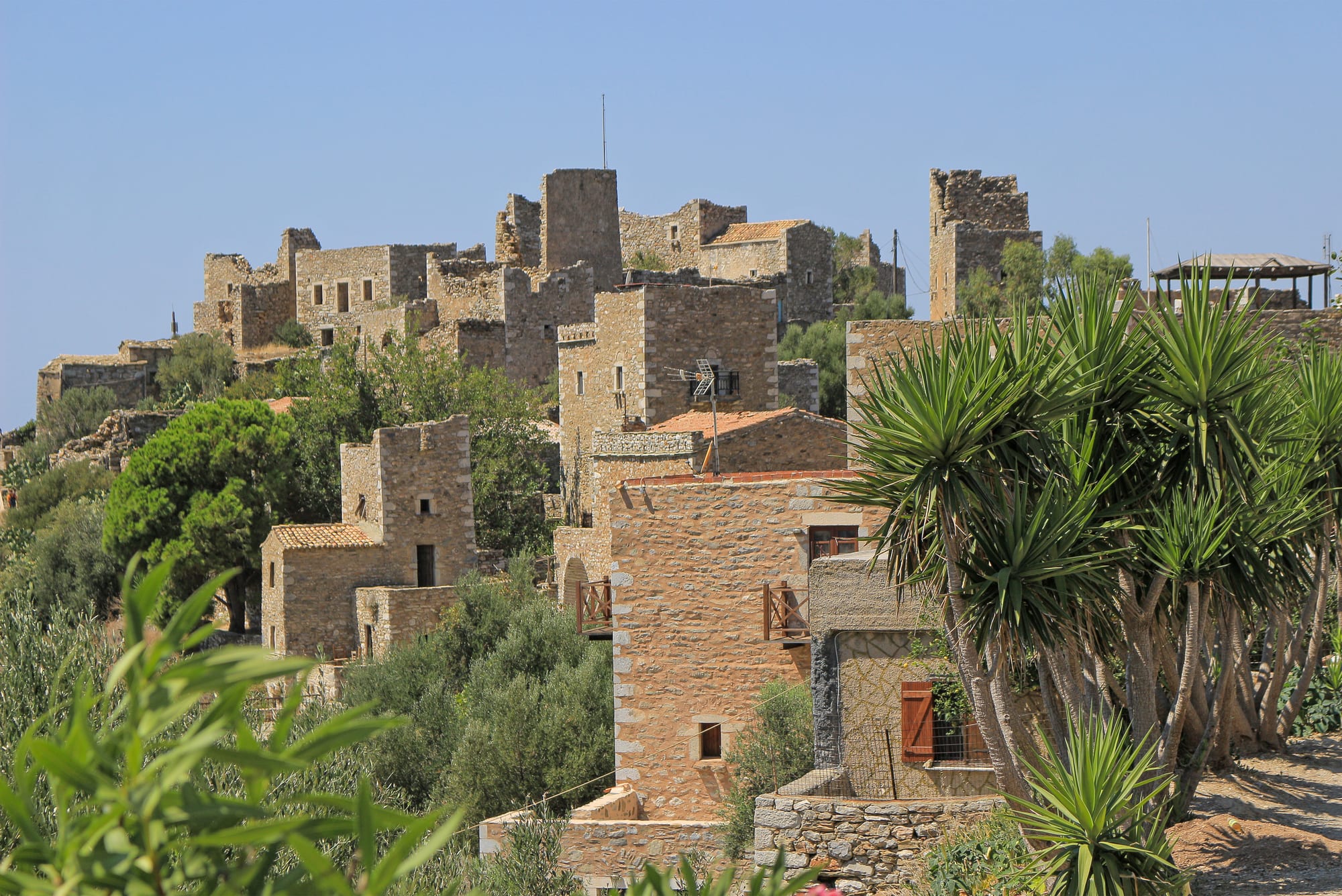
Square stone tower-houses clustered on a hilltop under a clear blue sky, with green trees and spiky yuccas in front

Greece

The Peloponnese & Western Greece

The clan tower-houses of Vathia in the Mani, the southernmost peninsula of the Peloponnese. (Zois Sp. Koutroulis / Wikimedia Commons · CC BY-SA 4.0)

The great southern peninsula of mainland Greece, joined to Attica only by the Isthmus of Corinth, together with the northern shore of the Gulf of Patras around Messolonghi and Agrinio — a region of Mycenaean citadels, Sparta and Olympia, Frankish, Byzantine and Venetian castles, the tower villages of the Mani and the port city of Patras.

Explore The Peloponnese & Western Greece

History

The Peloponnese was the heart of Bronze Age Greece. Between about 1600 and 1200 BC the palaces of Mycenae, Tiryns and Pylos ruled the plains around them, and the clay tablets found at Pylos preserve some of the earliest written Greek. In the classical centuries Sparta held the peninsula through its league of allies and its Messenian helots, Corinth grew rich on the portage across the Isthmus, and every four years from, by tradition, 776 BC the Greek world met at Olympia. Thebes ended Spartan power in 371 BC and freed Messenia; Rome razed Corinth in 146 BC, and after winning the sea battle of Actium off the Acarnanian coast in 31 BC Octavian refounded Patras as a Roman colony.

After the Fourth Crusade of 1204 French knights made the peninsula the Principality of Achaea, governed from Andravida and guarded by castles such as Chlemoutsi. The Byzantines returned in 1262, and their Despotate of the Morea, ruled from Mystras above Sparta, became the last centre of Byzantine art and learning. The Ottomans took the Morea in 1460, while Venice clung to Methoni, Koroni, Nafplio and Monemvasia and came back to rule the whole peninsula from 1687 to 1715. The Holy League destroyed the Ottoman fleet off Lepanto, today's Nafpaktos, in 1571.

The revolution of 1821 began here. The Maniots rose at Areopoli on 17 March, Kalamata fell six days later, and Kolokotronis took Tripoli later that year. Byron died at Messolonghi in April 1824, and the town's starving defenders broke out through the Ottoman lines in April 1826; an allied fleet sank the Ottoman-Egyptian navy in Navarino Bay in October 1827, and Nafplio was the capital of the new state until the court moved to Athens in 1834. German troops shot the men of Kalavryta on 13 December 1943, and the Rio–Antirrio bridge joined the two halves of the region in 2004.

Culture & Customs

The Moraites, as the people of the Peloponnese are known, hold a particular place in the national story. The strongest local identity is that of the Mani, whose clans were never effectively governed by the Ottomans, built tower-houses to fight one another, and kept the vendetta into the late 19th century. On the Arcadian coast around Leonidio a dwindling number of mostly elderly people speak Tsakonian, the only living descendant of ancient Doric Greek, and the town sends paper hot-air balloons into the sky at Easter.

Patras stages Greece's biggest carnival, which opens on 17 January and climaxes on the last weekend before Lent with a parade of floats and costumed groups and the burning of the Carnival King at the harbour. The city's patron is St Andrew, by tradition crucified here, whose skull is kept in the huge basilica by the sea. Kalamata gave its name to the kalamatianos, the twelve-step circle dance performed at every Greek wedding, and holds an international dance festival.

Antiquity is kept in use rather than merely preserved. The flame for every Olympic Games is lit from the sun's rays with a parabolic mirror in front of the Temple of Hera at Olympia, ancient drama is played at Epidaurus on summer weekends, and the 246-kilometre Spartathlon ends each September at the statue of Leonidas in Sparta. Messolonghi, officially a "sacred city", commemorates the Exodus of 1826 each spring with a procession to the Garden of Heroes. Elsewhere the year turns on the village panigyri, the saint's-day feast of clarinet bands, roast meat and dancing, which peaks around 15 August, when the emigrants come home.

Daily Life

About 1.2 million people live in the two administrative regions — roughly 540,000 in the Peloponnese and 650,000 in Western Greece. Patras, with some 215,000 in its municipality, is Greece's third city and its western gateway, a port and university town of arcaded streets; Kalamata, with about 70,000 in the municipality, Agrinio, Corinth, Tripoli, Pyrgos, Argos and Sparta are the other centres, and Nafplio, for all its fame, has only about 14,000 residents. The mountain interior of Arcadia and the inner Mani have been losing people for more than a century, first to America and Australia and then to Athens, and many stone villages are full only in August.

The economy is agricultural to a degree unusual in the European Union: olives and oil in Messenia and Laconia, oranges on the plains of Argos and Sparta, currants along the Gulf of Corinth, wine at Nemea, strawberries in Elis — picked largely by migrant workers — and fish farms in the Messolonghi lagoon. Agrinio, once Greece's tobacco capital, has had to reinvent itself since the tobacco industry declined, and the lignite that has fed the Megalopoli power station since 1969 is running out. Patras lives on its university and its port, with ferries to Italy; tourism is concentrated in Nafplio, Olympia, the Mani and the Messenian coast.

Provincial hours hold: shops shut from about two until half past five, the afternoon is quiet, and the evening volta fills Nafplio's marble-paved Syntagma Square and the waterfront at Kalamata. Athenians arrive on Friday evenings now that motorways have put Nafplio and Kalamata within two to three hours of the capital, and the olive harvest, from November to January, still brings families back to their villages.

Food

This is olive country. The dark, almond-shaped Kalamata table olive and the oil pressed from the Koroneiki olive are the region's best-known exports, and most cooking starts from them. The Mani adds syglino, salted and smoked pork preserved in its own fat, and lalangia, strips of fried dough eaten with cheese. Hilopites egg noodles and trahanas are mountain staples, and sfela, a semi-hard white cheese in brine protected since 1996, belongs to the south.

Leonidio holds a summer festival for its aubergines, Argolis grows oranges, and Aigio has shipped currants since the 19th century. At Messolonghi the lagoon gives avgotaraho, grey-mullet roe salted, dried and sealed in beeswax. Sweets include diples, folds of fried pastry drenched in honey and walnuts and served at weddings, and Kalamata's pasteli sesame-and-honey bars.

The wines are among Greece's most important. Nemea, the country's most important red-wine appellation, grows Agiorgitiko; the Mantinia plateau near Tripoli makes aromatic white Moschofilero; Patras has dry Roditis, Muscat and the sweet fortified Mavrodaphne, first made by the Bavarian Gustav Clauss, whose Achaia Clauss winery of 1861 still receives visitors; and Monemvasia gave its name to Malvasia, the sweet "Malmsey" of medieval trade. Patras' own digestif is tentura, a dark liqueur of cinnamon and cloves.

Attractions & Natural Wonders

The north-east corner is the most densely packed. Nafplio, a Venetian and neoclassical harbour town, lies beneath the fortress of Palamidi, with the Bourtzi fort on its islet in the bay. Within 30 kilometres are Mycenae, with the Lion Gate, the grave circles and the beehive Treasury of Atreus, the Cyclopean walls of Tiryns, and Epidaurus, whose 4th-century-BC theatre seats about 14,000 and carries a whisper to the top row. Ancient Corinth, the fortress-mountain of Acrocorinth and the 6-kilometre Corinth Canal lie on the way from Athens.

In Laconia the ruined Byzantine city of Mystras climbs a spur of Taygetos above Sparta, and Monemvasia, a walled town on the seaward face of a huge rock joined to the coast by a causeway, is still lived in. South of Gythio the Mani towers begin — clan tower-houses at Vathia and Areopoli — along with the Diros caves, toured by boat, and Cape Tainaro, the southern tip of mainland Greece. Messenia has the walls and stadium of ancient Messene, Navarino Bay with the horseshoe beach of Voidokilia and Nestor's palace, and the Venetian sea-castles of Methoni and Koroni. In Arcadia the stone villages of Dimitsana and Stemnitsa overlook the monasteries of the Lousios gorge, and the temple of Apollo at Bassae stands alone at 1,100 metres beneath a protective tent.

Olympia, in the west, keeps the stadium track, the fallen columns of the Temple of Zeus and a museum with the Hermes of Praxiteles. Patras has its castle, Roman odeon and the Rio–Antirrio bridge; the rack railway climbs from Diakopto through the Vouraikos gorge to Kalavryta, near the Cave of the Lakes and the Chelmos ski slopes; and the pine forest and dunes of Strofylia back the long beach at Kalogria. Across the gulf, Messolonghi has the Garden of Heroes and its lagoon, Nafpaktos a tiny Venetian harbour below its castle, and Trichonida is the largest natural lake in Greece.

Cities in The Peloponnese & Western Greece

Planning basics

Budget

The Peloponnese and Western Greece are cheaper than Athens and far cheaper than the famous islands. Patras, Kalamata, Tripoli, Agrinio and the mountain villages of Arcadia are good value all year; Nafplio at weekends, rooms inside Monemvasia's walls, the Messenian resorts around Costa Navarino and the Mani coast in August are the expensive exceptions. The costs that add up are a hire car, motorway tolls, the Rio–Antirrio bridge toll and the tickets for Mycenae, Epidaurus, Olympia and Mystras.

Daily Budget Midrange
USD 110–230 (guesthouse or mid-range hotel, taverna dinners, site tickets, a hire car and tolls)
Daily Budget Shoestring
USD 50–90 (simple rooms or campsites, grill-house and bakery meals, KTEL coaches)

See Nafplio midweek, when the Athenian weekenders have gone home and room prices drop, and sleep in Gefyra on the mainland side of the causeway rather than inside Monemvasia's walls.

Safety

Crime against visitors is rare across the region. The hazards are on the road and in the landscape: mountain roads are narrow and often unfenced, rural driving is fast and the accident rate is high; summer wildfires are a serious risk — those of August 2007 killed dozens of people in the Peloponnese and threatened ancient Olympia; and the Gulf of Corinth and Messenia are earthquake country, Kalamata having been badly damaged in 1986. Heat at shadeless sites such as Mycenae and Mystras is the everyday danger in summer.

Reach the big sites at opening time in summer with water and a hat, obey wildfire road closures and the 112 alerts sent to mobile phones, and avoid driving mountain roads at night. Check current official travel advice before travelling.

Climate

The mountains split the region in two. The Ionian side — Patras, Elis, Messenia and Aetolia-Acarnania — catches the winter rain and stays green, with much more rain than Argolis, Corinthia and the Mani, which lie in the rain shadow and are nearly as dry as Attica. The plains of Laconia and Messenia are among the hottest places in Greece in July, while Tripoli, at 650 metres on the Arcadian plateau, has frost and snow, and Chelmos and Mainalo hold enough snow for skiing from about December to March.

Summer
hot and dry, 30–36°C on the coasts and 38°C or more in heatwaves around Sparta, Kalamata and Argos; cooler nights in the Arcadian villages
Winter
mild and wet on the west coast, 8–15°C; cold on the Arcadian plateau, with snow on Taygetos, Chelmos, Mainalo and Kyllini

Transportation

A car is the practical way round. Motorways run from Athens to Corinth and Patras (about two and a half hours) and from Corinth through Tripoli to Kalamata, with a branch to Sparta, and the Ionia Odos heads north from the Rio–Antirrio bridge past Messolonghi and Agrinio; everything else is slow, winding road. KTEL coaches from Athens' Kifissos terminal serve Nafplio, Sparta, Kalamata, Patras and Pyrgos, for Olympia. The suburban railway from Athens runs through Corinth and Kiato to Aigio; services on much of the old Peloponnese network were cut in 2011, but the Diakopto–Kalavryta rack railway still climbs to Kalavryta. Kalamata and Araxos airports take seasonal flights, and ferries leave Patras for Italy and Kyllini for Zakynthos and Kefalonia.

Allow more time than the map suggests in the Mani and Arcadia, where 50 km can take ninety minutes, and fill the tank before leaving the main roads.

Best Time to Visit

April to mid-June and September to October, when the sites can be walked in the middle of the day, the sea is warm from late May and spring wildflowers cover the Mani and the ruins of Olympia and Messene. July and August are very hot at the inland sites, which have little shade, though Epidaurus stages ancient drama on summer weekend evenings. The Patras carnival fills the city in the weeks before Lent, the olive harvest starts in November, and winter suits Nafplio, the stone villages of Arcadia and the Kalavryta ski centre.