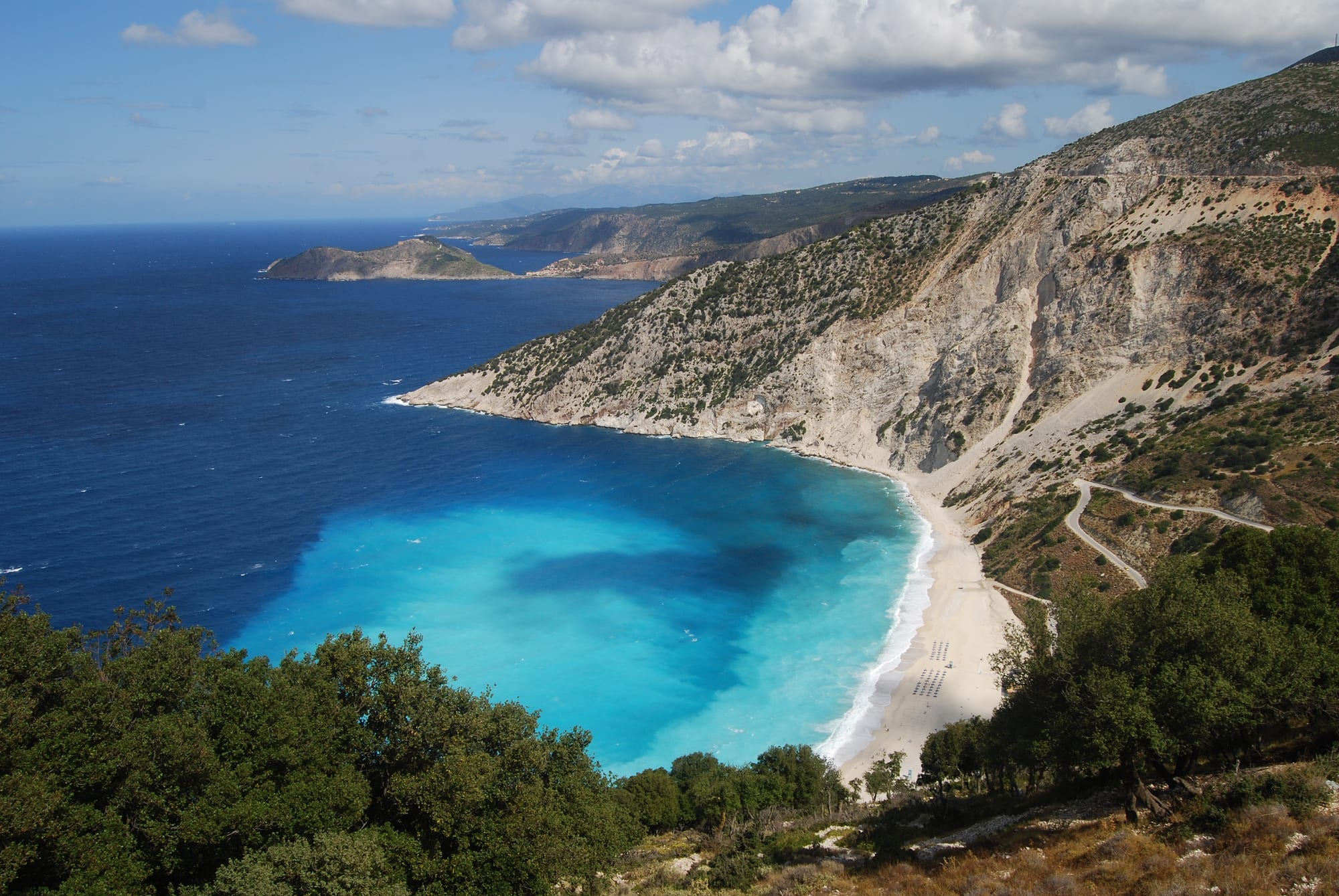
A curving white beach and turquoise bay beneath steep scrub-covered cliffs, with a winding road down the hillside

Greece

The Ionian Islands

Myrtos Beach on the north-west coast of Kefalonia, seen from the road above. (Matt Sims / Wikimedia Commons · CC BY 2.0)

The chain of green islands off Greece's western coast, from Corfu near the Albanian border south to Zakynthos off the Peloponnese — the Heptanese, or "Seven Islands", whose centuries under Venice and Britain rather than the Ottomans gave them a culture of their own, as well as olive groves, cliff-backed beaches and the Ithaca of Odysseus.

Explore The Ionian Islands

History

The islands appear at the very start of Greek literature: Ithaca is the home of Odysseus in Homer's Odyssey, and Corfu is often identified with Scheria, the land of the Phaeacians. Corfu, ancient Corcyra, was founded by Corinth around the 8th century BC and became a sea power in its own right; its quarrel with its mother city was one of the sparks of the Peloponnesian War in 431 BC. Rome and then Byzantium held the islands, which suffered Norman and Sicilian raids and passed between Western lords after the Fourth Crusade of 1204.

Venice is the decisive influence. It held Corfu from 1386 and gradually took the other islands, and Corfu, heavily fortified, resisted Ottoman sieges in 1537 and 1716. Because the Ottomans never ruled the region for long — Lefkada was the main exception, Ottoman from 1479 to 1684 — the islands kept an Italian-speaking nobility, a Catholic minority and Western tastes in music and art.

When Venice fell in 1797 the islands passed to the French, then to a Russian-Ottoman protectorate, the Septinsular Republic, and in 1815 to a British protectorate, the United States of the Ionian Islands. The British built roads, made the Ionian Academy a university and built Corfu's Palace of St Michael and St George, before ceding the islands to Greece in 1864. Two islanders shaped the young state: Ioannis Kapodistrias of Corfu, its first governor, and Dionysios Solomos of Zakynthos, whose Hymn to Liberty became the national anthem. In 1943 German troops killed thousands of surrendering Italian soldiers of the Acqui Division on Kefalonia, and in August 1953 a great earthquake destroyed almost every house on Kefalonia and badly damaged Zakynthos, driving a wave of emigration.

Culture & Customs

Islanders call their region the Eptanisa, the Seven Islands (the seventh, Kythira, is now administered from Attica), and they see themselves as the most European of Greeks. Venetian and Italian words run through local speech, surnames often end in Italian forms, and Corfu has a small Catholic community with its own cathedral. Orthodox life centres on local saints: Saint Spyridon, whose preserved body lies in his church in Corfu Town, and Saint Gerasimos, the patron saint of Kefalonia.

Music is the region's pride. The Ionian school of composers, including Nikolaos Mantzaros, who set the national anthem, grew out of Italian opera, and Corfu's philharmonic brass bands still march in its processions. Across the islands the kantades, serenades sung in harmony with guitar and mandolin, are sung by male choirs, traditionally in the streets at night. At Corfu's Easter, on Holy Saturday morning residents throw clay pots, the botides, from their balconies to smash in the streets below.

The British left a quirkier legacy. Cricket is still played on Corfu's Spianada, and the island's ginger beer, tsitsibira, is still made. A painting tradition, the Ionian school, mixed Byzantine icon-making with Italian Renaissance styles.

Daily Life

About 200,000 people live in the Ionian Islands, half of them on Corfu, whose main town has around 24,000 residents within a larger urban area. Argostoli on Kefalonia, Zakynthos Town and Lefkada Town are small port towns, rebuilt after the 1953 earthquake in the case of the first two. Ithaca and Paxos have only a few thousand residents each, and many villages are largely empty in winter.

Tourism is the economic backbone, much of it package holidays from Britain, Italy and northern Europe on Corfu and Zakynthos, and villa rentals on Paxos, Kefalonia and Ithaca. Olive oil is the traditional crop — Corfu and Paxos are covered in groves planted under Venetian encouragement — alongside wine, fishing and some farming on Kefalonia's plateaus. The Ionian University in Corfu Town keeps a student population on the island year-round.

The rhythm is seasonal: a frantic summer from May to October, when families work long hours in hotels, restaurants and boat hire, and a quiet, rainy winter spent on olive picking, repairs and local life. Current concerns include overtourism at a few famous beaches, water shortages in dry summers, the protection of turtle-nesting beaches on Zakynthos, and the loss of young people to Athens and abroad.

Food

Ionian cooking has a Venetian accent. Corfu's signature dishes are pastitsada, beef or rooster slow-cooked in a spiced tomato sauce with cinnamon and served over pasta; sofrito, a veal dish of Venetian origin; and bourdeto, fish stewed in a fiery sauce of red pepper. Kumquats, grown on the island, are made into a sweet drink, and ginger beer, a legacy of British rule, is still made locally.

Kefalonia is known for its kreatopita, a meat pie, and Corfu for mandoles, caramelised almonds. Mandolato, an almond nougat, is a common sweet across the islands, and Zakynthos gave its name to the Zante currant, while Lefkada is known for its lentils from the mountain village of Englouvi and its cured salami. Fish and seafood feature everywhere, often simply grilled with olive oil and lemon.

The islands produce distinctive wines. Robola, a white grape grown on the limestone slopes of Kefalonia, makes the region's best-known wine. Olive oil from Corfu and Paxos is the cooking fat of choice, and tsipouro or ouzo accompanies the meze on a long evening.

Attractions & Natural Wonders

Corfu is the most populous and most varied island. Its old town, a UNESCO World Heritage Site, runs between the Old Fortress on its headland and the New Fortress, with the arcaded Liston café terrace facing the Spianada. Beyond it are the Achilleion, the palace built in the 1890s for Empress Elisabeth of Austria; Mon Repos, the villa where Prince Philip was born; the bays and monastery of Paleokastritsa; the fishing village of Kassiopi; and Mount Pantokrator, the island's highest point, with views to Albania. South of Corfu, Paxos is a small island of olive groves, stone harbours at Gaios, Lakka and Loggos, and sea caves on its western cliffs, with the beaches of Antipaxos a short boat ride away.

Lefkada is joined to the mainland by a causeway and floating bridge. Its west-coast beaches, Porto Katsiki and Egremni, lie below white cliffs, Vasiliki is a windsurfing centre, and Nydri faces a scatter of small islets. Ithaca, just to the south, has the harbour of Vathy, the villages of Kioni, Frikes and Stavros, and sites linked by tradition to the Odyssey.

Kefalonia is the largest island by area. Myrtos Beach, the village and castle of Assos, and Fiskardo, the harbour largely spared by the 1953 earthquake, lie in the north; Melissani, a partly roofless cave lake, and the Drogarati cave lie near Sami; and Mount Ainos, covered in the native Kefalonian fir, is a national park. Loggerhead turtles surface in Argostoli harbour. Zakynthos, the southernmost island, has Navagio, the Shipwreck Beach, the Blue Caves on its northern tip, and Laganas Bay, protected as a national marine park for its turtle-nesting beaches.

Cities in The Ionian Islands

Planning basics

Budget

Prices sit close to the Greek average, below Santorini and Mykonos but above the mainland. Corfu and Zakynthos have large package-holiday resorts with cheap rooms in shoulder season, while Paxos, Fiskardo on Kefalonia and Kioni on Ithaca are among the more expensive places to stay, much of it in villas. Ferries between the islands are short and inexpensive; a hire car or scooter is the main extra cost.

Daily Budget Midrange
USD 130–250 (mid-range hotel or small villa share, taverna dinners, a hire car, boat trips)
Daily Budget Shoestring
USD 55–90 (domatia room, bakery and taverna meals, local buses and deck-class ferries)

Stay in Corfu Town, Argostoli or Lefkada Town for better value than the beach villages, and book Paxos and Ithaca well ahead for July and August.

Safety

The islands are safe, with little crime beyond petty theft in the busiest resorts. The real risks are scooter and quad accidents on steep, narrow roads, heat, rough seas and falling rock below the cliff beaches, and alcohol-fuelled trouble in the busiest party resorts. The region is seismically active and moderate earthquakes occur.

Wear a helmet on any scooter, keep away from cliff bases on beaches such as Myrtos and Navagio, and give nesting turtles space on Zakynthos. Check current official travel advice before travelling.

Climate

The Ionian Islands are among the wettest and greenest parts of Greece. Most of the rain falls between October and March, especially on Corfu, which keeps the cypresses and olive groves green through the summer. Summers are hot and dry, and the sea stays warm into October.

Summer
hot and dry, 28–34°C, with little rain
Winter
mild and wet, 8–15°C, with heavy rain on Corfu

Transportation

Corfu, Kefalonia and Zakynthos have airports with summer charter flights from much of Europe, and Lefkada is served by Preveza airport on the mainland, a short drive away across a causeway and floating bridge. Ferries link Corfu to Igoumenitsa and to Sarandë in Albania; Zakynthos connects with Kyllini in the Peloponnese; and local ferries join Kefalonia, Ithaca and Lefkada. Paxos is reached by boat from Corfu or Igoumenitsa. Buses are thin outside the main towns.

Island-hopping between the northern and southern Ionian islands is less straightforward than in the Cyclades; check summer routes before planning a chain of crossings.

Best Time to Visit

May, June and September are the best months: warm sea, green hills and open tavernas without the August crowds. July and August are hot and busy, especially in the Corfu and Zakynthos resorts, and prices peak. Corfu's Easter, with its brass bands and pot-throwing on Holy Saturday, draws many visitors. Many resorts close from November to April, when the islands return to their residents.