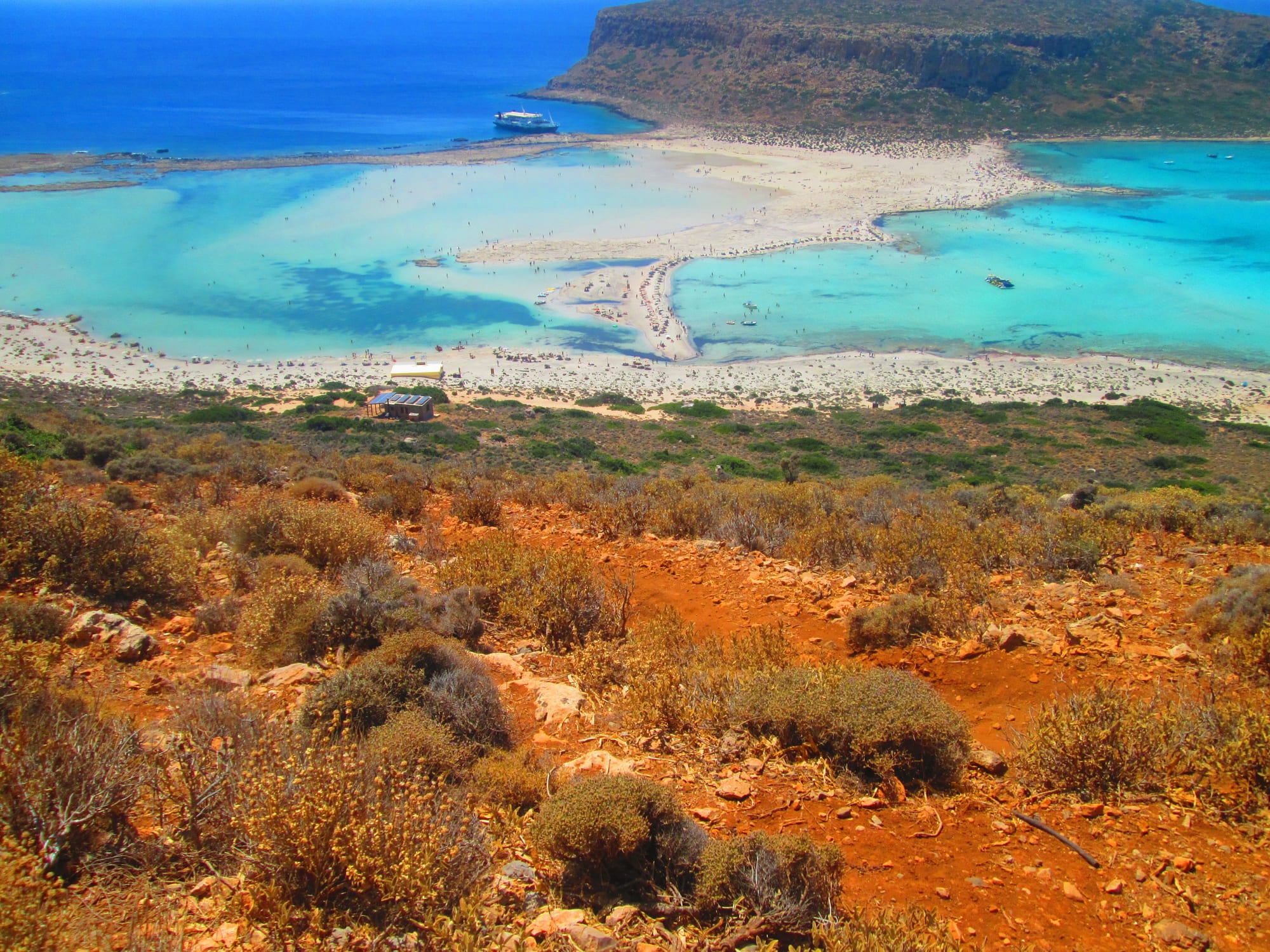
A turquoise lagoon and white sand spit seen from a hillside of red earth and low dry shrubs, with a rocky headland beyond

Greece

Crete

The lagoon and beach of Balos on the Gramvousa peninsula in north-western Crete. (Mwchalmers / Wikimedia Commons · CC BY-SA 4.0)

Greece's largest island, closing off the southern Aegean with a long spine of mountains — the home of Europe's first palace civilisation at Knossos, of Venetian harbour towns at Chania and Rethymno, of deep gorges and lagoon beaches, and of a fiercely independent culture of lyra music, raki and a celebrated island diet.

Explore Crete

History

Crete was the centre of the Minoan civilisation, named by the archaeologist Arthur Evans, who excavated Knossos from 1900. From about 1900 BC the Minoans built palaces at Knossos, Phaistos, Malia and Zakros, painted frescoes of bull-leaping and sea life, and wrote in the Linear A script. After around 1450 BC Mycenaean Greeks took over Knossos, leaving tablets in Linear B. Myth placed the labyrinth of the Minotaur and the birth of Zeus on the island. Under Rome, Gortyn in the Messara plain was capital of a province joining Crete with Cyrenaica in Libya.

Arabs from Andalusia held Crete from the 820s until the Byzantine general Nikephoros Phokas retook it in 961. Venice acquired the island after the Fourth Crusade and ruled for over four centuries from Candia, today's Heraklion. The Cretan Renaissance of the 16th and 17th centuries produced the painter Domenikos Theotokopoulos, El Greco, and the verse romance Erotokritos. The Ottomans took Candia in 1669 after a siege of more than twenty years.

Ottoman rule brought repeated uprisings, the most famous at the Arkadi Monastery in 1866, when defenders blew up the powder store rather than surrender. Crete became an autonomous state in 1898 and joined Greece in 1913, a union championed by Eleftherios Venizelos of Chania, who became Greece's leading statesman. In May 1941 German paratroopers invaded in the Battle of Crete, and the occupation that followed saw a strong resistance and harsh reprisals against villages. Heraklion replaced Chania as capital in 1971.

Culture & Customs

Cretans consider themselves Cretans first. The island has its own dialect, with distinct vocabulary and a softened pronunciation of some consonants, and a strong sense of honour, family and hospitality, felt most keenly in mountain districts such as Sfakia and the villages around Psiloritis.

Music is central. The three-stringed Cretan lyra, played with a bow and backed by the lute, leads the dances, among them the fast pentozali and the syrtos. Singers improvise mantinades, rhyming couplets on love, loss and local rivalries, and the village of Anogeia, home of the singer Nikos Xylouris, is famous for its musicians. Glendia, all-night feasts with music, mark weddings, baptisms and saints' days.

Hospitality usually comes with a glass of raki, the local grape spirit also called tsikoudia, served at the end of a meal with fruit or a sweet. The writer Nikos Kazantzakis of Heraklion, author of Zorba the Greek, gave the wider world its picture of Cretan character, and his grave on the city walls carries the words "I hope for nothing. I fear nothing. I am free."

Daily Life

Crete has about 620,000 people. Heraklion, with around 180,000 in its municipality, is Greece's fourth-largest city and the island's commercial centre; Chania has roughly 110,000 in its municipality, Rethymno about 35,000, and Agios Nikolaos, Ierapetra and Sitia are smaller towns in the east. The University of Crete and technical colleges give Heraklion, Rethymno and Chania a large student population.

Tourism is the main earner, but Crete has a broader economy than most islands. Olive groves cover much of the island, the greenhouses around Ierapetra supply vegetables all year, and wine, cheese and oranges matter too. The Souda Bay naval base near Chania is a major installation of the Hellenic Navy and NATO.

Life is less seasonal than on small islands: towns stay busy all year, and many Cretans keep a village house and family olive trees. Current issues include road safety, water shortages in dry years, over-building on the north coast, a new international airport being built at Kastelli, and housing costs pushed up by holiday lets.

Food

The Cretan diet, rich in olive oil, greens, pulses and cheese, has been studied for its link to long life. The simplest dish is dakos, a barley rusk softened with grated tomato, olive oil and crumbled mizithra, a soft white cheese. Kalitsounia are small pies of fresh cheese or greens, sometimes flavoured with herbs; Sfakiani pita is a thin pancake filled with cheese and drizzled with honey.

Meat is often lamb or goat, roasted or cooked with wild greens, and gamopilafo, a rich rice cooked in goat and rooster broth, is served at weddings. Chochlioi boubouristi are snails fried in oil with vinegar and rosemary. Apaki, cured pork, and staka, sheep's-milk cream cooked with flour and served with eggs, are Cretan specialities. Graviera Kritis, a hard sweet cheese, is the island's most famous.

Olive oil runs through all of this cooking. Crete makes about a fifth of Greece's wine, mostly around Peza, from local grapes such as the white Vidiano and the red Liatiko. Raki ends every meal, and thyme honey with yoghurt is a common dessert.

Attractions & Natural Wonders

Heraklion's Archaeological Museum holds the finest Minoan collection anywhere, including the frescoes of Knossos and the Phaistos Disc. The city keeps its Venetian walls, the Koules harbour fortress and the Morosini fountain, and Knossos lies about five kilometres south. The Messara plain has the palace of Phaistos, Roman Gortyn and the rock-cut caves above the beach at Matala, and the palace of Malia lies on the coast east of the city. Mount Psiloritis, the island's highest peak, rises inland, with the Idaean Cave.

Chania's Venetian harbour, lighthouse and old town are the most photographed in Crete. To the west lie the lagoon of Balos on the Gramvousa peninsula, the long beach at Falasarna and, in the far south-west, Elafonisi with its shallow water and pink-tinged sand. The Samaria Gorge crosses the Samaria National Park in the White Mountains from Xyloskalo to Agia Roumeli, from where boats continue to Loutro and Chora Sfakion; the Venetian castle of Frangokastello stands nearby.

Rethymno has the Fortezza and the Venetian Loggia in its old town, with the Arkadi Monastery in the hills and Preveli's palm-lined beach to the south. In the east, Agios Nikolaos sits around Lake Voulismeni on the Mirabello Bay, close to Elounda, the island fortress of Spinalonga, the frescoed church of Panagia Kera at Kritsa and the windmill-dotted Lasithi Plateau with the Dikteon Cave. The Vai palm forest lies at the island's eastern tip.

Cities in Crete

Planning basics

Budget

Crete is a little cheaper than the Cyclades and more varied in price. The big resort hotels of the north coast and the Elounda luxury strip are expensive, but Heraklion, Rethymno, the south-coast villages and the mountain interior offer good-value rooms and tavernas. A hire car is the main extra, as the island is large and much of it lies away from bus routes.

Daily Budget Midrange
USD 130–250 (mid-range hotel, taverna dinners, a hire car, site tickets)
Daily Budget Shoestring
USD 55–90 (domatia room or hostel, taverna and bakery meals, KTEL buses)

Base the trip in two or three places rather than one, as crossing the island takes hours; village tavernas inland are markedly cheaper than harbour-front ones.

Safety

Crete is safe for visitors, but its roads are among the most dangerous in Greece: the north-coast highway is narrow in parts and driven fast, and mountain roads are steep and winding. Heat exhaustion and injuries on gorge walks, strong currents on exposed beaches and occasional flash floods after heavy rain are the other risks. The island is seismically active.

Drive defensively, start gorge walks early with plenty of water and proper shoes, and heed closures for wind or flooding. Check current official travel advice before travelling.

Climate

The southernmost and warmest part of Greece, with long dry summers and mild winters on the coasts. The south coast, facing Africa, is the hottest and driest, and hot southerly winds can bring dust. The mountains are a different climate: the White Mountains, Psiloritis and the Lasithi plateau see snow from December to March, sometimes later on the peaks.

Summer
hot and dry, 28–35°C on the coast, cooler in the mountain villages
Winter
mild and wet on the coasts, 10–16°C; snow on the high mountains

Transportation

Heraklion and Chania airports handle most arrivals, and overnight ferries link Heraklion and Chania's port at Souda with Piraeus, with fast summer boats to Santorini. KTEL buses run often along the north-coast highway between Chania, Rethymno, Heraklion and Agios Nikolaos, less often to the south coast. Parts of the south coast, including Agia Roumeli and Loutro, are reached only by boat or on foot.

Hire a car to see the south coast and the mountains, and plan the Samaria walk with the return boat and bus in mind, or join an organised trip.

Best Time to Visit

April to June for wildflowers, green hills and comfortable walking, and September to October for a warm sea and the grape and olive harvest. July and August are hot and crowded on the north coast. The Samaria Gorge normally opens from around May to October, depending on the weather. In winter the cities stay lively, though many resorts close.