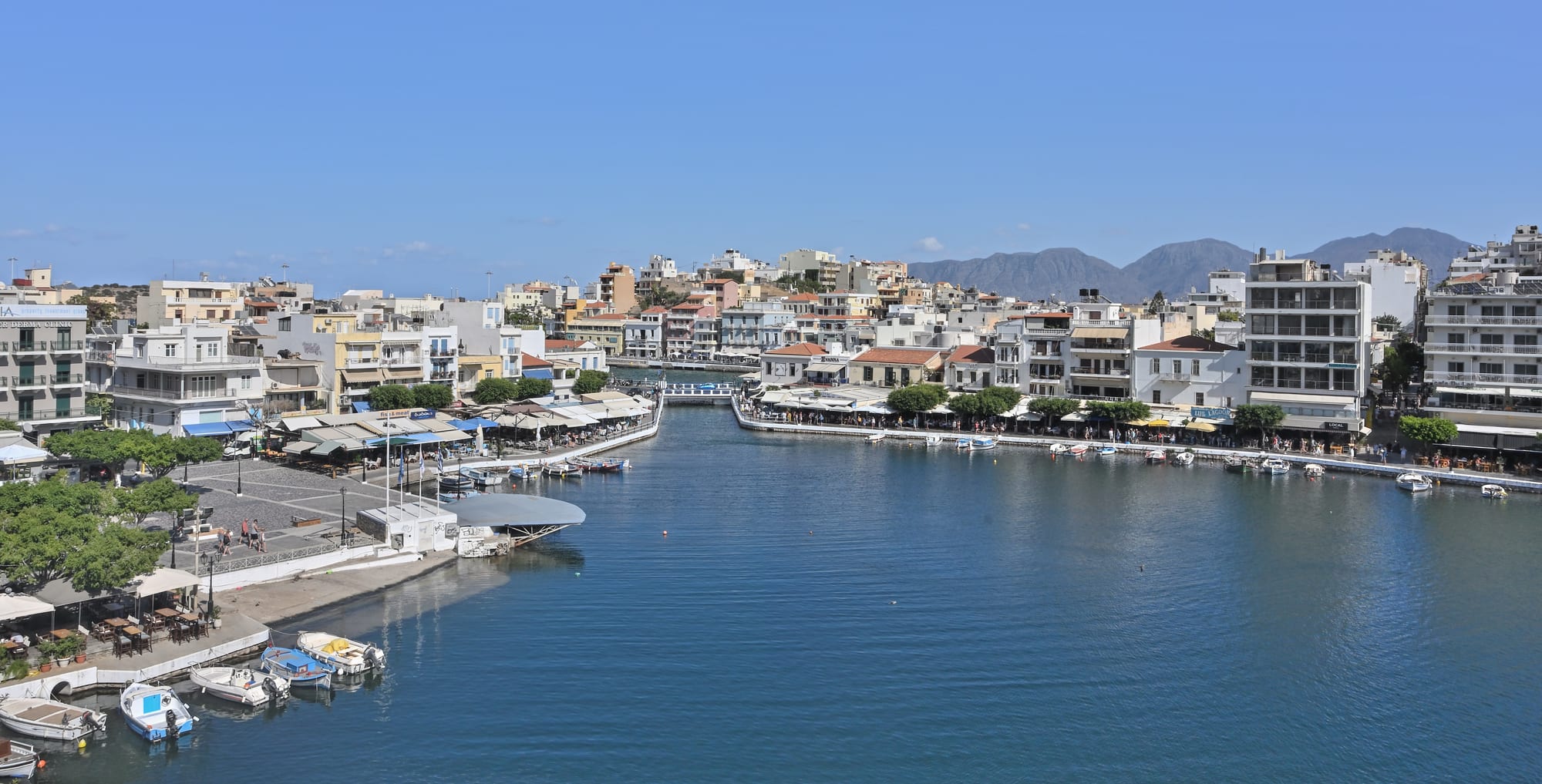
A round blue lagoon ringed by small boats, café awnings and white apartment blocks, with bare mountains behind

Crete, Greece

Agios Nikolaos

Lake Voulismeni in the centre of Agios Nikolaos, with the channel to the harbour in the background. (Cayambe / Wikimedia Commons · CC BY-SA 4.0)

The capital of the Lasithi regional unit in eastern Crete, a small harbour town on the western shore of the Mirabello Bay built around Lake Voulismeni, a deep circular lagoon joined to the sea by a channel. Refounded in the 19th century on the site of ancient Lato pros Kamara, it became a resort in the 1960s and is the base for Spinalonga, Kritsa and the Lasithi Plateau.

Neighbourhoods

  • Lake Voulismeni and the harbour
    • First-time visitors
    • Cafés
    • Close to the buses

    The heart of the town: the circular lagoon, lined with cafés, fishing boats and a small amphitheatre, and the channel that links it to the harbour. A park of pines and tamarisks above the lake gives a view over the town.

    Open in Maps
  • Kitroplatia and the seafront
    • Best for food
    • Town beach
    • Evening walks

    A small square with a little beach, named after the citron trade — its deep water let merchant caiques load here before the town had a harbour. A stone-paved promenade follows the shore from here to the municipal marina, past tavernas and cafés.

    Open in Maps
  • Ammoudi and the north shore
    • Beaches
    • Quieter stays

    The coast running north from the harbour towards Elounda, with small beaches and the Ammoudi peninsula, about two kilometres north of the centre, where the 9th-century Byzantine chapel of Saint Nicholas gave the town its name.

    Open in Maps
  • Almyros
    • Beaches
    • Families

    A long sandy beach about a 20-minute walk from the centre, where a cold-water stream enters the sea at the southern end. Studios and apartments stand close by.

    Open in Maps

Things to do

In the town

  • Lake Voulismenilandmark

    A formerly freshwater lake about 137 metres across and nearly 49 metres deep, formed in a collapsed sinkhole on a fault line and joined to the harbour by a channel first cut between 1867 and 1871 and widened to its present form by the French Army in 1905–1907.

    Open in Maps
  • Archaeological Museum of Agios Nikolaosmuseum

    The museum of eastern Crete's archaeology, whose collection was founded in 1969; its building reopened in 2024 after an extensive renovation.

    Open in Maps
  • Kitroplatiabeach

    The small town beach and square at the start of the seafront promenade to the marina.

    Open in Maps
  • The Rape of Europa statuelandmark

    A four-metre statue of hand-forged bronze, steel and glass on the new pier of the harbour, designed by the film director Nikos Koundouros and made by the sculptors Nikos and Pantelis Sotiriadis.

    Open in Maps

Short trips from the town

  • Spinalongalandmark

    A Venetian island fortress in the Gulf of Elounda that served as a leper colony from 1904 to 1957, now one of the most visited sites in Crete; boats run from Agios Nikolaos, Elounda and Plaka.

    Open in Maps
  • Eloundaneighborhood

    A small resort town to the north, known for its seaside luxury resorts and for the remains of ancient Olous, partly sunk beneath the bay.

    Open in Maps
  • Kritsaneighborhood

    A hill village about 10 kilometres from the town, built in tiers on a rocky hill among olive groves and destroyed many times for its part in Crete's revolutions.

    Open in Maps
  • Church of Panagia Keralandmark

    A Byzantine church about a kilometre from Kritsa, holding the best-preserved Byzantine-era frescoes in Crete.

    Open in Maps
  • Latolandmark

    The ruins of a Dorian hill city about three kilometres from Kritsa, whose harbour, Lato pros Kamara, lay where Agios Nikolaos stands today.

    Open in Maps
  • Gournialandmark

    A Minoan town and palace complex just inland from the north coast, inhabited from around 2650 BC until about 1470 BC, named after the many stone troughs found on the site.

    Open in Maps
  • Lasithi Plateaupark

    A high enclosed plateau in the mountains, famous for the white-sailed wind-pumps that have irrigated its fields since the 1920s.

    Open in Maps
  • Psychro Cavelandmark

    A Minoan sacred cave on the Lasithi Plateau, linked by some scholars with Dikte, the mountain where ancient writers placed the infancy of Zeus.

    Open in Maps

Seasonal events

  • Easter midnight by the lakeOrthodox Easter, March, April or May

    At midnight as Orthodox Easter Day begins, much of the town gathers around Lake Voulismeni for fireworks and firecrackers.

  • Raki distilling seasonlate October and early November

    In the villages around the town, licensed distillers turn the pomace left from the grape harvest into tsikoudia, the pomace brandy that eastern Cretans often call raki.

Eat and drink

Long-standing places and food districts in Agios Nikolaos. Hours, ratings and directions come from your maps app, always current.

Agios Nikolaos classics

  • Cafés around the lakeneighborhood

    The ring of cafés and restaurants around Lake Voulismeni and along the channel, the town's main place to sit over coffee or an evening drink.

    Open in Maps
  • Kitroplatia tavernasneighborhood

    Meze restaurants and tavernas around the small square and beach of Kitroplatia and along the seafront towards the marina.

    Open in Maps

Markets and nights out

  • Wednesday marketmarket

    A weekly morning market of locally grown fruit and vegetables, known for its tomatoes, with thyme honey among the local produce.

    Open in Maps
  • 25 Martiou Streetneighborhood

    A street of Greek bars that fills with local students at weekends, playing modern Greek music rather than catering to tourists.

    Open in Maps

Experience Agios Nikolaos

History

The town stands on the site of Lato pros Kamara, the harbour of the Dorian hill city of Lato near Kritsa. When the security of the hillfort mattered less than easy access to the sea, its people moved down to the coast, and by the 3rd century BC the two towns formed one administrative unit, worshipped the same goddess, Eileithyia, and shared a coinage. The harbour town grew as Lato declined, leaving an extensive Roman cemetery, and in the early Byzantine period it was the seat of the bishopric of Kamara.

Early in the 13th century, perhaps in 1206, a fortress was built on the hill where the regional government offices now stand, probably by the Genoese Enrico Pescatore. Named Mirabello, it gave its name to the province and the bay. The Venetians rebuilt it after an earthquake in 1303 and again after pirates destroyed it in 1537. In 1646, during the long war for Crete, its commander surrendered it to the Ottomans at once; the Venetians retook it but destroyed it, as Spinalonga met their needs. Under Ottoman rule the place emptied, though its harbour still shipped carobs from the province.

The modern town was founded during the revolution of 1866 by settlers from Fourni, Kritsa, Heraklion and Sfakia, who used the ruins of the fortress as building stone. First called Mantraki, it took its present name from a small 9th-century Byzantine chapel of Saint Nicholas on the Ammoudi peninsula. In 1904 the capital of the Lasithi prefecture moved here from Neapoli, and between 1905 and 1907 the French Army built the wider channel that now joins the lake to the harbour. The population grew from about 1,100 in 1928 to more than 8,000 in 1981, and from the 1960s the town grew rapidly as a resort.

Culture & Customs

The town's best-known moment of the year comes at Orthodox Easter. As midnight turns to Easter Day, most of the population gathers around Lake Voulismeni — to locals simply "the Lake" — for fireworks and firecrackers. The lake has gathered legends of its own: an ancient story has the goddesses Athena and Artemis bathing in it, and modern ones claim it has no bottom or is connected to the volcano of Santorini. Cliff-diving competitions with athletes from several countries have been held at the lake in recent years.

The cinema left a mark here. In the 1960s directors including Jules Dassin and the Disney studio came to film, and productions shot in and around the town include He Who Must Die, The Moon-Spinners and the BBC series The Lotus Eaters; Daphne du Maurier set her story Not After Midnight here. The film director Nikos Koundouros, who lived in the town, designed the four-metre Rape of Europa statue on the harbour pier, made by the local sculptors Nikos and Pantelis Sotiriadis, who also made the Horn of Amalthea sculpture facing the bay and the islet of Agioi Pantes.

Local identity is strongly Cretan. People in the surrounding villages still call the town Gialos, "the shore". The steep stairways between the seafront and the upper streets are a feature in themselves, several designed by local architects and many painted with motifs. Sport is organised through town clubs for football, basketball, cycling, tennis and sailing, and sailing races are held from the municipal marina.

Daily Life

At the 2021 census the town had between about 12,100 and 13,600 people by different counts, and the wider municipality about 27,800, which takes in Elounda, Kritsa, Neapoli and many smaller villages. As the capital of the Lasithi regional unit, Agios Nikolaos holds the administrative offices of Lasithi and serves as the hub for the twenty or so villages and farms around it, which keeps it busy outside the holiday season.

Tourism is the main source of income, alongside olive growing and free-range livestock farming. Most foreign visitors come from western Europe, with Greek holidaymakers concentrated in mid-August; the luxury resorts of Elounda, a short drive north, add to the area's employment. A department of the Hellenic Mediterranean University now teaches tourism courses in the town, and on weekend nights students fill the bars of 25 Martiou Street.

The town is built on five hills beside the mouth of the Xeropotamos stream, and much of daily life happens on the level ground between them: around the lake, along the harbour and on the seafront promenade to the marina. The Wednesday morning market brings produce in from the countryside, and the town's many small beaches are regularly certified for cleanliness and facilities.

Food

The food here is Cretan, built on plants, olive oil, pulses and wild herbs, with meat traditionally playing a smaller part and yoghurt with fresh fruit the usual dessert. Dakos is the classic starter: a slice of soaked paximadi, a hard barley rusk, topped with tomato and cheese such as mizithra or feta, flavoured with oregano and often finished with olives or capers. Kalitsounia are small pies of fresh mizithra cheese or herbs, baked or fried, and sometimes sweet with honey poured over them; sarikopita is a cheese pie twisted into the shape of the sariki, a traditional Cretan headscarf.

Snails are a Cretan speciality — chochlioi boubouristi are fried with rosemary and vinegar, and they are also cooked with tomato — and Cretan wine accompanies meals. The weekly market is known for its tomatoes, and the local thyme honey takes its flavour from the thyme the bees feed on. Kitroplatia's meze restaurants and the cafés around the lake are where visitors and residents eat out.

Meals often end with tsikoudia, which in eastern Crete is often called raki: a strong brandy distilled from the grape pomace left after winemaking, usually made in the villages in late October and early November, served chilled from the freezer and often offered free at the end of a meal.

Planning tools

Budget

Agios Nikolaos is a mid-priced town by Cretan standards, with apartments, studios and small hotels in and around the centre and a youth hostel. The luxury resorts of nearby Elounda are far more expensive. A hire car adds to the bill but makes the hill villages and the Lasithi Plateau much easier to reach; local buses and taxis cover the coast.

Daily Budget Midrange
USD 130–250 (mid-range hotel, taverna dinners, a hire car, site tickets and a boat trip)
Daily Budget Shoestring
USD 55–90 (hostel bed or studio room, bakery and taverna meals, local buses)

Lakeside and harbour-front tables cost more than tavernas a street or two back or in the inland villages; the lake, the seafront promenade and the town beaches are free.

Best Time to Visit

April to June and September to October are the most comfortable months, with warm days and fewer visitors. July and August are hot and busy, and Greek holidaymakers arrive in mid-August. Orthodox Easter brings the midnight celebration at the lake. In winter the town stays lived-in as the capital of its regional unit, though many resort businesses close.

Suggested Number of Days

Two or three days are enough for the town itself. Most visitors use it as a base for eastern Crete, and a week allows time for the islands, villages, archaeological sites and the mountains around the bay. A hire car shortens the time needed for the inland trips.

First Visit
2–3 days
With Surroundings
5–7 days

Transportation

The centre is small and walkable. Local buses serve the town, and KTEL buses run along the north-coast highway towards Heraklion, Malia and Hersonissos, and out to Elounda, Kritsa and Sitia. Taxis are plentiful, and cars and scooters can be hired in town. Boat trips leave the harbour for Spinalonga and along the coast.

Crash helmets are compulsory on scooters; avoid hiring quad bikes, which are not designed for the road and are involved in many accidents.

Airport & Station Connections

Most visitors arrive through Heraklion International Airport, about 64 kilometres away — roughly 45 minutes to an hour by car or taxi — or on the overnight ferries to Heraklion's port, continuing by KTEL bus from the main bus station near the port. Sitia Airport, about 67 kilometres east, has some domestic and charter flights. A new airport at Kasteli, south-east of Heraklion, is due to replace Heraklion's by 2027.

Walkability

The town is compact: the lake, harbour, Kitroplatia and the marina are all within a short walk of each other, linked by the seafront promenade. It is built on and around five hills, so many streets climb steeply, with stairways — some decorated with painted motifs — leading up from the seafront to the centre. Almyros beach is about 20 minutes on foot.

Safety

Greece is a safe country for visitors, with low levels of violent crime. In and around Agios Nikolaos the main risks are on the roads — fast stretches of the coast highway, steep mountain roads and hired quad bikes and scooters — along with summer heat and strong currents off exposed beaches when the wind is up.

Drive defensively, wear a helmet on any scooter, carry water on walks to the archaeological sites in summer, and choose a sheltered pebble beach on windy days. Check current official travel advice before travelling.

Climate

A hot-summer Mediterranean climate, with hot, dry summers and very mild, rainy winters. The mountains inland, including the Lasithi Plateau, are harsher winters, with snow that can last into spring.

Summer
hot and dry — in nearby Heraklion summer maximums are usually no more than 28–30°C, cooled by the sea
Winter
very mild and rainy — in nearby Heraklion the port has never recorded a temperature below 1.4°C — with snow on the high mountains

Local Customs

Agios Nikolaos is a working Cretan town as well as a resort, and hospitality often ends with a glass of raki, served chilled and on the house after a meal. Tipping is not traditional, though diners often leave a few coins or a euro or two on the table for good service. The biggest local gathering of the year is the Easter midnight celebration at the lake.

Churches and monasteries, such as Panagia Kera near Kritsa, may ask for covered shoulders and knees; in museums, obey signs restricting photography.

Common Payment Methods

The currency is the euro. Cards are widely accepted in shops, hotels and travel agencies, and ATMs are easy to find, but some restaurants, very small guesthouses and petrol stations take only cash, so a small amount is useful for trips inland.