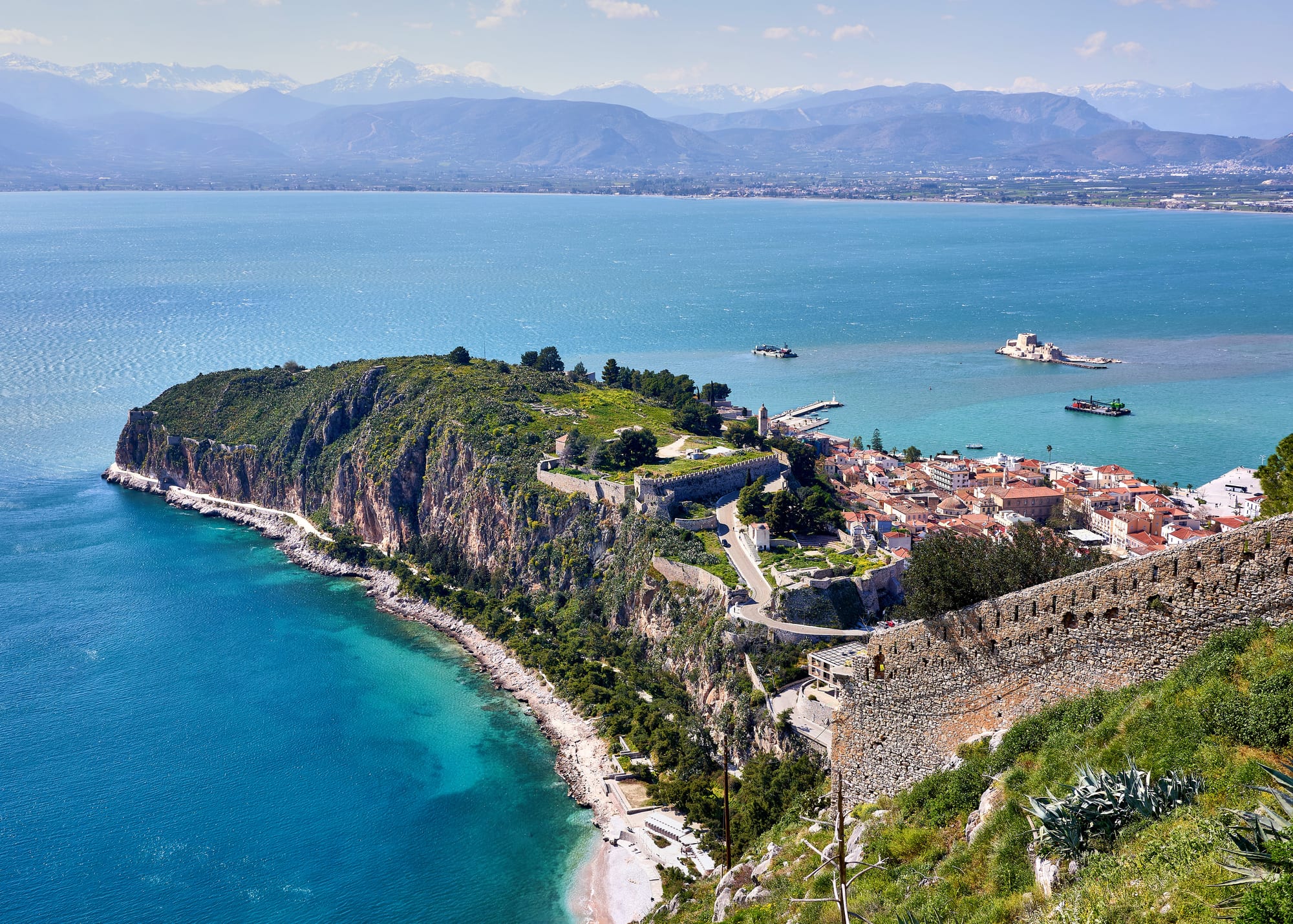
Old town of Nafplio on a green rocky headland, with a stone fortress wall in front and the Bourtzi islet castle in the turquoise gulf

The Peloponnese & Western Greece, Greece

Nafplio

The Acronauplia and the old town of Nafplio seen from Palamidi, with the castle of Bourtzi in the bay. (George E. Koronaios / Wikimedia Commons · CC0)

A harbour town on the Argolic Gulf, its old quarter packed onto a rocky peninsula beneath the Acronauplia and the Venetian fortress of Palamidi. Fought over by Franks, Venetians and Ottomans, it was the first capital of modern Greece from 1827 to 1834. Today it is the capital of Argolis and one of the country's favourite weekend escapes from Athens.

Neighbourhoods

  • The old town
    • First-time visitors
    • Historic district
    • Best for food

    The whole peninsula below the Acronauplia, a grid of lanes with colourful Venetian-influenced houses and neoclassical mansions around the large Syntagma Square. All the major sights are within a fifteen-minute walk of each other.

    Open in Maps
  • Psaromachalas
    • Quiet and residential
    • Atmosphere

    The old fishermen's quarter tucked under the rock of the Acronauplia, a small cluster of lanes that is worth a short detour from the busier streets below.

    Open in Maps
  • The harbour front
    • Evening strolls
    • Views

    The seafront along the northern edge of the old town, from the port to Philellinon Square, with the old customs house, cafés and the view out to the castle of Bourtzi.

    Open in Maps
  • Pronoia and the new town
    • Local life
    • Close to public transport

    The modern town spreading north and east of the peninsula, where most residents live. Pronoia was laid out by the planner Stamatis Voulgaris, and the KTEL bus station sits at the edge of the old town.

    Open in Maps
  • Arvanitia and Karathona
    • Beaches

    The beaches south of the castles: Arvanitia, about ten minutes' walk from the town, and the quiet sandy bay of Karathona just south of Palamidi's hill.

    Open in Maps

Things to do

Fortresses

  • Palamidilandmark

    A Venetian baroque fortress of eight bastions on a 216-metre hill, built in 1711–14 and taken by the Greeks in 1822; it is reached by a long stairway of several hundred steps or by road.

    Open in Maps
  • Acronauplialandmark

    The oldest part of the town, a walled rock that was a town in its own right until the 13th century, later fortified by the Franks and Venetians and for a time used as a prison.

    Open in Maps
  • Bourtzi Castlelandmark

    A small Venetian water castle on an islet in the middle of the harbour, its first part built around 1400.

    Open in Maps

Museums and monuments

  • Archaeological Museum of Nafpliomuseum

    Finds from southern Argolis from the Neolithic to the Roman period, in the old Venetian barracks on Syntagma Square; the exhibits include the Mycenaean bronze armour found at Dendra.

    Open in Maps
  • Peloponnesian Folklore Foundationmuseum

    A museum of Greek costume and folk culture founded in 1974 by the costume designer Ioanna Papantoniou.

    Open in Maps
  • Vouleftikolandmark

    An Ottoman mosque finished around 1810–20 that briefly housed the first parliament of the provisional Greek government, hence its name; it is now used for cultural events.

    Open in Maps
  • Church of Agios Spyridonlandmark

    The church of 1702 on whose steps Ioannis Kapodistrias, the first head of state of independent Greece, was assassinated in 1831; the mark of a bullet is still pointed out.

    Open in Maps
  • Komboloi Museummuseum

    A private collection of about 1,500 komboloi, the strings of worry beads used to pass the time in Greece, with a workshop where old ones are repaired.

    Open in Maps
  • War Museummuseum

    A military museum in the building that housed Greece's first military school.

    Open in Maps

Beaches and walks

  • Arvanitia beachbeach

    The town beach behind the castles, about ten minutes' walk south of the centre.

    Open in Maps
  • Karathona beachbeach

    A quiet sandy beach just south of Palamidi's hill, linked to Arvanitia by a coastal path.

    Open in Maps

Short trips from the town

  • Tirynslandmark

    A Mycenaean citadel with massive 'Cyclopean' walls on the plain just outside the town, close enough to reach on foot or by bicycle.

    Open in Maps
  • Mycenaelandmark

    The Bronze Age citadel of Agamemnon's legend, with the Lion Gate and the royal grave circles, on a hill above the Argive plain.

    Open in Maps
  • Ancient Theatre of Epidauruslandmark

    A late 4th-century-BC theatre in the sanctuary of Asclepius, famed for its acoustics and still used for drama in summer.

    Open in Maps
  • Toloattraction

    A coastal village on the bay of Tolo, part of the Argolic Gulf, in the municipal unit of Asini.

    Open in Maps

Seasonal events

  • Carnivalthe weeks before Lent, February or March

    Costumed parades, music and events in the streets, with masquerade parades.

  • EasterMarch, April or May

    The most important festival of the Orthodox year, marked across the town's churches.

  • Nafplio Festivallate June

    A week of classical music concerts held in the town's historic buildings and castles.

  • Athens Epidaurus Festivalweekends in July and August

    Performances of ancient Greek tragedy and comedy in the ancient theatre of Epidaurus, a short drive from the town.

Eat and drink

Long-standing places and food districts in Nafplio. Hours, ratings and directions come from your maps app, always current.

Nafplio classics

  • Tavernas of Staikopoulou Streetneighborhood

    The old town street where many of the tavernas are concentrated, serving regional dishes such as bogana, lamb with potatoes.

    Open in Maps
  • Portokalopitacafe

    An orange cake soaked in syrup and usually eaten with coffee; oranges are grown on the irrigated plain around the town.

    Open in Maps

Cafés and the waterfront

  • The harbour promenadeneighborhood

    Cafés and restaurants line the streets near the promenade, looking out over the harbour to Bourtzi.

    Open in Maps
  • Ice cream in the old towncafe

    Locally made ice cream is one of the town's traditions, sold in shops across the old town.

    Open in Maps

Experience Nafplio

History

Nafplio was the ancient port of Argos, built on a rocky peninsula joined to the mainland by a narrow isthmus, and it may appear on an Egyptian list of the 14th century BC. Legend named it after Nauplius, son of Poseidon, though Strabo thought the name came from its harbour. Conquered by Argos around the time of the Second Messenian War, it was deserted by the 2nd century AD. The Acronauplia, whose walls go back to pre-classical times, was a town in its own right until the 13th century.

French crusaders took Nafplio in 1212, and it became part of the lordship of Argos and Nauplia, sold to Venice in 1388. As Napoli di Romania it was one of Venice's key places in the Levant: the lower town was expanded and fortified, and it held off Ottoman sieges by Mehmed the Conqueror and Suleiman the Magnificent before surrendering in 1540. The Ottomans called it Mora Yenişehir. Venice returned in 1685, made it the capital of its Kingdom of the Morea and built Palamidi in 1711–14, but the town fell back to the Ottomans in 1715.

In the War of Independence Nafplio was a major Ottoman stronghold, besieged for more than a year until starvation forced its surrender in 1822. Its walls made it the seat of the provisional government. Ioannis Kapodistrias, the first head of state, landed here in January 1828 and made it the capital, and was assassinated on the steps of the church of Agios Spyridon in October 1831. King Otto ruled from Nafplio until the capital moved to Athens in 1834. After the Greek Civil War the town became one of the first places on the mainland to develop mass tourism, and its old buildings survived the post-war rush to replace them with apartment blocks.

Culture & Customs

Nafplio's identity rests on its role in the birth of modern Greece. Statues of Kapodistrias, King Otto and Theodoros Kolokotronis stand around the town, the former mosque on Syntagma Square is still known as the Vouleftiko, the parliament house, and the War Museum occupies the building of the country's first military school. The old town keeps a distinct architecture of colourful, Venetian-influenced houses beside neoclassical and eclectic buildings, and its branch of the National Bank of Greece is the only example of Mycenaean Revival architecture.

The town is also a small cultural centre. The University of the Peloponnese has a School of Fine Arts here, with a theatre department, the Peloponnesian Folklore Foundation studies and displays Greek costume, and the Nafplio Festival brings a week of classical music to the castles and historic buildings each June. The Komboloi Museum celebrates the strings of worry beads that Greeks turn in their hands to pass the time. Carnival is celebrated with masquerade parades.

Life in the old town is lived outdoors and on foot. In the evenings families, couples and groups of friends stroll the harbour front and the lanes, and the town is known as the place Athenians come for a weekend or a day out. Churches expect modest dress, and the Orthodox calendar, above all Easter, shapes the year.

Daily Life

About 14,500 people lived in Nafplio at the 2021 census; the wider municipality, formed in 2011, also takes in Asini, Midea and Nea Tiryntha. The town is the capital of the regional unit of Argolis, and much of its population lives in the modern districts that spread north and east of the old peninsula, on land that has nearly doubled in area since landfill projects began in the 1970s.

Tourism is the main business, with visitors coming all year, most of them from Athens and other Greek cities, followed by Germans, French, Scandinavians and others. Farming matters almost as much: the town is surrounded by a fertile irrigated plain that grows oranges, lemons, peaches, apricots, olives and almonds. The port is too shallow for much besides bulk cargo, but fills with yachts in summer, and there is no industry of note.

Weekends and weekdays feel very different. On Friday and Saturday nights the old town fills with visitors from the capital, while midweek and in winter it returns to a provincial rhythm of offices, schools and cafés. The suspension of the railway in 2011, during the financial crisis, left the town dependent on roads and buses.

Food

Nafplio's own specialities come from the kitchens of the Argolid. Among them are gogges and striftades, two kinds of local pasta, the second made by hand; giosa, made with lamb or goat; bogana, lamb with potatoes; and dishes of ankinares, artichokes. Many of the town's tavernas line Staikopoulou Street in the old town and the streets near the promenade.

Oranges are the produce of the plain, and portokalopita, an orange cake soaked in syrup and usually eaten with coffee, is a local favourite; oranges and olives are the main crops of Argolis. The town is also known for its locally made ice cream, sold in shops across the old town and eaten on evening walks along the harbour.

Beyond the local dishes, the tables are those of all Greece: meze, small dishes shared and often taken with ouzo or tsipouro; grilled souvlaki; and horiatiki, the Greek salad of tomatoes, cucumbers, onion, feta and olives dressed with oregano, lemon juice and olive oil. Wine comes from Nemea, elsewhere in the region.

Planning tools

Budget

Nafplio is cheaper than Athens but one of the dearer places in the Peloponnese at weekends, when Athenians fill its guesthouses. Midweek and out of season, prices fall noticeably. The costs that add up are site tickets for Palamidi, Mycenae, Epidaurus and Tiryns and, for the surrounding sites, a hire car or coach fares.

Daily Budget Midrange
USD 120–230 (guesthouse in the old town, taverna dinners, site tickets, a hire car for Mycenae and Epidaurus)
Daily Budget Shoestring
USD 60–95 (simple room or nearby campsite, bakery and grill-house meals, KTEL buses)

Visit midweek, when the weekenders from Athens have gone home and room prices drop.

Best Time to Visit

April to June and September to October are best for walking the town and the shadeless sites nearby. July and August are hot and busy but bring the Epidaurus theatre season. The town's mild climate and closeness to Athens make it a year-round destination, and winter weekends are lively with Greek visitors.

Suggested Number of Days

Two days cover the town and its fortresses. Four or five allow time for the ancient sites of the Argolid and the beaches along the coast; relying on buses rather than a car adds time.

First Visit
2 days
With Surroundings
4–5 days

Transportation

The old town is best on foot. KTEL Argolida buses, running since 1952, serve the towns and villages of the region. A car is the easiest way to combine the outlying sites. Rail services to Nafplio were suspended in 2011.

Leave the car in the large harbour car park and walk into the old town, where streets are narrow and parking is scarce.

Airport & Station Connections

Nafplio is about 147 km from Athens, roughly one and a half to two hours by car on the motorway. KTEL coaches leave Athens' Kifissos terminal several times a day and take about two hours to two hours and twenty minutes via Corinth and Argos; from Athens airport, the X93 bus links to the Kifissos terminal. There is no passenger train; the nearest station is at Corinth.

Walkability

Very walkable: the old town can be crossed in under fifteen minutes on flat, orderly streets. The climbs are the exceptions — the long stairway to Palamidi and the slopes of the Acronauplia — and the beaches south of the castles are a short walk away.

Safety

Greece is a safe country for visitors, with low levels of violent crime. Nafplio is a quiet town and safe to walk at night. The real hazards are summer heat, especially on the long stairway to Palamidi and at shadeless sites such as Mycenae, and wildfires in the countryside in summer.

Climb Palamidi and visit the ancient sites early in the day in summer, with water and a hat, and obey wildfire road closures and the 112 alerts sent to mobile phones. Check current official travel advice before travelling.

Climate

A Mediterranean climate with hot, dry summers and mild, damp winters. Rainfall in nearby Argos varies widely from year to year, and sunshine is frequent all year.

Summer
hot and dry; nearby Argos, just inland, is among the hottest towns in Greece in summer, and in 2023 heatwave temperatures in mainland Greece reached 45°C
Winter
mild and damp, though some winter months see little rain; in nearby Argos, temperatures below 0°C come mostly at night

Local Customs

The town is Greek Orthodox, and churches expect modest dress, with shoulders and knees covered. A handshake with eye contact is the usual greeting, and older people are addressed as Kyrios or Kyria. Name days are celebrated, often more than birthdays, with a wish of 'chronia polla'.

Accept food or drink when it is offered, since a flat refusal can seem rude, and remember that an upward tilt of the head means 'no'. Look for signs or ask before photographing inside churches.

Common Payment Methods

Greece uses the euro. Cards are accepted almost everywhere after reforms to curb tax evasion, though kiosks and some small tavernas still prefer cash. ATMs are easy to find in the old town and the new town.