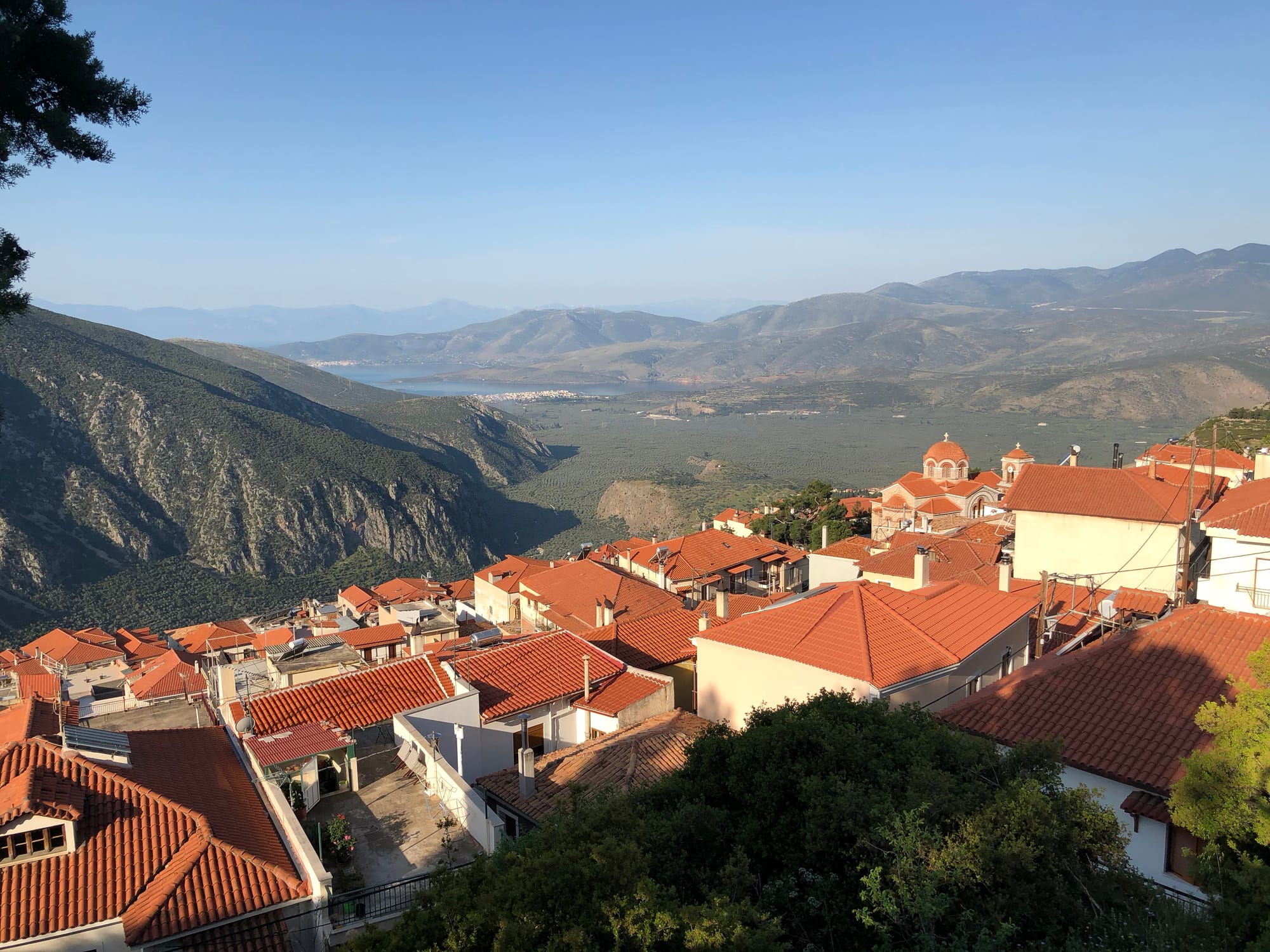
Red-tiled roofs of Delphi village with a domed church, above a valley of olive groves running to a bay between mountains

Athens, Delphi & Central Greece, Greece

Delphi

The village of Delphi, looking down over the olive groves towards the Gulf of Corinth. (Davide Mauro / Wikimedia Commons · CC BY-SA 4.0)

A village on the south-western slope of Mount Parnassus, beside the ruins of the sanctuary where Apollo's oracle was consulted for centuries. The modern village was built after the old one was moved off the ancient site for excavation; today it lives on visitors to the UNESCO-listed sanctuary and its museum, above a valley of olive groves running to the Gulf of Corinth.

Neighbourhoods

  • The village
    • Places to stay
    • Views
    • Tavernas

    The modern village, built after the old one was moved off the ancient site, strung along the mountainside. Its shops, cafés and tavernas serve visitors to the site, and many rooms look down over the olive groves to Itea and the Gulf of Corinth.

    Open in Maps
  • The archaeological zone
    • First-time visitors
    • Historic district

    The sanctuary of Apollo, the Castalian Spring and the lower precinct of Athena Pronaia, spread along the road east of the village beneath the Phaedriades cliffs. The museum and the site are both within walking distance of the village.

    Open in Maps

Things to do

The ancient sanctuary

  • Temple of Apollolandmark

    The ruined temple where the Pythia, Apollo's priestess, gave the oracle's answers, reached up the Sacred Way past the treasuries of the Greek city-states.

    Open in Maps
  • Treasury of the Athenianslandmark

    A small marble building on the Sacred Way, said to have been paid for from the spoils of Marathon, which French archaeologists rebuilt from its original blocks in 1903–06.

    Open in Maps
  • Theatre of Delphilandmark

    The ancient theatre of the sanctuary, built against the mountain slope, which held about 4,500 spectators and in the late Hellenistic and Roman periods staged the vocal and musical contests of the Pythian Games.

    Open in Maps
  • Stadium of Delphilandmark

    The stadium of the Pythian Games, higher up the hill beyond the Sacred Way and the theatre.

    Open in Maps
  • Castalian Springlandmark

    The sacred spring in the ravine between the Phaedriades cliffs, where visitors purified themselves before consulting the oracle.

    Open in Maps
  • Sanctuary of Athena Pronaia and the Tholoslandmark

    The lower precinct of Athena Pronaia, with the remains of the circular tholos, built between 380 and 360 BC.

    Open in Maps

Museum

  • Delphi Archaeological Museummuseum

    The finds of the sanctuary, including the bronze Charioteer of Delphi, the Sphinx of Naxos, the statues of Kleobis and Biton, the frieze of the Siphnian Treasury and the fragments of the Delphic Hymns, inscribed with their musical notation.

    Open in Maps

Short trips from the village

  • Arachovaneighborhood

    A mountain town east of Delphi on the road to Livadeia, the base for the Parnassos ski centre to its north.

    Open in Maps
  • Mount Parnassustrail

    The limestone mountain above Delphi, rising to 2,457 m, with a national park founded in 1938 and the largest ski centre in Greece.

    Open in Maps
  • Iteaneighborhood

    The small port on the Gulf of Corinth 8 km south-west of Delphi, 2 km west of Kirra.

    Open in Maps
  • Galaxidineighborhood

    A harbour town whose mansions recall its 18th- and 19th-century merchant fleet, known for its flour war on Clean Monday.

    Open in Maps
  • Hosios Loukaslandmark

    A walled 10th-century Byzantine monastery near Distomo, a UNESCO World Heritage Site known for its mosaics.

    Open in Maps

Eat and drink

Long-standing places and food districts in Delphi. Hours, ratings and directions come from your maps app, always current.

Delphi and around

  • Tavernas in Delphi villageneighborhood

    The tavernas and cafés along the village's main streets, many with terraces looking over the olive groves to the sea.

    Open in Maps
  • Arachovaneighborhood

    The mountain town up the road, known for formaela, a hard cheese made only in Arachova and usually eaten grilled or fried.

    Open in Maps
  • Amfissaneighborhood

    The market town at the head of the valley, home of the Amfissa olive, grown in the great olive grove of the Crisaean plain.

    Open in Maps

Experience Delphi

History

Delphi was a settlement by the late 9th century BC, and offerings at the sacred precinct grew steadily from the late 8th century. Myth said Apollo had killed a serpent here, in some accounts Python, a name related to that of his priestess, the Pythia, who was consulted on important decisions across the ancient world. The Pythian Games, held every four years in honour of Apollo's victory, brought musical and athletic contests, and the city-states filled the Sacred Way with treasuries and monuments. The Amphictyonic Council, representing six Greek tribes, controlled the sanctuary, and several Sacred Wars were fought over it.

The oracle survived the rise of Christianity through the 4th century, and the games were held at least until 424 AD, but the sanctuary declined and Delphi became a bishopric with a large basilica. A village called Kastri, meaning fort, grew over the ruins. European travellers suspected it stood on ancient Delphi, but its residents resisted moving until an earthquake damaged the village badly and they were offered a new one in exchange.

The French School at Athens then began the Great Excavation, removing vast quantities of landslide earth in 1893 to reveal the sanctuary of Apollo, the precinct of Athena Pronaia and thousands of objects, inscriptions and sculptures. The modern village grew up beside the site. In 1927 and 1930 the poet Angelos Sikelianos staged festivals of ancient drama in the theatre, and the sanctuary is now a UNESCO World Heritage Site.

Culture & Customs

Delphi's identity is bound up with its past. The ancient Greeks placed the centre of the world here, marked by the Omphalos, the navel stone, and the oracle, the Pythian Games and the Amphictyonic Council made it a meeting place for rival city-states — UNESCO cites the monuments they built there as evidence of a shared Hellenic culture. The Delphic Hymns in the museum, inscribed with their musical notation, and the vocal and musical contests held in the theatre are reminders that music was part of the games.

The Delphic Festivals of the poet Angelos Sikelianos revived ancient drama in the theatre, and the European Cultural Centre of Delphi keeps a sculpture park and stages exhibitions. The village itself is small and Orthodox, with its church at the centre of its year, and shares the customs of the Parnassus area: Arachova's feast of St George on 23 April, and Galaxidi's flour war on Clean Monday.

Daily Life

Delphi is today both a modern village beside the ancient precinct and the name of a wider municipality. The village is small, and most of its families earn their living from the visitors who come to the site, running hotels, rooms, tavernas and souvenir shops along its main streets. The museum and the site are a short walk east of the village.

Below the village, the foothills of Parnassus are covered with an estimated nine million olive trees, some many hundreds of years old, and olive growing remains the other pillar of the local economy. The rhythm of the day follows the coach tours: busy mornings when groups arrive from Athens, quieter afternoons, and evenings when overnight visitors and villagers share the tavernas.

In winter the village becomes quieter, though the ski season on Parnassus brings weekend traffic through on the way to Arachova. Like the other Parnassus villages, it depends on winter weekends, summer visitors and returnees.

Food

Delphi eats the cooking of the Parnassus mountains and the olive plain below. Tavernas serve grilled meats, slow-baked lamb, pies of greens and cheese in filo, and the Amfissa olive, grown in the great olive grove of the Crisaean plain.

Up the road, Arachova is known for formaela, a hard cheese with a protected designation of origin, made only in the town from sheep's or goat's milk and usually eaten grilled or fried. Hilopites, a pasta of flour, eggs and milk cut into small squares, is part of the same Greek cooking.

Olive oil, vegetables, cheeses, herbs and lemon juice run through Greek cooking, and meals follow the Greek pattern: a spread of meze to share — tzatziki, dolmades, fried saganaki cheese and horiatiki, the village salad of tomato, cucumber, onion, olives and a slab of feta — followed by baked dishes such as moussaka or gemista, stuffed vegetables, and grilled souvlaki, with ouzo or tsipouro alongside.

Planning tools

Budget

Delphi is cheaper than Athens: the village has many modest hotels and family-run rooms, and taverna meals cost less than in the capital. The site and museum ticket is the main fixed cost. Prices rise at weekends and in winter, when skiers fill nearby Arachova.

Daily Budget Midrange
USD 130–220 (guesthouse with a view, taverna dinners, site and museum ticket, a hire car)
Daily Budget Shoestring
USD 60–95 (simple room, taverna and bakery meals, KTEL coach from Athens)

Stay overnight rather than coming on a day trip, and see the site and museum midweek, when hotel prices drop.

Best Time to Visit

April to early June and mid-September to October, when days are clear and mild on the mountainside. Summer afternoons on the open site are hot and crowded with coach tours; winter brings real cold, occasional snow and the ski season on Parnassus, with far fewer visitors.

Suggested Number of Days

One full day covers the site and museum, though an overnight stay allows for quieter hours on the site. Three or four days take in the mountain, the coast below and the monasteries of the area; a car shortens the time needed.

First Visit
1–2 days
With Surroundings
3–4 days

Transportation

The village is small enough to walk end to end, and the museum and the site are within walking distance. KTEL coaches link Delphi with Athens, Arachova and Itea, but services to the coast and the mountain villages are infrequent, so a hire car is the easiest way to explore further.

Mountain roads around Parnassus are steep with hairpin bends; carry snow chains in winter.

Airport & Station Connections

KTEL coaches from Athens leave several times a day from the Liosion Street terminal and take about three hours; from the north, travellers change at Lamia and Itea. The nearest major airport is Athens International. Most visitors arrive by coach, hire car or organised tour from Athens.

Walkability

The village's two main streets are linked by stepped lanes, and the walk to the museum and the sanctuary follows the road east of the village. The site itself climbs steeply from the Sacred Way to the theatre and stadium on uneven stone paths, exposed to the sun.

Safety

Greece is a safe country for visitors, with low levels of violent crime. The village is quiet, and the main hazards are natural: summer heat on the open site, winter snow on the Parnassus roads, and earthquakes, which have damaged the area before.

Carry water and wear sturdy shoes on the site, avoid the steep upper paths in midday heat, and check road conditions in winter. Check current official travel advice before travelling.

Climate

A mountain version of the Mediterranean climate: the village stands on the slope of Parnassus, with warm summers and snowy winters, while the high mountain has very cold winters and cool summers.

Summer
warm, with pleasant nights in nearby Arachova; hot on the open site; in Athens, by comparison, July highs average about 35°C
Winter
cold on the mountainside, with snow in Arachova and very cold winters on Mount Parnassus; in Athens, by comparison, January averages about 9°C

Local Customs

Tipping is not obligatory in Greece. The village is small and traditional; greetings are returned, and churches expect covered shoulders and knees.

Do not climb on or remove stones from the ancient monuments, dress modestly in churches and monasteries, and keep to marked paths on the site.

Common Payment Methods

Greece uses the euro. Cards are accepted in most hotels, shops and restaurants, and the village has ATMs, but carrying some cash is wise for small tavernas and kiosks.