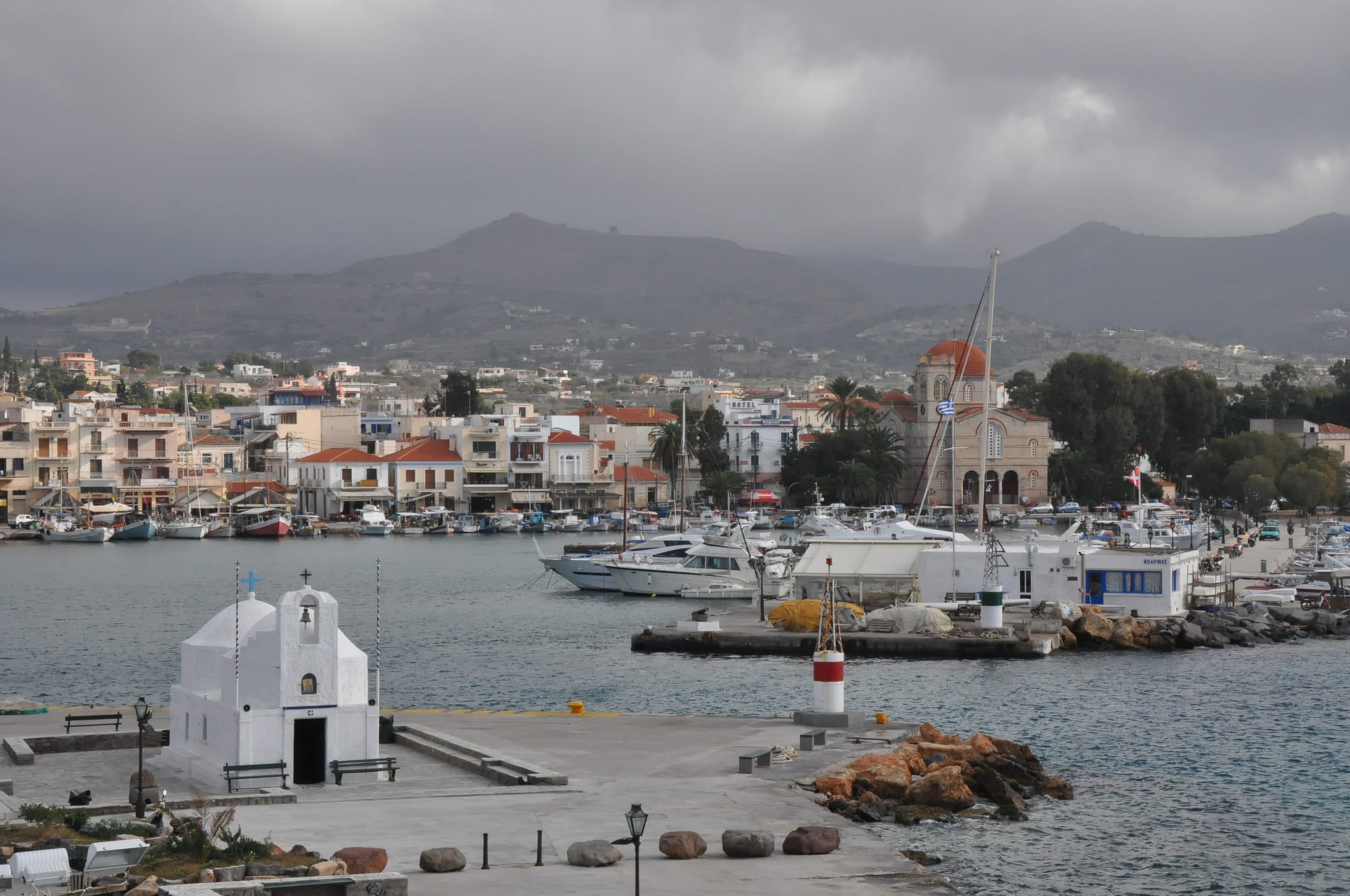
Aegina harbour with a small white chapel on the pier, moored boats and a domed church on the waterfront beneath grey hills

Athens, Delphi & Central Greece, Greece

Aegina

The harbour of Aegina town, with the chapel of St Nicholas on the pier. (Jorge Láscar from Australia / Wikimedia Commons · CC BY 2.0)

A Saronic island 27 km from Athens, whose port town on its north-western shore was briefly the first capital of modern Greece. Ancient Aegina minted Europe's first coins and rivalled Athens at sea; today the island is a holiday retreat for Athenians, known for its pistachios, the hilltop Temple of Aphaia and the pilgrimage church of St Nektarios.

Neighbourhoods

  • Aegina town
    • First-time visitors
    • Historic district
    • Close to the ferries

    The island's capital and ferry port at its north-western end, with a waterfront lined with cafés, a fish market in an alley by the harbour, neoclassical buildings from its time as Kapodistrias' capital and the Kolona headland just to the north.

    Open in Maps
  • Souvala and the north coast
    • Beaches
    • Families

    The main village of the beach and resort strip along the north coast, one of the island's best places to swim.

    Open in Maps
  • Agia Marina
    • Beaches
    • Close to the Temple of Aphaia

    A small harbour and beach resort on the east coast, near the Temple of Aphaia, at the end of the bus route across the island.

    Open in Maps
  • Perdika
    • Fish tavernas
    • Quiet

    A fishing village at the south-western tip of the island, with a café strip by the harbour, a lane round the headland looking towards Epidaurus, and water taxis to the islet of Moni.

    Open in Maps

Things to do

Temples and history

  • Temple of Aphaialandmark

    A Doric temple of about 500 BC, built over an earlier one destroyed by fire, in a sanctuary of the goddess Aphaia, who was worshipped only here.

    Open in Maps
  • Kolona and the Archaeological Museummuseum

    The headland just north of the harbour, where a single standing column of the temple of Apollo once guided ships, with the ancient acropolis and a museum that keeps the mosaic floor of a Roman-era synagogue.

    Open in Maps
  • Monastery of Saint Nektarioslandmark

    The Holy Trinity convent, founded in 1904 by St Nektarios, who lived there as a monk from 1908 until his death in 1920 — the island's great pilgrimage site.

    Open in Maps
  • Paleochoralandmark

    The abandoned hillside town where islanders sheltered from raiders in Byzantine and Venetian times, known as 'the Mystras of Aegina'.

    Open in Maps
  • Tower of Markelloslandmark

    A Venetian watchtower in Aegina town, later the home of the revolutionary leader Spyros Markellos.

    Open in Maps
  • Orphanage of Kapodistriaslandmark

    The large building in town that Kapodistrias built in 1828–29 for children orphaned by the War of Independence, later a library, museum and prison.

    Open in Maps

Beaches and islets

  • Marathonasbeach

    A beach about 5 km south of Aegina town on the coast road to Perdika.

    Open in Maps
  • Monibeach

    A wooded islet just west of Perdika, about a kilometre long, reached by a ten-minute water taxi.

    Open in Maps

Seasonal events

  • Fistiki Festmid-September

    The island's pistachio festival, held every year in mid-September.

  • Feast of Saint Nektarios9 November

    The feast day of St Nektarios, the island's saint, whose convent is its great pilgrimage site.

Eat and drink

Long-standing places and food districts in Aegina. Hours, ratings and directions come from your maps app, always current.

Aegina classics

  • Aegina fish marketmarket

    The town's fish market, in a narrow alley by the harbour.

    Open in Maps
  • Aegina pistachiosmarket

    Fistiki Aeginis, the island's pistachios, which carry Protected Designation of Origin status and are sold in Aegina town.

    Open in Maps

Waterfronts

  • Aegina town waterfrontneighborhood

    The harbourfront of the main town, lined with cafés from end to end.

    Open in Maps
  • Perdika harbourneighborhood

    A strip of cafés and tavernas on the harbour of the fishing village at the island's south-western tip.

    Open in Maps

Experience Aegina

History

Aegina was settled in the Bronze Age, and in the Early Bronze Age Kolonna, a stone-built fortified site, was its most important settlement. By the 7th century BC it was a sea power, and on the authority of the historian Ephorus it is usually said that Pheidon of Argos founded a mint here, making Aegina the first city-state in Europe to issue coins — staters stamped with a sea turtle. Trade rivalry with Athens led to war, and in 431 BC, in the first winter of the Peloponnesian War, Athens expelled the islanders and settled its own colonists. In Roman times a Jewish community built a synagogue whose mosaic floor survives.

Arab raids around 830 drove many people to the mainland, and others retreated inland to found Paleochora, the island's main town through Byzantine and Venetian times. In the 16th century Hayreddin Barbarossa sacked the island, massacred its men and carried off some 6,000 women and children as slaves; Albanians later settled around Perdika and were absorbed into the Greek population. The Venetians returned between 1687 and 1715, and probably built the Tower of Markellos as a watchtower.

From 1827 to 1829 Aegina was officially the provisional first capital of the new Greek state, and Ioannis Kapodistrias, briefly based here, built the orphanage that later served as library, museum and prison. When the capital moved to Nafplio, Aegina declined and its population fell by half. In 1896 the physician Nikolaos Peroglou introduced the systematic growing of pistachios, which by 1950 had displaced most other crops and made the island famous.

Culture & Customs

Aegina's modern identity rests on three things: its antiquities, its saint and its pistachios. The Temple of Aphaia draws visitors to the east of the island, while the convent of St Nektarios, who is buried there and is one of the most renowned Greek saints, is the island's great pilgrimage site, above all on his feast day, 9 November. Paleochora, known as "the Mystras of Aegina", is the abandoned main town of the Byzantine and Venetian centuries.

The island has long been a holiday retreat for Athenians, and on summer weekends it feels more like a beach suburb of the capital than a remote island. Its history as the first capital of modern Greece is remembered in the statue of Kapodistrias in the main square.

Pistachios are a point of pride: Fistiki Aeginis has had protected status since 1996, and each mid-September the island holds its Fistiki Fest at harvest time. Fishing survives alongside tourism, and Perdika is still a fishing village.

Daily Life

About 7,000 people lived in the community of Aegina town in 2021, and the island as a whole had about 13,000 people at the 2011 census, spread through villages such as Kypseli, Mesagros, Vathy and Perdika. Aegina is roughly triangular, about 15 km across, and the town at its north-western corner is the island's capital, port and shopping centre.

Pistachio is the most characteristic crop of the fertile northern and western plains, which also grow grain, olives, almonds and figs, and half the growers belong to the island's pistachio cooperative. Tourism and the Athenian weekend trade are the other pillars.

Daily life follows the ferry timetable and the seasons. Weekday mornings bring villagers into town on the buses for errands, the fish market and the cafés; summer weekends bring crowds from Piraeus; and in winter the island settles into a quiet routine with fewer sailings. The island's buses are timed for villagers coming into town for essentials and taking them home again.

Food

Aegina's signature is the pistachio. Fistiki Aeginis, protected by name since 1996, is prized for the flavour that the island's dry climate and soil give it, and the nuts are sold in shops in Aegina town. The Fistiki Fest celebrates the nut each September.

The fish market sits in its narrow alley by the harbour, and the town's tavernas and ouzeri serve a spread of meze — taramosalata, tzatziki, grilled octopus and fried saganaki cheese — with ouzo. Perdika, the fishing village in the south-west, is the island's other place for fish by the water, and Agia Marina has a grill selling souvlaki and gyros, grilled meat in pita with onion, tomato and tzatziki.

Home cooking follows the Greek pattern of baked dishes such as moussaka and gemista, stuffed vegetables, horiatiki salad with feta and olives, and pies of greens and cheese in filo. Sweets include loukoumades — fried dough drizzled with honey and cinnamon — and baklava.

Planning tools

Budget

Aegina is cheaper than Hydra or Spetses and close enough to Athens for a day trip, which keeps it busy with Athenians at weekends. Ferry tickets are modest, rooms in the town and the beach villages are mostly simple, and eating at the fish market tavernas costs less than on the waterfront.

Daily Budget Midrange
USD 130–230 (guesthouse in town, seafood dinners, temple and museum tickets, a hired scooter or car)
Daily Budget Shoestring
USD 65–100 (simple room, souvlaki and taverna meals, island buses, deck-class ferry from Piraeus)

Visit midweek outside August, and hire a scooter or car for a day if the limited bus timetable does not fit.

Best Time to Visit

May to early October for swimming and frequent ferries. July and August are hot and busy, above all at weekends. Mid-September brings the pistachio harvest and festival, and November the feast of St Nektarios; winter is quiet, with fewer sailings.

Suggested Number of Days

Many visitors come for a single day from Athens, but one night gives time for the temple, the town and a swim. Three days suit those adding the beaches and villages around the coast; the stay grows without a scooter or car, as buses are infrequent.

First Visit
1–2 days
With Surroundings
3 days

Transportation

Three bus routes start from the stand by the harbour — across the island to Agios Nektarios, the Temple of Aphaia and Agia Marina, and south along the coast to Perdika — but they run a limited service for villagers. Car, scooter and motorbike hire agencies cluster near the harbour, and a taxi can be hired for a day trip.

Take care on scooters on the island's narrow roads, and check the return bus times before setting out.

Airport & Station Connections

Hydrofoils from Piraeus reach Aegina in about 40 minutes and conventional ferries in about an hour; ferries dock on the west pier of the harbour in Aegina town. Athens International Airport is linked to Piraeus by metro and suburban railway, making the island an easy first or last stop.

Walkability

Aegina town is flat and easy to walk, from the ferry pier along the waterfront to the Kolona headland and the backstreets. The sights and beaches elsewhere on the island are too far apart to walk between, except for the lane round the headland at Perdika.

Safety

Greece is a safe country for visitors, with low levels of violent crime. Aegina is relaxed and crime is rare; the main hazards are summer heat, traffic on narrow roads and wildfire risk in the dry season.

Take care with scooters on island roads, watch for sea urchins when swimming, and avoid lighting fires in dry weather. Check current official travel advice before travelling.

Climate

A hot semi-arid climate with an average annual temperature of about 20°C and less than 340 mm of rain a year: long, hot, dry summers and mild winters.

Summer
hot and dry — in Athens, across the Saronic Gulf, July days average about 35°C
Winter
mild and damp — in Athens, January averages about 9–10°C

Local Customs

Tipping is not obligatory in Greece. The monastery of St Nektarios is a major pilgrimage site, and visitors are expected to dress and behave as in any working church.

Cover shoulders and knees at the monastery and in churches, keep voices low during services, and ask before photographing pilgrims.

Common Payment Methods

Greece uses the euro. Cards are widely accepted in Aegina town and there are ATMs by the harbour; carry cash for the fish market, buses, kiosks and village tavernas.