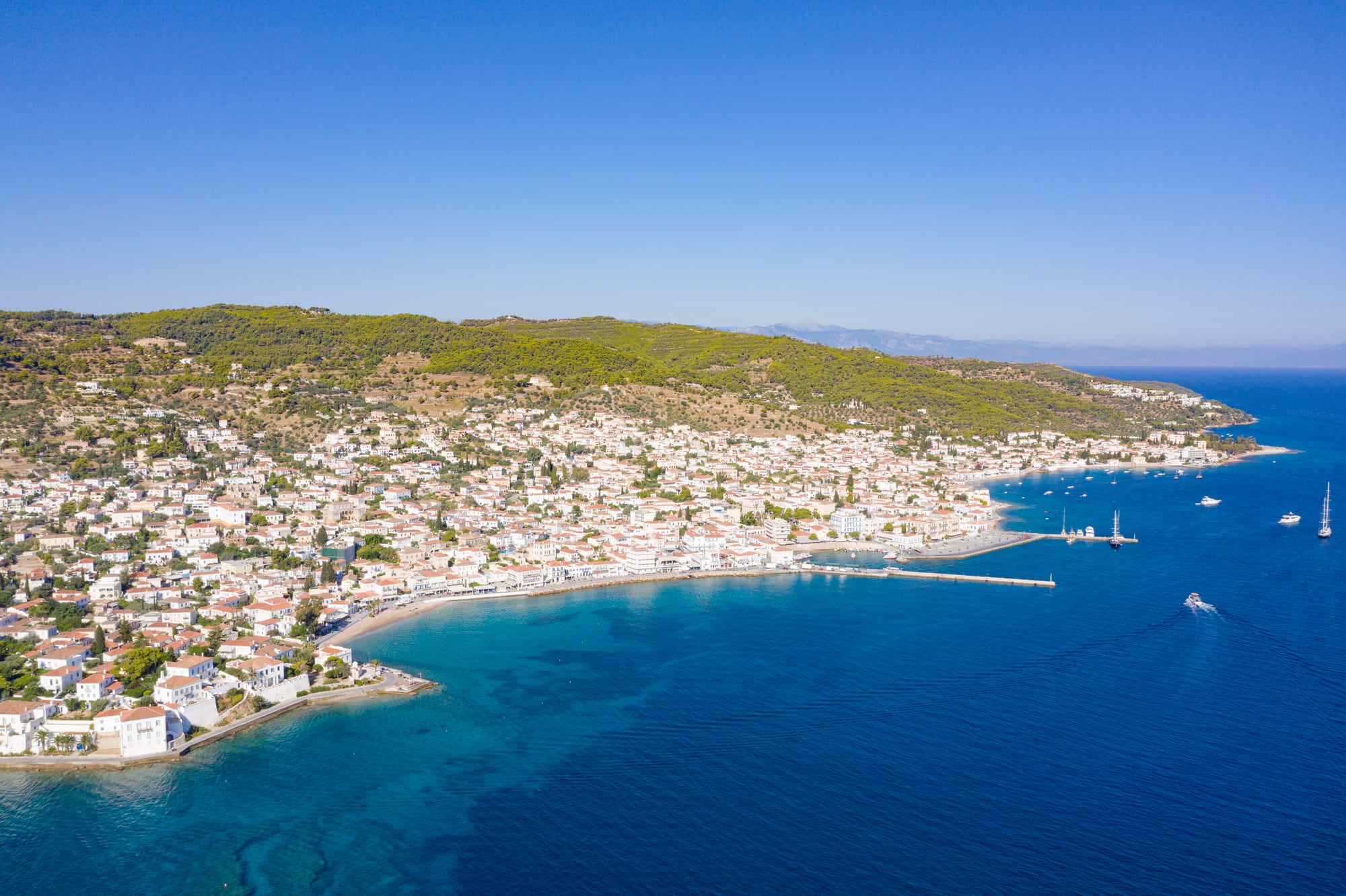
Aerial view of Spetses town's white houses spread along a bay of turquoise water below pine-covered hills

Athens, Delphi & Central Greece, Greece

Spetses

Spetses town, its port and Agios Mamas beach from the air. (dronepicr / Wikimedia Commons · CC BY 2.0)

A small pine-covered island off the tip of the Argolid, whose town runs along the shore from the Dapia harbour to the Old Harbour. Its merchant fleet made Spetses rich in the 18th century, and it was the first island to raise the flag of revolution in 1821, home of the heroine Laskarina Bouboulina. No private cars are allowed in the town, and the island now lives on visitors, many of them Athenian.

Neighbourhoods

  • Dapia and the town centre
    • First-time visitors
    • Close to the ferries
    • Cafés

    The modern harbour at the heart of the town, where ferries and hydrofoils dock, with the town beach of Agios Mamas and a cluster of popular cafés and ouzeris. Only taxis and delivery vehicles may enter the centre.

    Open in Maps
  • The Old Harbour
    • Nightlife
    • Best for food
    • Historic district

    The old port east of the Dapia, about half an hour's walk away, lined with cafés, bars and restaurants and with the yachts of holidaying Athenians. The walk continues to the chapel of Panagia Armata and the lighthouse.

    Open in Maps
  • Kounoupitsa
    • Fish tavernas
    • Quiet

    The waterfront district a ten-minute walk west of the Dapia, with a well-known fish taverna on the water and beaches such as Kaiki a little further on.

    Open in Maps
  • Kastelli
    • Quiet and residential
    • Traditional tavernas

    The older upper part of the town, a few hundred metres inland from the Dapia, with a simple, old-fashioned taverna.

    Open in Maps

Things to do

History and the town

  • Bouboulina Museummuseum

    The 17th-century mansion of Laskarina Bouboulina, sea captain and heroine of the War of Independence, privately run as a museum with guided tours.

    Open in Maps
  • Hatzigiannis Mexis Museummuseum

    The island's other museum, in the mansion of the shipowner and first governor of Spetses, a five-minute walk south-west of the harbour.

    Open in Maps
  • Panagia Armata and the lighthouselandmark

    The chapel at the entrance to the Old Harbour that gives the Armata festival its name, beside a lighthouse built in 1837, one of the first in Greece.

    Open in Maps
  • Agios Nikolaoslandmark

    The metropolis church of the island, above a tiny beach south of the town centre, where a special mass is held for the Armata.

    Open in Maps

Beaches

  • Agioi Anargyroi and the Bekiris Cavebeach

    One of the island's two most popular beaches, on the west side, with a sea cave and its own sandy beach at its northern end.

    Open in Maps
  • Agia Paraskevibeach

    With Agioi Anargyroi, one of the island's two most popular beaches, on the west side, served by the summer bus.

    Open in Maps
  • Zogeriabeach

    A bay on the northern edge of the island reached by tourist boats in summer, with a restaurant.

    Open in Maps
  • Agia Marinabeach

    A beach 2 km south of the town with water sports.

    Open in Maps

Walks and short trips

  • Island trailstrail

    Footpaths that ring the island, totalling some 25 to 30 km, through the pine woods over the ridge to the beaches.

    Open in Maps
  • Kostaattraction

    The point on the Peloponnese coast across the narrow strait, once joined to the island by an isthmus, reached by ferry or water taxi.

    Open in Maps

Seasonal events

  • Spetses Classic Yacht RegattaJune

    A weekend of sailing races for vintage and classic yachts and traditional caiques, starting and finishing in the strait between Spetses and Kosta.

  • Armatasecond weekend of September

    The island's great festival, commemorating the naval battle of 8 September 1822 with the feast of Panagia Armata and the torching of a mock Ottoman flagship in the harbour.

  • Spetses Mini MarathonOctober

    A programme of running and swimming races, held since 2011, whose main event is a 26 km run around the island.

Eat and drink

Long-standing places and food districts in Spetses. Hours, ratings and directions come from your maps app, always current.

Where Spetses eats

  • Kounoupitsa fish tavernaneighborhood

    A well-known fish taverna on the water a ten-minute walk west of the Dapia.

    Open in Maps
  • Old Harbour cafés and restaurantsneighborhood

    Cafés, bars and restaurants along the old port, busy late on summer evenings.

    Open in Maps
  • Kastelli tavernaneighborhood

    A simple, traditional taverna in the upper town, known for its barrel wine.

    Open in Maps

Experience Spetses

History

In prehistoric times Spetses was joined to the Argolid by an isthmus at the point now called Kosta, and its natural harbours sheltered ships trading in the Argolic Gulf around 2300 BC. The ancient Greeks called it Pityoussa, the island abounding in pine trees. Goth raids on the Eastern Roman Empire later sent refugees to resettle it, and in the 18th century many Arvanites fled here from the Ottoman-ruled Peloponnese.

Merchant seafaring was the only livelihood on the rocky island, and the Mediterranean and Black Sea trade made its captains rich. During the Orlov Revolt of 1768–74 the Spetsiot fleet fought the Ottomans, and the island suffered heavily in reprisal; its people then came down to the shore and built the present town. On the morning of 3 April 1821 (Old Style) Spetses became the first island to raise the flag of revolution. The island was home to Laskarina Bouboulina, merchant, shipowner and admiral, and the Spetsiot fleet took part in the sieges of Nafplio and Monemvasia and the battles of Samos and Kafireas. On 8 September 1822 an Ottoman fleet trying to supply besieged Nafplio was driven off in the strait — the battle the Armata still commemorates.

After independence the island declined as a trading centre and its population fell, from 8,843 in 1861 to 3,166 in 1951. Sotirios Anargyros, of an old Spetsiot shipping family, began its revival as a resort in the early 20th century, planting pines on the hills. John Fowles taught English at the island's private Anargyrios and Korgialenios School from 1951 to 1953.

Culture & Customs

The island's identity is built on 1821. The Bouboulina Museum keeps the mansion of its heroine, whose statue stands on the waterfront, and the second weekend of September is given over to the Armata, combining the feast of the chapel of Panagia Armata with celebrations of the 1822 battle. It is the high point of the summer, drawing as many as 40,000 visitors, and ends with the re-enactment of the battle and the burning of a mock Ottoman flagship.

Spetses has a place in literature and film. John Fowles turned it into Phraxos, the island of his 1965 novel The Magus, with the school as the "Lord Byron School" and a villa above a southern beach as the "Villa Bourani", and The Lost Daughter (2021) and Glass Onion: A Knives Out Mystery (2022) were both shot here. Since the early 20th century it has been a summer retreat for wealthy Athenians, and the yachts in the Old Harbour show it still is.

Sailing and sport are part of the calendar: the Spetses Classic Yacht Regatta brings vintage yachts and traditional caiques to the strait each June, and the Spetses Mini Marathon, held since 2011, sends runners round the island. An Arvanite community still lives on the island.

Daily Life

The municipality of Spetses covers about 27 square kilometres, and the town is the island's only large settlement, stretching along the shore from Kounoupitsa past the Dapia to the Old Harbour. Its population fell for nearly a century after independence, grew strongly from the 1960s to 2011, and declined again at the 2021 census. The municipality also takes in the uninhabited islands of Spetsopoula, Falkonera and Velopoula.

Tourism is the economy. The main Athenian season lasts only two months, though most hotels and restaurants open from Easter until October. The private Anargyrios and Korgialenios School is a landmark of the town.

The ban on private cars shapes daily life: islanders get about on mopeds, motorcycles and bicycles, horse-drawn carriages run in high season, and water taxis cross to the mainland. Residents and regular visitors complain that the noise of mopeds and motorbikes has grown to rival busier islands. Winter is quiet, with few ferries and many businesses closed.

Food

Spetses eats from the sea. Kounoupitsa has a well-known fish taverna on the water west of the Dapia, and the Old Harbour is lined with cafés, bars and restaurants; in the upper town of Kastelli a simple taverna serves barrel wine. At Zogeria beach the taverna is known for chicken in tomato sauce served with spaghetti or chips.

Meals follow the Greek island pattern: a spread of meze — tzatziki, taramosalata, a spread of fish roe with olive oil, lemon juice and bread or potato, melitzanosalata, dolmades and grilled octopus — with horiatiki, the village salad of tomato, cucumber, onion, olives and a slab of feta, followed by grilled fish, baked dishes such as moussaka, pastitsio and gemista, or souvlaki in pita. Ouzo is drunk with meze, retsina and Greek wines with meals.

Frappé coffee is part of the Greek breakfast, and sweets follow the national repertoire: loukoumades, fried dough balls often spiced with cinnamon and drizzled with honey, or baklava.

Planning tools

Budget

Spetses runs to boutique prices in high summer, when wealthy Athenians fill its villas and yachts crowd the Old Harbour. Transport on the island is expensive because private cars are banned from the town, so taxis, water taxis and carriages add up; walking, a hired bicycle or the summer beach buses keep costs down.

Daily Budget Midrange
USD 170–290 (guesthouse in town, seafood dinners, a scooter or water taxi, hydrofoil from Piraeus)
Daily Budget Shoestring
USD 75–115 (simple room, taverna and bakery meals, hired bicycle, ferry from Piraeus)

Book well ahead for Easter and the Armata weekend, when rooms can be impossible to find.

Best Time to Visit

Most hotels and restaurants open from Easter until October, but the main Athenian season lasts only two months in high summer. June brings the classic yacht regatta and the second weekend of September the Armata; late spring and September are warm but quieter.

Suggested Number of Days

Two or three days suit a first visit, allowing time for the town and the beaches around the coast. With the coast of the Peloponnese across the strait, four days is enough; ferry timetables, thinner outside summer, often set the length of the stay.

First Visit
2–3 days
With Surroundings
4 days

Transportation

No private cars are allowed in the town. People walk, ride bicycles, mopeds and motorcycles, or take horse-drawn carriages; only taxis and delivery vehicles may enter the town centre. In high season two buses link the town with the western beaches and Ligoneri, tourist boats run to the beaches, and water taxis serve the whole island and the mainland coast year-round.

Water taxis and carriages are expensive; hire a bicycle or moped, or walk the island's trails.

Airport & Station Connections

Ferries and high-speed hydrofoils arrive regularly from Piraeus, calling on the way at Poros and Hydra; only the conventional ferry carries motorcycles and bicycles, and the fast boats can be cancelled in bad weather. Drivers can leave their cars at Kosta on the Peloponnese coast and cross the strait by ferry or water taxi. The nearest major airport is Athens International.

Walkability

Most of the island's sights are within walking distance of the town: the Dapia, Kounoupitsa and the museums are close together, and the walk along the shore to the Old Harbour takes about half an hour. Trails of 25 to 30 km in all ring the island, though mopeds and motorbikes make the main road noisy in summer.

Safety

Greece is a safe country for visitors, with low levels of violent crime. Spetses is quiet and crime is rare; the hazards are moped traffic on the island road, summer heat and the risk of wildfire in the pine woods.

Wear a helmet on a hired moped, watch for sea urchins when swimming off rocks, and never light fires in the woods. Check current official travel advice before travelling.

Climate

Summers are hot and dry and winters mild. The island's ancient name, Pityoussa, means abounding in pine trees, and its woods give some shade in the heat.

Summer
hot and dry — in Athens, July days average about 35°C
Winter
mild and damp — in Athens, January averages about 9–10°C

Local Customs

Tipping is not obligatory in Greece. Spetsiots are proud of their island's part in 1821 and of Bouboulina, and part of the population is of Arvanite descent. Churches expect covered shoulders and knees.

Dress modestly in churches, especially during the Armata and Easter services, and keep beachwear for the beaches.

Common Payment Methods

Greece uses the euro. Cards are accepted in most hotels, shops and restaurants in town, and there are ATMs near the Dapia; water taxis, carriages and small tavernas may prefer cash.